

CANNES, France — Take an immensely skillful young European director with a worldwide cult following, a hot young North American actor with considerable cultural cachet and a classic Los Angeles heist-gone-wrong story that recalls both Roger Corman’s B-movie aesthetic and the glossy Hollywood spectacles of Michael Mann. You probably know already whether that’s a movie you’d line up around the block to see or one you’d pay to avoid, but either way it’s called “Drive,” it stars Oscar nominee Ryan Gosling (of “Half Nelson” and “Blue Valentine”) and it was directed by Nicolas Winding Refn (whose career ranges from the insane medieval fantasy “Valhalla Rising” to the campy, stylized prison film “Bronson”), single-handedly trying to redeem Denmark’s honor after l’affaire Lars von Trier.
Ultra-violent and ultra-stylish, “Drive” stands out in this year’s Cannes competition for its calculated, hard-edged brilliance. It’s frankly commercial and sneakily artistic, in a way no other film I’ve seen in this festival is. It could be a big international hit — Americans will get to see it in September — or it could become one of those genre-geek fetish objects that doesn’t quite connect with a mass audience. It’s been the talk of the town since its Thursday night premiere, and no wonder; the history of Cannes is all about the long cinematic collaboration between Europe and America, and “Drive” distills that into one concise, intense and exciting movie. Is it a genuine Palme d’Or contender? I’m not sure about that; even in a year when the jury is headed by Robert De Niro, it’s a little hard to imagine a genre movie winning that prize amid an extraordinary Cannes lineup that includes Terrence Malick and the Dardenne brothers and Aki Kaurismäki and Pedro Almodóvar, not to mention the exiled von Trier.
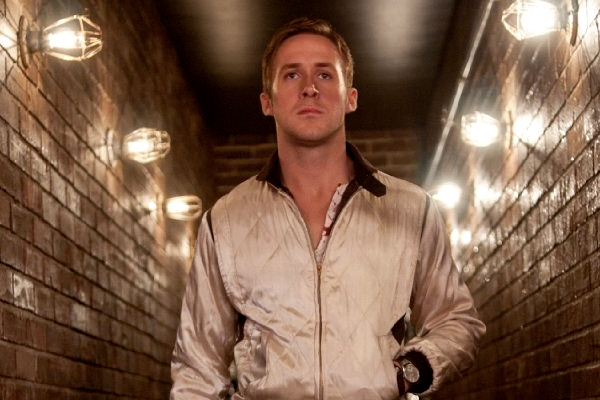
Adapted by British screenwriter Hossein Amini from a novella by James Sallis — and you’d have to say this is pretty far from Amini’s award-winning script for the 1997 “Wings of the Dove” — “Drive” follows a few days in the criminal career of a solitary, unnamed stunt driver, who works on movie sets by day and drives specially modified getaway vehicles at night. One obvious point of comparison for the Driver (as he is identified in the credits) is Clint Eastwood’s Man With No Name in the Sergio Leone westerns; like him, the Driver wears the same clothes throughout the film — a stained white bomber jacket with a yellow scorpion embroidered on the back — speaks rarely and only when spoken to, and never lies or brags. Gosling is a very different actor from Eastwood, but they both use composure and self-containment, rather than volume or violence, to radiate toughness.
As we learn in a dynamite opening sequence, the Driver hires himself out to robbery teams as a short-lived accomplice. He doesn’t carry a gun and doesn’t want to know much about what they’re doing. For the right price, he’ll get you where you want to go, just as often by out-thinking the cops, or sneaking past them unobtrusively, as by outrunning them. There are a couple of terrific old-school car chases in “Drive,” but Refn isn’t trying to outdo “Bullitt” or get the next assignment in the “Fast/Furious” franchise. This is more like a tense, moody noir in the Murphy’s Law tradition, where the hero falls in love with the wrong girl and winds up with one of those bags of Evil Money that destroys everything it touches.
I’ve probably piqued your curiosity enough for a movie that won’t reach American theaters for four months and runs a real risk of being over-hyped in the meantime, but let’s add a few more touches. Carey Mulligan plays the aforementioned wrong girl, nicely underplaying her role as a working-class American woman, quite sweet and a little lost. She lives next door to the Driver with her adorable little boy, and lets the Driver go pretty far down the road of friendship, flirtation and seduction before she remembers that her husband, who boasts the unlikely but irresistible name of Standard Gabriel (Oscar Isaac), is about to come home from prison. When that happens, Standard and the Driver circle each other cagily but never quite come to blows, and then the Driver makes the fateful decision to help Standard with that “one last job” that will get him out of debt to the shadowy gangsters threatening his family.
Of course this allegedly straightforward pawnshop robbery in the San Fernando Valley goes as far off the rails as it possibly could, leaving the Driver and a girl he’s just met named Blanche (Christina Hendricks of “Mad Men,” in a brief but memorable role) holed up with an extremely large sum of money that some very bad people want to retrieve. Refn’s tremendous supporting cast also includes Ron Perlman as a low-rent, pizzeria-owning Jewish gangster, filmmaker and comedian Albert Brooks as his more urbane-seeming but even more sinister puppeteer, and Bryan Cranston (of “Breaking Bad”) as the likable, fatherly mechanic who is the Driver’s boss and only friend.
Refn’s composition and lighting and editing instincts are miles ahead of most people who work in action movies. He’s not enslaved by these archetypal characters and this classic “Treasure of the Sierra Madre” plot, nor is he seeking to reinvent or “subvert” them. It seems to me that he’s trying to answer the question of what happens when you make this kind of American crime film really, really well: Is it just a slick, nifty entertainment, or can it lay bare issues about human nature that other forms of storytelling never quite face? “Drive” builds extraordinary tension before exploding in brief outbursts of shocking violence, almost in the mode of a samurai film. There’s one sequence shot in an elevator, which takes the movie from love story to violent revenge thriller within a few seconds, that film students will be deconstructing, shot by shot, for years to come. (“Drive” was shot by ace cinematographer Newton Thomas Sigel, whose credits include “Three Kings” and “The Usual Suspects.”)
“Drive” was literally greeted with hoots and howls of joy from the press here, who perhaps felt beaten down by almost two weeks of sober, serious art-house cinema with nary an ass-kicking or supercharged Impala in sight. I felt some of the same exhilaration, but those who are comparing “Drive” to, say, “Pulp Fiction” today are getting overamped on the sea air and sunlight and strong coffee of the Mediterranean. Whatever you think of Tarantino’s 1994 Palme d’Or winner, it literally changed the course of movie history and established a paradigm for indie-film success that hasn’t quite been exorcised 17 years later. “Drive” has neither the outsize ambition nor the Godardian, art-school lack of discipline of that film — and anyway, what happened to “Pulp Fiction” can only happen once. Refn’s breakthrough film is successful in quite a different way, as an injection of clear, cool European technique into a classic American fable of guns, cars, girls and money. I think that’s quite enough.
