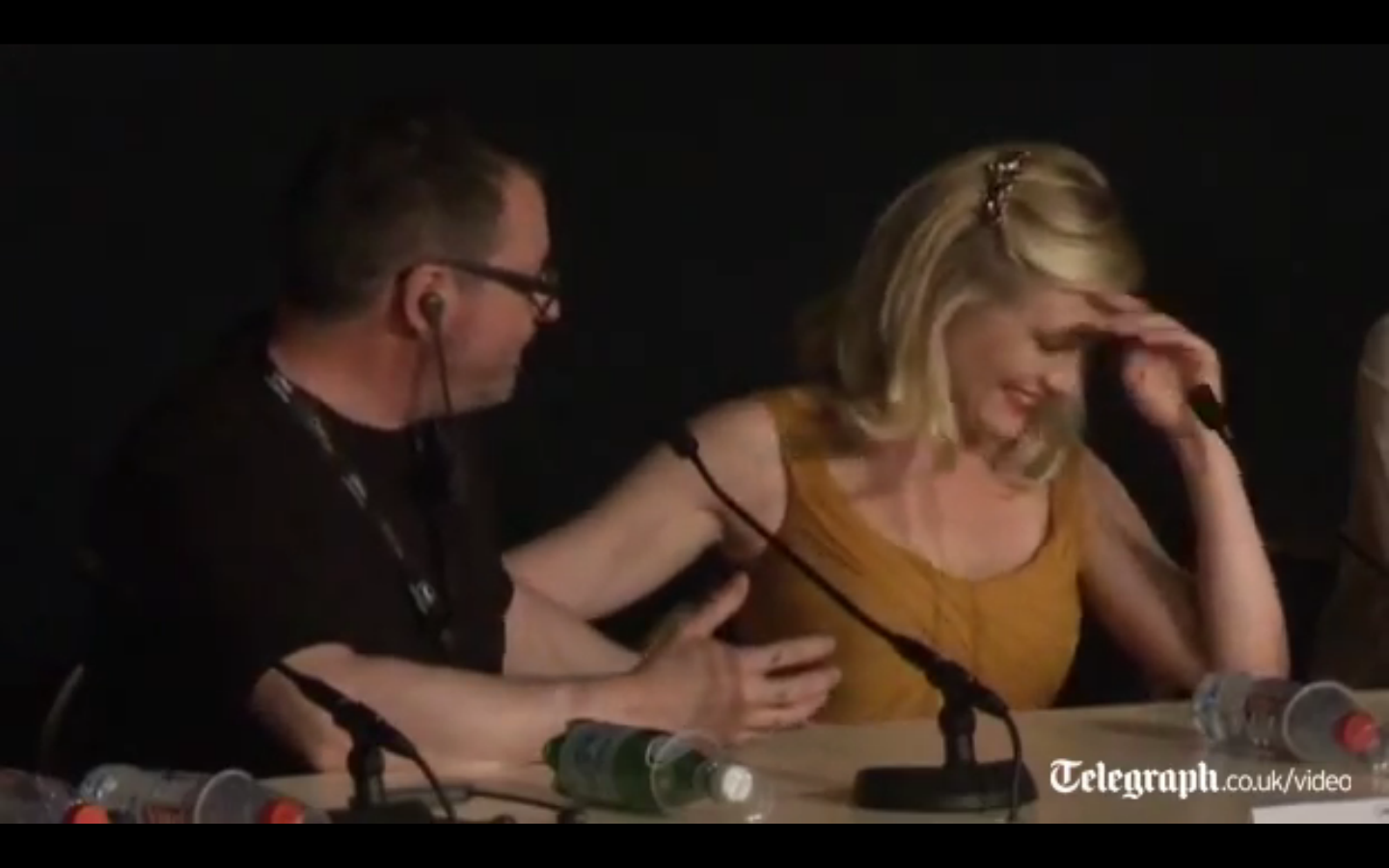

MOUGINS, France — No, Lars von Trier is not a Nazi or an anti-Semite. He grew up with a Jewish stepfather, in fact (who he long believed was his actual father). He may, based on what he says about his teenage years, still have a flame burning for the ideals of communism — and whatever you make of that, it’s not the same thing at all. The permanently controversial Danish director of “Antichrist” and “Dancer in the Dark” saw his bad-boy reputation blow up in his face this week, when the Cannes Film Festival barred him from the premises after a catastrophic Wednesday press conference, when he said he sympathized with Hitler “a little bit” and jokingly declared himself a Nazi. But give the guy credit: Rather than fleeing back to Denmark to lick his wounds, von Trier has spent the last several days receiving journalists at his luxury hotel just outside this village amid the hills, villas and vineyards a few miles north of Cannes.
To be sure, part of this is about refocusing media attention on his new film “Melancholia,” a strange and spectacular amalgam of wedding drama and sci-fi apocalypse starring Kirsten Dunst, Kiefer Sutherland and Charlotte Gainsbourg, which premiered at Cannes to mostly favorable reviews. (It’s my favorite film of the festival — and wouldn’t it be something if it won the Palme d’Or while the director watched on TV?) But von Trier also seems eager to express contrition, and to place his offensive and ill-considered remarks in context — that being the personality of an immensely talented film director who shoots off his mouth without thinking and is arguably way too devoted to playing the rebel or the “naughty schoolboy,” as he puts it.
Since von Trier rarely travels and has never been to the United States, he’s often assumed to be a reclusive figure after the fashion of Terrence Malick, who did no interviews here and did not even appear on the red carpet for the “Tree of Life” premiere. But in our Saturday afteroon meeting von Trier was friendly, loquacious and often very funny, talking cheerfully about subjects ranging from his cinematic idol Ingmar Bergman to communism, Humphrey Bogart and children’s author Tove Jansson — as well, of course, as the remarks that made him globally notorious this week. We sat at an outdoor table near his hotel room, on a dirt-floored patio normally used for a local sport called pétanque (the French equivalent of bocce), overlooking the spectacular gardens and terraces of Mougins. Wearing a white T-shirt and an oversized straw sun hat, von Trier looked ready to play the part of northern European tourist in a movie.
I have to ask you one very important thing about the movie, before we start talking about Hitler.
Yeah, yeah, yeah, about the funny issues like that.
You grew up in a Nordic country. Did you ever read the Moomintroll books by the Finnish children’s author Tove Jansson?
Oh, yeah, yeah, yeah! You are familiar with them?
Yes, I love them and so do my kids. I don’t know how many other Americans do, though.
Interesting. Well, my family have Swedish friends who were very close to her, and somebody has told me that one of her stories resembles the film. I didn’t remember it at all, but I have read it. I read everything. I was very, very taken by her universe. It was fantastic.
If you went back and read that book now — in English it’s called “Comet in Moominland” — I think you’d see some striking similarities to “Melancholia.”
I’m quite sure. She also did the mystical planet, or comet or whatever it is. Yeah, I’m sure. You know, you’re always stealing somehow. Sometimes you know it and sometimes you don’t know it, but this is a good source to steal from, I think.
There is even a character who’s obsessed with measuring the comet and figuring it out scientifically, like the character Kiefer Sutherland plays in your movie. They go to an observatory to see it through a telescope as it approaches, and the scientists tell them it will arrive on such and such a day at such and such a time, and of course the world will be destroyed.
[Holding head in hands.] You have now destroyed my self-respect! I have no self-respect anymore at all.
No, it’s a wonderful influence. I will go back to America and tell my children that a guy from Denmark made another movie of “Comet in Moominland,” but they have to wait until they’re grownups to see it.
That should have been the title! The whole thing might have worked better: “Comet in Moominland,” by Lars von Trier. [Laughter.]
Honestly, how do you feel about “Melancholia” after everything that has happened? Even before the premiere you seemed to have a very strange relationship with your own movie. You keep saying you are uncomfortable with it or aren’t sure you like it. Are you just joking? Is that just Lars von Trier shtick? It’s hard to tell with you, which may be part of the problem.
Those are actually not jokes. But, yeah, I can understand that with me it’s difficult to tell if it’s a joke or not. I must say that even jokes are not only jokes. I think that’s quite important. But this was not meant as a joke. You’re sitting there and you have to write a director’s statement. And I thought, if I have doubts this is where I should write them. It makes no sense to write, “This is exactly what I wanted, blah blah, blah.” I do have some doubts, and you don’t make them smaller by mentioning Moomintrolls, you know. [Laughter.]
I was just told by some Russian that the first time Tarkovsky saw “Solaris,” he said, “It’s far too beautiful.” Then he cut all the beautiful scenes out, and there was the film. That’s an honorable man. Maybe that would have made me more happy, I don’t know. I feel — I don’t know what I feel. It was a big pleasure to do the film, and maybe I feel a bit ashamed of that, that it was such a pleasure. There were no problems, really.
So you would rather — what? Feel fear and guilt and shame?
Yeah, something like that. It’s like you get to the top of Mount Everest without using oxygen and everybody says, “Fantastic!” And you feel funny about it. Maybe it was a little too easy. It’s also that it became so romantic, but that was on purpose. Then again, I feel a little guilty for doing something that was too easy. All this Dogme nonsense, and all the other things I have done, has been to prevent myself from doing things that I’m too good at, that I feel is the easy way out. To put up a camera that makes 1,000 frames a second and to do all the things in the overture to “Melancholia,” that’s easy. [The film opens with a montage of remarkable digital images, set to the overture of Wagner's "Tristan und Isolde."]
You know, I had a very funny conversation with Martin Scorsese, who is a very, very polite man. He said, “The beginning of ‘Antichrist’ was so beautiful.” You know, the prelude to my movie. And I said to him, “Yes, but it was black-and-white and slo-mo. How can you go wrong?” And then I said to myself, “Oh, shit — this is the man that made ‘Raging Bull’!” But he laughed and said, “You are right.”
This may make you hate me, but “Melancholia” feels in many ways like a more mature film artistically than any you have made before, and also one that’s more rooted in an adult sensibility. That may be the last thing you want.
But I don’t want to be adult! Please!
Yeah, so part of what happened to you the other day was a desire to …
A desire not to be an adult, yes. I had an interesting conversation with Gilles Jacob [president of the Cannes Film Festival] just the same day or the day before. He has written a book where he mentions me, and he says that the first time I came to Cannes with a shaven head and a leather jacket, and now I come in a tuxedo. And that’s what happens to all rebels — they’re not rebels anymore. Which irritated me, of course, like hell. I told him, “But, listen, I have a tattoo now.” And he just laughed, that wasn’t good enough.
I don’t know … it was not something I planned. But on the subconscious level, yeah, maybe I behaved like a naughty schoolboy. As Charlotte Rampling said, “You have not been bad, but you have been naughty.”
We have an American expression for this. It’s called pissing in the punch bowl.
Aha! I recently heard the English expression, “to piss on your chips.” I pissed on my chips, that is for sure. [Laughter.]
Look, I was in the room when you said that stuff, and I understood, or I think I understood, where you were trying to go. At this point you don’t need me to tell you this, but what you said offended and hurt many people, especially many Jewish people and descendants of Holocaust survivors. And I don’t think that’s what you meant to do.
No. I didn’t mean to do that. First of all, I like provocations, but I like provocations for a reason and there was no reason here. This was just — I felt like I was driving in a car and suddenly there was a curve I hadn’t seen and I couldn’t keep the car on the track. So there was no reason for this provocation and I really regret that it happened. I believe in good provocations that can start something, but this one was completely wrong. And I’m not clever enough to understand that saying things like that in this place, of all places in the world, this was absolutely a no-go.
But I don’t think that I said anything anti-Semitic. I said stupid things, like I think I said I understood Hitler. But that’s why I don’t believe in these press conferences. If I said to you that I understood Hitler, you would say, “What the fuck do you mean?” And I could say, well, in the sense that watching Bruno Ganz playing him in “Downfall” and all that, I understand that he is a human being and it’s very important for us to recognize that. You know, the Nazi thing lies in all of us somewhere, no matter what religion you are and no matter where you live in the world. It’s something that we have to fight against, and if you say that Adolf Hitler was not a human being, that’s the most stupid thing we can say.
But of course none of that came out in the press conference because I was just panicking — I was somewhere else. I think the most insulting thing I did was to say that when I found out I was not Jewish, which I did at a certain point, that in fact I was a Nazi. I only meant, of course, that I was on the other side of the fence, but saying that could only hurt the Germans. It’s a very Danish thing, you know — we’ve been beaten like hell by the Germans throughout our history.
I have talked to a lot of Germans and they’re in a very strange vacuum. They have nothing to do with the war, of course, but they have a grandfather who did whatever he did, and somehow they must be punished for being Germans. Their punishment is that they are overloaded with information about the war. When you see a documentary about the Second World War, they are saying “that bastard Hitler and his cruel henchmen,” where a film in Danish or English is much more neutral. I suppose that will last for some time and then stabilize. For me, I just think it’s important to understand that we are all Nazis, somewhere.
Well, right after leaving that press conference I had the Elvis Costello song “Two Little Hitlers” in my head. Do you know it? It’s about two lovers, of course. “Two little Hitlers will fight it out until/ One little Hitler does the other one’s will.”
[Laughter.] I don’t know it. That’s very cleverly put.
That’s the territory you were talking about, right? Everyone feels that urge to dominate sometimes, and artists may feel it a lot.
Oh, yes. Oh, yes. But I failed completely. I also have to say something about apologizing — especially after the Clinton thing. You know, I thought the Clinton affair with Monica Lewinsky was proof that he was a human being, even the president. I know that was not how it was seen in America! I thought, OK, that’s good, he’s a human being! It might hurt Hillary, yes. Or maybe they have an agreement, who knows! They were hippies or whatever. [Laughter.] But to go to a group of priests or whatever and say “I’m sorry” was so hypocritical. It gave me a bad taste in the mouth. You see a real human being, and he was for me a new kind of president, a man with good intentions and suddenly he has to submit to something that makes no sense. Saying you’re sorry — what does that change? If you were so sorry, you probably wouldn’t have done it! It’s a ritual, like sitting in the town square and being flogged.
It may help Americans to understand your personal back story a little better. So you grew up with a Jewish father, and then you found out as an adult that he wasn’t your biological father. You had believed you were half Jewish until that point.
Yes, that’s exactly right. But of course I know that Judaism comes through the mother — which is a very clever idea! — so I could not have been exactly Jewish. He was not religious, and I found out later on that the Jewish family I had was not considered to be a fine Jewish family, because they never went to the synagogue. In all groups, it’s like that. I remember when I was a communist as a young man, there were the Maoists and the Trotskyists, who hated each other much more than they hated the capitalists! They were fighting like hell over ridiculous things, over nothing.
You were a teenage communist! Which group did you belong to?
I belonged to — I was for Moscow. And I have to say that I still have that tendency. It’s strange, because I know Lenin was a bastard and he killed very many people. Still I somehow — now I’m getting into trouble again! — I somehow forgive him a little bit, because it was for a good cause, and I believe in the ideals of communism and socialism. Of course it was not all right. It was terrible! But you have to compare it to what was there before. Now, it’s a fact that communism will lead to dictatorship, that’s a fact I can’t argue with. But I still have a love for the ideals of the whole thing.
You’ve spoken a little bit about the influence of Ingmar Bergman on your movies, which I know is a cliché when talking about Nordic filmmakers — the great god Ingmar who rules your life. But the first part of “Melancholia” is like one of his country-house movies, “Smiles of a Summer Night” or “Wild Strawberries,” cranked up to 11, with all this gorgeous, decadent German Romanticism poured into it.
That is probably correct. But I have to say that I saw “Smiles of a Summer Night” again recently, and I don’t think that’s one of his better films. I was crazy about it when I first saw it. I used to own a book with interviews and pictures from it. The sun rises for the second time and all that. If you see “Wild Strawberries” or “Through a Glass Darkly,” those are much better films.
[To a publicist.] Just a minute, I’m talking to America here! And we will not allow anything to interfere! We will make a no-fly zone and call in the bombers!
He tried a lot of times to make funny films and never succeeded. I was so mad at him after “Fanny and Alexander.” I treasured his films so much, and I thought it was a discount highlights version of everything, all put together.
I know what you’re talking about, but I’m too sentimental, I guess. I still love both of those. Here’s my last shot: Like Bergman, you haven’t been able to get rid of God. In the movie, Kirsten’s character says that she knows we’re alone, that there is no other life elsewhere in the universe. And you have said that’s your personal view.
I don’t think that’s my personal view. But it’s like a revelation. It’s like, there are things you’re not supposed to say [laughter] and here’s something you’re not supposed to think: That there is no life, not the tiniest bacteria anywhere. This was purely an accident that will only happen once.
See, that’s another Northern European philosophical idea. We used to be special because God had created us, and now we are special because we’re all alone. You’re just sneaking God back into the equation, under the radar, and calling him something else.
Yeah, yeah. He will probably sneak back in. Even though I will deny him until the day I die.
You could say that Lars von Trier does not exactly have a way with the ladies. Maybe it’s because of the reports that he employed a “misogyny consultant” on the set of his 2009 film “Antichrist” whose sole job was to “furnish proof of the fact that women are evil,” or perhaps it was something he uttered in the film’s documentary supplement, charmingly titled “Antichrist: The Evil of Women.” It could also stem from the anecdote, recounted in a sidebar of Chris Heath’s recent GQ profile, that on set he referred to Kirsten Dunst’s nude scene in “Melancholia” as “the beaver shot.” Or perhaps we are all still wincing from that infamous image near the end of “Antichrist.”
Women are certainly not the only group of people that von Trier has alienated over the years: Add to that list Jews, French people, animal rights activists and other filmmakers (Polanski at Cannes ‘91 comes to mind). But von Trier’s comments about women (of his famously tumultuous relationship with “Dancer in the Dark” star Bjork: “The problem with her is a bit like the problem you have with women – sometimes they do something that you really don’t understand”) have always felt ridiculous – and more than anything, outdated. They smack of antiquated ideas about essentialism that feel terribly out of step with a world that’s more and more begun to think about both masculinity and femininity as fluid spectra rather than diametrically opposing forces. The evil of women. It’s hard to take seriously such a sweeping generalization about gender in 2011.
Still, when I first saw the gorgeous poster for “Melancholia” – featuring a wedding dress-clad Dunst floating serenely in a pond – I winced once again. The image is an obvious allusion to John Everett Millais’ iconic 1852 painting “Ophelia.” Did this mean that the latest von Trier heroine would be a stereotype of feminized hysteria modeled after Shakespeare’s controversial maid? Because, historically speaking, essentialist pontification and Ophelia iconography have gone together like peanut butter and jelly.
“Of all Shakespeare’s female characters, Ophelia is par excellence, the most feminine,” wrote the psychiatrist A.O. Kellogg in 1866. “[I]n her … we perceive a closer approximation to the divine perfection of a woman than is to be found in any other of the poet’s delineations.” Kellogg’s comments were echoed in that period’s stagings of “Hamlet” (Ophelia’s bawdier lines were often censored) and also in the most widely trafficked images of her. Note, for a representative example, John Bostock’s 1836 popular engraving of Ophelia, which portrays her as a vision of inviting, uncomplicated feminine delicacy.
Many authors and artists at the time seemed to have conveniently forgotten a pretty major plot point in “Hamlet”: the part where Ophelia goes mad.
“Female hysteria” was a popular psychological diagnosis in the 19th century; many doctors believed the trouble sprung from a woman’s uterus (think about the etymology of the word “hysteria” – and hysterectomy), and the treatments they administered included pelvic massages and the use of frighteningly primitive electromagnetic vibrators. As literature’s most iconic female hysteric, Ophelia was bound up in these diagnoses. In the early days of photography, Hugh Diamond of the Surrey County Lunatic Asylum was known to dress his patients up like Ophelia (draped clothing, laurel wreaths upon the head) and take photographs of them for medical use, illustrating what hysteria looked like in its “natural state.” Of course, this created a troubling link between fiction and diagnosis for mentally ill women in need of more effective treatment.
Thankfully, we don’t diagnose “female hysteria” anymore. Diagnoses today are more precise, and what we once called hysteria could today be called any number of things: schizophrenia, anxiety, depression.
“Melancholia” is a film about impending apocalypse, but it is also an intimate human drama about depression and the complex relationship between a mentally ill woman (Dunst’s Justine) and her caretaker (her sister Claire, played by Charlotte Gainsbourg). The Millais reference in the poster is only the beginning; “Melancholia” alludes to Ophelia repeatedly. There’s the caustic, wordplay-filled exchange with her boss (Stellen Skarsgard) that’s heavy on the use of the word “nothing” (one of Shakespeare’s favorite double-entendres, as it was also common Elizabethan slang for female genitalia, it’s the key word in the notorious “country matters” dialogue between Hamlet and Ophelia). A few scenes prior, when her depression begins to overtake her on her wedding night (“I’m trudging through this gray, wooly yarn… it’s really heavy to drag along,” Justine tells Claire), she retreats to a room filled with art books and flips them open to images that reflect her distress. Among them is Millais’ “Ophelia,” on which the camera lingers for a moment.
Though now perhaps the most recognizable image in the pre-Raphaelite canon, Millais’ Ophelia was something of a revolution when it was first exhibited. Previous images of the heroine had made a point to avoid disturbing the viewer or complicating his idea of Ophelia’s beauty, but Millais’ painting is full of unease, portraying her hovering between life and death. Some critics were so distressed that they attacked not just the painting but Millais himself: “There must be something strangely perverse in an imagination which souses Ophelia in a weedy ditch, and robs the struggle of the love-lorn maiden of all pathos and beauty, while it studies every petal of the darnel and anemone floating on the eddy.”
Maybe this is why Millais and von Trier seem like kindred spirits. Millais eschewed his era’s clichés about femininity in favor of a more personalized, painstakingly detailed approach, and von Trier does something similar with his depiction of Justine’s illness. In contrast to the cosmic drama unfolding in the sky, von Trier focuses meticulously on the struggle of small actions: Claire helping an ailing and inert Justine lift a foot into a bathtub, or Justine finding the strength to take a bite of meatloaf. It all feels more honest and less seeped in loaded, gendered clichés about “hysteria” than did recent memory’s most widely acclaimed portrayal of a woman suffering a mental illness, Natalie Portman’s Nina in Darren Aronofsky’s “Black Swan.”
Von Trier has been open about the fact that Justine is an autobiographical character, springing from his own experience with depression. When he interviewed Gainsbourg recently, Salon’s Andrew O’Hehir suggested that von Trier is “extracting the feminine aspects of himself and projecting them onto the screen.” Gainsbourg agreed: “He’s giving the parts to women, but there’s a lot of himself in there.” Perhaps this is why Justine feels like a much more realized and less essentially “feminine” character than the one Gainsbourg played in “Antichrist” (called, appropriately enough, “She”): she is presented to us not as a hysterical woman but as a depressed person.
Hugh Diamond’s portraits of asylum “Ophelias” tell us why honest and precise cultural representations of mental illness are so vital. That is not to say that making it through a screening of “Melancholia” is equivalent to passing the MCAT – however seeped in autobiography, it’s still a work of fiction. But in a society that does not take mental illness as seriously as it should, we need representations that portray depression as truthfully as possible, just as we need female characters who have got more on their minds than shoe shopping.
Some feminists will continue to take issue with von Trier. Heath’s GQ profile comes to a fair conclusion: it’s up to the individual to decide whether or not she can separate von Trier’s character from his art. But those who can separate the film from the ridiculous things he’s said about women might be pleasantly surprised by “Melancholia.” James Joyce once remarked, “I am the foolish author of a wise book.” Perhaps von Trier is the misogynistic author of a feminist film.
Continue Reading
Close
Lars von Trier’s “Melancholia” is a ravishing, emotional and often very funny film about a wedding gone wrong, the end of the world and a woman suffering from profound depression. It’s a story of competing and oppositional impulses, a story in two sections that’s about two sisters and two planets. It’s also the story of its director’s internal struggle, meaning his own struggle with mental illness and his struggle with maturity. After making the most composed and beautiful and conspicuously adult film of his career, von Trier seemed to wish to thrust it away or destroy it, which was partly why he got in all that trouble last spring by saying stupid things about Hitler.
But here’s the thing: Von Trier got trapped by his own nervousness and inarticulacy, and blundered into the electrified third rail of European politics. You can’t make jokes about Hitler in public, and you still pretty much can’t say anything about the Nazis in France, where national guilt over the occupation remains a fact of life, 65 years after the war. But what von Trier was actually trying to talk about wasn’t stupid at all, and it’s directly relevant to the artistic method and themes of “Melancholia.” With its spectacular photography by Manuel Alberto Claro, the sumptuous costumes and the setting at a brooding Swedish castle, and von Trier’s insistent, almost hypnotic use of the orchestral prelude to Wagner’s opera “Tristan und Isolde,” this movie may be the ultimate cinematic expression of the German Romantic aesthetic, which was an enormous source of inspiration for Adolf Hitler and the Third Reich. Furthermore, it isn’t quite correct or adequate to suggest that von Trier is trying to redeem the Romantic tradition from its Nazi legacy. To use his own words, he “desired to dive headlong into the abyss of German Romanticism,” good and bad. He’s embracing all of it, the Eros and the Thanatos, the sensuality and the mannered artfulness and the love of destruction, the thread that leads from Goethe and Schubert to the worst crimes of the 20th century. He’s suggesting that the tendency that leads to magnificent art and poetry and the one that leads to totalitarianism and the one that leads to, say, the cheesiest grade of 1990s music videos are all essentially the same. As von Trier puts it, “Melancholia” is “slightly on the edge of plastic, here and there.”
The two sisters are Justine (Kirsten Dunst) and Claire (Charlotte Gainsbourg), whose names are also given to the film’s sections. The planets are our own blue orb and another one, the eponymous Melancholia, which is 10 times bigger and has been “hiding behind the sun” and is now bound for a collision with Earth. (Von Trier has claimed that there’s at least some remote astronomical plausibility in “Melancholia,” but verisimilitude doesn’t strike me as the most important issue here.) Our dark sister planet makes only a guest appearance in “Justine,” the first section of the movie, as a strange red star in the constellation of Scorpio presiding forebodingly over the title character’s enormous wedding.
Von Trier plays with our expectations for these two actresses: Justine, played by a Hollywood star, is the blonde and conventionally beautiful one, who’s marrying a gorgeous if not impressively bright young man (Alexander Skarsgård) at her brother-in-law’s ostentatious country estate. But instead of being normal and well-adjusted, Justine is battling a crippling depression and keeps trying to escape from the whole wedding and from Skarsgård’s character, who’s totally out of his depth and has no idea how to reach her. In perhaps the most bitterly comic scene of “Justine” (and there are many), he shows her a snapshot of the apple orchard he has bought for her, that he hopes will make her happy. He has the best possible intentions, but you can feel her visibly recoiling from him as the seconds pass: I married this guy! And he has no idea who I am! When she gets up to go, she leaves the crumpled photograph on the sofa.
It’s Claire, played by an eccentric art-house brunette, who is the conventional one trying to keep the wedding party glued together as it disintegrates into hostility and pathology. In a later scene, Claire makes meat loaf, something I’m not convinced Charlotte Gainsbourg has ever done in real life. She’s married to a rich American prick (Kiefer Sutherland, who is perfectly cast in that role, of course) who owns the Swedish castle where the wedding takes place, and is inordinately fond of its 18-hole golf course. (We also see the flag atop the 19th hole a couple of times, which at many golf clubs is a euphemism for the bar, and here is — what, exactly? A gag? A von Trier symbol of apocalypse?)
Shot by Claro in gloriously rich colors, the “Justine” half of “Melancholia” is a rich comedy of manners and buried family secrets, deliberately recalling Bergman’s country-house comedies, like “Wild Strawberries” or “Smiles of a Summer Night,” and also perhaps “The Celebration,” by von Trier’s onetime Dogme 95 collaborator Thomas Vinterberg. Its big and crackling cast also includes John Hurt as Claire and Justine’s irresponsible reprobate dad (who addresses all women as “Betty”), veteran Swedish actor Stellan Skarsgård (Alexander’s real-life father) as the ruthless P.R.-agency boss who’s trying to get her to churn out a slogan on her wedding night, and Udo Kier as a queeny, resentful wedding planner who refuses, as his outrage mounts, even to look at Justine. It’s a lot of fun — not a concept often associated with von Trier’s work — even as the mutual hostility starts to come boiling through the glossy surface like hot magma. Best of all is ’70s art-film goddess Charlotte Rampling as Claire and Justine’s terrifying mother, who serves as a sort of wrathful voice of God. Weddings are stupid and love is not forever, she snaps at Justine: “Enjoy it while it lasts.” When Justine tries to confide in Mom that she feels frightened, the latter replies, “We all are, sweetie. Just get on with it.”
Von Trier has repeatedly said that this is “not so much a film about the end of the world as a film about a state of mind,” and clearly that’s true. Still, he wants us to know what will happen in “Claire,” the final section of the film, before we get there, and we learn the ultimate fate of the Earth in a brief, haunting montage of extraordinary images — set, in fact, to the “Tristan” overture — before we even get to the wedding scenes. His first shot is a stunner, a close-up of Dunst’s face looking as stricken and depressed as a beautiful face can, with birds falling from the sky all around her. Here’s what von Trier had to say about revealing his own ending, which I plan to clip and resend to every reader who ever writes to accuse me of violating spoiler protocol: “Sometimes we see a film to find out how it ends, and I object to that. Do we go to a James Bond film and think there’s a chance he may not survive? You can know what happens and still not know how it happens, or still hope that you are mistaken and that it might not happen, and that is interesting to me.”
“Claire” is apparently set some weeks after the wedding implosion, and the cast of characters is stripped down to the two sisters, Claire’s husband, John, (Sutherland) and their son, Leo, who is 7 or so. Justine has turned up back on Claire and John’s doorstep, so depressed she can barely speak or walk. Gainsbourg told me in a recent interview that when von Trier’s wife saw the scene in which Claire tries (and fails) to get Justine into the bathtub, she was reminded of her own attempts to deal with the director’s depressive illness. Ultimately, Justine’s depression will become a peculiar source of strength, as this small family unit follow Rampling’s advice and just get on with it, which means preparing however they can for the possibility or likelihood that that expanding blue ball in the sky — von Trier’s visual effects team has done some amazing work here — will bring with it the end of life on Earth. Indeed, Justine declares that there is no other life in the universe, and she thinks that’s a good thing: “The Earth is evil. No one will grieve for it.”
That moment upset me profoundly the first time I saw it; I was immediately in Claire’s corner, asking, “But where will Leo grow up?” On second viewing, this thought experiment on von Trier’s part strikes me as a theological argument, and perhaps even as a way of reintroducing God, in covert and obscure form, into a godless universe. When I suggested this to him in our interview last year, he didn’t disagree, and as a friend of mine observed after a recent screening, “Melancholia” has an almost religious intensity in its latter stages. Faced with the ultimate irrelevance of all the conventions and rituals she values, Claire moves from being Justine’s caretaker into total panic and despair, while it’s Justine who pulls herself out of her personal pit of gloom long enough to gather her sister and nephew to her, in a loving embrace, at the very end. Indeed, Justine seems to view Melancholia as a friend or kindred spirit or lover; in one breathtaking scene, she reclines naked on a riverbank at night, luxuriating in the double light of our own Moon and the new planetary visitor, looking like an extraterrestrial Rhine Maiden. “Claire” is harder to watch because we know how it’s going to end, but then, we know how our lives will end and that doesn’t stop us from wanting to live them.
The end of “Melancholia” is both gorgeous and terrifying, but von Trier is right that it’s not a movie about the end of the world. It might be expressing the fact that sometimes we all feel as if we wish the world would end — and it delights in going much further than Hollywood disaster movies ever dare to — but that’s a different matter. It’s about facing life and death and mental illness with as much courage and love as you can muster, and recognizing that it isn’t always enough. I’m not sure which aspect of “Melancholia” makes von Trier most uncomfortable, the grand and gorgeous romanticism or the bitter, tender realism. Either way, this is a better movie than I ever suspected this brilliant but admittedly damaged and self-indulgent director would make, and I suspect he may feel the same way.
“Melancholia” opens this week in New York and Los Angeles, with wider national release to follow.
Continue Reading
Close
Lars von Trier’s film “Melancholia,” which is surely one of the most spectacular screen achievements of recent years, is built around a series of dynamic opposites, or apparent opposites. It’s most obviously a movie about love and death: Its first half consists of a loosey-goosey, Ingmar Bergman-style marriage comedy with a large ensemble cast, while its second half is a darker and more intimate drama about a family facing the end of the world. It’s a story about two planets: Our beautiful blue one, home to the only known life in the universe, and a bigger, darker one called Melancholia, which has been hiding behind the sun and arrives to put an end to all that. It’s an allegory about an internal and invisible ailment, crippling depression, and one of the most potent and effective visions of science-fiction apocalypse ever brought to the screen.
I’ll publish a full review of “Melancholia” later this week, but let’s add one more opposition, the one between Kirsten Dunst and Charlotte Gainsbourg, as a pair of sisters whose mutual orbit seems almost as powerful and destructive as the one between Earth and Melancholia. To some extent both actresses are playing against type: Dunst, the beautiful Hollywood blonde, plays Justine, whose wedding comes unglued in the first half of the film, plunging her into a deep, dark depressive illness. Gainsbourg, the dark-haired Anglo-French androgyne known for her work in European art films (and also for her intermittent career as a singer-songwriter), plays Claire, the more conventional sister. A rich man’s wife — her permanently pissed-off American husband is played by Kiefer Sutherland, TV’s Jack Bauer — Claire seeks calm, order and continuity in all things, and completely panics when it becomes clear that the big planet closing in on Earth will render all her plans irrelevant.
It’s Dunst who has the showier and more heroic role. She displays a depth and commitment her previous films have only hinted at, and she clearly deserved the best-actress award she won at Cannes this year. But on seeing “Melancholia” a second time, I was struck by the tremendous courage Gainsbourg brings to the more timid, less obviously sympathetic character of Claire. Trying to keep your family together in the face of imminent planetary destruction is a task doomed to failure, of course. As Gainsbourg herself says, it’s perhaps a pathetic one. But it’s the sort of thing we all do, day after day — we keep on cooking dinner for our families and doing the laundry even as the darkness closes in.
Gainsbourg herself won exactly the same award at Cannes two years ago, for “Antichrist,” von Trier’s previous film. As she explains it, in that violent, divisive, crazier-than-any-loon psychodrama she was essentially playing a version of the Danish director (who has been public about his struggle with mental illness), and this time around Dunst got that assignment. You might expect that the daughter of European pop-culture royalty — her father was legendary French singer Serge Gainsbourg, and her mother is English actress Jane Birkin — might appear chilly or pretentious, but in two meetings I’ve found Gainsbourg a friendly, natural conversationalist. The first time I interviewed her we literally sat on the rug in her hotel room and drank tea. This meeting was a bit more formal in tone, maybe because she had just come from a photo shoot and was wearing a spectacular red gown and high heels. We sat on a white sofa and talked “Melancholia,” the end of the world, and von Trier’s infamous Hitler meltdown at Cannes.
You know, I’ve had a difficult time describing this film to people. I mean, it’s about a wedding and it’s about a planet destroying the Earth, and beyond that I don’t quite know what to say.
It’s difficult to sum it up. I’ve never had to try! I get that Lars’ films are all so personal. Reading the script, I really didn’t know where he was going, or what was behind it. You always want to know what lies behind the thoughts, or how he came up with the story, and Lars never answers any of your questions. So everybody sees what they want and analyzes it in a different way. I’ve never had to go through any analysis for myself. Just having to play the part is enough — you don’t have to understand everything. For “Antichrist” it was the same. I had many questions that were unanswered, but still I could play it.
Your character here is so different from the woman you play in “Antichrist.”
Yeah, completely different. I really had the impression, and maybe it’s trying to simplify it too much, that in “Antichrist” I was playing Lars and Willem [Dafoe] was playing the nurse. In this film, Kirsten is playing Lars and I’m playing the nurse. I really saw it that way.
Do you know, when Lars’ wife saw the film, she said that the scene that touched her the most was the scene in the bathroom, when I’m trying to pick Kirsten up and give her a bath. Because she saw herself and Lars in that moment.
So I think his films are really personal. He’s giving the parts to women, but there’s a lot of himself in there.
If you want to put it in psychoanalytic terms, he’s extracting feminine aspects of himself, and projecting them onto the screen.
Oh, really, very, very much. The fact that he could relate to Kirsten, with her depression, that whole side of her character, that’s very important.
This is a bit of a cliché, maybe, but the two of you are playing against type to some degree. Kirsten is blond and fair and basically a Hollywood star, and she’s playing the depressed one. You’re dark and European and artsy, and you’re playing the conventional one.
Yeah, that’s true. My character — she’s not facing reality. She’s very human in a way, panicking and not being able to cope with that disaster. But for the first time, I wasn’t proud of my character. I wasn’t proud of her weaknesses. She can’t face anything, and she’s such a failure! [Laughter.] Even as a mother, as a wife — every aspect of her is so, I mean, sad is not the way to put it. So much the opposite of a heroic character.
I don’t really see her that way. Well, at the end, yeah. Do you mean that in the first half of the film, when Claire is in charge of the wedding, she’s not facing the fact that her sister is really sick, and doesn’t actually want to marry this guy?
Yeah. Now, she does say that Justine was the one who wanted to get married. I didn’t push her to get married. But as soon as that’s what she says she wants, it’s as if Claire has a contract in hand. I think she needs to reassure herself with principles, with things you have to do. She goes through her days like that. For me, it’s like she’s pretending to be a mother, pretending to be a wife, pretending to take care of the house. Nothing’s really truthful. That’s the way I find it, but I don’t think Lars had this vision of my character being so cold and, um — antipathique?
Right, yeah. Unsympathetic or unpleasant.
That was what I felt. I didn’t like myself. It was interesting — not to fight against the character, because I really was her and I felt for her. But I felt ashamed. In those scenes where the end is close and I start crying — the whole thing is about being so naive!
Well, OK. But she wants them to all be together at the end of the world! It’s the most incredibly romantic thing you can imagine.
I know! But it’s pathetic!
Are you saying that if the world really were about to end, you wouldn’t care about that stuff — about facing it with your loved ones?
I don’t think I would. But I don’t know how I’d react. Maybe I’d panic even worse than she does.
The two chapters of the story are also so incredibly different. Did you shoot it in the order we see it?
No, it wasn’t shot in order. But we did start with the wedding scenes, because we had to have all the actors and we started with about 100 extras. We got into the more intimate scenes later on, but for me it was a big, big change because I still had the shoot for “Antichrist” in my head. To go from something so intimate, just being alone in a cabin, totally isolated, to a wedding party with hundreds of people — I didn’t know where to stand. It was very hard, a hard beginning. Also, I didn’t have Lars to myself! I had to share.
Well, I would have to assume you had some pretty large personalities on that set. Charlotte Rampling, John Hurt, Kiefer Sutherland, Stellan Skarsgård …
Everybody was really sweet. With Lars you have to be very simple, there’s no real ego going on. So, yes, that’s true, big personalities, but no crises, nobody felt they had to fight for themselves.
How does Lars manage a large group of people like that?
He doesn’t! That’s his thing. He doesn’t really talk. He lets you deal with the scene yourself, and is interested in getting what he needs. For me those scenes were the hardest, because the script doesn’t say what I’m doing while other people are talking. I had to invent whatever my character was going through. But it’s difficult, when you’re not very confident at the beginning of a shoot, to feel, OK, I’m in this scene and I’m dancing. To improvise for yourself. It was easier for me to just disappear. So it took time for me to figure out what he wanted me to do, and if he was happy or not.
I felt very paranoid, really, because he didn’t have time to deal with me or reassure me. Later on, I asked him if he wanted to fire me. I was so paranoid! Because I had had so much of him before, on “Antichrist.” Even though he said he was going through a very difficult time on that film, and didn’t know whether he would be able to cope with the shoot, still he was there and watching us. He was very present. This film got easier and easier as it went along. It got much closer to what I had already experienced with him.
One thing people may not get is that there’s a lot of comedy in the first half of this film. It’s often very funny: John Hurt and Charlotte Rampling as your impossible parents, Skarsgård trying to get Kirsten’s character to come up with a P.R. slogan on her wedding night.
Well, Lars is a funny man. He is! With that cynical taste.
Even casting you and Kiefer Sutherland as a married couple is already unexpected and funny, all by itself.
Yeah, sure. But Lars has this wonderful thing, in that he attracts everyone. We all want to shoot with him, and it’s really worth it. A lot of times I get asked if it was too difficult, if I would shoot again with him. How did I manage with such a monster! And he’s wonderful!
He’s a wonderful human being first. I really like him, not knowing a lot about him, but he’s someone that touches me very much. And also working with him — once you’ve worked with him it’s very hard to be satisfied with another way of working. There’s so much exploration, nothing is established. You explore the scenes, you never do the same thing again, continuity is no matter. When you go back to a more classical way of shooting, it seems weird.
Does he do any kind of rehearsal?
No, not at all. He shoots the rehearsal. I know that other actors love that thing of just jumping in, and I always felt it was very intimidating. Not to know what you’re expected to do, and then having the courage to do what you want to do. And then to hear Lars say: “This was a catastrophe! This was so wrong!” But then he blames himself as well. He’s not nasty about it. He’s just being honest. You have to dive into the unknown, and I sometimes find it really hard. But that’s part of the work, to accept being that bad at the beginning, and gradually finding your way.
Even the cameraman doesn’t know what to expect, or where to go. And the light is what it is. I remember a scene where we shot at night, where we were just shooting with lamps. We shot the first take, and either I could go and do the scene close to the lamp, if I wanted to be seen, or I could do it in the dark. But I had to choose. And it’s a weird thing, having this responsibility.
But then he takes the responsibility back. He’s always so right in his way of hearing the words and the honesty that you put behind it. You won’t get away with it if you’re not honest with him, or truthful. Or trying to be truthful, anyway!
Arguably, this movie isn’t really about an unknown planet coming and destroying the Earth, but all the same, I found that literal aspect profoundly emotional and difficult to deal with.
Yeah, well, we were just playing the situation, which is the end and death and fear. With Lars, I find that it always has to do with fear. It’s strange being scared all the time. My character, after a while, is scared all the time.
In a strange way, it’s a very unselfish film. It reminded me that it is much more frightening to think about the destruction of the entire planet than just about my own death. I’m going to die one day, I’m mostly OK with that. But the world and other people will still be here.
Yeah, to think about all the nonsense of everything, all of life, being gone. That’s very weird.
I was in Cannes for Lars’ famous press conference, and I can tell you two things about my reaction. First of all, I more or less knew — or thought I knew — where he was trying to go with those remarks about Hitler and the Nazis, and then it was clear to me that he was making a joke that went badly off the rails. Secondly, there were journalists in that room who should be ashamed of themselves, because they reported the event in bad faith to make headlines. But you were on the podium right next to him, which must have been different. Did you have any idea what he was talking about while he was saying it?
No! [Laughter.] No! I’m always quite nervous at press conferences. It’s not an easy thing to do. So I was inside my bubble and not realizing what he was saying. Then suddenly the words got through a little and I said, yes, he is talking about Hitler! My God! Then I was a little bit ashamed of myself for not having reacted. You don’t know what to do in that situation, so it was quite painful.
But the thing is, I wasn’t shocked by him. You know, it was a bad joke, a very bad joke in bad taste. But he’s done other stuff with us. I remember him and Willem Dafoe getting naked before we shot, and always talking about dicks. That’s just him. I’m not saying that sex and Hitler have anything to do with one another, but he’s got a certain type of humor.
It strikes me as a teenager’s sense of humor. A desire to shock people.
Exactly. And then he got deeper in his caca. It became worse and worse and worse. But what I want to say is that he’s still my friend. It wasn’t out of character, I’d have to say that too.
He also says he wants you and Kirsten to do another film with him, which he at first said would be hardcore pornography and then said probably wouldn’t.
It is true! You never know, but he has sent me a synopsis and I really want to do it. I don’t know what it’ll be like and maybe he won’t ask me in the end. But for the moment, yeah, I’d be really happy to work with him again. The most precious thing you can get is to collaborate and continue collaborating. It doesn’t mean you get better, but when you admire someone you just want to go on. It’s as simple as that.
You know, I have to go, but I want to thank you for helping me understand the film better. I can tell it’s not that easy to talk about.
I feel very comfortable talking about Lars’ way of working, but not what the film means. Also, I don’t have a clear point of view, having played in it. I don’t have the distance that I’d like.
It’s funny how reviews come in waves. Everybody who saw it at Cannes pretty much loved it, and then after the New York Film Festival I read a couple of reviews that said it was too dark or nihilistic. Everybody’s going to have their own reaction, of course, but that’s such a limited way of looking at it.
Yeah. You know, Lars is saying that it’s the most optimistic film he’s ever made.
I think I agree with him, even though I don’t really know what he means!
I don’t know what he means either. I sort of get a glimpse of something, yes. But I couldn’t explain it.
It’s so spectacular. It’s hard to be depressed by that.
Maybe it’s just the beauty of it, yeah. That might be it.
“Melancholia” opens this week in New York and Los Angeles, with wider national release to follow.
Continue Reading
Close