

(updated below)
Alex Seitz-Wald of Think Progress rightly takes Sen. Rand Paul to task for going on Sean Hannity’s radio program — one week after commendably leading opposition to the Patriot Act on civil liberties grounds — and advocating the arrest of people who “attend radical political speeches.” After claiming to be against racial and religious profiling, Paul said: ”But if someone is attending speeches from someone who is promoting the violent overthrow of our government, that’s really an offense that we should be going after — they should be deported or put in prison.” Seitz-Wald correctly notes the obvious: ”Paul’s suggestion that people be imprisoned or deported for merely attending a political speech would be a fairly egregious violation on the First Amendment, not to mention due process.”
Indeed, the First Amendment not only protects the mere “attending” of a speech “promoting the violent overthrow of our government,” but also the giving of such a speech. The government is absolutely barred by the Free Speech clause from punishing people even for advocating violence. That has been true since the Supreme Court’s unanimous 1969 decision in Brandenburg v. Ohio, which overturned the criminal conviction of a Ku Klux Klan leader who had threatened violence against political officials in a speech.
The KKK leader in Brandenburg was convicted under an Ohio statute that made it a crime to ”advocate . . . the duty, necessity, or propriety of crime, sabotage, violence, or unlawful methods of terrorism as a means of accomplishing industrial or political reform” and/or to “voluntarily assemble with any society, group, or assemblage of persons formed to teach or advocate the doctrines of criminal syndicalism.” The Court struck down the statute on the ground that it “purports to punish mere advocacy” and thus “sweeps within its condemnation speech which our Constitution has immunized from governmental control.” The Court ruled that “except where such advocacy is directed to inciting or producing imminent lawless action” — meaning conduct such as standing outside someone’s house with an angry mob and urging them to burn the house down that moment — “the constitutional guarantees of free speech and free press do not permit a State to forbid or proscribe advocacy of the use of force“ (emphasis added).
As Think Progress explains, Paul’s argument runs directly afoul of these established constitutional principles and ”is especially appalling coming from someone who fashions himself as a staunch defender of civil liberties.” There’s no doubt about that (and, ironically, some of the rallies from the Tea Party movement, the faction most responsible for Paul’s election, as well as many pro-life rallies, may well qualify as “speeches from someone who is promoting the violent overthrow of our government” if viewed by a hostile government official).
But what Think Progress doesn’t mention is that the Obama administration is not only advocating views that violently breach the same principle, but has been attempting to act on those violations for more than a year now as they try to kill the American-born Terrorist suspect Anwar al-Awlaki (along with at least three other unknown U.S. citizens targeted for assassination). Indeed, this is one of the prime principles that has made me view the President’s assassination program as so odious from the start.
What has made Awlaki of such great concern for American officials is not any alleged operational role in Terrorism, but rather the fact that he advocates violent jihad and does so with some degree of efficacy. To see how true that is, just consider this morning’s New York Times debate forum that asks: “How Dangerous Is Anwar al-Awlaki? With Yemen on the verge of civil war, how aggressive should the U.S. be in trying to kill an American-born cleric?” The responses from five Terrorism experts span the range of opinion from “he’s not particularly dangerous” to “he’s extremely dangerous,” but all of them — in explaining why he’s attracted so much attention — emphasize the speeches he gives and ideas he advocates, and make only the most passing and cursory reference to the unproven government assertions that he’s involved in plotting Terrorist attacks:
Gerges: Awlaki “is not even the leader of Al Qaeda in the Arabian Peninsula . . . a more effective measure [than killing him] would be to shut down Awlaki’s propaganda shop by convincing the tribe that gives him shelter, the Awalik in southern Yemen, to turn him over to the Yemeni authorities.”
Bodurian and Nelson: ”Awlaki’s real danger — his potential to incite Islamist terrorism among far-flung constituencies living in the United States, Europe and even Asia. The American-born, Yemeni-raised cleric delivers scathing English-language online lectures to audiences in the West. Awlaki’s rhetoric plays up a war between the West and Islam and has led some Muslims living throughout the world to embrace Al Qaeda’s toxic ideology and to plan attacks.”
Benotman: ”Awlaki’s fluent English certainly sets him apart from most other Al Qaeda members. It also makes him a potent force among Western Muslims. Thanks to a long immersion in American culture and many years of working with Muslims living in the West, he understands how to recruit impressionable young Muslims with his message that Muslims will never be accepted by the West, and that the only correct Islamic response to the West’s cultural, political and economic influence is jihad.”
Khalil: ”Awlaki remains a potent threat to U.S. security. He has a proven ability to radicalize would-be violent extremists in the West in a way that Bin Laden, Zawahiri and others could never have. He has a unique talent in reaching out to a segment of disaffected people, mostly male and English-speaking, who may or may not have originally come from a Muslim background. . . . He is able to reach them through snazzy graphics, videos and speeches posted online. Inspire Magazine, an online English publication thought to be published by Awlaki encourages a kind of do-it-yourself terrorism . . . .”
Mendelsohn: “Few jihadists represent a bigger threat to the United States than Anwar al-Awlaki. He played an important role in a string of attacks in the West and, more than any other figure, proved to be great inspiration for homegrown cells and lone terrorists.”
Plainly, the American obsession with Awlaki has virtually everything to do with his advocacy and, especially, the fear that it’s effective because he can speak to English-speaking Muslims. In other words, the U.S. Government is trying to kill him primarily because of his constitutionally-protected speech in advocating the justifiability and necessity of violence.
This is not an academic question. The right at stake here is absolutely vital. It is crucial to protect and preserve the right to argue that a government has become so tyrannical or dangerous that violence is justified against it. That, after all, was the argument on which the American Founding was based; it is pure political speech; and criminalizing the expression of that idea poses a grave danger to free speech generally and the specific ability to organize against abusive governments. To allow the government to punish citizens — let alone to kill them — because their political advocacy is threatening to the government is infinitely more dangerous than whatever ideas are being targeted for punishment, even if that idea is violent jihad.
Indeed, it is simply obvious that an American citizen — Muslim or otherwise — is and should be Constitutionally permitted to stand up and make the following argument:
For decades, the U.S. Government has been engaging in violence and otherwise interfering in the Muslim world. Hundreds of thousands of innocent Muslim men, women and children have died as a result. There is no end in sight to this American assault on the Muslim world and those of its client states. Therefore, it is not only the right, but the duty, of Muslims to engage in violence against Americans as a means of self-defense and to deter further violence against Muslims. That is the only available means for fighting back against the world’s greatest military superpower. The only alternative is continuing passive submission to this onslaught of violence aimed at Muslims.
That is Awlaki’s core message in explaining why he supports the use of violence aimed at Americans (while arguing that it should be aimed at military rather than civilian targets):
I have been seeing my brothers being killed in Palestine for more than 60 years, and others being killed in Iraq and in Afghanistan. And in my tribe too, US missiles have killed 17 women and 23 children, so do not ask me if al-Qaeda has killed or blown up a US civil jet after all this. The 300 Americans [targeted by Abdulmutallab] are nothing comparing to the thousands of Muslims who have been killed. . . . The American people are the ones who have voted twice for Bush the criminal and elected Obama who is not different from Bush as his first remarks stated that he would not abandon Israel, despite the fact that there were other anti-war candidates in the US elections, but they won very few votes. The American people take part in all its government’s crimes. If they oppose that, let them change their government.
One can find that view odious and repugnant. One can find it dangerous and frightening. But what one cannot do is dispute that it is pure political speech squarely within the zone of First Amendment protection, as established by Brandenburg. And to punish or kill an American citizen for expressing those views — which is exactly what the Obama administration is attempting to do with Awlaki — is a grave assault on core free speech rights (let alone to do so without any judicial process). The Supreme Court, in Claiborne, has also ruled — unanimously — that the First Amendment bars imposing liability on someone for the criminal acts “inspired” by their speech (it so ruled when protecting NAACP officials from attempts by the State of Mississippi to hold them liable for the violent acts their fiery speeches inspired on the part of their followers). If one wants to argue that Awlaki’s speech falls outside the scope of Brandenburg and Claiborne protections, the place to do that is a courtroom after indicting him, not vesting the President with the power to act as judge, jury and executioner.
In recognition of that fact, the Obama administration — once the existence of its hit list became public — began asserting, with no evidence presented and usually anonymously, that Awlaki has an “operational role” in Al Qaeda. But as Yemen expert Gregory Johnsen said today in response to the NYT debate: ”We suspect a great deal about Anwar al-Awlaki, but we know very little, precious little when it comes to his operational role“; he added in response to Mendelsohn’s claim that Awlaki “played an important role in a string of attacks in the West”: “We just don’t know this, we suspect it but don’t know it.” Of course, punishing (or killing) Americans based on government accusations that have never been proven in court happens to violate a different though equally critical Constitutional principle (the Fifth Amendment’s guarantee that “no person shall be deprived of life [or] liberty . . . without due process of law).
It will never cease to amaze me how acquiescent the country is to the seizure by this President of the extremist and warped power to target American citizens, far from any battlefield, for killing, all without a shred of due process. It’s not just a profound assault on due process rights but also free speech rights.
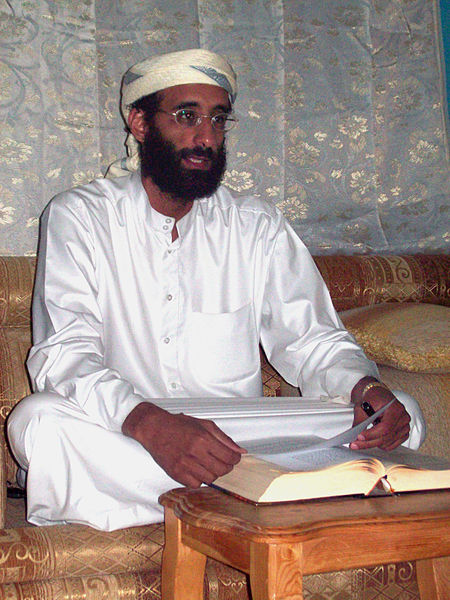
Submission to this power is, I believe, based on three factors: (1) blind faith in political leaders of the type that led Americans to accept the due-process-free punishment at Guantanamo (“my President accuses this person of being a Terrorist and therefore it’s true; I don’t need a trial to know it’s true”); (2) acceptance of anything done to a fellow citizen as long as he has a foreign-sounding, Muslim-ish name like “Anwar al-Awlaki,” who dresses in white cleric robes and is in Yemen and is thus probably guilty of something or other; and (3) the automatic and enthusiastic embrace by America’s Foreign Policy Community of the use of force in response to any problem, as epitomized by this bloodthirsty-rant-masquerading-as-Serious-analysis in Foreign Policy, which notes that Awlaki’s role in Al Qaeda has been drastically overstated but nonetheless concludes — citing the fact that he’s a “brilliant and captivating orator” and that Yemeni officials privately describe “Awlaki’s sermons as convincing and dangerous” – with this:
The most omnipresent terrorist threat the United States faces today is the opportunistic attacks that are either homegrown or stem from weak or failing states, not the spectacular attacks that take months of preparation. . . . And those are the kind of attacks Awlaki has the power to inspire. In the end, it doesn’t help much to ask who the next bin Laden is, since the problem is bigger than any one man. Regardless of whose image captivates the world, al Qaeda figures, including Awlaki, are busy plotting terrorist mayhem. And Washington needs to do all it can to reduce the risk of another attack.
The government “needs to do all it can” in the name of Terrorism: even targeting its own citizens with assassination without a trial based on the mere suspicion that he’s doing something criminal — or invading other countries that haven’t attacked us — or dropping a continuous stream of missiles on people’s homes who are purely innocent — or locking people up for life without a trial. This is the sociopathic mindset of the security fetishist that dominates our political discourse — Terrorism: the meaningless though all-justifying slogan — and, more than anything else, this is what explains why something as radical and dangerous as the President’s due-process-free assassination program aimed at American citizens triggers so little objection. ”Washington needs to do all it can” — no matter how violent and lawless — “to reduce the risk of another attack.” To a militarized, authoritarian, collapsing Empire in a posture of Endless War, security is the only cognizable value.
UPDATE: Last week, I delivered the keynote address to the ACLU in Massachusetts for their annual Bill of Rights dinner. The topic was the Bipartisan National Security State and President Obama’s continuation of it, and it relates to many of the topics discussed here. Those interested in listening to the 25-minute speech can do so here.
