
Kanye West’s “Monster” video: Warning does not excuse misogyny

The final version of the hip-hop epic includes a lot of dead women piled up. Is it art just because we're told so?

Topics: Kanye West, Music, Violence Against Women, Television,

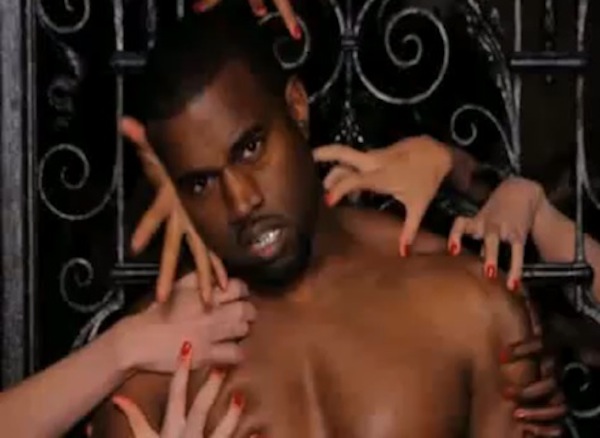
Kanye West's Kanye absolves himself for dead model imagery in "Monster."

Back in December, a video leaked of Kanye West’s “Monster,” featuring Jay-Z, Nicki Minaj and Rick Ross. Today, the video has “officially” come out, though the only thing that’s changed is the inclusion of a dubious warning label.

Websites like the Huffington Post are reporting that a disclaimer at the beginning of “Monster” reads, “The following content is in no way misogynistic or negative towards any groups of people. It is an art piece and shall be taken as such.” I don’t see that disclaimer anywhere in the 5-minute official video, but even if there is one, does it make any difference? The theme of the “Monster” video is “dead models”: There they are hanging by nooses, getting rearranged in bed by Kanye, stuffed in between cushions, getting stepped over by Jay-Z. It’s like something Patrick Bateman might have been into, and when you use such powerful imagery throughout your music video, you don’t get a pass just because “it’s a work of art.” You still need to explain why you chose these images, what cultural significance they have, or what they symbolize. Just saying, “It’s art,” and then showing a bunch of dead women is a cheap way to cop out of the claims of misogyny.

If “Monster” speaks to hip-hop’s history of objectifying women by taking it to its illogical extreme, then that should be Kanye’s official statement. Or Kanye should have enough faith in his viewers that they would understand the video’s commentary without being told that it’s not misogynistic. But what worries me is that there is no statement behind these images: that they are meant only to provoke and sensationalize, and that Kanye thinks a magic phrase like “artistic license” suddenly absolves him of any responsibility for the piece.

Here is “Monster,” in its NSFW glory:

Do you think having a disclaimer on this piece helps explain some of the imagery?

Continue Reading Close

Drew Grant is a staff writer for Salon. Follow her on Twitter at @videodrew.

Next Article

Featured Slide Shows

What To Read Awards: Top 10 Books of 2012 slide show

close X
  • Share on Twitter
  • Share on Facebook
  • Thumbnails
  • Fullscreen
  • 1 of 10
  • 10. "The Guardians" by Sarah Manguso: "Though Sarah Manguso’s 'The Guardians' is specifically about losing a dear friend to suicide, she pries open her intelligent heart to describe our strange, sad modern lives. I think about the small resonating moments of Manguso’s narrative every day." -- M. Rebekah Otto, The Rumpus

  • 9. "Beautiful Ruins" by Jess Walter: "'Beautiful Ruins' leads my list because it's set on the coast of Italy in 1962 and Richard Burton makes an entirely convincing cameo appearance. What more could you want?" -- Maureen Corrigan, NPR's "Fresh Air"

  • 8. "Arcadia" by Lauren Groff: "'Arcadia' captures our painful nostalgia for an idyllic past we never really had." -- Ron Charles, Washington Post

  • 7. "Gone Girl" by Gillian Flynn: "When a young wife disappears on the morning of her fifth wedding anniversary, her husband becomes the automatic suspect in this compulsively readable thriller, which is as rich with sardonic humor and social satire as it is unexpected plot twists." -- Marjorie Kehe, Christian Science Monitor

  • 6. "How Should a Person Be" by Sheila Heti: "There was a reason this book was so talked about, and it’s because Heti has tapped into something great." -- Jason Diamond, Vol. 1 Brooklyn

  • 4. TIE "NW" by Zadie Smith and "Far From the Tree" by Andrew Solomon: "Zadie Smith’s 'NW' is going to enter the canon for the sheer audacity of the book’s project." -- Roxane Gay, New York Times "'Far From the Tree' by Andrew Solomon is, to my mind, a life-changing book, one that's capable of overturning long-standing ideas of identity, family and love." -- Laura Miller, Salon

  • 3. "Billy Lynn's Long Halftime Walk" by Ben Fountain: "'Billy Lynn's Long Halftime Walk' says a lot about where we are today," says Marjorie Kehe of the Christian Science Monitor. "Pretty much the whole point of that novel," adds Time's Lev Grossman.

  • 2. "Bring Up the Bodies" by Hilary Mantel: "Even more accomplished than the preceding novel in this sequence, 'Wolf Hall,' Mantel's new installment in the fictionalized life of Thomas Cromwell -- master secretary and chief fixer to Henry VIII -- is a high-wire act, a feat of novelistic derring-do." -- Laura Miller, Salon

  • 1. "Behind the Beautiful Forevers" by Katherine Boo: "Like the most remarkable literary nonfiction, it reads with the bite of a novel and opens up a corner of the world that most of us know absolutely nothing about. It stuck with me all year." -- Eric Banks, president of the National Book Critics Circle

  • Recent Slide Shows

  • Share on Twitter
  • Share on Facebook
  • Thumbnails
  • Fullscreen
  • 1 of 10

More Related Stories

Comments

14 Comments

Comment Preview

Your name will appear as username ( profile | log out )

You may use these HTML tags and attributes: <a href=""> <b> <em> <strong> <i> <blockquote>