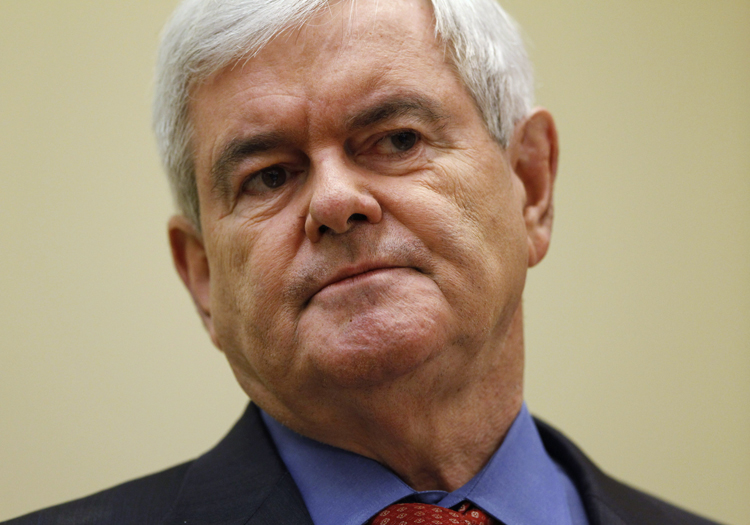

Newt Gingrich
The richly earned humiliation of Newt Gingrich
No one has ever endured such a terrible first month as a presidential candidate -- nor deserved to more
Republican U.S. presidential candidate Newt Gingrich attends the 51st Washington Conference with Laffer Associates in Washington May 13, 2011. Former House Speaker Gingrich declared his 2012 candidacy on Wednesday. REUTERS/Jason Reed (UNITED STATES - Tags: POLITICS ELECTIONS HEADSHOT)(Credit: © Jason Reed / Reuters) If his goal when he officially launched his presidential candidacy last month was to inflict a massive amount of humiliation on himself in as short a time as possible, then Newt Gingrich has succeeded spectacularly.
After an epically botched campaign roll-out — which included accusations of ideological treason from influential conservatives and a nationally televised exchange with an Iowa voter who called him “an embarrassment to our party” and urged him to quit the race “before you make a bigger fool of yourself” — Gingrich was left struggling to explain how he and his wife racked up hundreds of thousands of dollars in charges at Tiffany’s jewelers. Then he randomly took off on a vacation (a lavish Greek cruise, it turned out), and now he’s returned to find that virtually his entire staff has quit.
Does this latest development change the presidential race in any significant way? Not really. Since even before his month from hell, Gingrich had no realistic chance of winning the GOP nomination, and not since the 1990s has he been a significant force on the right. Most conservative activists and opinion-shapers long ago tuned him out.
But much of the political media world never quite figured this out, instead treating Gingrich for the last decade as an enduring relevant national leader. The instinct was understandable: The celebrity (and notoriety) he attained during his mid-’90s stint as House Speaker never fully faded, and he could always be counted on for a lively, provocative quote or two.
This is the promise of Gingrich’s amazing crash-and-burn as a White House candidate (I know, he says he’s staying in despite the staff defections): that it might compel the political media to realize that the emperor has no clothes.
The reality is that Gingrich’s serious career in elected politics lasted for 20 years and ended in 1998.
He spent the first 16 of those years clawing his way through his party’s House ranks, finally reaching the top spot just as the ideal circumstances — complete Democratic control of Washington for the first time since the Carter administration, a profoundly unpopular president, and a ton of low-hanging fruit in the South — presented themselves for a Republican takeover of the House. The midterm election of 1994 made Gingrich Speaker of the House.
The tactics he employed during that rise could be devious. Early on, he formed the Conservative Opportunity Society with about a dozen fellow far-right GOP members. They pushed their party’s leadership toward a more confrontational posture and engaged in harsh and highly personal attacks on their Democratic colleagues.
In one episode in 1984, Gingrich used an after-hours “special orders” speech on the House floor to read off the names of ten Democrats who had written a letter to Daniel Ortega, whose Sandinistas had seized control of the country in 1979, urging him to hold democratic elections and to allow expatriates to return to vote. The ten, Gingrich said, had “undercut and crippled” U.S. foreign policy; he suggested they be prosecuted under the Logan Act of 1798, which gives the president the right to conduct foreign policy. Upon learning of this, Speaker Tip O’Neill confronted Gingrich on the floor, calling his attack “the lowest thing I’ve seen in my 32 years in Congress.”
In 1989, Gingrich edged out Edward Madigan, the candidate preferred by Robert Michel, the pragmatic House GOP leader, to become minority whip, then the No. 2 position on the Republican side. Four years later, in the run-up to the 1994 election, Michel announced that he’d retire. Officially, it was his decision, but Gingrich was breathing down his neck. The GOP conference was increasingly filled with confrontational conservatives who preferred Gingrich’s style.
His four-year run as Speaker proved disastrous, for Gingrich personally and for his party. His own obnoxious style — when a South Carolina woman drowned her children in a horrifying late 1994 incident, Gingrich called it a sign of society’s breakdown and proof that people needed to vote Republican — alienated all but the most hardcore Republicans. And his eagerness to force a government shutdown over a GOP plan to slash Medicare spending gave President Clinton and Democrats a winning issue in 1996, when nearly 20 Republican incumbents lost their seats and the GOP barely held the House. Shortly after that, Gingrich held off an attempted coup from a band of frustrated but incompetent House Republicans. Then he made things worse for his party by leading an impeachment drive against Clinton in 1998 (even, as we later learned, while engaging in an extramarital affair himself), which backfired and led to shocking Democratic gains in that year’s midterms.
It was then that Gingrich took his massive unpopularity and walked off the political stage, knowing that his party was ready to throw him off if he didn’t make the first move. From that moment on, the party’s elites — elected officials, activists, interest group leaders, and opinion-shaping commentators — have had little use for him. But the media has been a different story. A few years after his demise as Speaker, Gingrich reemerged and was quickly welcomed back into every green room in America. Convinced he’d been rehabilitated, he began making noise about seeking the presidency, first in the run-up to the 2008 race and then again this time. His taste for ugly, personalized attacks hadn’t faded, either, something he’s shown over and over during the Obama presidency.
But the idea that he was a real player in politics was an illusion, something that’s become clear during the month-long Gingrich candidacy. Most of the important figures in the Republican Party never had any interest in seeing him run for president. There have been few endorsements, donors have shunned him, and conservative activists and commentators have amplified every one of his embarrassments.
Even with his staff quitting on him, Gingrich insists he’ll stay in the race. We’ll see how long that lasts. One way or the other, he’ll soon be taking the same walk of shame off the political stage that he took 13 years ago. This time, let’s hope it’s for good.
Steve Kornacki writes about politics for Salon. Reach him by email at SKornacki@salon.com and follow him on Twitter @SteveKornacki More Steve Kornacki.
Gingrich Inc: Out of business
Newt stayed in the race too long -- and now even his old private companies are struggling. Will Romney rescue him?
Newt Gingrich (Credit: Reuters/Benjamin Myers) When the House of Representatives censured Newt Gingrich in 1997 for ethics violations — the first time ever for a sitting Speaker in 200 years — the vote was 395 to 28, with 196 Republicans joining. “Newt has done some things that have embarrassed House Republicans and embarrassed the House,” said then-Rep. Peter Hoekstra, R-Mich., who is now running for a Senate seat in Michigan. Gingrich resigned a year later, “in disgrace,” as Mitt Romney said in January.
Continue Reading CloseAlex Seitz-Wald is Salon's political reporter. Email him at aseitz-wald@salon.com, and follow him on Twitter @aseitzwald. More Alex Seitz-Wald.
SPIN METER: Rivals airbrush anti-Romney words
After the nastiness of the Republican primary race, former candidates have collective amnesia about Romney disses
FILE - In this Jan. 26, 2012 file photo, Republican presidential candidates, former House Speaker Newt Gingrich and former Massachusetts Gov. Mitt Romney talk during a commercial break at the Republican presidential candidates debate in Jacksonville, Fla. Remember Gingrich calling Romney a liar? Michele Bachmann saying Romney's unelectable? Rick Santorum calling Romney "the worst Republican in the country" to run against Obama? They're hoping you don't. And acting like it never happened _ even though most of their words are just clicks away online. (AP Photo/Matt Rourke, File)(Credit: AP) WASHINGTON (AP) — Remember Newt Gingrich calling Mitt Romney a liar? Michele Bachmann saying Romney’s unelectable? Rick Santorum calling Romney “the worst Republican in the country” to run against President Barack Obama?
They’re hoping you don’t. And acting like it never happened (even though most of their words are just clicks away online.)
One by one — with the exception of holdout Ron Paul — the GOP also-rans have coughed up endorsements of their onetime rival. And as they do, they’re pulling rhetorical backflips to distance themselves from their former harsh assessments of Romney.
Continue Reading CloseGoodnight, sweet Newt
The rise and fall, rise and fall, and rise and fall of the Gingrich 2012 campaign
(Credit: AP/David Duprey) Today is another fine day for Newt Gingrich, although not his best. After months of neglect, he’ll get the political media to pay attention to him for a final 10 or so minutes. “All of us have an obligation, I think,” he said in Tuesday’s video announcing his announcement of his resignation today, which he first announced last week, “to do everything we can to defeat Barack Obama.” For Gingrich, this typically would mean attacking Mitt Romney. But Newt seems serious about dropping out this time, as shameful as that is for the erstwhile “definer of civilization,” as he called himself in some early-1990s doodles.
Continue Reading CloseJim Newell has covered politics for Wonkette and Gawker and is a contributor to the Guardian. More Jim Newell.
How much gasoline is a GOP primary voter worth?
Gas prices have barely budged compared to the cost of buying votes in the GOP primaries
Republican presidential candidate former House Speaker Newt Gingrich speaks at his primary night election rally with wife Callista on Tuesday, March 13, 2012, in Birmingham, Ala. (Credit: AP/Butch Dill) The rising price of gas has become a pressing political concern, with Republicans hammering President Obama for not finding some way to bring prices down. Newt Gingrich has promised to bring the cost of gas down to $2.50, using space technology borrowed from native Martians at our Lunar Trading Post, and he has forced his followers to carry large totems featuring “gas pump” icons.
But as gas prices have soared since the beginning of the year, the cost of a Republican primary vote has plummeted. A few months ago, campaigns were spending a fortune in ad buys and organizations in the small early states. In Iowa, Mitt Romney and the PACs affiliated with his campaign spent around $144 for each vote received. By Florida that number was down to $19. On Super Tuesday, only $2.89 was spent by each campaign for each vote cast nationwide.
Continue Reading Close
Alex Pareene writes about politics for Salon and is the author of "The Rude Guide to Mitt." Email him at apareene@salon.com and follow him on Twitter @pareene More Alex Pareene.
Will Newt give up if he starts losing the Old South?
He can't keep this up forever, right?
Republican presidential candidate and former U.S. Speaker of the House Newt "Rocket Man" Gingrich is seen during a campaign event in Manchester, New Hampshire December 21, 2011. (Credit: Jessica Rinaldi / Reuters) Newt Gingrich’s “path to the nomination” is basically a Billy-from-The Family Circus-style dotted line through his rich fantasy life, but he’s remaining in the race for the time being, because he performs well in the Old South, where likely nominee Mitt Romney does not. There is also a weird casino billionaire who keeps funding his campaign, maybe in part because he thinks it aids Mitt Romney by hurting Rick Santorum.
Well, Newt Gingrich remaining in the race might be hurting Rick Santorum, but by no means would Rick Santorum be winning if Gingrich wasn’t around. Give Santorum all of Gingrich’s delegates, he’s still losing to Mitt Romney. More realistically, as Nate Silver wrote earlier this morning, no Newt would mean more delegates for Rick and Mitt.
Continue Reading Close
Alex Pareene writes about politics for Salon and is the author of "The Rude Guide to Mitt." Email him at apareene@salon.com and follow him on Twitter @pareene More Alex Pareene.
Page 1 of 55 in Newt Gingrich