
How the GOP’s war on workers’ rights undermines the economy

The economy can't get out of neutral until workers have more money in their pockets to buy what they produce

Topics: The Labor Movement, War Room,

How the GOP's war on workers' rights undermines the economyScott Walker

This originally appeared at Robert Reich’s blog

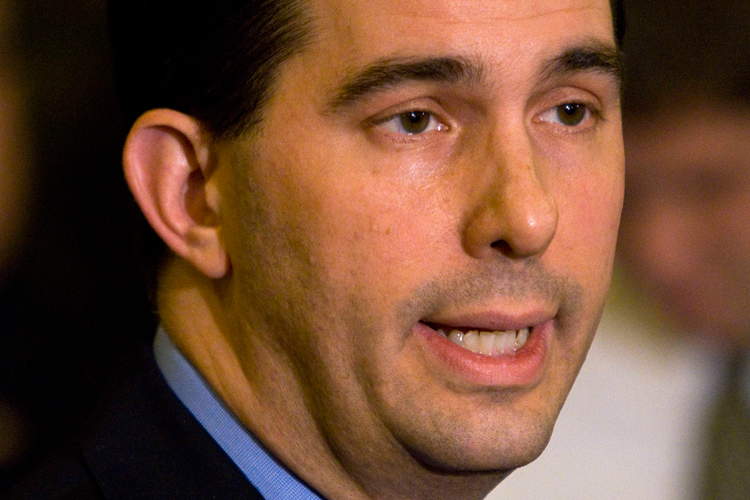
The battle has resumed in Wisconsin. The state supreme court has allowed Governor Scott Walker to strip bargaining rights from state workers.

Meanwhile, governors and legislators in New Hampshire and Missouri are attacking private unions, seeking to make the states so-called “open shop” where workers can get all the benefits of being union members without paying union dues. Needless to say this ploy undermines the capacity of unions to do much of anything. Other Republican governors and legislatures are following suit.

Republicans in Congress are taking aim at the National Labor Relations Board, which issued a relatively minor proposed rule change allowing workers to vote on whether to unionize soon after a union has been proposed, rather than allowing employers to delay the vote for years. Many employers have used the delaying tactics to retaliate against workers who try to organize, and intimidate others into rejecting a union.

This war on workers’ rights is an assault on the middle class, and it is undermining the American economy.

The American economy can’t get out of neutral until American workers have more money in their pockets to buy what they produce. And unions are the best way to give them the bargaining power to get better pay.

For three decades after World War II – I call it the “Great Prosperity” – wages rose in tandem with productivity. Americans shared the gains of growth, and had enough money to buy what they produced.

That’s largely due to the role of labor unions. In 1955, over a third of American workers in the private sector were unionized. Today, fewer than 7 percent are.

With the decline of unions came the stagnation of American wages. More and more of the total income and wealth of America has gone to the very top. Middle-class purchasing power depended on mothers going into paid work, everyone working longer hours, and, finally, the middle class going deep into debt, using their homes as collateral.

But now all these coping mechanisms are exhausted — and we’re living with the consequence.

Some say the Great Prosperity was an anomaly. America’s major competitors lay in ruins. We had the world to ourselves. According to this view, there’s no going back.

But this view is wrong. If you want to see the same basic bargain we had then, take a look at Germany now.

Germany is growing much faster than the United States. Its unemployment rate is now only 6.1 percent (we’re now at 9.1 percent).

What’s Germany’s secret? In sharp contrast to the decades of stagnant wages in America, real average hourly pay has risen almost 30 percent there since 1985. Germany has been investing substantially in education and infrastructure.

How did German workers do it? A big part of the story is German labor unions are still powerful enough to insist that German workers get their fair share of the economy’s gains.

That’s why pay at the top in Germany hasn’t risen any faster than pay in the middle. As David Leonhardt reported in the New York Times recently, the top 1 percent of German households earns about 11 percent of all income – a percent that hasn’t changed in four decades.

Contrast this with the United States, where the top 1 percent went from getting 9 percent of total income in the late 1970s to more than 20 percent today.

The only way back toward sustained growth and prosperity in the United States is to remake the basic bargain linking pay to productivity. This would give the American middle class the purchasing power they need to keep the economy going.

Part of the answer is, as in Germany, stronger labor unions — unions strong enough to demand a fair share of the gains from productivity growth.

The current Republican assault on workers’ rights continues a thirty-year war on American workers’ wages. That long-term war has finally taken its toll on the American economy.

It’s time to fight back.

Robert Reich, one of the nation’s leading experts on work and the economy, is Chancellor’s Professor of Public Policy at the Goldman School of Public Policy at the University of California at Berkeley. He has served in three national administrations, most recently as secretary of labor under President Bill Clinton. Time Magazine has named him one of the ten most effective cabinet secretaries of the last century. He has written 13 books, including his latest best-seller, “Aftershock: The Next Economy and America’s Future;” “The Work of Nations,” which has been translated into 22 languages; and his newest, an e-book, “Beyond Outrage.” His syndicated columns, television appearances, and public radio commentaries reach millions of people each week. He is also a founding editor of the American Prospect magazine, and Chairman of the citizen’s group Common Cause. His widely-read blog can be found at www.robertreich.org.

Next Article

Related Stories

Featured Slide Shows

The week in 10 pics

close X
  • Share on Twitter
  • Share on Facebook
  • Thumbnails
  • Fullscreen
  • 1 of 11
  • Lisa Montgomery embraces her nephew Thursday after a tornado tore apart her home in Cleburne, Texas. The twister killed six people and destroyed entire swaths of the North Texas town.
    Credit: AP/LM Otero

  • Jack McMahon, the defense attorney for abortion doctor Kermit Gosnell, speaks outside the Criminal Justice Center in Philadelphia Tuesday. His client was convicted of killing three babies in his clinic, and will serve multiple life sentences.
    Credit: AP/Matt Rourke

  • A photo taken Monday captures Vice President Joe Biden's response to a Milwaukee second-grader's innovative proposal to end America's epidemic of gun violence. This guy!
    Credit: AP/Jenny Aicher

  • Sen. Rand Paul, R-Ky., flanked by a grouper-eyed Michele Bachmann, addresses the IRS' admission that it targeted Tea Party groups in advance of the 2012 election. In an op-ed for CNN Thursday, the Kentucky senator slammed the president for his faux outrage.
    Credit: AP/Molly Riley

  • Ousted IRS chief Steven Miller is sworn in on Capitol Hill Friday. Miller testified before the House Ways and Means Committee on the extra scrutiny the agency gave conservative groups applying for tax-exempt status.
    Credit: AP/J. Scott Applewhite

  • Attorney General Eric Holder pauses as he testifies on Capitol Hill before the House Judiciary Committee Wednesday. Holder is under fire, among other things, for the Justice Department's gathering of phone records at the Associated Press.
    Credit: AP/Carolyn Kaster

  • O.J. Simpson sits during an evidentiary hearing at Clark County District Court in Las Vegas, Nev., Thursday. Simpson, who is currently serving a nine-to-33-year sentence in state prison for armed robbery and kidnapping, is using a writ of habeas corpus to seek a new trial.
    Credit: AP/Las Vegas Review-Journal/Jeff Scheid

  • Major Tom to ground control: On Sunday astronaut Chris Hadfield recorded the first music video from space, a cover of David Bowie's "Space Oddity."
    Credit: AP/NASA/Chris Hadfield

  • When it rains it pours. President Barack Obama speaks during a news conference Thursday with Turkish Prime Minister Recep Tayyip Erdogan, inexplicably inspiring an #umbrellagate Twitter meme.
    Credit: AP/Jacquelyn Martin

  • A smoke plume rises high above a road block at the intersection of County A and Ross Road east of Solon Springs, Wis., Tuesday. No injuries were reported, but the the wildfire caused evacuations across northwestern Wisconsin.
    Credit: AP/The Duluth News-Tribune/Clint Austin

  • Recent Slide Shows

  • Share on Twitter
  • Share on Facebook
  • Thumbnails
  • Fullscreen
  • 1 of 11

Comments

57 Comments

Comment Preview

Your name will appear as username

You may use these HTML tags and attributes: <a href=""> <b> <em> <strong> <i> <blockquote>