
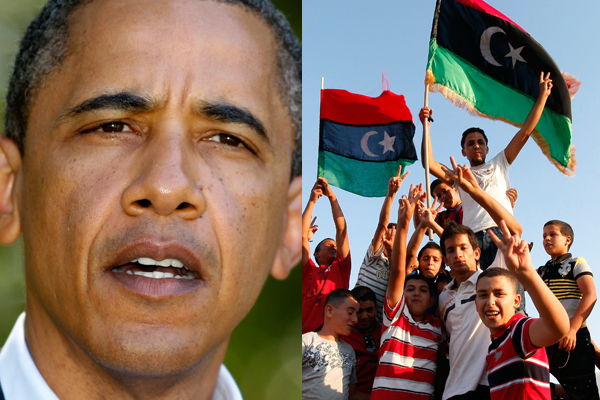

At The Daily Beast, Michael Tomasky today says that while President Obama “hasn’t been much of a domestic-policy president from nearly anyone’s point of view” (he apparently hasn’t read Steve Benen or Ezra Klein lately), the war in Libya highlights how “one can see how he might become not just a good but a great foreign-policy president.” Tomasky’s argument is somewhat cautious and expressly contingent on unknown, future events, but is nonetheless revealing — both in what it says and what it omits — about how some influential progressives conceive of the Obama presidency.
First, I’m genuinely astounded at the pervasive willingness to view what has happened in Libya as some sort of grand triumph even though virtually none of the information needed to make that assessment is known yet, including: how many civilians have died, how much more bloodshed will there be, what will be needed to stabilize that country and, most of all, what type of regime will replace Gadaffi? Does anyone know how many civilians have died in the NATO bombing of Tripoli and the ensuing battle? Does anyone know who will dominate the subsequent regime? Does it matter? To understand how irrational and premature these celebrations are in the absence of that information, I urge everyone to read this brief though amazing compilation of U.S. media commentary from 2003 after U.S. forces entered Baghdad: in which The Liberal Media lavished Bush with intense praise for vanquishing Saddam, complained that Democrats were not giving the President the credit he deserved, and demanded that all those loser-war-opponents shamefully confess their error. Sound familiar?
No matter how moved you are by joyous Libyans (just as one was presumably moved by joyous Iraqis); no matter how heinous you believe Gadaffi was (he certainly wasn’t worse than Saddam); no matter how vast you believe the differences are between Libya and Iraq (and there are significant differences), this specific Iraq lesson cannot be evaded. When foreign powers use military force to help remove a tyrannical regime that has ruled for decades, all sorts of chaos, violence, instability, and suffering — along with a slew of unpredictable outcomes — are inevitable.
Tomasky acknowledges these uncertainties yet does not allow them to deter him, but that makes no sense: whether this war turns out to be wise or just cannot be known without knowing what it unleashes and what follows. Just as nobody doubted that the U.S. could bring enough destruction to Iraq to destroy the Saddam regime, nobody doubted that NATO could do the same to Gadaffi; declaring the war in Libya a “success” now is no more warranted than declaring the Iraq War one in April, 2003.
Then there’s the issue of illegality. Tomasky pays lip service to this, dismissing as “ridiculous” Obama’s claim that he did not need Congressional approval because the U.S. role in Libya didn’t rise to the level of “hostilities.” By that, Tomasky presumably means that Obama broke the law and violated the Constitution in how he prosecuted the war. Isn’t that rather obviously a hugely significant fact when assessing Obama’s foreign policy? The Atlantic‘s Conor Freidersdorf argues that no matter how great the outcome proves to be, Libya must be considered a “Phyrrhic victory for America” because:
Obama has violated the Constitution; he willfully broke a law that he believes to be constitutional; he undermined his own professed beliefs about executive power, and made it more likely that future presidents will undermine convictions that he purports to hold; in all this, he undermined the rule of law and the balance of powers as set forth by the framers.
Similarly, The New Yorker‘s Amy Davidson warns of the serious precedential dangers not only from Obama’s law-breaking but from our collective willingness to overlook it. Honestly: can anyone claim that if George Bush had waged an optional war without Congressional approval — and continued to wage it even after a Democratic Congress voted against its authorization — that progressives would be lightly and parenthetically calling it “ridiculous” on their way to praising the war? No, they’d be screaming — rightfully so — about lawlessness and the shredding of the Constitution; that this identical contempt for the law by Obama has become nothing more than a cursory progressive caveat (at most) on the way to hailing the glorious war is astounding.
That leads to an equally dangerous precedent from acquiescing to illegality that has not received nearly enough attention. There seems to be this sense that while it’s regretful that Obama had to break the law to wage this war, the outcome is so good, the cause was so imperative, that we can accept this.
As someone who spent years arguing literally on a daily basis about Bush’s lawlessness, I can assure you that this rationale was exactly the one offered by Bush followers over and over again: even if it was technically illegal to eavesdrop without warrants, it was justified because (a) FISA is too restrictive a law on presidential authority and (b) the cause — detecting Terrorist plots — is so important and just. Replace “FISA” with “War Powers Resolution” and “detecting Terrorist plots” with “vanquishing Gadaffi” and one finds that mentality in full force today (in December, 2005, I wrote a post entitled “Claiming the Right to Break the Law,” highlighting how Bush officials such as Condoleezza Rice were defending the NSA program on that ground that stopping Terrorists was so vital that it justified the warrantless eavesdropping (and see the discussion there of how Bush followers justified anything their leader did even when it was illegal), and in January, 2006, I wrote a post entitled “The Bad Law Defense,” critiquing the claim from Gen. Michael Hayden that illegal eaveasdropping was permissible because FISA was too restrictive). As I wrote back then about that latter view:
As always, the first — and, for this scandal, the dispositive — principle is that the solution to a bad law is to change the law, not to break the law in secret and then claim once you’re caught that the law you broke was a bad law. If the President has the power to comply only with those laws he likes but to violate the laws he dislikes – and that, at bottom, is the Administration’s position — then we have a President who, by definition, does not believe in the rule of law and refuses to comport himself to it.
And as I wrote in my first book, How Would a Patriot Act?, about Bush lawlessness and the NSA scandal:
The heart of the matter is that the president broke the law, deliberately and repeatedly, no matter what his rationale was for doing so. We do not have a system of government in which the president has the right to violate laws, even if he believes doing so will produce good results. . . .
An illegally fought war isn’t some minor nit on Obama’s foreign policy record generally or the war in Libya particularly; it’s fundamental to what he did and how it should be assessed.
Then there are the multiple claims and promises of Obama’s that were clearly breached by this war. When running for President, he vowed that “we will again set an example for the world that the law is not subject to the whims of stubborn rulers” and: “no more ignoring the law when it’s inconvenient. That is not who we are.” He unambiguously told The Boston Globe that “the President does not have power under the Constitution to unilaterally authorize a military attack in a situation that does not involve stopping an actual or imminent threat to the nation.” And he told the nation when explaining the war in Libya after he ordered U.S. involvement that the purpose was protecting civilians, not regime change, and that “broadening our military mission to include regime change would be a mistake.” All of those public vows were simply brushed aside — blithely violated — without the slightest explanation.
But even more confounding than the praise Tomasky heaps on the war in Libya is his broader admiration for Barack Obama’s foreign policy generally. Not only has the Democratic President escalated the war in Afghanistan, but he’s dramatically increased American violence and aggression in multiple countries around the world, including Pakistan, Somalia, and Yemen. His actions have ended the lives of dozens upon dozens of innocent civilians, including a single cluster bombs attack in Yemen — cluster bombs — that by itself killed 23 children and 17 women; his own top General in Afghanistan described an “amazing number” of innocents killed at checkpoints; drone attacks continue to pile up the corpses of innocent human beings. None of this massive war escalation, increased aggression, and civilian death at Obama’s hands even merits a mention from Tomasky, let alone impedes the gushing; all of that has just been whitewashed from the progressive mind.
Then there is Obama’s continuation — and strengthening — of the Bush/Cheney Terrorism and civil liberties template that many progressives once pretended to find so deeply offensive. Perhaps Tomasky could argue that these don’t belong in a critique of Obama’s foreign policy (though I was just told by Scott Lemieux that these issues don’t belong in a discussion of Obama’s domestic policy), but surely some of it does. Obama has fought to deny Afghan prisoners any minimal habeas corpus rights, employed Somali proxies to house accused Terrorists in black sites, used “detention and torture by proxy” in Kuwait and elsewhere, targeted U.S. citizens for due-process-free assassinations, and vastly bolstered the secrecy regime surrounding his actions. Maybe some of that should be taken into account by progressives rushing to proclaim Obama’s foreign policy Greatness?
Stranger still are the alleged accomplishments Tomasky cites in his concluding paragraph:
But it’s hardly impossible to envision an Obama administration in a few years’ time that has drawn down Afghanistan and Iraq, helped foster reforms and maybe even the growth of a couple of democracies around the Middle East, and restored the standing of a country that Bush had laid such staggering waste. And killed Osama bin Laden. If this is weak America-hating, count me in.
That’s all very moving, except for the fact that none of it is real. Obama hasn’t “restored” America’s standing; granted, the country is more popular in Western Europe, but in the crucial Middle East and predominantly Muslim regions, America, if anything, is viewed more negatively now than it was under Bush. There’s no sign that Obama is “drawing down” in Afghanistan (his announced “withdrawal” plan would leave more troops than were there when he was inaugurated), and he’s currently working hard to pressure Iraq to agree to U.S. troops in that country beyond the repeatedly touted deadline (beyond the private army to be maintained by the State Department). And Tomasky’s fantasy that Obama will spawn “the growth of a couple of democracies around the Middle East” – the hallmark of neocon yearning — is revealing indeed; it’s also quite redolent of this bit of speculative presidential tongue-bathing about Bush’s democracy-spreading from Time‘s Joe Klein in 2005:
But that is where the democratic idealism of the Bush Doctrine has led us. If the President turns out to be right — and let’s hope he is — a century’s worth of woolly-headed liberal dreamers will be vindicated. And he will surely deserve that woolliest of all peace prizes, the Nobel.
Tomasky is right about Obama’s tonal improvements over Bush: as I’ve noted before, his less belligerent rhetoric is welcome. And it’s also true that it’s impossible to imagine Obama landing on an aircraft carrier wearing a fighter pilot costume (though he was hardly shy about dispatching anonymous aides leaking classified information to cover him with glory over the bin Laden killing). And Obama deserves credit for more effective use of the U.N. and alliances to manage American wars. But much of that is atmospheric, and it is setting a very low bar indeed: he’s not as much of an overtly chest-beating play-acting warrior as George W. Bush is not exactly greatness-establishing.
On the level of actions, any progressive decreeing Barack Obama’s foreign policy Greatness can do so only via willful blindness and/or a complete repudiation of previously claimed progressive principles. Both are vividly on display in Tomasky’s salute.
* * * * *
On the subject of Libya and Obama’s foreign policy generally, Jeremy Scahill’s appearance this morning on Morning Joe, in which he tries to explain some basic facts to a very confused Howard Dean and Tina Brown, is a must-watch:
