
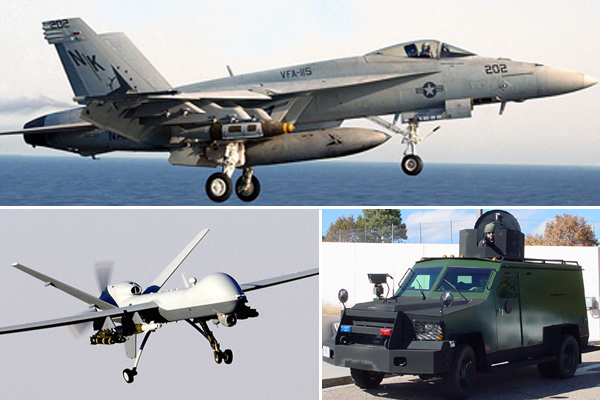

The Los Angeles Times examines the staggering sums of money expended on patently absurd domestic “homeland security” projects: $75 billion per year for things such as a Zodiac boat with side-scan sonar to respond to a potential attack on a lake in tiny Keith County, Nebraska, and hundreds of “9-ton BearCat armored vehicles, complete with turret” to guard against things like an attack on DreamWorks in Los Angeles. All of that — which is independent of the exponentially greater sums spent on foreign wars, occupations, bombings, and the vast array of weaponry and private contractors to support it all — is in response to this mammoth, existential, the-single-greatest-challenge-of-our-generation threat:
“The number of people worldwide who are killed by Muslim-type terrorists, Al Qaeda wannabes, is maybe a few hundred outside of war zones. It’s basically the same number of people who die drowning in the bathtub each year,” said John Mueller, an Ohio State University professor who has written extensively about the balance between threat and expenditures in fighting terrorism.
Last year, McClatchy characterized this threat in similar terms: ”undoubtedly more American citizens died overseas from traffic accidents or intestinal illnesses than from terrorism.” The March, 2011, Harper‘s Index expressed the point this way: ”Number of American civilians who died worldwide in terrorist attacks last year: 8 — Minimum number who died after being struck by lightning: 29.” That’s the threat in the name of which a vast domestic Security State is constructed, wars and other attacks are and continue to be launched, and trillions of dollars are transferred to the private security and defense contracting industry at exactly the time that Americans — even as they face massive wealth inequality — are told that they must sacrifice basic economic security because of budgetary constraints.
Despite these increasing economic insecurities — actually, precisely because of them — the sprawling domestic Security State continues unabated. The industry journal National Defense Magazine today trumpets: ”Homeland Security Market ‘Vibrant’ Despite Budget Concerns.” It details how budget cuts mean “homeland security” growth may not be as robust as once predicted, but “Lockheed Martin, General Dynamics, Boeing and Northrop Grumman . . . have been winning more contracts from DHS”; as a Boeing spokesman put it: ”You’ll still continue to see domestically significant investment on the part of the government and leveraging advances in technology to stand up and meet those emerging threats and needs.”
Of course, the key to sustaining this Security State bonanza — profit for private industry and power for Security State officials – is keeping fear levels among the citizenry as high as possible, as National Defense expressly notes, and that is accomplished by fixating even on minor and failed attacks, each one of which is immediately seized upon to justify greater expenditures, expansion of security measures, and a further erosion of rights:
Polls still show that there is increasing public concern about another terrorist attack. It is this fear and an unrealistic American perception of risk that will continue to propel some aspects of the market, analysts say. . . .
Small-scale attacks, whether successful or not, will continue to prompt additional spending, the market analysts at Homeland Security Research Corp. say. They point to the failed 2009 Christmas plot of a man trying to blow up a flight to Detroit with explosives sewn into his underwear and the attempted car-bombing in Times Square early the next year. Though unsuccessful, these events led to immediate White House intervention, congressional hearings and an airport screening upgrade costing more than $1.6 billion.
The LA Times, while skillfully highlighting these wasteful programs, depicts them as some sort of unintended inefficiencies. That is exactly what they are not. None of this is unintended or inefficient but is achieving exactly the purposes for which it is designed. That’s true for two reasons.
First, this wastefulness is seen as inefficient only if one falsely assumes that its real objective is to combat Terrorist threats. That is not the purpose of what the U.S. Government does. As Daniel Weeks explains today, the Congress — contrary to popular opinion — is not “broken”; it is working perfectly for its actual owners. Or, as he puts it, “Washington isn’t broken — it’s fixed”:
Our problem today is not a broken government but a beholden one: government is more beholden to special-interest shareholders who fund campaigns than it is to ordinary voters. Like any sound investor, the funders seek nothing more and nothing less than a handsome return — deficits be darned — in the form of tax breaks, subsidies and government contracts.
The LA Times, and most people who denounce these spending “inefficiencies,” have the causation backwards: fighting Terrorism isn’t the goal that security spending is supposed to fulfill; the security spending (and power vested by surveillance) is the goal itself, and Terrorism is the pretext for it. For that reason, whether the spending efficiently addresses a Terrorism threat is totally irrelevant.
Second, while the Security State has little to do with addressing ostensible Terrorist threats, it has much to do with targeting perceived domestic and political threats, especially threats brought about by social unrest from austerity and the growing wealth gap. This Alternet article by Sarah Jafee, entitled ”How the Surveillance State Protects the Interests Of the Ultra-Rich,” compiles much evidence — including what I offered two weeks ago — demonstrating that the prime aim of the growing Surveillance State is to impose domestic order, preserve prevailing economic prerogatives and stifle dissent and anticipated unrest.
Pointing out disparities between surveillance programs and the Terrorist threat is futile because they’re not aimed at that threat. The British Government, for instance, is continuing its efforts to restrict social media in the wake of the poverty-fueled riots that plagued that country; as The New York Times reports today, it is secretly meeting with representatives of Twitter, Facebook, and the company that owns Blackberry “to discuss voluntary ways to limit or restrict the use of social media to combat crime and periods of civil unrest.” That revelation prompted taunting condemnations of British tyranny from China and Iran, both of which have been routinely excoriated for surveillance abuses and Internet suppression of the type increasingly common in the West.
Meanwhile, much of the anti-Terrorism weaponry in the U.S. ends up being deployed for purposes of purely domestic policing. As the LA Times notes: those aforementioned BearCats are “are now deployed by police across the country; the arrests of methamphetamine dealers and bank robbers these days often look much like a tactical assault on insurgents in Baghdad.” Drones are used both in the Drug War and to patrol the border. Surveillance measures originally justified as necessary to fight foreign Terrorists are routinely turned far more often inward, and the NSA — created with a taboo against domestic spying — now does that regularly.
Exaggerating, manipulating and exploiting the Terrorist threat for profit and power has been the biggest scam of the decade; only Wall Street’s ability to make the Government prop it up and profit from the crisis it created at the expense of everyone else can compete for that title. Nothing has altered the mindset of the American citizenry more than a decade’s worth of fear-mongering So compelling is fear-based propaganda, so beholden are our government institutions to these private Security State factions, and so unaccountable is the power bestowed by these programs, that even a full decade after the only Terrorist attacks on U.S. soil, its growth continues more or less unabated.
