
It was all I could do not to scarf the entire stromboli, neatly packaged for me in a Styrofoam clamshell, while in the car. The dough was soft. The balance of ham and mozzarella, just right. And so, only about half was left when I parked on Third Avenue, the main drag in Huntington, West Virginia, and offered a bite to some friends.
“Wow. That’s great,” said one.
“Yeah, where’d you get that?” asked another.
“You’ll never believe it,” I told them. “This is school lunch.”

Times have changed since celebrity chef Jamie Oliver broadcast startling and deliberately inflammatory—this was reality TV, after all— images of kids here dumping trays of fresh food untouched into the trash. For those of you who missed, Oliver’s prime-time program, “Food Revolution,” the British chef arrived in Huntington in 2009 after it was named the most unhealthy metropolitan area in America and went to work ousting greasy burgers and pizza in favor of from-scratch meals made with fresh ingredients. Two years later, on the first week of school, which began in mid-August, students in Cabell County sat down to meals of from-scratch chicken quesadillas and brown rice and, on the day I visited, creamy chicken and noodles served with freshly made coleslaw, steamed broccoli with parmesan, an orange and hot rolls, the smell of which floated enticingly through the halls.
And that stromboli? Well, it’s not one of the meals that the school district is most proud of. The dough is made from scratch, of course. But school cooks would be happier if they actually made the ham or cheese. As I said, times have changed.
School officials repeatedly point out that the county’s food already was 50 percent made from scratch before Oliver rolled into town. And you can’t blame them for wanting a little credit. The culinary crusader may have focused the national klieg lights on this otherwise quiet Appalachian city, but it’s local officials that have done the real work of overhauling school food. Over the last two years, Rhonda McCoy—the school food service director who was portrayed on the show as an aloof bureaucrat more concerned with budgets and caloric counts than kids’ health—has redeveloped recipes, held after-hours taste tests, sourced fresh and unprocessed ingredients at affordable prices, bought new equipment and trained school cooks. She also endured an unprecedented four regulatory audits to ensure that the new meals met federal nutritional and caloric standards. She passed.
McCoy hasn’t stopped there. This year, she introduced free meals for all low-income students and free meals for all students at one county elementary school. She also plans to introduce lower-sugar flavored milk, and to buy a projected 12,000 pounds of sweet potatoes for the district, grown by a county high school’s vocational agriculture students.
Now, deservedly, McCoy’s county is a model in the state. Last spring, Dr. Jorea Marple, the state schools superintendent, visited Cabell County and decided that other districts need to follow its path. As a result, eight counties—most of which are in the poor, southern coal fields— this fall will introduce 100 percent from-scratch meals at breakfast and lunch – and provide them to all students, regardless of their family’s income, free of charge.
It’s easy to imagine how this kind of warp-speed transition might be painful for those eight lucky counties. My husband and I spent six months in Huntington researching a book about how and if the town can change its food culture, and in meeting after meeting, McCoy told me that she never objected to the changes that Oliver suggested, just the way and speed at which she was forced to implement them.
But this new set of cooks won’t be starting from scratch. McCoy provided a binder full of USDA-approved recipes and order forms with all the ingredients they need to purchase. She also organized a two-day training where the now-experienced Cabell County cooks demonstrated recipes: rotisserie chicken, roasted potatoes, sugar snap peas, pizza sauce and homemade salad dressings and croutons, among others. They also imparted tips and techniques for, say, quickly chopping dozens of heads of romaine lettuce or cabbage for coleslaw rather than just opening a bag.
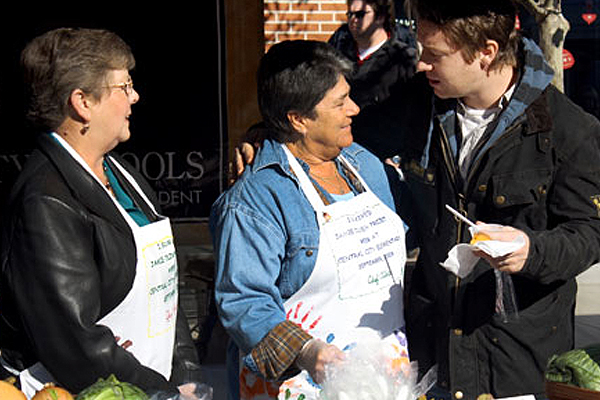
Alice Gue, the school cook who “Food Revolution” viewers will remember as Oliver’s grumpy nemesis, was one of the trainers. (And, for the record, she’s one of the warmest, cuddliest school cooks I’ve met in years of covering the subject.) “It’s a lot for them to take on but most were really excited,” she told me after serving stromboli to almost 200 students. “You always get some people who will say, ‘I can’t do that. We have no time. We don’t this or we don’t do that.’ Just like you get some people who say: ‘Well, why do the extra work when the kids are just going to throw away the food?’ And sure, some of them will. And if they don’t eat it today, okay they didn’t today. But down the road they will. You have to take pride in what you do and what you put out there for these kids.”
Pride is one thing. Money is another. And a lack of federal funds is the perennial reason for the piles of cheap, processed food that end up on children’s trays. And so I asked McCoy: Where would West Virginia get the money for new equipment, better ingredients and free lunches for all low-income students?
“I don’t know,” she said. “They’re just going to find it.”
It’s a non-answer. But, in a way, it doesn’t really matter. What does is that state and county leaders in West Virginia now agree that good food in schools is so important that they’ll find some way to put it on students’ plates. Or, to put it another way, remaking school food is more about leadership than cash. While chef-advocate Alice Waters and others would like to see the federal government spend $5 per student for organic, sustainable and local school lunch, the Cabell County school district is proving that it’s possible—with dedication and a little ingenuity— to put out tasty, from-scratch meals that both kids and a discriminating food writer will happily eat.
That’s not to say that more money wouldn’t help. Doling out money is how Congress leads. And school food would be a popular cause if children suddenly got the vote. But the experience in Cabell County proves that sometimes what schools need most is a push to change. “If I had to do it my way, we would have gone slower,” McCoy told me. “But now that it’s all done, I think, yes, it was worth it.”
Jane Black is a Brooklyn-based food writer who covers food politics, trends and sustainability issues. Her work has appeared in the Washington Post (where she was a staff writer), the New York Times, Slate, New York magazine and other publications. To read more, visit www.janeblack.net.
