
Action movies

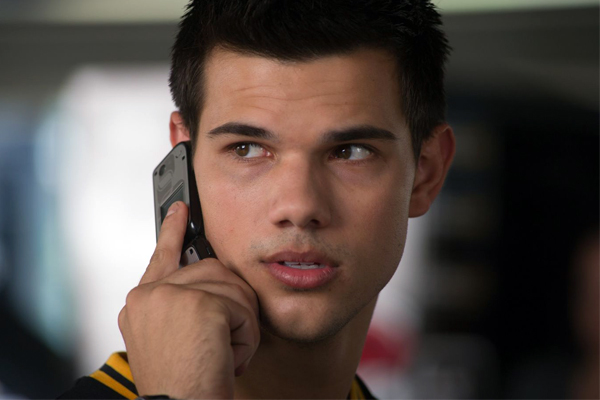
“Abduction”: Taylor Lautner's chest gets a movie

Team Jacob obsessives may love it, but this fourth-rate "Bourne"-style thriller does the Twi-hunk no favors

  • more
    • All Share Services

Taylor Lautner in "Abduction"

Writing a review of “Abduction,” the new thriller designed as a star vehicle for “Twilight” hunk Taylor Lautner, is pretty much a free-fire zone. Lautner’s fan base — which I would presume to be young and female and interested in viewing his hairless and monumental chest — isn’t super-likely to read reviews before rushing out to see the movie. On the other hand, if you’re here reading this, the likelihood that you’re actually going to pay to watch “Abduction” is exceptionally low. So I can pretty much make up any damn thing without fear of contradiction: The sequence where aliens destroy the earth was pretty cool, but the B&D sex scene between Lautner and Sigourney Weaver was somewhat disturbing. Unless it was the other way around.

Yes, I’m desperate here. I’d really like to come up with some mildly contrarian take on “Abduction” — to report, perhaps, that Lautner is a self-effacing charmer who can dance, or that director John Singleton (long, long ago the auteur behind “Boyz n the Hood”) has reversed his long slide into hackdom and made an enjoyable “Bourne Identity” knockoff. Sadly, it’s impossible to fake the faintest enthusiasm for this picture, which is a fourth-rate Hollywood thriller that bungles a lot of thievery from better movies, is entirely bereft of suspense or excitement and features a leading man who absolutely, positively cannot act. I saw the film with an old friend who compared Lautner’s performance to that of Vanilla Ice in the legendary 1991 “Cool as Ice.” I can’t say, personally, but given that Lautner has considerable camera experience for a 19-year-old, his block-like impassivity and utter incapacity to register humor or emotion are remarkable. He spends the whole film looking smug or baffled, possibly smaffled.

Here’s what I can say for “Abduction”: It heightened my respect for the “Twilight Saga” movies, where Lautner is employed quite effectively as Jacob Black, the American Indian werewolf who relentlessly woos but will never win Kristen Stewart’s emo-tinged, virginal heart. Jacob is of course a doubly “other” character, capitalizing on the fact that Lautner looks both racially ambiguous and borderline inhuman, and I suppose Singleton and screenwriter Shawn Christensen had some vague idea of emulating that. In “Abduction,” Lautner plays a hard-partying Pittsburgh teen named Nathan, who discovers — while surfing the Internet, literally — that his parents aren’t his real parents and that both the CIA and some quasi-Slavic hoods (their background and nationality and motives are never clear) are looking for him. So Nathan hits the road with the girl next door (Lily Collins, rumored to be Lautner’s real-life squeeze) for a series of remarkably uninvolving chase scenes and supposed romantic interludes.

“Abduction” may win the 2011 prize for wasting good actors in absolute balderdash; we’ve got the aforementioned Sigourney Weaver as a psychiatrist and/or secret agent with a bouquet of balloons, Alfred Molina as a paunchy, lumbering CIA bigwig, and Swedish actor Michael Nyqvist (co-star of the “Girl Who …” movies) as the sinister but non-specific international bad guy. Nyqvist and Lautner have a nice scene sitting in the stands together at a Pittsburgh Pirates game, and I would have paid good money to turn the movie into some kind of sentimental father-son drama at that moment. Furthermore, Pittsburgh is a picturesque city, underutilized in American film, and here and there Singleton seems to wake up from his extended power nap and pay attention to that fact. There! I finally said something nice, and kind of meant it.


“Battleship”: Dumbest military spectacle ever?

Aliens invade a Navy recruitment video and turn back the gender-politics clock in this moronic blockbuster

  • more
    • All Share Services

A still from "Battleship"

One of the great marketing constants of contemporary Hollywood is the idea of appealing to the 11-year-old boy within every moviegoer (whatever gender that person may manifest on the surface). Almost every American movie released during the summer season has that squirmy pre-adolescent id in view, and about two-thirds of the movies made the rest of the year. But what about a movie as baffling and incoherent and flat-out stupid as “Battleship” — an alien-invasion adventure by way of a Hasbro game, or maybe the other way round — a movie that would make your inner 11-year-old stomp out of the theater in disgust?

It’s undoubtedly gilding the lily to claim that “Battleship” is the dumbest movie I’ve ever seen — for all that I front as someone who only likes Turkish films where people stare at the landscape without talking, I’ve seen a lot of dumb movies — but it’s definitely up there. Over and above its extraordinary, mind-melting level of stupidity, “Battleship” (which is directed by actor-turned-filmmaker Peter Berg, of “Hancock” and “Friday Night Lights,” and written by action-flick brothers Erich and Jon Hoeber) is also extremely weird. Its shameless and nonsensical combination of ingredients finally won me over, after a fashion, when I realized that its gung-ho Navy-recruitment propaganda and retrograde gender politics shouldn’t be taken any more seriously than the ZZ Top, AC/DC and Billy Squier songs on the soundtrack. The only point of the whole exercise is to make small boys whoop and holler.

You know that bar over on the roughneck side of town, the one where all the jingoistic, pro-military, America-hell-yeah movies go to quaff some brewskis and swap tales about kickin’ Communist hiney? Yeah, that one. Well, when “Battleship” shows up there and starts breaking beer glasses on its head, “Top Gun” and “Red Dawn” and “The Green Berets” get to feel all grown-up and complicated and full of girly-man sensitivity. That’s how stupid it is. Come to think of it, that’s the same Oahu tavern where we first meet our handsome but headstrong hero, Alex Hopper (Taylor Kitsch, last seen fleeing the ruins of “John Carter”), who’s enjoying a birthday beverage and stern lecture, both provided by his uptight Navy officer brother, Stone (Alexander Skarsgård). Let me back up and repeat that key piece of information: Skarsgård’s character is named Stone Hopper, and I promise that if you remind me of that in three years, I’ll still think it’s hilarious.

That bar on that evening is also where Alex first claps eyes on Sam (Brooklyn Decker), a leggy, cheerleader-ish blonde who’s come into this testosterone-rich dive bar unaccompanied, only to be denied a microwave burrito. Alex gets her that burrito, and wins her heart, at the end of a painful slapstick sequence that involves the total destruction of a convenience store and him being repeatedly Tased by local law enforcement. Funny! Shortly after that, we get to see Sam wearing short-shorts and a tank top, smooching with Alex on the beach — and that’s the one and only moment of faint implied sexuality anywhere in “Battleship.” Decker’s Sam might as well be encased in a glass vitrine; for the rest of the movie she’s seen only in chaste white dresses or tomboyish outdoor clothes. She’s less a Megan Fox-style sex object than a small boy’s vague and non-threatening idea of a sexy lady, and in her remaining scenes with Alex she spends her time urging him — I’m not kidding about this! — to ask her father for her hand.

Alex doesn’t get around to doing that right away, because after the seemingly endless throat-clearing of these early scenes, stuff finally starts happening and the action movie gets here at last. See, Alex has been dragged into the Navy by his big brother Stone Hopper and somehow gotten an officer’s commission, and Sam’s dad (Liam Neeson, doing his growly Amurkin act) is some big-shot admiral who hates him, and then some huge alien vessels from outer space show up, because of a beacon sent out there by geek scientists (thanks, nerds!), destroy Hong Kong and land in the Pacific right in the middle of RIMPAC, which sounds vaguely pornographic but is actually a massive naval exercise involving fleets from many nations. The alien ships are immense gleaming CGI monstrosities wielding impressive firepower — as usual, far beyond our comprehension, etc. — but they’re also kind of the McMansions of the alien-invader world, meaning that they look great for the first few minutes and then you start wondering what the point is, and how well anybody thought any of this through before they started building.

There appear to be no clear rules governing the behavior of the marauding aliens, which is to say that the only rule is this: Despite their overwhelming military superiority, the invaders must have weaknesses that will eventually allow the United States Navy to boo-ya all over their asses. So the aliens never fire on anyone who doesn’t pose a direct threat (except when they do), even though their apparent purpose is world conquest. They come from a planet that, as we are repeatedly told, is very similar to Earth, yet they have reptilian eyeballs and cannot tolerate direct sunlight. Their ships can apparently fly — or, at least, they flew here across millions of miles of space — yet they navigate through the ocean with a frog-hopping motion not unlike metallic whales doing the butterfly stroke. In fairness, all the big machines and humanoid monsters and things that go boom are awesomely rendered; Berg has definitely spent his reported $200 million budget on stuff you can see. It’s just all so profoundly stupid.

Thanks to whatever marketing logic dictates that these kinds of summer movies have to last more than two hours, Berg and the screenwriters pack in all kinds of Navy protocol, ludicrous subplots and irrelevant comic business, among the explosions. R&B star Rihanna is here, in a nothing role as a tough-as-nails petty officer, and Tadanobu Asano, a major Japanese star whose presence may pay off in East Asia, plays a kind of guest-star captain who figures out how to track the radar-cloaked alien ships using a low-tech grid that somewhat resembles — yes! — the traditional layout of the Battleship game. I bet there were high-fives all around in the writing room when they figured that one out. (Let me observe here that playing the Hasbro version is lame; Battleship can and should be played with graph paper.)

I’m not even getting into the bizarre “Space Cowboys” twist toward the end, in which a mothballed World War II-era battleship, and its crew of geriatric docents, is dragged into the fray in a last-ditch effort to save the world. I mean, I know what the title of the movie is, but it’s somehow especially funny that they got all worried about the fact that the real-life Navy doesn’t use battleships anymore. (“Man, we can’t let down the people like this! They want a freakin’ battleship, and they’re gonna get one!”) Plus, did you know that museum ships built 70 years ago are kept all fueled up and ready to go, with stacks of live missile shells piled up behind the Grab-a-Smurf machine? Me neither! But please forgive me; I’m just bitter. Unlike Taylor Kitsch’s endlessly enthusiastic character, I never did get around to asking my wife’s dad for her hand in marriage. And when you get right down to it, isn’t that kind of a charming custom? Why in the world did we let that one get away?

Continue Reading Close

“The Avengers” and Hollywood’s gender wars

Despite the success of the "Hunger Games," this summer's blockbusters are aimed squarely at male action fantasies

  • more
    • All Share Services

I don’t think I’m breaking any news if I tell you that “The Avengers,” Joss Whedon’s ensemble action-adventure that unites an entire posse of Marvel Comics superheroes, will be far and away this weekend’s No. 1 film at the box office. (In fact, “Avengers” is already the eighth-highest grossing film of 2012, with more than $260 million in global revenue before its North American release.) Or that a large majority of those ticket buyers will be teenage boys and young men. Like most summer “tent-pole” productions — those designed to support franchises, and ensure the financial future of major studios — “The Avengers” is aimed squarely at guys under 35, long the demographic, psychological and economic bulwark of the movie industry. In the weeks ahead, we’ll see a whole bunch more male-centric, big-budget releases: “Battleship,” “The Dictator,” “Men in Black III,” “Prometheus,” “The Amazing Spider-Man” and “The Dark Knight Rises,” potentially the biggest of all.

All this is standard operating procedure in 21st-century Hollywood, where the industry is dominated by post-boomer males reared on the comic books, TV shows and blockbuster movies of the ’60s, ’70s and ’80s, and the audience is understood in almost Pavlovian terms as a slavering horde of permanent adolescents. Audience familiarity and “pre-awareness” are greatly prized, so nearly all these guy-oriented movies derive from superhero comics or video games or other decades-old pop franchises. (It is, of course, possible to go too far into the pop-culture past. Let’s observe a moment of silence, once again, for “John Carter.”) We can certainly argue about which of these movies create an interesting twist on existing formula and which are cynical crap, but I don’t think we can argue that it makes much difference to the bottom line. “The Avengers” will make a kazillion dollars, and so did “Transformers: Dark of the Moon.” The differences between the two are mostly a matter of fine-grained detail; they’ve both got cartoonish male bonding, a lot of stuff blowing up, and hot-chick eye candy.

If you’re female and you’re interested in any or all of the above pictures, by the way, I apologize for making it sound as if you don’t exist. But in marketing terms, you don’t. There’s no end of paradox in Hollywood’s patronizing attitude toward female viewers, especially given the long-held marketing truism that in a date-night situation, the woman’s vote typically holds more sway than the man’s. (It’s a standard sitcom joke, right? She persuades him to go see “The Notebook,” and he has to pretend he didn’t cry at the end.) But broadly speaking, women are supposed to be satisfied with the mid-budget, low-prestige romantic comedies made on the Hollywood margins, many of which are so phoned-in and formulaic — hello, Garry Marshall! — they make Michael Bay look like Fassbinder. (Actually, Michael Bay is kind of like Fassbinder. But let’s not get distracted.)

Of course, the Hollywood suits have no objection to making enormous piles of money off female moviegoers, whom they rediscover every few years. (See also: “Ghost,” “Pretty Woman” and the careers of Meg Ryan and Hugh Grant.) But even enormously profitable franchises like “Sex and the City” and “The Twilight Saga” exist in a sort of pink-hued ghetto, and are widely understood both inside and outside the industry as being silly and second-rate. As opposed to the movies about muscular guys in colored costumes who fight evildoers from outer space, which attract the biggest budgets, the biggest stars and the highest possible production values. When feminist critics argued, for example, that “Sex and the City 2″ received far more scathing treatment from male reviewers than did guy-oriented movies that were every bit as wretched, I at first resisted. I now think they were correct: Critics make allowances for dumb, macho action movies, because they conform to unconscious norms and expectations, in a way they don’t for silly, superficial “vagina movies.” I have long contended that if you construct a Venn diagram showing the best of the (universally derided) “Twilight” movies and the worst of the (universally praised) “Harry Potter” movies, there’s way more overlap than fans of the latter would easily admit.

All of this reflects deeply ingrained social and cultural ideas about gender, which are present in people of both sexes. Maybe men’s preference for violent action yarns and women’s preference for sappy love stories — and our tendency to understand one as more “serious” than the other — are hard-wired in some biological way, although that falls a long way short of scientific truth. But despite the torrent of male-centric franchise flicks we’ll see this summer, and next summer, and for all the summers into the foreseeable future, the tide in the Hollywood gender wars has begun to shift, slightly but perceptibly. As I said earlier, “The Avengers” will be No. 1 this coming weekend. But the top-grossing film for the preceding six weeks was a female-oriented picture: Four weeks of “The Hunger Games,” followed by two weeks at the top for surprise hit “Think Like a Man,” whose principal audience was not just women but African-American women, who make up about 6 percent of the United States population. (Clearly a lot of other people went to see it too.)

Those six weeks aren’t statistically meaningful by themselves. But when added to the big numbers rolled up last year by “The Help” and “Bridesmaids,” and the $1.7 billion taken in so far by “The Twilight Saga” around the world, they begin to suggest the contours of a new reality, one in which films aimed at girls and women are high-end blockbusters on an equal footing with guy-flicks. This year, “Hunger Games” will be somewhere near the top in global box-office returns, alongside “The Avengers” and Chris Nolan’s final Dark Knight film. While I don’t think “Hunger Games” is likely to be remembered as a cinematic breakthrough, it’s an important movie in other ways. Its canny blend of science fiction, action flick and love story nosed it out of the pink ghetto in various ways; it was presented by industry insiders as a high-stakes gamble and a worthy successor to the Harry Potter franchise, and male critics were mostly respectful, not reacting as if they were being flooded with icky estrogen. If the film’s audience was predominantly female, the film’s ethos — the cultural narrative surrounding it — was more butch.

Maybe it’s coincidental that two of the biggest female-oriented films we’ll see this summer — Pixar’s animated “Brave” and “Snow White and the Huntsman,” with Kristen Stewart and Chris Hemsworth — are genre-mixing action pictures with independent-minded heroines. But when it comes to the sluggish, reactionary and massively over-thought process of making Hollywood movies, I don’t believe in coincidence. Some of you with long cultural memories may be wondering whether this could mark the beginning of a long-arc trend that brings us back to big-budget Hollywood movies that aren’t so niche-marketed and gender-specific, that are meant to appeal to all ages and both sexes. One answer to that question is “Hey, Tim Burton and James Cameron and Peter Jackson,” and another answer is “only sort of.” In the meantime, it’s business as usual: “Battleship,” which is based on “the classic Hasbro naval combat game,” will open directly opposite “What to Expect When You’re Expecting,” which is based on a series of lecturey and divisive pregnancy advice books. I honestly can’t decide which one to see first.

Continue Reading Close

“Safe”: Ultra-violent ’70s action flicks are back!

Cynical, bloody and ridiculously entertaining, Jason Statham's "Safe" revives '70s-style ultra-violence

  • more
    • All Share Services

Jason Statham in "Safe"

It’s easy at first to draw comparisons between today’s America and that of the 1970s — economic struggle, a widening gulf between rich and poor, a persistent sense of national crisis — but as those who actually lived through that storied decade can tell you, once you get to the details it all falls apart. The ’70s was a decade of explosion: Exploding inflation, exploding crime rates, terrorist bombings all across the Western world. Civil society itself seemed to be collapsing back then, whereas today we have an almost opposite set of problems: low crime, low mortgages, low wages, and an intrusive, all-seeing security state that keeps disorder to a minimum.

But movies, speaking generally, are better at depicting psychological states than objective reality. And given the pervasive anxiety of our times, it isn’t surprising that mainstream cinema has started to hark back to the ’70s, a decade of maximum screen disorder and maximum creativity. There are quite a few thrillers and action flicks of the past few years that partake of a ’70s-flavored dystopian and/or paranoid vision, from Chris Nolan’s “Batman” series to “The Hunger Games” to “In Time” and the underappreciated Liam Neeson thriller “Unknown.” (Jonathan Hensleigh’s “Kill the Irishman,” one of my favorite dark-horse actioners of the past several years, has the excuse of actually being set in the ’70s.) But none, perhaps, possess the Charlie Bronson, bullet-in-the-teeth authenticity of writer-director Boaz Yakin’s trashy, bloody, riveting “Safe.”

I assume the title is meant to be ironic, possessing all the subtlety of Jason Statham hitting you repeatedly in the head with a shovel. I don’t think that actually happens in “Safe,” but given the impressive body count piled up by Statham’s character, an ex-MMA cage fighter (and ex-NYPD officer, and ex other things I’m not supposed to tell you about) named Luke, I wouldn’t be surprised. No one and nothing is ever safe in “Safe,” and no one is decent or trustworthy, with the possible and partial exception of Mei (Catherine Chan), a kidnapped 11-year-old Chinese girl whom Luke fastens on to as his vehicle of redemption. Luke would be the first to tell you — in Statham’s put-on but entertaining Noo Yawk wise-guy accent — that he’s a bad dude in all senses of the term. But he’s also one of those action-movie heroes who’s lost everything and everyone he’s ever cared about and has decided to go out with guns blazing to fight for whatever flickers of decency still exist in this crazy freakin’ world.

Yakin builds an impressive mountain of nihilism in this movie. And though it’s not precisely the same nihilism you’d encounter in a genuine Charlie Bronson movie from the Carter administration, it has a similar nightmarish flavor of present-tense dystopia. In the New York that Luke moves through, kicking extensive ass without bothering to take names, the ungovernable metropolis of 35 years ago has been transformed into a massive rigged game. Russian and Chinese mobs are engaged in an endless turf war, with Mei — a math prodigy who can hold massive amounts of numerical data in her head — serving as their pawn. Meanwhile, the NYPD are depicted as a posse of cynical scumbags who make the vicious, warring gangsters look honorable, playing them off each other for an ever-larger piece of the action. And need I even mention that when the upper echelons of city government get involved, they’re the worst of all? (Among all the sleazy supporting roles in “Safe,” I especially enjoyed Chris Sarandon as the gay, mustachioed and profoundly evil mayor of Gotham.)

Arguably the vertiginous, corrosive, all-encompassing paranoia of “Safe” is just a matter of style for Yakin, a Hollywood veteran whose career as a producer, writer and director follows no particular pattern. (Maybe you can connect the dots between “Hostel,” “Remember the Titans” and “Prince of Persia: The Sands of Time,” but I can’t.) More to the point, it’s a style that sets a perfect stage for Statham, the bald, blocky, graceful English action star who seems on course to becoming a modern-day Bronson or Burt Reynolds. (He will reportedly star in a remake of “Heat” — the 1986 Reynolds vehicle, not the 1995 Michael Mann movie — for Brian De Palma.)

Statham definitely possesses a certain man’s-man charm to go with his admirable stunt-man skills, but I hope he’s smart enough to understand that this role opposite a preteen Chinese girl is as close as he should come to doing kiddie movies (à la late Schwarzenegger, or Dwayne Johnson). Absolutely do not bring the little ones to “Safe,” unless they’re sick bastards who’ve gotten bored with your VHS copies of “Death Wish II” and “The Evil That Men Do.” This is a nonstop barrage of indiscriminate killings, beatings and bone-breakings, much of it inflicted by Statham’s Luke without him even changing expression. From its implacable hero and thoroughgoing cynicism to its electrified pace and fairytale conclusion, “Safe” is both a slavish imitation of cinema gone by and a movie for our time. I found it wickedly entertaining and perversely refreshing in its total lack of contemporary piety. But maybe that’s just me.

Continue Reading Close

Pick of the week: A dazzling martial-arts sensation

Pick of the week: Claustrophobic and intense, "The Raid" is a no-holds-barred instant action classic

  • more
    • All Share Services

Pick of the week: A dazzling martial-arts sensationIko Uwais in "The Raid: Redemption"

It probably isn’t helpful for me to tell you that Gareth Evans’ slam-bang Indonesian action flick “The Raid: Redemption” feels like a video game, because that’s likely to inspire only two kinds of reactions. Either you’ll roll your eyes and walk away in sadness and outrage at what our culture has become, or you’ll sniff that no, it isn’t anything like a video game, because it doesn’t have multiple pathways and the viewer can’t control the outcome or destination. Listen, just watch the doggone movie. “The Raid” is a witty, pulse-pounding instant midnight classic, an immediate sensation at the Sundance and Toronto festivals that should appeal to cinema buffs, action freaks and a pretty large mainstream audience besides. It offers some of the best Asian martial-arts choreography of recent years and an electric, claustrophobic puzzle-palace atmosphere that’ll leave you wrung out and buzzed.

Evans is a Welsh-born filmmaker who became obsessed with Indonesian culture generally, and then with the intricate martial-arts style (or collection of styles, I guess) called Silat, which is practiced throughout Southeast Asia but is especially popular in Indonesia and Malaysia. There’s an extensive tradition of cheaply made Silat-based action movies from those countries, which have rarely or never reached the West. Evans has obviously seen plenty of them, and decided to infuse the genre with higher production values and Western film-school technique. Even more important, he has replaced the outrageously fake fight choreography seen in many Southeast Asian films with elegant, visceral and utterly convincing combat scenes. His stars and fight choreographers, Iko Uwais and Yayan Ruhian, are leading practitioners of the Indonesian style called Pencak Silat. (Check out this outrageous amateur video of those two performing live onstage at the Doha Tribeca Film Festival.)

Evans’ first film with Uwais and Ruhian, the 2009 “Merantau,” was a hit in Asia and has a following among martial-arts buffs, but “The Raid” is something else again. It’s essentially an extended pitched battle inside a grimy, gloomy apartment tower, where you can almost smell the boiled laundry, fear and Indonesian cookery, and where a heavily armed police SWAT team has been lured into an ambush by the crazed shock troops of an ultra-scary drug lord. It’s tense, relentless and masterfully paced, showcasing some of the most adrenalized fight scenes I’ve ever encountered. As I’ve suggested, “The Raid” bears a relationship to the first-person shooter game genre; for most of the film, Evans sticks close to Rama (Uwais), a handsome, likable family man, and one of the few cops on the SWAT team who definitely isn’t corrupt or incompetent. Locked into the building’s middle floors with thugs below and above them, Rama and his dwindling band of cops must fight both vertically and horizontally, going through doors, floors and walls, by subtlety or by force, taking on dozens of assailants armed with guns, knives, fists, sticks, machetes, furniture and random household implements.

No doubt Evans has been to school on the classic Hong Kong action movies of the ’80s and ’90s, and is also steeped in a venerable American drive-in aesthetic: Imagine if John Woo had directed “Escape From New York,” and Kurt Russell’s Snake Plissken wasn’t just a badass but a finely honed Indonesian fighting machine. (I’m not saying there’s anything wrong with “Escape From New York” the way it is, mind you.) It’s important to note, however, that there’s not the slightest iota of snarky, jokey, postmodern pastiche in “The Raid.” It never feels like a tongue-in-cheek, Tarantino-style East-West hybrid; the dialogue is entirely in Indonesian (not that there’s much of it), and if you didn’t know the director was British, you’d never guess that from internal evidence.

As in many Asian action films, low-budget or otherwise, character and plot are kept to minimal basics. All we ever learn about Rama is that he has a young, pregnant wife and isn’t a crook, and that he and his team of fellow cops are undertaking a dubious mission to take down a notorious crime czar called Tama (Ray Sahetapy) and his entire operation. Furthermore, Evans’ script employs an archetypal, almost fairy tale structure, and an obsession with honor and ethics (even, or especially, in a situation where they don’t seem to apply), both of which are familiar elements of Asian crime cinema.

There are those who fight honorably on both sides, and those who don’t. Tama is a zero-integrity slimeball from the moment we meet him, but at least one member of Rama’s SWAT team turns out to be just as bad. As Rama battles his way through any number of deranged opponents with machetes, knives or guns, one fearsome opponent awaits: the ponytailed, sad-eyed Mad Dog (Ruhian), who willingly gives up chances to shoot his enemies because a real man kills with his hands, in a fair fight. Of course there’s still a powerful element of fantasy to the final showdown between Rama and Mad Dog, but compared to almost all fight scenes in martial-arts movies, it feels bone-crunchingly authentic, driven by dazzling footwork, exemplary cinematography (by Matt Flannery) and the real weight of real bodies.

Evans has said in interviews that in real life Uwais and Ruhian are two of the gentlest and most polite guys you’d ever want to meet — and why wouldn’t they be? It’s not like anybody in Indonesia is likely to try messing with them. For any viewer, the question of whether something like “The Raid” was worth making, or is worth watching, is always going to be subjective. It’s a proud, even celebratory genre movie, and while I’m sure Indonesian viewers can detect a level of social commentary, that isn’t really the point. Dramatically, it’s definitely limited — Evans, Uwais and Ruhian aren’t doing “The Cherry Orchard,” but they aren’t trying to. They’re spinning a thrilling yarn of ultra-macho, hand-to-hand combat with humanity, spirit and even a kind of nobility. I don’t want to watch this movie every day for a year or anything, but it delivers an invigorating and entirely unpretentious legal high.

“The Raid: Redemption” opens this week in Chicago, Los Angeles, New York, San Francisco and Washington, with wider release to follow.

Continue Reading Close

“The Hunger Games”: A lightweight Twi-pocalypse

Jennifer Lawrence is spectacular in the spring's biggest movie -- but its vision of the future is addled and dumb

  • more
    • All Share Services

Jennifer Lawrence in "The Hunger Games"

In the world of “The Hunger Games,” the celebrity culture and media overload of our age have been rolled back to something that approximates the middle of the 20th century, crossed with the Roman Empire. Instead of today’s narrow-casted onslaught of Internet, cable and satellite entertainment, there’s one TV channel and one reality show, which occupies the entire culture as nothing has in the real world since perhaps O.J.’s Bronco chase, or the Challenger disaster. In Panem, “Hunger Games” author Suzanne Collins’ nightmarish future version of America, it’s as if the first season of “Survivor” or “American Idol” is on the air year after year, with real killings, no competition and ratings that never go down.

It’s an interesting scenario, I suppose, but how did this happen? Nothing in Collins’ books, or in director Gary Ross’ simultaneously chaotic and desultory film adaptation, even tries to explain that (or seems aware of it as a narrative problem). Somewhere amid the civil war and widespread destruction and rise of a totalitarian state that forms the scanty back story of “The Hunger Games,” the collective knowingness and jadedness and pseudo-sophistication of the Information Revolution society has evaporated. Or at least it has among the subject populations, in the outlying districts annually compelled to supply young combatants to the Hunger Games. Where Collins’ heroine Katniss Everdeen (Jennifer Lawrence, in the movie) grows up, in the Appalachian coal-mining zone called District 12, willowy women in print dresses with flyaway hair live in tumbledown shacks, looking for all the world as if they just stepped out of a Dorothea Lange photo essay from 1937. (Have blue jeans for women and indoor plumbing been abolished, along with consumer society, corporate capitalism and postmodernity in general?)

If that sounds like too much intellectual heavy lifting to apply to a girl-centric action-romance that mashes up a bunch of disparate influences and ingredients, from Greek mythology to Orwell to Stephen King, well, it probably is. My point is that the patchwork of “The Hunger Games” never really holds together or makes any sense, except as an elementary fairy tale about a young girl’s coming of age and an incipient romantic triangle (which is the focus of the film, far more than the book). In Collins’ novel, the first-person narration and Katniss’ intense physical and psychological struggle seize center stage and overwhelm the threadbare situation, at least to some degree. Ross’ movie version — co-written by him, Collins and Billy Ray — is probably adequate to satisfy hardcore fans, but only just. It’s a hash job that offers intriguing moments of social satire and delightful supporting performances, but subsumes much of the book’s page-turning drama to sub-“Twilight” teen romance. Of course it will make a zillion dollars opening weekend, but I’m not convinced this franchise will be as ginormous, in the long run, as Hollywood hopes.

It’s easy to be seduced by something that’s both as clever and as successful as “The Hunger Games,” and to conclude that it must have something to say about violence and the media and changing ideas of femininity and other hot-button topics it appears to address. But as becomes even clearer in the movie version, it really doesn’t. It’s a cannily crafted entertainment that refers to ideas without actually possessing any, beyond an all-purpose populism that could appeal just as easily to a Tea Partyer as to a left-winger. If not more so — the true villain of “The Hunger Games” is the all-powerful state, and the population of Panem’s capital city (in Ross’ movie, and to some extent in the book too) is a decadent, affected and polysexual media elite, whose outrageous peacock fashions suggest the court of Marie Antoinette appearing in a Duran Duran video.

In fact, “The Hunger Games” is precisely the thing it pretends to disapprove of: a pulse-elevating spectacle meant to distract us from the unsatisfying situation of the real world, and to offer a simulated outlet for youthful disaffection and anxiety (in this case, the anxieties of girls and young women in particular). Bread and circuses, only without the bread, and pretending to be anti-circus. I’m not claiming that’s anything new in pop culture, and it certainly isn’t a crime. Furthermore, the shapeless politics of “The Hunger Games” have very little to do with the question of whether it’s any good, although they do illustrate how calculated the whole project is.

About one ingredient there can be little question: “The Hunger Games” announces Jennifer Lawrence’s arrival as an A-list movie star, likely at or near the level of “Twilight’s” Kristen Stewart. I’m not sure that Ross — a longtime Hollywood insider who co-wrote “Big” for Tom Hanks, and wrote and directed “Seabiscuit” — asks Lawrence to do half as much acting as she did in “Winter’s Bone,” but she commands the screen with effortless magnetism, a noble innocent who is gorgeous but not quite sexy, simultaneously a tomboy and a princess. As I saw clearly for the first time, the character is clearly meant to invoke Artemis, the Greek goddess of the hunt. When her younger sister’s name is drawn, against all odds, at the annual “reaping” for Hunger Games contestants, Katniss steps forward to take her place, beginning her appointment with destiny and her confrontation with the cruelty of the Capitol. She’s leaving behind her friend, hunting partner and maybe-kinda boyfriend Gale, played woodenly, or perhaps beefily, by smoldering male-model type Liam Hemsworth.

As Collins’ readers already know, Katniss must battle to the death against 23 other “tributes” aged 12 to 18 — one boy and one girl from each of the 12 subservient districts — in an arena that appears to be a natural outdoor setting but may not be. Now we know why Ross and the film’s producers didn’t show us any footage of the actual Hunger Games combat in advance: They hadn’t shot any until last week. OK, that’s unfair. Most of the book’s Games encounters are here, in abbreviated form, but Ross and company have streamlined the story and altered several details (some significantly), and the whole thing feels ultra-perfunctory. Almost no actual bloodshed is depicted (in deference to the required PG-13 rating), and during the fight sequences cinematographer Tom Stern relies on a wobbly, nonsensical, quick-cut style that leaves you utterly unsure about who has killed whom, and may have you squeezing your eyes shut to avoid throwing up. The problem really isn’t the lack of explicit violence; far more important, we get no sense of the hunger, thirst, cold, disease and harrowing physical torment undergone by Katniss and Peeta (Josh Hutcherson), the shy, blond District 12 baker’s son who has long loved her from afar. OK, they get a few superficial nicks and scratches, but they look as well-fed and runway-ready in the second half of the movie as they did at the beginning.

I have many more bones to pick with the Games — the Cornucopia, used by the game designers to lure contestants into a free-for-all? So bogus! — but when you pull back and look at the fripperies around the edges of Ross’ “Hunger Games,” it becomes much more entertaining and nearly worthwhile. Stanley Tucci is amazing as Caesar Flickerman, the host of the Hunger Games broadcast. All of a sudden, this universe without media savvy becomes all about media savvy, all wrapped into this unctuous persona whose sincerity is so fake it becomes real (or the other way around), and whose dazzling smile is at once comforting and terrifying. As he so often can, Woody Harrelson turns Haymitch, a drunken past winner of the Games from Katniss’ district, into a fascinating and mysterious figure, even though the script gives him little to do. Wes Bentley plays a game designer who must frequently consult with Panem’s sinister president (Donald Sutherland, apparently playing Brigham Young), in expository scenes that aren’t in the book but provide helpful background.

I also dug Lenny Kravitz, playing a stylist named Cinna who grooms Katniss for the Games — the only person she meets in the decadent Capitol who has a shred of genuineness or integrity — and becomes her confidant. In his sly, androgynous sexiness, Kravitz has way more chemistry and connection with Lawrence than do Hemsworth or Hutcherson, playing the two lunkheads supposedly smitten with Katniss. I’d way rather watch a love story about Katniss and Cinna than the lightweight Twi-triangle inflicted on us by Ross, who has (with Collins’ permission, evidently) stripped his heroine of almost all her Artemis-like uncertainty about boys and romance. (In the book, you couldn’t be quite sure Katniss wasn’t a lesbian, at least at first.)

But we’re not getting Katniss and Cinna, of course, and we don’t get anything that feels remotely like an ending in this clunky, clumsy adaptation; the story reaches a certain point and the curtain simply drops. Wait another year and spend another $12, and you’ll get another chapter. Maybe I’m old-fashioned, but that just seems mean (and neither the Harry Potter nor the “Twilight” series were quite this blatant about it). I realize it will probably work, or work well enough. “The Hunger Games” has some cool moments here and there, and is never entirely dreadful. Lawrence is both radiant and triumphant. They haven’t screwed it up badly enough to kill it, although they’ve tried. Go ahead and put that on your poster.

Continue Reading Close

Page 1 of 3 in Action movies