
Rick Perry

One Republican candidate's hellfire

Global warming-denying governor and presidential candidate Rick Perry can't escape a major reckoning at home

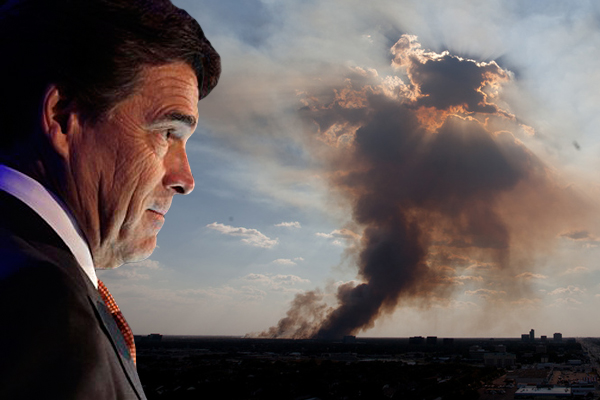
Gov. Rick Perry. Right: Wildfires in George Bush Park in West Houston on Sept. 13, 2011.(Credit: Reuters/Ed Schipul / CC BY 3.0)

George Bush Park burst into flames on Sept. 13, one month to the day after Texas Gov. Rick Perry announced his candidacy for president of the United States. In a summer of fierce wildfires across Texas, the George Bush Park blaze was the first big fire to erupt inside the city limits of a major metropolis — in this case, Houston, the nation’s fourth largest city and the headquarters of the oil and gas industry, a major contributor to the man-made global warming that Gov. Perry famously insists does not exist.

The national media overlooked the George Bush Park fire, just as they ignored the link between climate change and the hellish summer Texas experienced, but the fire was big news in Houston. Local TV stations showed trees burning like torches, unleashing orange flames and black smoke.No evacuations were ordered, but guests at nearby hotels were spooked. “The hallways in the hotel here, you can hardly breathe,” said hotel guest Shawn Porter. “It’s in all the rooms. They’re getting filled with smoke.” 

It took helicopters and fire trucks three days to get the fire 95 percent contained, according to the Texas Forest Service. By then, 1,623 acres had burned, an area the size of two Central Parks in New York City.

A week later, the park, which was named after the senior President Bush, was still recovering but back in service. Seeking relief from the 98-degree heat, a German Shepherd splashed in a pond named after Bush’s White House dog, Millie, while the pop-pop-pop of pistol shots rang out from one of the park’s practice ranges. In the burned area, however, the soil was still charred, the grass burned away. The trunks of shrubs and trees were as black and lifeless as charcoal.

Sizable though it was, the George Bush Park fire was a minor fire in the context of Texas 2011. Some 3.7 million acres of Texas have burned in the last 12 months, an area roughly equal to the state of Connecticut. Fires are still burning today, as the Texas Forest Service reports, yet Gov. Perry has offered little in the way of relief but the power of prayer and positive thinking.

“We’ll be fine,” Perry said in mid-August. “As my dad [a retired cotton farmer] says, ‘It’ll rain. It always does.’”

Perry’s followers among evangelical Christians like to talk about the “end of days,” when the Lord will return to judge the living and the dead. The ferocious heat and drought that have been punishing Texas for the last 12 months made it seem that the end of days might well be approaching, though not exactly in the way Gov. Perry and fellow evangelicals mean. As one region of the Lone Star State after another has been engulfed in flames and smoke, Texas appeared to have descended into the fires of hell.

- – - – - – - – - -

When President Obama criticized Perry on Sept. 25 as being “the governor of a state that is on fire [while he is] denying climate change,” Obama probably had in mind the fires in Bastrop, a bedroom community 25 miles east of Austin, the Texas capital. The Bastrop fires were so powerful, photogenic and devastating that they received not just statewide but national news coverage.

Responding to Obama, Perry spokesman Mark Miner told ABC News, “It’s outrageous President Obama would use the burning of 1,500 homes, the worst fires in state history, as a political attack.”

With Texas suffering the most severe one-year drought in the state’s history and the hottest summer in the entire nation’s history, firefighters were supremely challenged. In Bastrop, the heat of the fire “was so intense, our firefighters couldn’t get close enough to fight it [at first]. They had to shift to evacuation mode,” said Judge Ronnie McDonald, Bastrop’s highest-ranking local official.

“No one on the face of this Earth has ever fought fires in the face of such extreme conditions,” said the Texas Forest Service.

The Bastrop fires destroyed 1,633 homes and caused two deaths, reported Judge McDonald as he led a Salon reporter on a tour of the disaster zone on Sept. 23. Most of the homes that were destroyed had burned down to the ground, with nothing left standing but a stone foundation or chimney. Outside one house, a pickup truck had been scorched so intensely that its color had changed to a ghostly white.

In contrast to the three days required to subdue the George Bush Park fire, the Bastrop fires “burned for two weeks before we reached more than 90 percent containment,” McDonald added. As a result, more than 34,068 acres were scorched — an area larger than the entire city of San Francisco. The judge estimated that the town stands to lose 10 to 12 percent of its tax base.

Meanwhile, three other major fires had combined with the Bastrop blaze to encircle the state capital with flames and smoke. Lee Leffingwell, the mayor of Austin, was monitoring a fire in Steiner Ranch, a hilly area west of the city, when he saw a “huge cloud of black and gray smoke” in the eastern sky, coming from the Bastrop fire.

“Standing at the Steiner Ranch fire, we were surrounded by fire on all four sides,” Leffingwell told Salon. “We could see the Bastrop fire to the east, there was a fire in Leander to the north and a fire in Spicewood to the south.”

“It looked like we’d been bombed,” added Leffingwell, who served as a U.S. Navy pilot in Vietnam. “It looked like a war zone.”

- – - – - – - – - -

It was the Bastrop blaze, and the high-profile media coverage of it, that led Perry to leave the campaign trail and return to Texas on Sept. 6. The governor spent less than 24 hours in his fire-ravaged state. After a helicopter tour of the Austin area, he issued a statement calling the fires “as mean as I have ever seen” and expressing his thanks for “the brave men and women who put themselves in harm’s way to protect Texans’ lives and property.”

But Perry treated those same brave men and women quite differently three months earlier. In the name of balancing Texas’ budget, Perry and the Republican super-majority in the Legislature slashed fire protection spending, while also cutting spending for education, healthcare, parks and other state services. With a $10 billion shortfall to accommodate and revenue increases off the table thanks to Perry’s antipathy to raising taxes, the arithmetic demanded huge spending cuts. Thus a state fund that volunteer fire departments across Texas have historically drawn on to buy firefighting equipment, supplies and protective clothing was cut by a staggering 72 percent, from $25 million a year down to $7 million, according to Chris Barron, executive director the the state Firemen’s and Fire Marshal’s Association of Texas. The Texas Forest Service budget was also sharply cut, from $122 million down to $75 million.

“To cut is fine, but you can’t cut first responders — that’s a matter of life and death,” responded Texas state Sen. Mario Gallegos, a Democrat who spent 22 years as a firefighter and paramedic in Houston before entering politics. “Volunteer fire departments are the backbone of fire protection in this state, and they need heavy equipment and other resources to do their job. If they had had those resources, maybe we could have stopped those fires in Bastrop sooner and saved another 100 or 200 homes.”

“The 2012-13 appropriation for the Volunteer Firefighter Assistance Account is comparable to that in previous budgets signed by Gov. Perry,” Lucy Nashed, the governor’s deputy press secretary told Salon. “According to the Texas Forest Service, their funding level does not hinder their ability to fight fires…. The state has been and will continue to provide the Texas Forest Service and local officials with all available resources to fight these fires.”

Perry demanded these spending cuts in the spring of 2011, Gallegos added, “when there was no mystery that Texas was in the midst of a record drought and heat wave.” Indeed, it was in April that Perry convened the prayer rally where he urged fellow Texans to appeal for heavenly help against the drought. At the time, the governor was telling the Legislature that voter identification control and sanctuary cities for immigrants “were emergency issues” that required immediate attention, recalled Gallegos, who added, “I come from a public safety background, and to me, maintaining the forest service and fire protection during a time of record heat and drought is a real emergency, not this other stuff.”

Meanwhile, Perry was ignoring the findings of mainstream climate scientists in his state, whose research indicates that while climate change was not the primary cause of the hellish summer of 2011, it was undoubtedly a contributing factor. “This summer’s temperatures were about 5.4 degrees Fahrenheit above the long-term average in Texas,” John Nielsen-Gammon, the Texas state climatologist and a professor of atmospheric sciences at Texas A&M, told Salon. “My rough calculation is that about 74 percent of those 5.4 degrees was due to La Niña [the oceanic-atmospheric phenomenon that influences weather patterns across the Western Hemisphere] and about 9 percent from greenhouse gas emissions.” These higher temperatures made the impact of the drought worse, Nielsen-Gammon explained, by increasing evaporation and reducing soil moisture — thereby making trees and grasses more vulnerable to fire — while also boosting the demand for water on the part of humans and livestock.

“There are no skeptics involved in climate change science in Texas,” Nielsen-Gammon said, but public opinion is mixed. Appointed state climatologist in 2000 by Gov. George W. Bush, Nielsen-Gammon deals with skeptics by presenting the data and arguments on all sides of the issue before concluding, “Whether you believe this is what is going to happen with temperatures in the future or not, it’s a possibility you have to take seriously, because here’s the evidence.”

Nielsen-Gammon has never tried this approach on the state’s No. 1 climate skeptic, however. Gov. Perry, he says, has never asked for a briefing on climate change, nor have his top advisors.

- – - – - – - – - -

It’s no shock that a Texas governor would resist taking action against climate change; the oil and gas industry has dominated the state’s economy and politics for decades. As a state, Texas emits the most greenhouse gases in the U.S.; if it were a separate nation, it would rank as the world’s seventh largest emitter. When George W. Bush left the governor’s mansion for the White House in 2000, he quickly became the most hostile president to climate action ever to occupy the Oval Office.

But Rick Perry is well to the right of Bush on climate change, well to the right even of the oil and gas industry. Bush accepted the science of climate change for the most part, he just didn’t like the policy implications and sought, quite successfully, to torpedo them. Likewise, even Exxon-Mobil, the biggest funder of climate disinformation activities over the past 20 years, no longer publicly disputes the science of climate change; it simply refuses to do anything about it. By contrast, Perry’s rhetoric on the issue channels the paranoid extremism of the Tea Party and its corporate founders, the Koch brothers.

In his book, “Fed Up!,” Perry doesn’t engage the arguments pro or con about climate science or policy. He simply asserts that “it’s all a contrived phony mess that is falling apart under its own weight” and the economic effects of addressing it “could be absolutely devastating.”

As governor, Perry has been an enthusiastic booster of fossil fuel consumption and the corporations that profit from it. In 2005, he tried to fast-track construction of 11 new coal-fired power plants outside of Dallas that, as a complex, would have ranked as the single largest emitter of greenhouse gases in the U.S. On the very same day that Perry signed his executive order, the retired chairman of the utility company pushing the project, TXU, gave Perry a $2,000 check. TXU as a whole contributed $104,000 to Perry’s 2006 election campaign, highlighting a recurring theme in Perry’s gubernatorial career that will be the focus of Part 2 of this Salon special report: Perry’s willingness to do favors for big donors, including making Texas land available for a nuclear waste dump proposed by Dallas billionaire Harold Simmons, the second largest donor to Perry’s gubernatorial campaigns.

“Gov. Perry makes decisions in the best interest of Texas,” said deputy press secretary Nashed. “In the decade of the 2000′s Texas reduced ozone emissions by 27 percent — more than any other state — and reduced SO2 emissions by 32 percent and NOX emissions by 58 percent, all while remaining the nation’s leading energy producer and protecting jobs.”

Perry’s handling of the fires of 2011 does not appear to have hurt him politically, at least not yet. Perhaps seeking to contain the problem, Perry joined with legislative leaders on Sept. 15 to provide an additional $5 million to the volunteer fire department fund. It helps that neither the Texas nor the national media tend to connect the wildfires with climate change. The Houston Chronicle even came to Perry’s defense on his cuts to fire protection, saying he was falsely accused. Why? Well, the newspaper explained, because the cuts didn’t take effect until the new fiscal year on Sept. 1 — an odd defense to offer, considering that the Bastrop mega-fire did take place after Sept. 1, as did the George Bush Park fire.

The Texas Farm Bureau, which represents the state’s farmers and ranchers, also continues to support Perry’s budget decisions and handling of the drought, even though the drought has caused $5.2 billion of losses to Texas agriculture, according to official calculations, a figure that is expected to rise to at least $8 billion before year’s end. “Rick Perry has been a good governor, and we support elected officials making the decisions they need to make,” said Gene Hall, a genial former cattle rancher from east Texas who is the farm bureau’s director of public relations. Asked whether the bureau accepts the mainstream science view of global warming and climate change, Hall ignored the question of science in favor of condemning the policy of cap-and-trade, which the bureau vehemently opposes on the grounds that it would raise the costs of fossil fuel. “You just can’t produce a crop without putting diesel in the tractor and crossing the field a certain number of times,” explained Hall.

In the end, it is Perry’s combination of ideological fervor and his Pay-to-Play approach to politics that is most alarming about his potential ascension to president of the United States, according to critics. But friends and enemies alike agree that no one should underestimate the man.

“Rick Perry is not book smart, but he is very shrewd,” said Tom “Smitty” Smith, the executive director of Public Citizen Texas. “He’s one of the best politicians I’ve ever seen. He can connect with voters and he knows how to hire good staff and let them do what they need to do.”

But the drought and fires now afflicting Texas also illuminate the governor’s weaknesses, Smith added. “Perry is not a thinker,” Smith told Salon. “He lacks intellectual curiosity. So if he became president and faced a climate change crisis like we have today in Texas, he wouldn’t be able to get past his ideological, knee-jerk reaction and think his way out of it. Ideology and donors drive his policy decisions, so he tends to insist that his policies are right no matter what reality might say.”

Coming: Pay to Play: The greening of Rick Perry

Mark Hertsgaard (www.markhertsgaard.com) is an independent journalist who has covered politics and the environment for 20 years for leading outlets around the world, including Vanity Fair, Time, the Nation and the BBC. He is the author of six books, including most recently, “Hot: Living Through the Next Fifty Years on Earth.”

Romney rivals all become socialists, to horror of conservatives

GOP candidates trash capitalism, and good on them

Mitt Romney and Rick Perry (Credit: AP)

Mitt Romney accidentally said he likes firing people the other day, sort of. A fair reading of his statement, in context, is much less damning. He was talking about insurance companies, and he was saying he likes the idea that a consumer can “fire” someone providing them a service and choose someone else to provide that service, which is well and good.

(I happen to think the “fire people” gaffe did reveal something essential about Romney’s character: Not that he’s a heartless capitalist robber baron, but that the man is incapable of speaking off-the-cuff without saying something bizarre and tone-deaf. “I like being able to fire people who provide services to me” is just a really weird phrase, and an odd way of expressing a perfectly reasonable sentiment.)

Of course, his rivals for the Republican nomination wisely ignored the greater context and promptly turned “I like being able to fire people” into a ringtone. Which they are supposed to do, because they’re running for president against this guy.

But Gingrich and Huntsman and Perry are seizing on this “gaffe” in the midst of a campaign against Romney that has grown increasingly (and to an outsider amusingly) class-based, to the horror and disgust of conservative elders.

Rick Perry, in particular, has basically become a communist:

“Now, I have no doubt Mitt Romney was worried about pink slips — whether he was going to have enough of them to hand out because his company, Bain Capital, of all the jobs that they killed,” Mr. Perry said. “I’m sure he was worried that he would run out of pink slips.”

He said that people in nearby Gaffney, S.C., in particular, “would find his comments incredible,” because it is where Mr. Perry said Bain shut down a plant and fired 150 workers.

“That didn’t happen until Mitt Romney’s private equity firm, they looted that company with more than $20 million in management fees.”

This is an attack on successful corporate restructuring! Perry added that “there is something inherently wrong when getting rich off failures and sticking it to someone else is how you do your business,” which is basically a wholesale rejection of the free market system.

(Even the reasonable Jon Huntsman got shrill: “Governor Romney enjoys firing people. I enjoy creating jobs.”)

Sarah Palin is among those attempting to stanch the bleeding by blaming the bad old liberal media for attacking Romney for his success, but everyone can plainly see who’s actually responsible.

National Review’s Jim Geraghty complains that the candidates now all sound like Occupiers. The Club for Growth is pissed at Newt for his anti-Bain Capital attacks. Phil Klein accuses Romney’s rivals of Marxist rhetoric. Avik Roy diagnoses Romney derangement syndrome. (The American Spectator literally calls for Gingrich to be investigated for violating campaign finance law for perhaps coordinating with a Super PAC. What happened to the absolute defense of campaign funding as speech?)

It looks like Republican opinion leaders are beginning to coalesce around Romney due in part to disgust over anti-capitalist attacks being levied against him. Of course, his rivals wouldn’t be pushing this line if they didn’t think it was effective. The irony is that the Republican candidates are shameless enough to embrace the exact arguments conservatives and centrists have successfully shamed liberals out of making.

One frustrating fact of life for a lot of progressives and left-wingers is that full-throated economic populism practically doesn’t exist in the Democratic Party. What passes for “class warfare” nowadays is the the president apologetically suggesting that the top marginal tax rate eventually be restored to a level far below where it stood for the majority of the Reagan administration. (Or even simple defenses of the welfare state, in the case of that radical Elizabeth Warren.)

Republicans have continued to practice the “cultural” populism (or white populism or Southern populism) that has served them well since they absorbed the conservative Dixiecrat vote while Democrats have come to find class-based populism extremely distasteful and counterproductive, as neoliberalism took hold and the eastern Rockefeller Republican class became the effective center of power in the Democratic Party (which admittedly did counter the Reagan-era GOP’s massive fundraising advantage). Ron Paul’s newsletters and Newt Gingrich’s “food stamp president” line and Rick Perry’s massive prayer festival and every candidate’s constant invocation of dastardly “elites” are all the “acceptable” kind of populism: the kind based on amorphous racial and tribal resentments and not economics. But the reason the GOP and rich centrists cry foul when the other kind of populism is hinted at is because it works, really well, because unmitigated capitalism is really destructive and awful for huge segments of the population.

But desperation and shameless vote-grubbing makes it all too tempting to bridge the gap between the two forms of populism, as horrified conservative observers can now see. The “deal” has always been that you offer red meat to the rubes and all’s fair as long as once in power you devote your energies to ensuring that people like the Kochs can operate without scrutiny and perhaps with a bit of extra tax incentives. You’re not supposed to go after the real elites, though — just public school teachers and people who enjoy fresh greens.

I am all in favor of the GOP adopting economic populism, even if it’s for their own evil ends, because it makes it marginally more likely that leftists will be allowed to try it out themselves again, some day.

Continue Reading Close
Alex Pareene

Alex Pareene writes about politics for Salon and is the author of "The Rude Guide to Mitt." Email him at apareene@salon.com and follow him on Twitter @pareene

Today’s GOP makes Mississippi look liberal

Most 2012 contenders back a personhood amendment too extreme for a red, red state, while Rick Perry hits a new low VIDEO

Rick Santorum, Rick Perry, Mitt Romney, Newt Gingrich, Ron Paul, Michele Bachmann and Jon Huntsman (Credit: AP)

The flailing Rick Perry is trying to revive his sinking campaign by histrionically announcing he’s changed his views on abortion and now opposes it even in cases of rape and incest. Apparently Perry met a young woman who’d been conceived as a result of rape, and that changed his mind.

“Looking in her eyes, I couldn’t come up with an answer to defend the exemptions for rape and incest,” he said at a “tele-town hall” sponsored by far-right Iowa radio host Steve Deace. “And over the course of the last few weeks, the Christmas holidays and reflecting on that … all I can say is that God was working on my heart.”

It’s just one more step toward society’s political margins for the GOP contenders. Perry has already announced his support for the “personhood” movement, which declares that life begins the moment an egg is fertilized, a measure that was rejected by the deep-red state of Mississippi as too extreme. But Michele Bachmann, Newt Gingrich and Rick Santorum also back the personhood crusade. That’s your modern Republican Party: It makes Mississippi look liberal. They’d like women to have more rights before they’re born than after.

It’s obvious the Tea Party is pulling the GOP even further to the right. While the movement’s fans used to insist it was about the economy, not social issues, in fact its House caucus has used its year in office working harder to stop all funding for Planned Parenthood than to reduce unemployment. The House even passed a bill that lets health providers “exercise their conscience” and refuse to perform an abortion even in cases where the woman would die without the procedure. (h/t Digby)

But their target is no longer just abortion, but contraception as well. At Tuesday’s “tele-town hall,” Bachmann lied about President Obama’s Plan B stance, insisting the president is “putting abortion pills for young minors, girls as young as 8 years of age or 11 years of age, on [the] bubblegum aisle.” Of course, Obama backed HHS Secretary Kathleen Sebelius’ decision to override the FDA and refuse to allow Plan B to be sold on drugstore shelves, specifically citing concerns about young girls. Personhood legislation would make the IUD illegal, as well as any measure that interferes with a fertilized egg attaching itself to the uterine wall, including some fertility treatments.

Resurgent front-runner Mitt Romney stands apart from the far right on some of these issues. He hasn’t supported personhood legislation, for instance (yet). But in some ways Romney’s flip-flopping on abortion is as disturbing as his rivals’ extreme anti-choice fanaticism. Running for Massachusetts governor, Romney told voters he’d become pro-choice after a close family friend died due to a botched illegal abortion. (Salon’s Justin Elliott told the tragic story here.) What happened to his feeling for that friend? How could he flip-flop again, after a supposed moral and political awakening like that? And libertarian Ron Paul opposes full liberty for women: He’s antiabortion (though he’d leave it to each state to decide). The man who wants to deregulate industry wants to regulate women’s bodies. That doesn’t sound like libertarianism to me.

Will the GOP’s continuing shift right on abortion, clearly intended to court the religious-right base during the primaries, hurt the party in the general election? I have to assume so. Ever since Ronald Reagan campaigned with the blessing of the Christian right, there’s been a pronounced difference between men and women when it comes to their attitude toward the Republican Party. Women have been registering and voting increasingly Democratic, not just because of abortion rights or other so-called women’s issues. It’s also because women are more likely to believe in a government safety net, to back programs like Head Start, education funding and other services for poor families as well as Social Security and Medicare. I don’t think that means women are more compassionate than men; I think it reflects their greater economic vulnerability, since poverty rates are higher and median incomes lower for women than men. Clearly the far-right GOP is writing off increasing numbers of women, as well as blacks and Latinos, immigrants, and gay people. Good luck with that, long term.

There are two warring forces at work in the world: One is the empowerment of women, especially in the developing world. There is no magic bullet for global poverty, but the only thing that comes close is expanding education and human rights for girls. Educated girls have children later, and when they do become mothers, their children are healthier and better educated. Their family incomes rise, and so do the living standards of their community. It is clear that promoting the rights and status of women improves the well-being of the entire society; some people, and governments, get that, globally.

But there’s also an intensifying hostility to full freedom for women in all corners of the world. One of Wednesday’s most disturbing stories was the New York Times tale of an 8-year-old Orthodox Jewish Israeli girl spat upon and abused by ultra-Orthodox bullies because even her modest outfits didn’t conform to their stifling dress code for girls and women. Israel, which was once defended as a European enlightenment outpost in the supposedly backward Middle East, is facing a rising tide of far-right religious activism trying to ensure that women are neither seen nor heard outside the home. Literally. These crusaders believe in separate worship for each gender, because men are not supposed to hear a woman’s voice in public, not even singing hymns. On some bus lines serving ultra-Orthodox neighborhoods, women are literally made to sit at the back of the bus.

Meanwhile, the Arab Spring hasn’t ushered in more rights for women. In the “new” post-Mubarak Egypt, men are using sexual assault and violence to suppress female activists. Islamic fundamentalists, like their ultra-Orthodox Jewish brothers, likewise want to make women second-class citizens.

No, I’m not comparing the personhood movement or the GOP contenders to violent misogynist Egyptians or to the religious extremists who want to exclude women from Israeli or Arab public life.  But the increasing extremism on choice that is now seeping into public policy on contraception reflects a related discomfort with full personhood for women. There is no freedom or equality for women without reproductive freedom. Having been raised a Catholic, I understand religious objections to abortion, and my only answer is, by all means, don’t have one. Work to make them less common. A rape victim who doesn’t want an abortion is of course free to make that decision. But a secular society has no business imposing one religion’s values on everyone.  (Lost in all the insanity about abortion is the fact that the incidence of abortion has declined by at least a third since the 1980s.)

Michelle Goldberg and I talked about increasing GOP extremism on abortion on MSNBC’s “Hardball” today:

Visit msnbc.com for breaking news, world news, and news about the economy


Continue Reading Close
Joan Walsh

Joan Walsh is Salon's editor at large.

“Rick Perry is just like my dad”

A conservative endorsement

Rick Perry (Credit: AP/Eric Gay)

Ten contributors to the conservative blog RedState have collaborated on a post endorsing Rick Perry for the presidency. Yes, that Rick Perry. The one who hasn’t led a national poll of Republicans since late September. The one who only makes headlines when he says something amusingly stupid. “Don’t settle,” their headline urges. Don’t settle for someone who doesn’t routinely humiliate himself every single time he attempts to speak extemporaneously.

The post lays out Perry’s oft-told history of being a true conservative tax-cuttin’ god-fearin’ job-creator, says every other candidate is vulnerable and insists that Perry can win. But what about the fact that the guy appears to be the dumbest person in the room every time he’s in front of a camera? Oh, that’s a minor problem, really.

The one knock on Perry is that his poor debate performances and periodic campaign trail gaffes will open him to the same vulnerabilities in office as President Bush: an inability to respond to criticism or explain his own policies.

Perry’s poor communication skills are easily overcome:

Second, debating skill takes on outsize importance in the primaries, when candidates have to stand out on a stage crowded with 7 or 8 people who all agree with each other 80-90% of the time. All Rick Perry needs to do is step onstage and everyone will know how he’s different from Barack Obama.

Well, that’s undeniable. (Emphasis mine.)

The “Not Mitt Romney” coalition — remember the internet petition? — is basically out of time. We’ll see, after Iowa, whether they give up or go with Perry, should he eke out a decent finish.

It’s actually within the realm of possibility that Perry could take the nomination, I guess. One poll has him at third place in Iowa again, with Gingrich declining. He has a lot of money.

But Perry is precisely the sort of toxic candidate that the White House would be thrilled to run against. (Most recent polls show Obama barely beating Romney, and handily trouncing Perry.) The two things he’s made headlines for recently have been going well outside the mainstream with desperate anti-gay bigotry and double dipping on his massive government pension.

RedState founder Erick Erickson has previously written a dejected post bemoaning the inevitable nomination of Romney, and wishing he could take back his rejection of Jon Huntsman. But it’s obviously too late for that. Erickson did not jump on the Perry bandwagon and isn’t likely to any time soon.

These guys are just nostalgic for that brief moment when Perry showed up to save the party from nominating that unlikable loser Romney, before the governor ruined it all by opening his mouth. It’s just about that mental image of Barack Obama and Rick Perry on a stage together, and fantasizing that the scales will fall from the eyes of everyone in America, and they’ll all realize that that is what a president is supposed to look like.

They quote a blogger (also highlighted by the great Roy Edroso) making the most intriguing argument for Rick Perry I’ve yet seen:

Until yesterday, I wasn’t completely sure why I liked Rick Perry so much. I have a list of reasons, but none of them really got to the root of why I like him.

Yesterday the reason finally dawned on me. I watched this wonderful 11-minute video from Ben Howe entitled “The Rick Perry I Know”…

… and I had a revelation: Rick Perry is just like my Dad.

And there’s the decision-making process of the conservative base, laid bare. Vote for dumb right-wing dad.

Continue Reading Close
Alex Pareene

Alex Pareene writes about politics for Salon and is the author of "The Rude Guide to Mitt." Email him at apareene@salon.com and follow him on Twitter @pareene

Rick Perry: More disliked than Rebecca Black

As his ad goes viral -- and divides his campaign -- the Texas governor proves again to be a world-class punch line VIDEO

Rick Perry (Credit: rickperry.org)

Which FTD Thank You bouquet do you think John Pike sent Rick Perry this week? Did he go for the “Sweet Splendor” or the “Because You’re Special”? Maybe he opted for the Hickory Farms sausage and cheese box? He must have done something grand, because who else but Rick Perry could have provided the Internet with the most funny-horrible thing since Pepper Spray Cop?

You’ve seen the “Strong” video by now. Your friends have posted it all over Facebook, usually with a string of LOLs underneath. In a campaign ad that, unfortunately for Perry, strongly evokes both Heath Ledger’s tormented performance and his sartorial leanings in “Brokeback Mountain,” the man who uproariously still believes he has a shot at the White House says, “I’m not ashamed to admit that I’m a Christian, but you don’t need to be in the pew every Sunday to know there’s something wrong in this country when gays can serve openly in the military but our kids can’t openly celebrate Christmas or pray in school.” He goes on to promise, “As president, I’ll end Obama’s war on religion. And I’ll fight against liberal attacks on our religious heritage.” (Perry staffers are already distancing themselves from responsibility, with his top pollster calling the ad “nuts.”)

To Perry’s credit, he does manage to get through the entire 30 seconds without once losing his train of thought or laughing like he’s auditioning to be the villain in the next Muppets movie. Sure, he comes off like a man whose barrel is full of bullet-riddled fish when he declares he’s not ashamed to be a Christian. The Republican presidential field is otherwise littered with Muslims, Jews and atheists, I guess.

What Perry can’t do, however, is prove his mind makes logical associations – something that’s a pretty important qualification for our nation’s highest office. Perry’s prickly disdain for men and women who are serving their country would, by itself, be hateful and ignorant. But his assertion that there’s a “war on religion” interfering with Christmas celebrations? If kids can’t openly celebrate Christmas, I hope nobody tells all the tykes waiting to see Santa at the mall. But it’s that combination of those two vastly unrelated ideas that really makes the “Strong” clip pure gold. Is Perry somehow suggesting that if we can just push  homosexuals back into the closet, we can then teach how Jesus fought the dinosaurs in the public schools? OK, you gays openly serving in the military! President Perry is going to mind-wipe everyone you’ve come out to! And then he’s going to put a Nativity scene in every classroom! Because that’s what the Founding Fathers would have wanted.

Excuse me, I have to go wipe these copious tears of derisive laughter off my cheeks.

It didn’t take long for Perry’s video – as brilliantly painful a piece of performance art as any of Katie Roiphe’s recent Slate columns – to become a viral sensation. It’s racked up nearly 3 million YouTube views. And though the campaign has disabled comments – no doubt in anticipation of a more critical response – on Friday the video was heading toward a half-million “dislikes,” a new YouTube record. The newly unseated “dislikes” champion, Rebecca Black, also owes someone an Edible Arrangement today.

Meanwhile, over on Facebook, Perry’s official page has drowned in thousands of comments, mostly expressing disdain. “Sure, I’ll share it,” wrote one woman. “I want EVERYONE to see ‘How to sink a campaign in 30 seconds or less.’” My personal favorite is from the person who congratulates Perry “on making Ron Paul the sane one.”

Elsewhere on the Internet, the Tumblr of Perry’s “unpopular opinions” and a cavalcade of parody videos have sprung up with the inevitability of hairy chests at a bears convention. Second City’s Andy Cobb was quick with a look-alike clip, noting that “The gay and atheist presidents didn’t get us into the war in Iraq, the financial crisis or turn your mortgage into toilet paper. It took some God-fearing vagina penetrators to do that.”

It’s likely we can enjoy the dreadfulness of Perry’s video – even as it disgusts us – because it’s evident his campaign is now as worthless as your 401K. There’s a degree of safety in this gasbag’s harmlessness, kind of like your racist uncle’s Thanksgiving rants. Offensive? Yeah. Effective? Uh, no. Yet even as we point and laugh — repeatedly — it’s sobering to remember that the sentiments Perry awkwardly expresses aren’t just the ramblings of one demented Texan. The guy did manage to get relatively far in American politics with Jesus and homophobia by his side. And though the outpouring of giddy contempt for his incompetence is encouraging, just imagine – had he been a more coherent candidate, that over the top “Strong” ad wouldn’t be funny at all.

Continue Reading Close
Mary Elizabeth Williams

Mary Elizabeth Williams is a staff writer for Salon and the author of "Gimme Shelter: My Three Years Searching for the American Dream." Follow her on Twitter: @embeedub.

Debate advice for Rick Perry – slam Newt!

The Texas governor needs a win, and he can get it by tying Gingrich to Mitt Romney. They're flip and flop VIDEO

Newt Gingrich and Mitt Romney (Credit: Reuters/Scott Audette)

This is Texas Gov. Rick Perry’s moment. The GOP primary campaign has always been an effort to winnow the many candidates down to two: Mitt Romney and Not Mitt Romney. It’s got to be killing Perry (assuming he feels any pain at all) to watch Gingrich emerge as the latest Not Mitt.

Gingrich is still surging in the polls – the latest to find him in first place is CNN – and while I think his history of selling himself to corporate America will ultimately turn off Tea Partyers, what do I know about Tea Partyers, anyway? I try to give them credit for ideological consistency – they supposedly hate crony capitalism, and Newt is its poster boy – but I may be politically naive in that.

That’s where Rick Perry comes in. The guy’s got enough money to be the Not Mitt. He’s never lost an election. Surely he’s got to have more substance than it’s seemed so far – he can’t really be a stoner frat boy let loose in a presidential race. Can he? I think he can redeem a series of horrible debate performances with a good pummeling of Gingrich Tuesday night.

And why not Rick Perry, really? He managed to hire some of the campaign staff who ditched Gingrich in June, after they figured out his campaign was mainly about shilling for Gingrich Productions and the Gingrich Group. And Perry hung on to them, even after some other Newt-ditchers returned once he became the new front-runner.  Perry’s Gingrich veterans have to have insight into how to unsettle him. Gingrich has gotten a free ride so far in the debates because until the last week or so, he’s been an also-ran, the tiresome, has-been uncle everyone smiles at when he makes a clever quip, or when he implores them not to take the media’s bait and turn on one another.

Rick Perry, it’s time to take the media’s bait and turn on Gingrich.

First, a couple of things not to do:

  • Don’t mix alcohol and pain medication, or Five Hour Energy drink and pain medication. I’m not saying you’ve done that before, I’m just saying.
  • Don’t attack Gingrich for calling child labor laws “truly stupid.” It was an abominable thing to say, but given the nature of these GOP debate crowds, it could be Newt’s biggest applause line of the whole campaign. Let’s face it, crowds who’ve cheered for the death penalty, letting uninsured people die of treatable illness, and an electrified border fence, and who’ve booed a gay soldier as well as your own plan to let the children of undocumented workers pay in-state tuition at Texas universities – well, they’re not going to reject Gingrich for wanting to put children to work. Forget about that one.

So then, what to do?

  • Do make clear that Gingrich and Romney are ideological chameleons separated at birth, the brothers Flip and Flop. Gingrich has changed positions almost as much as the Mormon the Tea Party loves to hate, in the course of making millions. He supported the individual mandate and planning for “end of life care” until the Tea Party turned those things into Obamacare and “death panels.” I know this debate is about foreign policy, and that’s not one of your strong suits (you’re still trying to find a strong suit, besides fundraising). But Gingrich’s bald-faced fakery on the question of Libya is a great issue. It’s actually worse than Herman Cain’s long brain-freeze, because nobody expects Cain to know anything. Pretend Gingrich is that coyote who messed with your daughter’s dog. If that really happened. Which it probably didn’t. Pretend whatever works.
  • Do pretend Gingrich is President Obama. You’ve treated the president with such practiced, suave contempt. You questioned whether he really loved his country, and you said the discredited, disgraceful birther issue — questioning whether Obama was really born here, after he’d released his long- and short-form birth certificate — is “a good issue to keep alive.” Practice that Obama-contempt in the mirror, and then Tuesday night, in the debate, turn it on Newt Gingrich. He deserves it more than Obama does. The president got 66 million votes, 53 percent of the total, in 2008. Gingrich came from a small Georgia district and squandered the political “mandate” that made him speaker by being an arrogant grifter. Pick a worthy enemy, and have fun. You can’t get to Obama without going through Gingrich, at this point. Why not enjoy it?

I talked about Gingrich’s latest outrages — backing the reversal of child labor laws and telling Occupy Wall Street protesters to “get a job” and “take a bath” Monday night on MSNBC’s “The Ed Show.” With Christmas approaching I realized that Gingrich, who once proposed putting the children of welfare recipients in orphanages, is a real-life Dickensian character who must, every year at this time, root for Scrooge.

Visit msnbc.com for breaking news, world news, and news about the economy

Continue Reading Close
Joan Walsh

Joan Walsh is Salon's editor at large.

Page 1 of 17 in Rick Perry

www.salon.com/topic/rick_perry/