Media Criticism

OMG! Did Demi and Ashton really tweet that?

With rumors swirling, a hilariously desperate media tries to crack the couple's Twitter stream

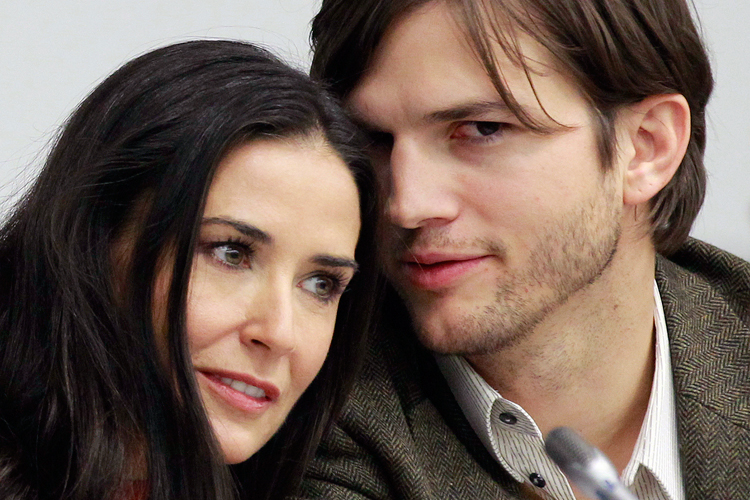
Demi Moore and Ashton Kutcher(Credit: Reuters)

It’s been the pop culture equivalent of the buildup to Hurricane Irene. If you follow entertainment news, you know what I’m talking about. Are Demi and Ashton splitting up? OMG you guys! How about now? Now? Anything? OK, so how about if, while there’s no official statement from the couple, we all just try to interpret their tweets?

Speculation over the robustness of the Kutcher/Moore union has been going on ever since the duo started dating eight years ago. But it’s gone into wild overdrive over the past week, thanks to the fact that the couple recently spent their sixth wedding anniversary on separate coasts. While Moore was in New York promoting her directorial effort in the Lifetime breast cancer awareness movie “Five,” Kutcher stayed in California to party with friends. More damningly, TheDirty.com reported that Kutcher spent some of anniversary weekend putting it to a 23-year-old blonde. The woman in question has already diligently hired a lawyer, gone into seclusion and deleted all her social media accounts. A cover story in the new issue of the Star alleges that Kutcher’s “serial cheating” is the reason “it’s over.”

Even a faux breakup can drive Web traffic and sell tabloids. And what with Will and Jada totally refusing to get divorced after all the hype last month, seriously, what choice do the gossip police have?

But the couple themselves has so far remained tight-lipped, refusing to comment on the rumors. And that’s where the Twitter analysis comes in. Because as anyone who’s ever endured — or posted — one of those cryptic, “Sigh. Relationships are so hard,” or “Learning to let go of the pain,” status updates knows, surely all the details of anyone’s private life are encoded within those 140-character bursts.

And so, in this corner, we have Ms. Moore, who, if things go as Us magazine seems to believe they will, may soon have to change her Twitter name from @mrskutcher. Last week, one day before her anniversary, she tweeted a quote from the Greek philosopher Epictetus: “When we are offended at any man’s fault, turn to yourself; study your own failings. Then you will forget your anger.” A man’s fault — that’s clearly Ashton, right? Anger, yes. Over some sort of sexual betrayal, no doubt! As Entertainment Weekly noted , the message was obviously “especially revealing.”

Three days later, she tweeted, “I see through you ….” and a photo of herself with closed eyes. What does Demi see through? Her eyelids? Or Ashton Kutcher’s web of lies? It didn’t take long for Starpulse to describe the image of Moore as “distraught,” while Hollywood News reported that the image proves “that Demi is on to Ashton’s crap.”

Kutcher, meanwhile, who debuted in his new “Two and a Half Men” shoes just this past Monday, has been relatively silent on the rumors. OR HAS HE? On Thursday, he just happened to tweet what was playing on his Spotify account: Public Enemy’s classic “Don’t Believe the Hype.” And right on cue, ABC news was quick to report that “The ‘hype,’ presumably, refers to the reports that his marriage to Demi Moore is on the rocks” and the L.A. Times called it a likely “nod to new rumors of infidelity.” Even more tellingly, Kutcher posted later that “When you ASSUME to know that which you know nothing of you make an ASS out of U and ME.” Also, “Ashton Kutcher” is an anagram for “Cheater hunk rots.” Think about it, America.

Now, maybe Ashton and Demi really are heading to Splitsville. Maybe he really has been doing the do with other chicks. Fortunately for those who care, there’s probably a video or voice mail somewhere that can clear this all up until there’s some official announcement on the subject. (Those “Two and a Half Men” stars, they’re such scamps!) But that’ll be a sad moment for all the rest of us — the ones who get a kick out of watching the likes of ABC News trying to interpret the hidden messages within the Twitter stream of the guy who starred in “Dude, Where’s My Car” and the woman who gave us “Striptease.” I haven’t seen that kind of analysis of subtext since my junior year Irish literature class. Or the last time I got an email from an ex. But in the midst of rumors, innuendo and mysterious messages, just remember one thing that’s certain. The walrus was Paul.

Mary Elizabeth Williams

Mary Elizabeth Williams is a staff writer for Salon and the author of "Gimme Shelter: My Three Years Searching for the American Dream." Follow her on Twitter: @embeedub.

Manny Pacquiao doesn’t want you dead

A gross misquote gets out of hand -- but the iconic boxer still has a long way to go on the sensitivity front

Manny Pacquiao (Credit: Reuters/Steve Marcus)

Let’s get something straight, so to speak, right off the bat. There’s no disputing that Manny Pacquiao is not the most enlightened guy to ever put on gloves and fight for a belt. In a story for Examiner.com this past weekend, blogger Granville Ampong wrote of how the boxing champ takes issue with Barack Obama’s recent groundbreaking declaration of support for same-sex unions. “God’s words first … obey God’s law first before considering the laws of man,” Pacquiao told Ampong, in what the writer described as “an exclusive interview.” Pacquiao was further quoted explaining that “God only expects man and woman to be together and to be legally married, only if they so are in love with each other… It should not be of the same sex so as to adulterate the altar of matrimony, like in the days of Sodom and Gomorrah of Old.”

OK, it’s generally accepted that invoking Sodom and Gomorrah in general — and Sodom and Gomorrah of Old, in particular — is not going to win anybody a seat at the GLAAD awards. Sure enough, Pacquiao’s statements quickly set off a chain of angry and just plain disappointed responses from across the Net, where Pacquiao has been celebrated as a Filipino icon, and beloved for his humanitarian works. On Tuesday evening, the Los Angeles shopping center the Grove, where Pacquiao was to be interviewed for “Extra,” called off the event. “Based on news reports of statements made by Mr. Pacquiao,” read a statement from the center’s spokesman Bill Reich, “we have made it be known that he is not welcome at the Grove and will not be interviewed here now or in the future. The Grove is a gathering place for all Angelenos and not a place for intolerance.”

It’s a relatively free country, which means that the Catholic Pacquiao is welcome to express his views, even views many of us find backward and exclusionary. In return, a business like a shopping mall may choose to decline his patronage. What is not OK is what happened along the way.

You see, within the original Examiner.com piece, Ampong went off on a bit of biblical tangent. “Pacquiao’s directive for Obama calls societies to fear God and not to promote sin, inclusive of same-sex marriage and cohabitation,” he wrote, “notwithstanding what Leviticus 20:13 has been pointing all along: ‘If a man lies with a man as one lies with a woman, both of them have done what is detestable. They must be put to death; their blood will be on their own heads.’”

That’s Ampong. Quoting Leviticus. You could go ahead and infer that this is what Pacquiao was alluding to in his remarks, and you definitely could say that’s some convoluted writing there. But Pacquiao himself clearly didn’t issue the quote. But let’s not let the barest understanding of attribution get in the way of a sensational headline, shall we? Before you could say gross perversion of the facts, Change.org was running a petition asking Nike to drop “homophobic boxer Manny Pacquiao,” declaring, “In an interview published Tuesday, March 15th with the conservative Examiner newspaper, the world-famous boxer and Los Angeles resident quoted Leviticus…” And except for the fact that Pacquiao didn’t quote Leviticus, Examiner.com is not a conservative newspaper, and the interview didn’t run on Tuesday, sure.

The confusion stems largely from a Tuesday L.A. Weekly blog post by Simone Wilson, in which she wrote, “Pacquiao told the National Conservative Examiner over the weekend that gay men should be ‘put to death’ for their sexual crimes.” She then backpedaled a tad by noting “Yes, he was quoting Leviticus 20:13, but he hasn’t backed down from his harsh stance.” She continued further in the piece to invoke “what Pacquiao said” and ponder that “For the sports star to announce that he thinks thousands of gay Angelenos should be ‘put to death’ for loving a same-sex partner should hugely alienate him to the locals,” adding that “Because … uh … ‘put to death’? You just don’t say that kind of thing in 21st century America.” Maybe that’s why he didn’t. And by the way, calling the source “the National Conservative Examiner” greatly glorifies Examiner.com, a site anybody with an Internet connection and rudimentary typing ability can write for, “even if you’re not a professional writer.” It’s a site with all the journalistic credibility of, oh, L.A. Weekly.

But what kind of commitment to facts could we have expected from Simone Wilson? This is the person who, when real journalist Lara Logan was attacked in Egypt last year, hastily banged out a grotesquely offensive fantasy version of events, writing, “In a rush of frenzied excitement, some Egyptian protestors apparently consummated their newfound independence by sexually assaulting the blonde reporter.”

Wilson’s colleague Dennis Romero added more fuel to the mythic Pacquiao interview story Tuesday, in a piece headlined “Manny Pacquiao Says Gay Men Should Be ‘Put to Death.’” USA Today then jumped in, reporting that “Pacquiao also invoked Old Testament, and recited Leviticus 20:13, saying: “If a man lies with a man as one lies with a woman.” And the Village Voice blog, for good measure, reported, “The Bible Via-Manny Pacquiao: Gays Shouldn’t Get Married, They Should Be ‘Put To Death.’” How ridiculous did the whole thing get? On Pacquiao’s own “official” website Tuesday, writer Keith Terceira said, “Manny Pacquiao was recently quoted in the USAToday as invoking the old testament.” [sic]

I get that nobody really pays attention to what anybody posts on Examiner.com, but seriously. If you’re going to quote someone, read the damn source material already. You need to have an eighth-grade reading proficiency level to get a driver’s license, yet apparently you can be functionally illiterate and work for L.A. Weekly and USA Today.

On Wednesday, Granville Ampong wrote a follow-up post on the matter, saying of the Leviticus quote, “Pacquiao never said nor recited, nor invoked and nor did he ever refer to such context.” And Pacquiao likewise issued a statement, saying, “I didn’t say that, that’s a lie… I didn’t know that quote from Leviticus because I haven’t read the Book of Leviticus yet,” and adding, “I’m not against gay people … I have a relative who is also gay. We can’t help it if they were born that way. What I’m critical off are actions that violate the word of God. I only gave out my opinion that same-sex marriage is against the law of God.”

Pacquiao inarguably has a long way to go in the tolerance department. And his remarks were ignorant, to be sure. But you can’t cure ignorant with stupid. And you can’t change minds with lies.

Continue Reading Close
Mary Elizabeth Williams

Mary Elizabeth Williams is a staff writer for Salon and the author of "Gimme Shelter: My Three Years Searching for the American Dream." Follow her on Twitter: @embeedub.

Internet doomsday, explained

According to media reports, July 9 will be our online apocalypse. The better story is how this crazy rumor started

The apocalyptic story line was once reserved for truly apocalyptic events. Nuclear war. The return of Christ. Environmental or economic collapse. But it’s 2012, and the apocalypse has become the basis for everything from Super Bowl commercials to summer romantic comedies – and no media story is too small to have an apocalyptic moniker attached to it. (Remember Snowmageddon?) If you want to get the world’s attention, simply proclaim that the world will soon end — or the Internet. Just read coverage of the so-called Internet Doomsday virus, which will supposedly strike and shut down the Web on July 9.

Here’s how the story got started. Back in October, the FBI announced that it had broken up an international crime ring when it arrested six Estonians in what was then heralded as “the biggest cyber criminal takedown in history.” The Estonians had, over the course of four years, hijacked more than 4 million computers in 100 countries through the use of malware known as DNSChanger. By redirecting the infected browsers of unwitting users, DNSChanger was able to send high volumes of traffic to the criminal ring’s rogue websites and servers, collecting more than $14 million in fraudulent advertising revenue and exposing their victims to information theft in the process.

“Operation Ghost Click” (as the FBI dubbed its sting operation) put an end to the Estonian scheme, but a problem remained. If the feds simply shut down the Estonian servers, the 4 million infected machines — nearly 1 million of which were in the United States — would be unable to reach the Internet. To give the cyber-crime victims time to clean up their machines, the FBI contracted the Internet Systems Consortium (ISC) to maintain valid servers in place of the criminal servers. The new servers would remain online until March 8, 2012.

And so it came to pass that the FBI tried to warn the people, but the people were not listening. The people were too busy swatting the pop-up ads that buzzed like flies around TMZ.

As things turned out, a cabal of Estonian thieves in an international crime ring wasn’t enough to get the public’s attention. By early February, nearly half of all Fortune 500 companies and half of all major federal agencies still had computers infected with the virus — along with 400,000 other computers around the world. If the government shut down its proxy servers on March 8, as was planned, all of these computers would be unable to access the Internet. (The FBI, frankly, hadn’t done the best job in getting the word out about DNSChanger: It slapped up a PDF on the Web and assumed people would find it.)

And then it happened. Somebody put two and two together. There was a larger, more familiar narrative at work here. The tale of Operation Ghost Click and DNSChanger held all the elements of a familiar story. A set date. The need for the wayward computer users to repent before the date came. The smug satisfaction that when the date finally came, the non-believers would be cast into a disconnected hell, with nary a Google Map to lead them out of it. Have you not accepted Norton AntiVirus as your savior? IT nerds across the nation waved their MacBooks in contemptuous indignation.

This wasn’t just any old computer virus. For those who did not repent — or at least scan their computers for the virus — March 8 would be INTERNET DOOMSDAY.

Let’s back up for a moment: “Doomsday?” one might ask. Really? Some accountant at Hormel might not be able to access the Internet one day because of slovenly security habits, and that becomes doomsday? Has the apocalyptic bar really been set that low?

In fact, it has — and there are three reasons for this.

Understanding the first reason requires a quick trip back to the last time apocalyptic rhetoric was as mainstream as it is today — the 1970s, when the country was buffeted by oil shocks, stagflation, Watergate, spiraling crime, inner-city decay, and defeat in Vietnam. A paranoid and pun-filled tome soon emerged to explain the chaos as signs of the end of the world — Hal Lindsey’s “The Late Great Planet Earth,” the “No. 1 nonfiction seller of the decade” (as the New York Times put it), which found its way onto the bookshelves of more than 15 million Americans. And now the teens and 20-somethings who had clutched copies of “The Late Great Planet Earth” in the 1970s are editors, writers and producers, and they bring to the media landscape the narrative of their youth, in much the same way that indie music from the 1980s and ’90s, which never sold very well at the time, has reached a wider audience in the 2000s as Gen Xers find themselves program directors at radio stations or music supervisors at ad agencies and television networks.

The second reason came at the dawn of the next decade, with the launch of CNN in 1980. The rise of cable news (and, in the late ’90s and early 2000s, the rise of the Internet) didn’t merely transform the media landscape; it exponentially expanded it. Prior to 1980, the “Big 3” networks — ABC, CBS and NBC — programmed little more than three hours of news per day. Nowadays, even the “24-hour news cycle” seems like an antiquated idea; Twitter has brought us the 24-minute news cycle, with reporters on their Tweetdecks chasing headlines like little kids playing soccer. In this new media landscape, where speed and hyperbole trump investigation and accuracy, apocalyptic headlines draw the all-important consumer eyeball, regardless of the story that runs beneath.

The third reason that we so readily embrace the apocalyptic story line — not merely as producers of news, but as consumers — can be found in the decade behind us. As we’ve written before, the first decade of the 21st century was a decade punctuated by historic events that seemed (or were treated as) nearly apocalyptic in scope. From preparations for Y2K to the attacks of Sept. 11, from rising evidence that climate change has arrived to the economic collapse of 2008 in which we still find ourselves entangled, the belief that the world is coming undone — that the final straw is just moments away from being lowered onto the camel’s back — has surged from the edges of conspiracy and into the center of our public discourse.

The problem with this arms race toward the ever more apocalyptic is that it depletes our reservoirs of concern. If everything is an apocalyptic threat, then nothing is. And when each overhyped threat passes with nothing happening — where are you now, Ebola virus? — we find ourselves more capable of dismissing real concerns like climate change as overhyped as well.

We called the FBI Press Office to ask them why they were trying to frighten people with their overheated rhetoric about “doomsday.” Didn’t they know that small children also used the Internet, and might be haunted by nightmares of never feeding their Moshi Monsters again? “I don’t think we’ve ever used that word,” the press officer who answered at FBI headquarters assured us. “We’ve never called it ‘Internet doomsday.’”

Ever since Y2K, the media has mastered the technique of combining any potential threat — no matter how remote the probability and no matter how localized or contained its likely impact — with the apocalyptic story line. The result has been an increasing hyperbole in the news, and an endless parade of stories that imagine the “end of the world” in the most unlikely of scenarios, from solar flares to polar shifts to … well, some get-rich-quick scheme cooked up by some hoodlums in Estonia.

Take, as another example, the headlines in March that warned us that an impending solar flare could knock out most of our satellite communications, GPS and utilities, plunging the world into unplugged chaos. Beneath the headlines, usually in the final paragraph, was a little-noticed caveat: Such flares occurred with regularity a decade ago, with virtually zero impact.

But it’s the headlines that matter, not the details or the subsequent paragraphs, and “Internet Doomsday” was a great headline. The blogs lit up with stories about the horrors that might befall us if we couldn’t access Gawker. And like all good apocalyptic narratives, the Internet Doomsday quickly took a turn toward the conspiratorial: The FBI itself was going to pull the plug on the Internet on March 8, it was said. Government efforts to protect computer users had become a government plot to unplug computer users. There was much logging on, and rumors of not logging on.

But this was not yet the end. A judge, apparently consulting with Harold Camping (who knew much about the flexibility of having a backup date for the apocalypse), ordered the FBI to keep its goodly proxy servers going for another 120 days, until July 9, to give the unrepentant more time to download Kaspersky. And the FBI became more Internet savvy: A few weeks ago, it unveiled a new website where computer users could check to see if their computers were infected with DNSChanger.

The press dutifully reported on the FBI’s valiant effort to help the remaining victims of the scam — perhaps 200,000 out of 2.3 billion Internet users in the world — repair their computers. The most common headline? You guessed it: “Internet Doomsday Coming July 9.”

Continue Reading Close

Mathew Gross is considered one of America's top new-media strategists. Together with Mel Gilles he is the author of "The Last Myth".

Mel Gilles is a writer and a former advocate for victims of domestic abuse. Her essay, "The Politics of Victimization," went viral in 2004, reaching more than 2 million readers.

New Yorker profile? No, thanks

It's an honor to be the subject of a long, flattering, well-written New Yorker piece. It is also the kiss of death

(Credit: AP/Salon)

Last year, The New Yorker ran a long, flattering profile of the director Andrew Stanton, the Pixar veteran who was engaged at the time in reshoots for the troubled “John Carter.” The article, by Tad Friend, noted some of the studio’s concerns about the initial cut of the film, which was Stanton’s debut in live action, but for the most part, its tone was highly positive, portraying Stanton as nothing less than Pixar’s resident storyteller: “Among all the top talent here,” an executive is quoted as saying, “Andrew is the one with a genius for story structure.”

Six months later, “John Carter” became one of the costliest flops in Hollywood history, and while the film may have its redeeming qualities, story structure isn’t among them. Read in retrospect, the Stanton profile now seems laden with irony, and it isn’t alone: A striking number of recent New Yorker features on movie directors and actors have been followed by embarrassing setbacks for the artists in question, usually involving the very projects that the articles are extolling.

In other words, whenever a New Yorker profile shows a director hard at work in the editing room, the studio should start to worry. Since the beginning of 2010, the magazine has published eight features on artists best known for their work in film. Two are profiles of Clint Eastwood and Jane Fonda that are basically career retrospectives. Of the remaining six, five of their subjects — Steve Carell, Guillermo del Toro, Anna Faris, John Lasseter and Andrew Stanton  — experienced significant professional reversals soon after the articles appeared. And while I’ll discuss the one exception in a moment, such a dire track record might well give pause to Armando Iannucci, the British director of “In the Loop,” who was profiled by the magazine in March.

To put it mildly, there’s something of a New Yorker feature curse going around Hollywood these days. It doesn’t always hold true — Dana Goodyear’s profile of James Cameron certainly didn’t hurt “Avatar” — but when it does, the results can be startling, especially when you set the articles alongside the films they so effusively describe. Tad Friend’s profile of Steve Carell, for instance, portrays its subject as “a brilliant piece of software, a 2.0 fix for the problem of unfunny comedy,” whose approach to collaboration is nothing less than “a painstaking set of procedures aimed at maximum creativity.” The result? “Dinner for Schmucks,” a critical and commercial nonevent that few would hold up as a model of “the golden age of improvisation.”

Other profiles read even more strangely in hindsight. Last May, the film “Bridesmaids” had everyone talking about the role of women in modern comedy, a topic that Friend addressed in a lengthy feature published the month before. “What’s at stake is not merely a tenable marketplace for ‘hard’ female comedies,” he writes, “but a fresh vantage on romance and, perhaps, a fresh way of seeing men and women.” Unfortunately, he isn’t talking about “Bridesmaids,” but about Anna Faris in “What’s Your Number?,” which came out in September and promptly sank like a stone.

I don’t mean to pick on Tad Friend, a fine and perceptive writer, because he certainly isn’t alone. I first noticed the phenomenon in an article on Tony Gilroy by D.T. Max, who glowingly describes the creative process behind the underwhelming “Duplicity.” More recently, Guillermo del Toro had the curse hit him twice, first during the writing of a profile by features editor Daniel Zalewski, which coincided with del Toro’s departure from “The Hobbit,” and shortly after the piece appeared, when Universal passed on “At the Mountains of Madness.” These articles are invariably graceful, smart,and insightful — and their subjects are all talented. Yet there’s no shaking the sense that such a feature rarely bodes well for the future.

Sports fans have talked for decades about a Sports Illustrated jinx, in which a player’s cover appearance seems to lead to a string of unusual bad luck. The reason for the jinx, if it exists, isn’t hard to understand: Athletes generally make the cover after an exceptional performance, which is right when they often regress to the mean. The New Yorker doesn’t put stars on the cover, but its features are valuable real estate, so it tends to favor subjects with a big success already behind them. There’s room in the magazine for emerging artists, but it’s in the Brooklyn of the back pages, not the Manhattan of the features section, which prefers seemingly sure things. Much as in Hollywood itself, you can’t get fired for going with last year’s star.

In finance, this is called performance chasing. It means investing in today’s interview subject based on yesterday’s hit movie, which, as an outlier, is often followed by a slump. This is how we get a look behind the scenes of “Duplicity,” not “Michael Clayton,” and it sometimes results in reportage that has a troubling tendency to ignore obvious warning signs. Anthony Lane’s feature on John Lasseter and “Cars 2,” for instance, is written in his characteristically prickly style, but for all his evident cynicism, he never raises a crucial point that many other observers had noted at the time, which was that Pixar was making a sequel to one of its weakest films. In the end, Lane’s skepticism is only skin deep, and it’s ultimately sacrificed to the needs of the narrative, in which the critic is grudgingly won over by the studio’s charms.

Occasionally, of course, the feature section does devote space to an emerging talent, as Rebecca Mead did last year with the director Lena Dunham, before the release of “Tiny Furniture.” (Iannucci can take some comfort from Dunham’s example: Their shows “Veep” and “Girls” were both renewed last week by HBO, one of the few forces around that can reliably beat the curse.) In this article, the exception mentioned above, several elements combine to push it into feature territory — social media, the New York art scene, “the cinema of unexamined privilege” — and the result is a rare instance of a profile catching an artist on the way up. Dunham jumps the queue because her story feeds into fashionable issues, a fact she lightly mocks: “There’s always an article coming out, saying ‘The new thing is funny women.’”

And this gets close to the heart of the problem. Many feature articles — including this one — strive to tie a bow on the story, to tether themselves to some larger theme, a tendency visibly pronounced at the New Yorker, thanks both to its reputation and to the relatively small number of movie features it publishes. At four or so profiles per year, an article can’t just be about Steve Carell or Tony Gilroy or Anna Faris: To justify the use of such premium space, it has to be about the future of comedy, or adult drama, or funny women, which leads to grand claims that can ultimately seem peculiar when we finally see “Dinner for Schmucks.”

“Nobody knows anything,” the writer William Goldman famously said of Hollywood, and if that’s true of filmmakers, it’s doubly true of the journalists who try to draw conclusions about so unpredictable an industry. If journalism is the first draft of history, it’s no surprise that the draft occasionally contains 10 finely reported pages on “What’s Your Number?” But that shouldn’t stop reporters from trying. We desperately need thoughtful articles that go deeper than the average star profile, like Ian Parker’s New Yorker feature from a few years back on George Clooney, which remains one of my favorite pieces ever published in the magazine. It came out the same month, naturally, as “Leatherheads.”

Continue Reading Close

Time magazine’s breast-feeding cover star: Is he doomed?

A provocative magazine cover doesn't mean the breast-feeding preschooler is in for a lifetime of "Got milk" jokes

The cover of Time magazine

In the single, whipped-up day since Time magazine unleashed that cover story about crazed MILFs “driven” to “extremes” by attachment parenting, there’s been plenty of debate over its provocative image of blogger Jamie Lynne Grumet breast-feeding her almost 4-year-old son. And, as so often happens when adults see an image that unnerves them, that anxiety is projected onto kids. In this case, one kid in particular. Grumet’s.

Unshockingly, the National Review Online was quickest to leap into pearl-clutching position. After deeming the image “as bad as it will ever get,” Glenn T. Stanton pronounced that “This poor boy may be diggin’ life now, but will soon be forever teased as the Got Milk? boy that Time magazine and his indulgent mom made infamous.” And in the Contra Costra Times, Tony Hicks decided that all the mothers who appeared in the story’s photos did so “simply to have something really embarrassing to use against their kids when they become teenagers.”

Most of us who live in some degree in the public space – whether it’s our Facebook photo albums or the cover of Time magazine – grapple with how much of our children’s lives we share. The little babies whose adorable smiles are posted swiftly turn into teens who’d like you to cut it out already, Mom. The contract that we have with our children to protect them and respect them is one that has to be constantly renewed as they grow and change. But it’s not the same for any two families, and the boundaries are incredibly varied.

The complicated reality is that our experiences are entangled with those of our loved ones. A woman should have every right to write and talk and present herself to the world. But if we’re going to talk about our lives, there’s no way we won’t be bringing our families along for the ride. That’s not automatically a traumatic thing. If a child, like Grumet’s, grows up in a family that’s very open about itself, and the child’s own nature is of that bent, he may well think nothing of it. The hang-up isn’t his; it’s the journalists transferring their own discomfort onto him. To assume he’ll be mocked about that Time cover is to assume that the image of him breast-feeding is something to be embarrassed about, that there’s something inherently wrong about it.

That’s not to say that profound sensitivity isn’t required. Our children aren’t props for us to use to boost our careers – or even, for that matter, our Facebook statuses. They’re human beings, and when they can’t give consent, it’s our duty to make reasonable choices on their behalfs. Would I appear on the cover of Time, breast-feeding one of my kids? I’m not sure I’d appear on the cover of Time with my kids, period. But that’s my choice and my family’s. Frankly, I’m way more unnerved when I see a soon-to-be ex-Facebook friend post a photo of his toddler’s first poop in the big boy toilet or announce her daughter’s first period than I could ever be by a woman nursing her preschooler. We’ve all got different boundaries.

Last evening I was at an event on motherhood and writing, and the novelist Martha Southgate spoke about how she’d written a very personal essay about her son when he was in elementary school. Now that he’s 18, she wonders if she should have done things differently. And in Tablet last winter, columnist Marjorie Ingall declared that after years of chronicling her life with her family, she was giving her two daughters “the greatest gift of all: I’m not going to write about them anymore.” In my own life I’ve moved, with each passing year, from simply writing abut my children to collaborating with them on what they do and don’t want revealed about their personal lives. I’m grateful when they’re generous and open with their experiences, even though I know they may second-guess that openness later.

On Facebook Thursday, Grumet wrote that “My mother posed for similar images (not as big as TIME obviously) and was a public advocate of breastfeeding. I am so proud of her and loved my upbringing.” So why would her son’s future mortification be a fait accompli?

None of us has a crystal ball. If we did, we’d probably still find ways of making choices that our children will be telling their future shrinks about for years. Life isn’t always about what your child is going to feel when he’s in college. More significantly, isn’t how the child is now a much more tangible and important issue? Was Grumet’s son comfortable when the Time photo was taken? Did he want to nurse then? Was he coerced? Or was he simply doing something that felt comfortable and acceptable? Was he content to pose for the photo? Because if we can allow for the possibility that he didn’t give a damn when the picture was shot, who’s to presume he will in 15 years?

Continue Reading Close
Mary Elizabeth Williams

Mary Elizabeth Williams is a staff writer for Salon and the author of "Gimme Shelter: My Three Years Searching for the American Dream." Follow her on Twitter: @embeedub.

Why Time’s cover shocks

Hint: it's not the breast-feeding -- it's the contempt

The cover of Time magazine

It’s going to be a long Mom War, people.

In case you thought, nay, hoped, that the barrel-bottom had been fully scraped last week when the New York Times asked, in a query straight out of the Onion, “Has women’s obsession with being the perfect mother destroyed feminism?,” now Time magazine has upped the ante with a cover story brazenly challenging “Are You Mom Enough?”

It’s accompanied, by the way, by a picture of a hot blonde and her 3-year-old son standing on a chair to suckle her breast.  Yo, take THAT, Room for Debate page! I guess Time felt it really had to bring it after uber-troll Katie Roiphe’s piece last month on why feminists just want a good spanking.

In a feature on the not-at-all-incendiary subject of “why attachment parenting drives some mothers to extremes,” writer Kate Pickert takes on motherhood and its “guru,” attachment parenting author William Sears. Sears’ work and the practice of attachment parenting have come under heavy scrutiny since Elisabeth Badinter’s button-pushing “The Conflict: How Modern Motherhood Undermines the Status of Women” became an international hit, and you get a sense where Pickert’s piece is going as soon as she fires the opening shot. “Joanne Beauregard is nothing so much as she is a mother.” Then there’s the story’s cover girl, 26-year-old Jamie Lynn Grumet, who admits she was breast-fed herself until she was 6.

On Time’s blog, photographer Martin Schoeller explains of the shot of Grumet, along with similar images of three other breast-feeding mothers, that “I liked the idea of having the kids standing up to underline the point that this was an uncommon situation.” Fair enough. And though my personal feelings on Barry Sears are ambivalent at best, I am all for promoting breast-feeding. I will be first in line to applaud images of mothers feeding their children, both in real life and advertising, and to cry foul when those images are suppressed. But I call massive, massive BS here.

First of all, why, when a breast-feeding mother makes the cover of a national magazine, is it a thin, young one in a tank top? Grumet’s image is so obviously sexualized it’s not even trying to pretend otherwise. But the real problem with the cover story is its obvious, dripping disdain. This is not just an attention-getting MILF shot. It’s a picture of a woman “driven” to an “extreme.”

Sure, extended breast-feeding is unusual – and reliably controversial.  Two years ago, the Daily Mail pondered whether the practice was “horrifying.” It doesn’t, however, necessarily follow that a family that chooses long-term nursing is freakishly challenging anybody else to be “mom enough.” That’s what makes the whole thing gross. The entire Time cover story is framed in a way to make the viewer be simultaneously repulsed and aroused. Congratulations, editors. You’ve added to our already rampant cultural dismissal of motherhood as a kooky cult. And you’ve made a venerable news magazine one big hate bang.

Continue Reading Close
Mary Elizabeth Williams

Mary Elizabeth Williams is a staff writer for Salon and the author of "Gimme Shelter: My Three Years Searching for the American Dream." Follow her on Twitter: @embeedub.

Page 1 of 107 in Media Criticism

www.salon.com/topic/media_criticism/