
Occupy Wall Street

Jubilee 2012?

A leader of the global debt-relief movement says OWS can point to restructuring America's consumer debt crisis

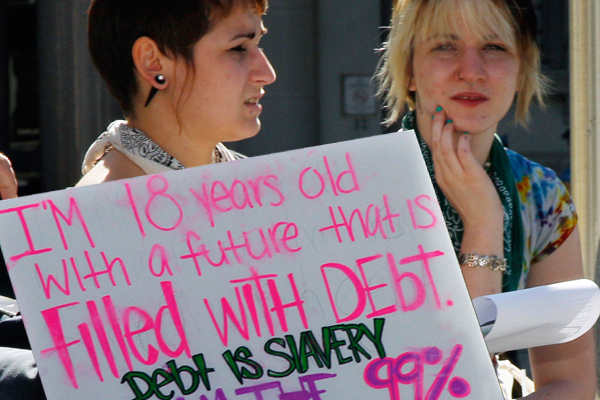
Two young women sit next to a sign as they listen to a speakers during a protest gathering across from the Statehouse in Trenton, N.J., Thursday, Oct. 6, 2011, as the "Occupy Wall Street" movement in New York has spread across the Hudson River.

As the Occupy Wall Street movement spreads to dozens more cities and towns, it’s waking many Americans to the unrivaled control Wall Street exerts over American politics and the economy. It’s also shining a spotlight on the crushing amount of debt carried by Americans today – debt that’s at the core of our lingering economic troubles, which many experts believe can never realistically be repaid.

In 2007, American debt was 100 percent of GDP; today, after an austerity binge, it’s down to 90 percent, which is still a stunning imbalance. Almost a quarter of all home mortgages today are currently underwater, 2 million homes are in the foreclosure process – and at least 5 million homes have already lost to foreclosure since 2007. American student loan debt is over $1 trillion right now, higher than American credit card debt, with the average student leaving school with about $24,000 in loans.

The debt crisis that’s at the heart of the global economic crisis has sparked some fascinating debate about whether and how American banks should restructure and even write off some of that debt. Our own Alex Pareene proposed that writing off all consumer debt should be a demand of the so far demand-free Occupy Wall Street movement. In fact, even some mainstream economists back some form of debt write-off. Last week a Reuters special report found surprising  establishment support for some modern version of the biblical concept of “Jubilee,” a recurring period, every 50 years or so, during which debts were forgiven.

Reuters gets one thing wrong: It claims the notion of “Jubilee,” hilariously, came to public consciousness thanks to a 2009 “South Park” episode about it (in which Kyle used a credit card to pay off everyone’s debts, in order to stimulate the local economy). In fact, more than 15 years ago, an inspiring global movement coalesced around a demand for “Jubilee 2000,” to free developing nations from their crushing debt burdens to public and private lenders and the austerity imposed by the International Monetary Fund.

I turned to political economist Ann Pettifor, the director of Jubilee 2000 from 1994 to 2001, to get her thoughts about OWS. She is the director of Advocacy International as well as the macroeconomic think tank PRIME.  Pettifor is also the author of the prescient 2006 book “The Coming First World Debt Crisis” and, more recently, with Maz Kessler, of “Cutting the Diamond: How to Shape a Movement to Make Transformational Change Happen.”

Are you encouraged by the OWS movement in the U.S.?

I am cautiously trying to understand the OWS movement from a distance, but from the news and intelligence that I have gathered, I am hugely encouraged and inspired. It is a movement that has already, in just a few weeks, given voice to many thousands of impoverished and indebted Americans, and that alone is a significant achievement. Once people are given voice, and once they understand that they can act collectively, there is no knowing what transformative power they find within themselves.  So I watch with some anticipation as this movement changes the dynamic between people, the White House and Congress, and between people and Wall Street.

It strikes me that this American movement stands on the shoulders of the very first, the American Revolution. As Benjamin Franklin argued, the colonists were provoked into revolt by the greed of British bankers, who bribed Parliament to introduce a Currency Act, which made it illegal for the colonies to print their own money. This meant that all taxes to Britain had to be paid in silver or gold. Those without silver and gold had to borrow them at interest from the banks – causing debt, unemployment and poverty to escalate in the colonies.

Then there are the broad shoulders of the “Greenbackers,” who just over a hundred years ago invented the idea of the March on Washington, and argued for detaching the dollar from gold to allow government to spend freely on job-creation programs.

Yes, and all Americans learn about that, if they learn anything, is the out-of-context William Jennings Bryan quote about the “cross of gold” – and then that Bryan opposed Darwinism during the Scopes trial. He’s remembered as an eccentric, if he’s remembered at all.

Bryan was wrestling with a really difficult issue: the nature of credit and the power of the producers of credit vs. the power of the producers of food, goods and services.  And he and his followers didn’t get it right, and yes, he was wrong on some other big issues. But he and the Greenbackers resisted Organized Money, and so we should not be surprised that their resistance is deliberately forgotten. “The Wizard of Oz” is all that remains of their story, and the true meaning of that story is lost to today’s generations.

Then there are the shoulders of 1930s Americans, including American Democrats, who four years after the 1929 Crash resisted the predations of Wall Street, and elected a government that tamed the finance sector. So to watch a people’s movement rise up against finance again — on the shoulders of these great Americans — is indeed a privilege.

How important is the symbolic power of targeting Wall Street?

Targeting Wall Street is not symbolic. And Wall Street’s power is not symbolic either.  The 99 percent are right. Wall Street is where U.S. financial and political power lies. The United States is a bank-owned state that enslaves its people in debt; and Wall Street is home to the banks.  Congress is in debt to Wall Street. In other words, like many Americans, Congress is enslaved.

Although the movement has yet to coalesce around a set of demands (to the chagrin of more pragmatic, action-oriented activists) it’s clear that the issue of bank power and consumer debt is practically and symbolically resonating. Are there any parallels with the early development of the Jubilee 2000 movement? And will you briefly describe the movement.

Jubilee 2000 was a campaign that mobilized many millions of people in more than 60 countries behind an effort to “break the chains of debt” that effectively enslaved poor debtor countries to rich creditor countries.  Like the British 19th century anti-slavery campaign, Jubilee 2000 arose as a response to a movement – people in poor debtor countries demonstrating against and resisting decades of foreign debt repayments, and the associated International Monetary Fund “structural adjustment” programs.

The IMF was, and is, the agent of the finance sector, all global creditors, official and private. Riots and resistance in debtor nations were triggered by policies imposed by the IMF on behalf of bankers, and included hikes in food and gasoline prices, increases in unemployment, cuts in government programs – all designed to generate resources for the repayment of foreign debts.  Jubilee 2000 set out to place pressure on creditors, one of which was our own government, to cancel these debts, and thereby render the IMF and its policies redundant.

But let me make clear: Jubilee 2000 was not the anti-debt, anti-IMF, anti-globalization movement. It was a campaign that for a few years harnessed a part of the global anti-debt, anti-IMF movement behind a specific, achievable goal: to drop the debt [of the poorest countries] by the year 2000, under a fair and transparent process.

Movements are broad, collective mobilizations, often arising spontaneously in response to injustice.  They are vital in giving voice to the voiceless. Campaigns are organized, have institutional capacity and adopt specific goals and targets. If well-designed and thought through, campaigns can harness the energy and power of a movement to achieve specific goals. Examples of great campaigns that harnessed movements against injustice, and achieved transformative change, include the movements to abolish slavery, to win the vote for women, to expand civil and political rights to African-Americans, and in this case, to “Drop the Debt.”

All of these campaigns had a specific legislative goal that altered the balance of power: between slaves and their owners; between women and men; and between black people and white people.  Jubilee 2000 succeeded in one of its goals: getting about $100 billion of debt written off for 35 poor countries — a huge achievement.  But we failed to achieve structural legislative change.  We failed to alter the balance of power between international creditors and sovereign debtors.

Instead, under pressure from millions of campaigners, creditors caved in. They, not an independent tribunal, decided which debtor country would get relief, how much relief would be given, and the terms of the relief. If we had achieved structural change, the debt write-offs would have been much bigger, Greece would not be in turmoil, and the eurozone would not be in crisis.

I feel a little strange linking the American consumer debt crisis to the global crisis addressed by Jubilee 2000, which was an effort to help desperate impoverished nations get out from under their crushing debt to powerful nations, including the U.S. And yet, it seems as though we can link the forces pushing debt, with harsh conditions, on struggling countries, with the forces pushing debt on American workers, students and families. Can you help me tease that out a little?

There are strong parallels between the Wall Street resistance movement that is growing in the U.S. today, and the IMF resistance movements that mobilized people in poor, debtor nations from the 1970s onward. The most important is this: both sovereign debt – the debts of whole nations – and individual, household and corporate debt in the U.S. rose dramatically after the deregulation of the private finance sector in the 1970s.  Associated with this rise in debt, were policies that impoverished those without financial assets, and wildly enriched those who had gained financial assets – by fair means or foul.

These levels of debt did not exist in the immediate postwar period. There was not a single international financial crisis between 1945 and 1971 according to the great historian of the financial system, Barry Eichengreen. And similarly, Americans were not burdened by rising debts and falling incomes during that period. The unregulated, liberalized expansion of credit and debt began quietly after President Nixon unilaterally dismantled the Bretton Woods system in 1971. Liberalization was given further impetus by President Reagan and later President Clinton, and as a result the rise of ultimately unpayable debts accelerated in the ’80s, ’90s and ’00s.

Millions of Americans are today enslaved by what in biblical times was called “usury,” the exploitation of those without money by those with money.  Bankers and financiers whose place it is to act as “servant” to the real economy in which Americans work and live, have instead become “stupid masters” of a world crafted, designed, worked and built, not by financiers, but by ordinary hardworking Americans.

As Ramsay MacDonald, Britain’s first Labour prime minister, once argued, “No community can be free until it controls its financial organization….”

The Occupy Wall Street movement seems to understand this.

Not that you or I are in charge of crafting either demands or proposals for OWS, but what might be some ways to approach a call for debt forgiveness? Can you start with student loans? Mortgages?

I would not use the language of “debt forgiveness.” This phrase was strictly prohibited in Jubilee 2000, because it implied that the debtor was the “sinner” and needed “forgiveness.” Instead we argued that there is co-responsibility for the debt, and within that frame the more powerful creditor must take a greater share of responsibility for the losses associated with the debt. As things stand in the U.S., as far as I can see, Wall Street takes no responsibility for the vast debts it heaped on the shoulders of working Americans – debts vast as space.

Second, I would absolutely demand a “Debt Jubilee” – especially for students –  based on the biblical principle outlined in Leviticus 25. A very large proportion of the debts owed by the American people cannot and will not ever be repaid. And if this debt is to be deleveraged in a disorderly, unmanaged way, then America will have decades of economic failure and social unrest ahead. Unfortunately, Wall Street bribed and lobbied the second Bush administration to implement a much tighter bankruptcy law, which favors lenders and penalizes debtors.  This law will have to be modified, and a “debt Jubilee” introduced.

We must remember that Jubilee principle is not just a tradition of the Torah or Old Testament; it was fundamental to the American Revolution and subsequently to the fight against slavery. It is a powerful symbol of American independence, which is why the text from Leviticus 25 is engraved on the Liberty Bell in Philadelphia: “Sound the trumpet of Jubilee, and declare Liberty throughout the land.”

Are there lessons from other crises in other countries?

I think the lessons to be learned are American. There are the lessons from the Revolution; the failed “Greenbackers” movement, and their populist leader, William Jennings Bryan. Above all, there are the lessons taught by President Franklin D. Roosevelt. In the 1930s, under Roosevelt’s leadership, Wall Street was once again made servant to the people of the United States. The Pecora Hearings dragged bankers into Congress to explain their misdeeds.   Structural legislative change, in the form of the Glass-Steagall Act and the setting up of the FDIC, subordinated bankers to the interests of the economy as a whole.  In his famous Oct. 31, 1936, speech, Roosevelt describes the

… struggle with the old enemies of peace — business and financial monopoly, speculation, reckless banking, class antagonism, sectionalism, war profiteering. They had begun to consider the Government of the United States as a mere appendage to their own affairs. We know now that Government by organized money is just as dangerous as Government by organized mob. Never before in all our history have these forces been so united against one candidate as they stand today. They are unanimous in their hate for me — and I welcome their hatred.

I’d rather look forward than backward, but did the Obama administration miss any key solutions as it dealt with the banking crisis and TARP in 2009?

Unlike President Roosevelt, President Obama and his advisors did not seem to welcome Wall Street’s hatred. Instead, in a fatal miscalculation, they bowed to “organized money.” Wall Street bankers were bailed out – unconditionally. Unlike the contracts that enslave millions of Americans, there were few “terms and conditions” for the bailout, and by the time the administration finally got around to discussing these in Dodd-Frank, Wall Street bankers had succeeded in turning Congress into a “mere appendage to their own affairs,” in Roosevelt’s words.

Occupy Wall Street is mobilizing a movement. We now need a second American revolution – a campaign that will structurally alter the balance of power between ordinary Americans and Wall Street.

Are there practical sorts of proposals, or next steps, you’d like to see this movement begin to coalesce around?

This one is tricky. I hear from friends that there is determined opposition to leadership, and therefore to organization. And I respect that approach by the movement, as well as their processes for communicating and mobilizing. There is profound disillusionment with both President Obama and political organizations, in particular the Democratic Party.

So it is not for me to suggest any practical steps. However, I do believe, as I am sure many of the 99 percent do, that just demonstrating is not enough. Specific campaigns and organization to achieve structural legislative change will be necessary.

But for now, let’s wait and see how this new movement spreads and grows. For the first time since the crash of 2007-09, I am optimistic!


Joan Walsh

Joan Walsh is Salon's editor at large.

First NATO protest targets Obama

A small rally kicks off a week of protests in Chicago and makes clear the president is a target in his city

Rahm Emanuel and President Obama (Credit: Reuters/John Gress)

In the first week of November 2008, tens of thousands of people gathered in Chicago to watch dewy-eyed as Barack Obama won the presidential election, believing, as the then-president-elect said in his victory speech, that “this time must be different.” This week, the Windy City is welcoming large crowds again — but as was made clear by a small protest action Monday — the president is not the sweetheart of these Chicago masses, which are assembling for a week of actions and protests surrounding the NATO summit.

Eight people were arrested Monday during a protest at Obama’s 2012 campaign headquarters. The rally, organized by social justice and anti-war group Catholic Workers, was the first organized demonstration — and the first instance of arrests — relating to the NATO counter-protests. It was small (just over two dozen participants assailed security and stormed the campaign headquarters and read a statement inside) but set a tone for actions later this week in asserting that the president and Democratic Party are protest targets alongside NATO generals and corporations like Boeing, who receive large government defense contracts.

For months the question has hovered over Occupy supporters, many of whom are attending NATO protests, partly organized by Occupy Chicago, from across the country: How many of them will manifest as Democratic voters come November? Will the energy that has brought hundreds of thousands into streets and parks across the country over the past half year be co-opted by the party machine? Of course, the small Catholic Workers demonstration is no indication either way. It will be interesting to watch, however, as the week of permitted and unpermitted protest actions continue in the city Obama calls home, the ways in which Mayor Rahm Emanuel and the president are willing to crack down on the dissenting crowds whose support they will ask for in November.

Continue Reading Close

Natasha Lennard covers the Occupy movement for Salon. A British-born, Brooklyn-based journalist, she has been covering Occupy Wall Street since before the first sleeping bag was unrolled in Zuccotti Park. One of the first journalists arrested at an Occupy action, she has managed to enrage Andrew Breitbart, Rush Limbaugh and Glenn Beck. You can follow her on Twitter (@natashalennard), and email her any Occupy updates/videos/ideas to natasha.lennard@gmail.com

Occupy: A Tea Party for the left?

The Mississippi Freedom Democratic Party didn't succeed by electing candidates. Occupy doesn't need to either

An Occupy Wall Street demonstrator chants during a march to celebrate the protest's sixth month, Saturday, March 17, 2012, in New York. (AP Photo/John Minchillo) (Credit: AP)
This article originally appeared on AlterNet.

As long as there has been a thing called Occupy Wall Street, there have been people who’ve suggested it should become the left’s version of the Tea Party. Josh Harkinson’s piece is a notable contribution to the conversation because it comes after eight months of in-depth reporting on the movement. Harkinson, like Jennifer Granholm, suggests that Occupy should recruit and run candidates, so the left has champions in Congress and can credibly threaten less ideologically aligned Democrats. According to this logic, it doesn’t matter if Occupy does this itself or essentially outsources the job to our progressive allies — the point is to find ways to elect more good Democrats.

AlterNetThe idea of a progressive Tea Party was totally my jam before Occupy started. Like Harkinson, I didn’t see how the left could create real change in America without taking control of the Democratic Party. Now I think it’s important to recognize that the problems we face as a country can’t be solved by electing more Democrats, or even by electing more good Democrats. A progressive Tea Party would be a welcome addition, but it wouldn’t be nearly enough to create the kind of change we need.

If Occupy tried to start a left Tea Party, we would be following in the footsteps of several progressive movement efforts that came up short. Howard Dean’s presidential campaign turned into Democracy for America to reclaim the “Democratic wing of the Democratic Party,” the Progressive Change Campaign Committee explicitly references the DCCC, andRebuild the Dream originally billed itself as the progressive Tea Party. I have worked for each of these organizations and have lots of respect for their work. But unfortunately, none of these projects, despite their many successes, have managed to mount a serious national effort to take out bad Democrats and replace them with good ones. They are constrained by the lack of a grassroots base in many congressional districts and big donors reluctance to fund challenges to Democrats. Even big, collaborative efforts to take out bad Democrats have a relatively poor record (See Sheyman, Ilya; Halter, Bill; or Lamont, Ned).

Occupy is less well suited than the Progressive movement to overcome these challenges. Most occupiers I know aren’t interesting in learning how to raise money, knock on doors, or run campaigns. Starting a progressive Tea Party is a completely legitimate, useful goal — but it’s something for the progressive institutions to take on. New York state and city provide a good model for how this can work harmoniously: the Working Families Party is a unified progressive block within the Democratic party. They support Occupy and we support them on the issues. Together, we won a huge, unexpected victory for the millionaires tax.

Despite the hard work of our progressive allies, the unfortunate reality is that our political system as presently constructed is simply incapable of responding to people’s needs. The election of the most progressive Democratic nominee of the past 30 years and a Democratic super majority in Congress resulted in relatively little change in American political economy, even during a time of massive economic crisis. The tepid response showed our political system was designed to serve the whims of the market, and no politician has the power to do much about it.

My generation doesn’t put all, or even most, of the blame for this state of affairs on President Obama. We don’t hate the player, so much as we hate the game. I believe Democrats are better than Republicans, because Democrats care more about the lives of gays, women, and people of color. I also believe everyone should all vote, because not voting would hurt people that I care about. That being said, we won’t just win by getting new players — we need to change the game. The system is fundamentally incapable of healing itself.

Occupy is hardly alone in believing our political system is in a state of crisis. Congress’ approval is at 9 percent. Many have written that our 18th Century political system has proven itself uniquely incapable of responding to external circumstances, including noted radicals likeJames FallowsEzra Klein and Matt Yglesias. The presidential system is prone to gridlock (and, frankly, falling apart) and our byzantine, bicameral legislative system makes it incredibly difficult for even winning parties to put their agenda into law. The crisis of parliamentary democracy taking place in Europe is happening in America as well.

Occupy grew at such an exponential rate because it spoke to people’s sense that the rules of our society are deeply unfair and the political system couldn’t do anything about it. In the midst of systemic failure, only Occupy was talking about systemic change. Occupy transformed the public debate by naming the problem — inequality of wealth and power — and the cause – the power of Wall Street. More important than our discursive accomplishments, we showed what an independent, citizen-led social movement for equality and democracy could look like in America. I don’t want to argue we’ve yet built that movement, because it’s still very much a work in progress. By giving people the space to connect, Occupy showed that people power is the only force capable of shaking the foundation of our corrupt system.

Only Occupy can provide the space, literally and figuratively, for this conversation. The Occupy movement would derelict of duty if we focused on the electoral at the expense of putting pressure on the system as a whole. The entirety of civic life can not be reduced to a get out the vote campaign. The left needs strategies that take aim at all the ways neo-liberalism breaks down our communities. The inherent conservatism of America government, and the limitations of electoral organizing, means we need inside and an outside strategies.

Occupy has already inspired a new generation of social justice leaders to build an inclusive, radical movement that also speaks to the mainstream. We continue to push institutional groups towards more confrontational forms of resistance, bring new people into the struggle and provide a unifying message. Like the civil rights, women’s rights, environmental movements before us, we can’t afford to ignore the electoral realm, but we also shouldn’t expect to succeed by voting alone. The Mississippi Freedom Democratic Party didn’t succeed by electing candidates — it succeeded showing the limitations of the electoral system. Occupy should aim to do the same.

Max Berger is an organizer with the Occupy movement.

Continue Reading Close

“Occupy Cop” under attack

Retired Philadelphia Police Capt. Ray Lewis could lose his life insurance for wearing his uniform to a protest

Ray Lewis (Credit: AP/Joseph Kaczmarek)

On Occupy Wall Street’s Nov. 17 Day of Action, the NYPD arrested nearly 250 protesters. Ray Lewis, however, stuck out: the retired Philadelphia Police captain was dressed in uniform. He was holding a sign that on one side encouraged people to watch the Charles Ferguson financial crisis documentary “Inside Job.” On the other: “NYPD Don’t Be Wall Street Mercenaries.”

“You have to get rid of corporate America,” Lewis told occupiers in Zuccotti Park. “You have to get rid of the powers that they have … As long as they have the power they are going to continue to exploit and manipulate the working class.”

The blowback from the police establishment was swift: A Nov. 23 letter from Philadelphia Police Commissioner Charles Ramsey demanded that Lewis “immediately cease and desist wearing, using or otherwise displaying any official Philadelphia Police Department uniform, badges or facsimiles thereof or any official departmental insignia.”

Ramsey soon backed down, citing Lewis’ First Amendment rights. Not so for the politically powerful Fraternal Order of Police Lodge 5, led by president John McNesby, which has continued its campaign against Lewis.

FOP pension director Henry Vannelli has filed a grievance that could prompt Lewis’ expulsion from the FOP, cutting him off from the life insurance and free legal support offered to current and retired officers.

The FOP, which frequently and vociferously defends police accused of excessive force and other misdeeds, must really hate Lewis. As Philadelphia Daily News reporter William Bender put it in a recent story,

It’s usually tough to get kicked out of Philadelphia’s Fraternal Order of Police.

You really have to screw up.

Worse than, say, the cop who allegedly beat his girlfriend with a closed fist and left her a voice mail threatening to ‘stomp your f—ing heart out.’ Or the officer convicted of child endangerment for pointing a loaded Glock at a kid who changed the radio station in his truck at the Police Academy.

Or the cop who allegedly forced a suspect to perform oral sex on him in his police cruiser.

Indeed. The FOP, which did not respond to a request for comment, makes no secret of the fact that its attack on Lewis is an extraordinary one: “It’s quite unusual,” Vannelli told the Daily News. “We had to dig into the books to see what we could do and and couldn’t do … We don’t want that guy around.”

McNesby even continues to insist that Lewis should be arrested, even though Commissioner Ramsey has long since clearly acknowledged that one is not “impersonating a police officer” if they are “not pretending to be a cop.”

“That is so egregious of a thing to say, because what he’s telling all of those officers in Philadelphia is that they should violate the law,” Lewis tells Salon. “There’s enough violation of people’s rights already.”

The same day that Bender’s report was published, the Daily News’ Jason Nark wrote a companion article on an eccentric lawyer and donor to police causes named Jimmy Binns, who, well, likes to dress up like a cop. A lot. It’s even alleged that he once illegally sported a handgun — but was not arrested by Margate, N.J., police because he’s a friend of the police chief. According to the Daily News, that crime carries a mandatory three- to five-year sentence. And Binns has illegally parked his car with an “Official Business” placard from the commissioner’s office lying across the dash, according to Temple University journalism professor George Miller.

Lewis continues to protest. In uniform. Last week he was in Center City Philadelphia, protesting outside police and FOP headquarters. He says that FOP leadership , a major force in city politics, depends on corporate donations to finance its union election campaigns and quarterly magazine.

“The major part of the movement is to hold corporations accountable and to stop them from having so much control over lives and the earth,” he says. “If John McNesby is a receiver of the favors of corporate America, then I’m going to be the number one enemy. Because I’m a tactical warhead.”

Continue Reading Close

Daniel Denvir is a staff writer at Philadelphia City Paper and a contributing writer for Salon. You can follow him at Twitter @DanielDenvir.

Why protesters curse cops

New stats about the NYPD's racist tactics show why some Occupiers chant "F*** the police."

(Credit: Reuters/Andrew Kelly)

Attitudes toward the police are the source of innumerable disagreements and divisions between those who’ve participated in Occupy-related actions in the past half year. From Oakland, Calif., to New York “Fuck the Police” marches regularly snake through the streets, while in early encampments chants of “We are the 99%, and so are you!” would ring out invitingly to surrounding police officers. (Unsurprisingly, anti-police sentiment increasingly outweighed support for police as more and more Occupy participants felt the jab of billy clubs and the sting of tear gas.)

It’s beyond the purview of these paragraphs to explain the many reasons someone might take to the streets and shout “fuck the police!” However, as a new report from the New York Civil Liberties Union confirms, the consistently racist practices of the NYPD should make fierce anti-police sentiments understandable, even for those who find such an attitude unpalatable.

Using the NYPD’s own statistics, the NYCLU report highlights what they describe as a “two-tiered” policing system, in which black and Latino New Yorkers receive very different treatment from whites. Perhaps the most shocking finding of all: There were more stops of African-American young men in 2011 than there are African-American men living in the city — and nine out of 10 of those stopped had committed no crime.

In nearly half of New York’s 76 police precincts, black and Latino New Yorkers accounted for more than 90 percent of those stopped; in almost all precincts black and Latinos accounted for more than half of stops. Furthermore, frisks, which are only supposed to take place if police suspect someone is carrying a weapon, occurred far more often if the person stopped was black or Latino, even though white people were found more often to be carrying weapons. The report also notes that despite the 600 percent increase in stop-and-frisks under Mayor Bloomberg, the number of guns recovered has not increased proportionately.

“This cannot stand. Real people’s lives are in the balance. Whole generations of boys and girls are growing up afraid of the very people that are supposed to be keeping them safe,” Donna Lieberman, executive director of the NYCLU, told press on Wednesday.

Is it a surprise, then, that in a march of 5,000 predominantly non-white New Yorkers organized to call for justice for the murdered Trayvon Martin, with Occupy support, that chants moved smoothly from “We are Trayvon Martin!” to “Fuck the Police!”? The greater surprise should perhaps be why more people don’t feel angry at the NYPD. Of course, many will continue to disagree with anti-police marches. However, when statistics on policing show what the NYCLU’s Lieberman called “a tale of two cities,” disagreements should only arise over tactics to redress this system; it seems there’s an overwhelming case for fury at the police.

In a statement, NYPD spokesman Paul Browne defended police practices, saying that “stops save lives” and that New York has this year seen a record low for murders. He said that it is “the safest big city in America,” which prompts the question: safe for whom? When vast swaths of New York’s population live in constant fear of being harassed by a well-armed, uniformed gang — and that this fear is largely contingent on a person’s skin color — this strikes me as the sort of safety I have no interest in maintaining.

Continue Reading Close

Natasha Lennard covers the Occupy movement for Salon. A British-born, Brooklyn-based journalist, she has been covering Occupy Wall Street since before the first sleeping bag was unrolled in Zuccotti Park. One of the first journalists arrested at an Occupy action, she has managed to enrage Andrew Breitbart, Rush Limbaugh and Glenn Beck. You can follow her on Twitter (@natashalennard), and email her any Occupy updates/videos/ideas to natasha.lennard@gmail.com

Twitter sides with Occupier

In a surprise move, the social media giant steps in to quash a subpoena against an OWS arrestee

Malcolm Harris (inset) and Occupy Wall Street protesters on the Brooklyn Bridge. (Credit: Sam Margevicius/AP/Daryl Lang)

Last month, Occupy Wall Street participant and Brooklyn Bridge arrestee Malcolm Harris was unable to quash a subpoena demanding Twitter hand over information about his account to the authorities. But in a surprise move this week, Twitter has come out batting for its user.

When a New York judge ruled in April that Harris did not have the standing to fight the subpoena (arguing that his tweets actually belonged to Twitter) and that there were no privacy grounds on which the individual user could refute the demand for his Twitter records, this seemed to suggest something worrying: that we have little jurisdiction over our online identities and can’t even fight for our online speech in court.

Harris’ lawyer, Martin Stolar, told me at the time that he planned to file another motion against the judge’s decision — to re-argue that his client indeed has a standing in fighting the order, and there are strong privacy grounds to resisting the authorities obtaining records of someone’s accumulated Twitter activities (including deleted messages) without a warrant. But now it seems Stolar doesn’t need to file this motion; Twitter has stepped in.

Arguing against the judge’s decision, Twitter’s lawyers point out that Harris does indeed have proprietary rights to his tweets — and has a right to challenge demands for his Twitter records. “To hold otherwise imposes a new and overwhelming burden on Twitter to fight for its users’ rights, since the Order deprives its users of the ability to fight for their own rights.” The social media leviathan’s message is clear: We’ll step in this once so that users can fight for themselves in future.

The points put forward in Twitter’s motion align with those put forward by Harris’ lawyer in the first place. If the district attorney wanted to use publicly available Twitter information as evidence in the case against Harris (which, it bears noting, is a mere violation charge for marching onto the Brooklyn Bridge), then it is possible to follow users on Twitter and glean information this way. It is another thing entirely to demand — without a warrant — an entire record of accumulated Twitter activity be handed over. (Stolar helpfully compared it to the fact that we are able to watch what a driver in a car does at any given time in public; the authorities would need a warrant to put a tracking system into the car to monitor the entirety of its activities.)

“To the extent the desired content is publicly available, the District Attorney could presumably have an investigator print or download it without further burdening Twitter or the Court,” Twitter argued.

Harris responded happily to the news: “It’s an unexpected but reassuring move, now it’s up to the prosecutor’s office whether or not to drop the whole charade. Either way, we’re setting a precedent that social media users and activists won’t be bullied by the state,” he told me via email (full disclosure: we’re friends).

His reference to a “charade” seems apt: Here we have an incident of a California-based social media company with over 140 million users having to deploy its legal resources for a New York case that, at base, is over a charge no more criminal than a traffic ticket. By nesting its little blue tweet birds on the side of its users instead of the authorities in this instance, however, Twitter have set an important precedent in defending online speech.

Harris took to Twitter to comment on the social media giant coming to his defense: “So I wasn’t expecting the two blue birds with shaved heads and ARs standing outside my door, but apparently Twitter goes hard,” he quipped.

Continue Reading Close

Natasha Lennard covers the Occupy movement for Salon. A British-born, Brooklyn-based journalist, she has been covering Occupy Wall Street since before the first sleeping bag was unrolled in Zuccotti Park. One of the first journalists arrested at an Occupy action, she has managed to enrage Andrew Breitbart, Rush Limbaugh and Glenn Beck. You can follow her on Twitter (@natashalennard), and email her any Occupy updates/videos/ideas to natasha.lennard@gmail.com

Page 1 of 66 in Occupy Wall Street

www.salon.com/topic/occupy_wall_street/