
War Room
The magical power of a gimmicky tax plan
Herman Cain has stumbled on a time-honored recipe for gaining attention and traction
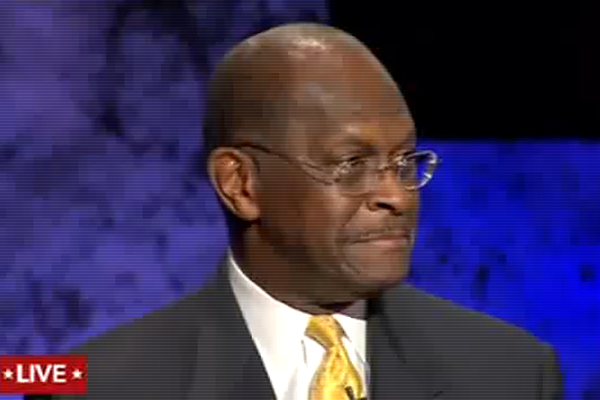
Herman Cain (Credit: dentonexable) At one point during Tuesday night’s GOP debate, Rick Santorum belittled Herman Cain’s “9-9-9″ tax plan, arguing that it would never pass Congress. This prompted a thunderous retort from Cain: “Therein lies the difference between me, the non-politician, and all of the politicians. They want to pass what they think they can get passed rather than what we need which is a bold solution. 9-9-9 is bold and the American people want a bold slution.”
I’d say Cain got the better of Santorum in this exchange, partly because his delivery was so powerful but mainly because of the superficially compelling nature of what he was saying. 9-9-9 is a simple, catchy idea that surely does sound bold to the average viewer, especially since it’s being pitched by a businessman who has no previous experience in elected office and who is being told by career politicians like Santorum that it’s not practical. Cain’s rise to first place in national polling (and in Iowa) certainly demonstrates how truly reluctant Republicans are to get behind Mitt Romney, but it’s also the latest affirmation of the power a simple tax plan gimmick.
After all, we’ve seen this sort of thing play out before. On the Democratic side, there was the 1992 version of Jerry Brown, who jumped into the race shortly after ending a nearly decade-long exile from politics. The Brown of ’92 pitched himself as a hell-raising outsider with contempt for the political establishment and corporate power. He offered a series of bold, maybe even radical policy prescriptions. The highlight: Junking the federal tax code and replacing it with a flat 13 percent income tax and a 13 percent value added tax. He seemed to introduce the idea almost on a whim during a debate early in the primary season, when he was struggling for attention, but as the field winnowed and front-runner Bill Clinton’s negative ratings rose, Brown began breaking through. He turned the flat tax into a rallying cry, picking up copies of the tax code during speeches and throwing them into trash cans. Since he was positioning himself as a champion of the underclass, Brown made for a curious flat tax messenger, but the electorate’s initial reaction was positive and Brown scored one of the biggest surprises of the modern primary era, winning Connecticut’s late-March contest and setting up a two-week death match in New York with Clinton.
On the Republican side, there’s the example of Steve Forbes, which I outlined a few days ago. The short version is that Forbes jumped into the 1996 Republican race late an with virtually no name recognition, but quickly distinguished himself by offering a 17 percent flat tax plan. (It helped that he could dip into his own pockets to pay for a barrage of ads promoting the plan.) Like Cain today, Forbes claimed that the derision of his rivals was symptomatic of their insiderdom — and proof of how much his bold plan unnerved the establishment. Just a few weeks before the New Hampshire primary, Forbes made the cover of Newsweek (this meant something back then) and grabbed the lead in the first-in-the-nation state.
Of course, neither Brown nor Forbes went on to win, partly because their plans gave their opponents — and the media — endless ammunition. Clinton emphasized the regressive nature of Brown’s flat tax, calling it a “rip-off” and noting that “I’d get a tax cut out of it and the people that really made the money in the ’80s are going to get a killing out of it.” Forbes’ GOP foes, as hard as it might be to imagine today, framed his plan as a politically suicidal giveaway to the super-wealthy (it would have exempted investment income from taxation). The relentless scrutiny wore down each man’s standing; Brown lost New York while Forbes won only two primaries (Arizona and Delaware). Maybe there’s a lesson here for Cain, whose own 9-9-9 plan comes with more than its share of potential ammunition: A catchy tax plan gimmick is a great way to move to the top in polling, but it may not help you stay there.
Steve Kornacki writes about politics for Salon. Reach him by email at SKornacki@salon.com and follow him on Twitter @SteveKornacki More Steve Kornacki.
W’s elevator endorsement trick
The 43rd president is a willing accomplice in the Romney effort to pretend 2008 never happened
George W. Bush (Credit: Reuters/Kevin Lamarque) George W. Bush may have established a new world record today for the shortest, most awkward public endorsement statement in presidential campaign history:
“I’m for Mitt Romney,” Bush told ABC News this morning as the doors of an elevator closed on him, after he gave a speech on human rights a block from his old home — the White House.
The reason for this strange scene is obvious: Romney and his fellow Republicans want absolutely nothing to do with the 43rd president, lest voters connect the epic financial meltdown that played out on his watch to the economic anxiety they’re now feeling. As Jamelle Bouie explained today, the case that Romney is making for voting out President Obama depends on the public downplaying (or forgetting altogether) that he inherited an economy that was in the throes of a crisis not seen in generations:
Continue Reading Close
Steve Kornacki writes about politics for Salon. Reach him by email at SKornacki@salon.com and follow him on Twitter @SteveKornacki More Steve Kornacki.
The Bain beast returns
A scathing new anti-Romney ad from the Obama campaign picks up right where Rick Perry and Newt Gingrich left off
Mitt Romney (Credit: Reuters/Rebecca Cook) With the release of a new two-minute (!) negative ad from the Obama campaign, it’s now official: Mitt Romney’s perfect record of being attacked over his Bain Capital days is still intact.
OK, there’s an asterisk: Technically, Bain didn’t come up in Romney’s first campaign, for the 1994 Republican Senate nomination in Massachusetts. But that was barely a race: His opponent, John Lakian, had been shamed out of politics by a résumé embellishment scandal a dozen years earlier, barely qualified for the primary ballot, and lost to Romney by 66 points. And Lakian’s background was in venture capital too, so Bain was not exactly a logical topic for him to raise.
Continue Reading Close
Steve Kornacki writes about politics for Salon. Reach him by email at SKornacki@salon.com and follow him on Twitter @SteveKornacki More Steve Kornacki.
Ron Paul’s chaos threat
Paul-ites wreak havoc at yet another GOP state convention, and this time their victim is Mitt Romney’s son
Ron Paul (Credit: AP) This weekend brought another reminder of the real threat that Ron Paul and his supporters pose to Mitt Romney: chaos in Tampa, Fla.
As they’ve done elsewhere, hundreds of supporters of the libertarian congressman descended on Saturday’s state Republican convention in Arizona, which was being held to choose delegates to the party’s national convention. The state’s delegation will be pledged to support Mitt Romney, who easily won Arizona’s Feb. 28 winner-take-all primary, in Tampa, but there’s nothing to prevent Paul-ites from packing state conventions and gobbling up delegate slots, even if they won’t actually be able to vote for their candidate.
Continue Reading Close
Steve Kornacki writes about politics for Salon. Reach him by email at SKornacki@salon.com and follow him on Twitter @SteveKornacki More Steve Kornacki.
Scott Walker’s politically suicidal exchange
He tells a billionaire donor about his “divide and conquer” anti-union strategy – on camera
Scott Walker’s hopes of surviving Wisconsin’s June 5 recall election in part depend on his ability to convince voters that he’s only worried about a very particular type of union – and only because of fiscal issues, not philosophical ones. Democrats’ hopes of ousting him depend in part on convincing voters this isn’t true, and that their governor is waging an ideological war on all unions.
This is why a newly-released video could be very significant. The video, which was shot by a pro-Tom Barrett filmmaker who is working on a documentary, shows Walker in January 2011 talking with Diana Hendricks, the billionaire owner of a roofing company. She asks him if there’s any chance he’ll be able to make Wisconsin a right-to-work state. Walker tells her that “we’re going to start in a couple weeks with our budget adjustment bill. The first step is we’re going to deal with collective bargaining for all public employee unions, because you use divide and conquer.”
Continue Reading Close
Steve Kornacki writes about politics for Salon. Reach him by email at SKornacki@salon.com and follow him on Twitter @SteveKornacki More Steve Kornacki.
Mitt and the price of Liberty
The timing couldn’t be much worse for Romney to give the commencement address at Jerry Falwell’s school
Mitt Romney (Credit: AP/Carlos Osorio) The timing seemed a little odd when it was announced last month that Mitt Romney would be delivering an address at Liberty University’s commencement, which will take place this weekend. It was the kind of appearance you might have expected Romney to make in the spring of 2011, when he was just setting out to woo Republican primary voters, but not in the spring of 2012, after he’d secured the nomination and was setting out to win over general election swing voters.
Continue Reading Close
Steve Kornacki writes about politics for Salon. Reach him by email at SKornacki@salon.com and follow him on Twitter @SteveKornacki More Steve Kornacki.
Page 1 of 2650 in War Room