
The tragic, hilarious “We Are the 53 percent” movement

Conservatives launch a campaign against the poor and the old -- so we're launching one too

Topics: Occupy Wall Street, U.S. Economy, Erick Erickson, Taxes, Great Recession,

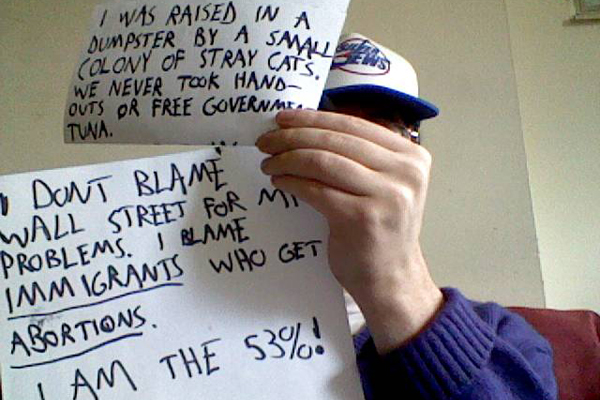
The tragic, hilarious (Credit: Alex Pareene/Salon)
The art with this story is Alex Pareene's parody of Erick Erickson's unintentionally hilarious web site We Are The 53%. It screams out for satire -- so go ahead and give it a try. We'll publish the best ones on Salon. Write a hand-written letter, take a picture and email it to us at 53@salon.com. Or you can publish it yourself on Open Salon -- just tag it "The Real 53 Percent."

The conservative response to the “We are the 99 percent” movement is … hilarious. (And, sure, heartbreaking.) Conservative filmmaker Mike Wilson and vacuous right-blogger Erick Erickson joined forces to start “We Are the 53%,” a blog made up of contributions from the 53 percent of Americans who pay more in federal income taxes than they receive back in deductions or credits.

The project was kicked off by Erick Erickson, who announced that he works “three jobs,” by which he means being a professional television pundit, radio pundit and Internet pundit. There is a stunning amount of cognitive dissonance, misplaced resentment and class revulsion going on, even for a conservative Web project.

The site can’t even manage to correctly represent that 53 percent, with multiple contributors very clearly belonging to the 47 percent of people who make up the supposed parasite class. There is a blog dedicated to this confused minority. The best example is obviously this dog.

Let’s get this out of the way early: Pretty much every adult American pays taxes. Workers who are too poor to pay federal income taxes still pay payroll taxes, and property taxes if they own their home. Even the unemployed pay sales taxes. The poorest Americans — people who make an average of $12,500 a year — pay, on average, 16 percent of their paltry income in taxes. That is less than every other demographic, but the point of a progressive tax system is that 16 percent of a poor person’s income is a hell of a lot more meaningful to that person than 30 percent of a millionaire’s. It’s a simple concept, and one that most Americans agree with. And that simplicity and popularity is why the conservative movement has spent 100 years attempting to muddy the debate with misinformation. (They are quite dedicated, actually, to class warfare, in that they seek to align the shrinking middle with the elites in a war against the downtrodden.)

So a good number of people who pay no federal income taxes are simply lucky enough to be impoverished. The rest are beneficiaries of tax breaks and loopholes championed most vocally by Republicans. A member of “the 1 percent” (or, more accurately, the tenth-of-1 percent) likely considers these harried taxpayers “the 53 percent of people without the sense to hire a good accountant.”

Here’s my Tumblr idea, for Americans resentful of the free rides they imagine others are getting as they work themselves to the bone: “We are the 94 percent of people who claim never to have received government benefits who have actually directly benefited from government social programs.”

In conclusion, rockets.

Continue Reading Close
Alex Pareene

Alex Pareene writes about politics for Salon and is the author of "The Rude Guide to Mitt." Email him at apareene@salon.com and follow him on Twitter @pareene

Next Article

Featured Slide Shows

What To Read Awards: Top 10 Books of 2012 slide show

close X
  • Share on Twitter
  • Share on Facebook
  • Thumbnails
  • Fullscreen
  • 1 of 10
  • 10. "The Guardians" by Sarah Manguso: "Though Sarah Manguso’s 'The Guardians' is specifically about losing a dear friend to suicide, she pries open her intelligent heart to describe our strange, sad modern lives. I think about the small resonating moments of Manguso’s narrative every day." -- M. Rebekah Otto, The Rumpus

  • 9. "Beautiful Ruins" by Jess Walter: "'Beautiful Ruins' leads my list because it's set on the coast of Italy in 1962 and Richard Burton makes an entirely convincing cameo appearance. What more could you want?" -- Maureen Corrigan, NPR's "Fresh Air"

  • 8. "Arcadia" by Lauren Groff: "'Arcadia' captures our painful nostalgia for an idyllic past we never really had." -- Ron Charles, Washington Post

  • 7. "Gone Girl" by Gillian Flynn: "When a young wife disappears on the morning of her fifth wedding anniversary, her husband becomes the automatic suspect in this compulsively readable thriller, which is as rich with sardonic humor and social satire as it is unexpected plot twists." -- Marjorie Kehe, Christian Science Monitor

  • 6. "How Should a Person Be" by Sheila Heti: "There was a reason this book was so talked about, and it’s because Heti has tapped into something great." -- Jason Diamond, Vol. 1 Brooklyn

  • 4. TIE "NW" by Zadie Smith and "Far From the Tree" by Andrew Solomon: "Zadie Smith’s 'NW' is going to enter the canon for the sheer audacity of the book’s project." -- Roxane Gay, New York Times "'Far From the Tree' by Andrew Solomon is, to my mind, a life-changing book, one that's capable of overturning long-standing ideas of identity, family and love." -- Laura Miller, Salon

  • 3. "Billy Lynn's Long Halftime Walk" by Ben Fountain: "'Billy Lynn's Long Halftime Walk' says a lot about where we are today," says Marjorie Kehe of the Christian Science Monitor. "Pretty much the whole point of that novel," adds Time's Lev Grossman.

  • 2. "Bring Up the Bodies" by Hilary Mantel: "Even more accomplished than the preceding novel in this sequence, 'Wolf Hall,' Mantel's new installment in the fictionalized life of Thomas Cromwell -- master secretary and chief fixer to Henry VIII -- is a high-wire act, a feat of novelistic derring-do." -- Laura Miller, Salon

  • 1. "Behind the Beautiful Forevers" by Katherine Boo: "Like the most remarkable literary nonfiction, it reads with the bite of a novel and opens up a corner of the world that most of us know absolutely nothing about. It stuck with me all year." -- Eric Banks, president of the National Book Critics Circle

  • Recent Slide Shows

  • Share on Twitter
  • Share on Facebook
  • Thumbnails
  • Fullscreen
  • 1 of 10

More Related Stories

Comments

123 Comments

Comment Preview

Your name will appear as username ( profile | log out )

You may use these HTML tags and attributes: <a href=""> <b> <em> <strong> <i> <blockquote>