
Occupy Wall Street

The man who blocked John Lewis speaks

Occupy Atlanta backer Joe Diaz isn't a white anarchist. He's a multiracial Obama voter who's given up on Democrats.

  • more
    • All Share Services

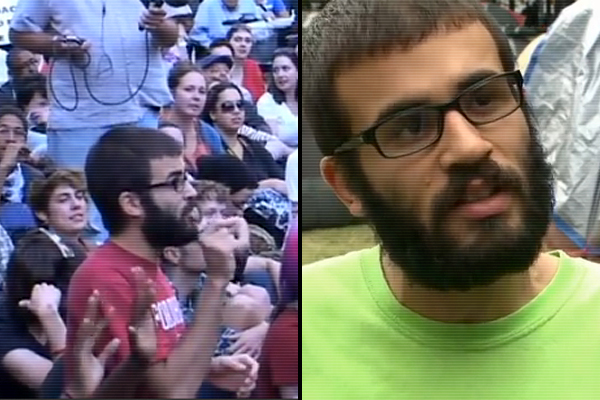
The man who blocked John Lewis speaks Joe Diaz (Credit: YouTube)

When Atlanta’s Occupy Wall Street offshoot seemed to turn away civil rights hero Rep. John Lewis last Saturday, it threatened to become one of those decisive moments in which a complicated social movement is defined, and not in a good way. Put simply, it looked like a mostly white group of young people disrespected an African-American hero from an early era of social struggle, preferring their own process over his wisdom.

Pretty quickly it became clear that wasn’t exactly the situation: Lewis hadn’t asked to address the group, and OA didn’t turn him away. The group asked him to speak in the segment of the agenda set aside for public speakers – but Lewis couldn’t stay. The Atlanta congressman told reporters he wasn’t insulted, that he related to the Occupy Atlanta protesters, and that their consensus-oriented process was “grassroots democracy at its best.”

All’s well that ends well – except questions persisted about the mysterious young activist identified as “Joe” who decided to block Lewis from speaking, when the larger group seemed open to hearing from him. After I wrote about Joe’s role in thwarting Lewis’ possible speech, people began emailing and messaging me asking who he was, suggesting he was with an anarchist group or some lefty sect. Others raised questions about why one lone young white man had the power to turn away a venerated African-American hero in Atlanta, a capital of the civil rights movement.

So I reached out to try to find Joe – and he contacted me and agreed to speak. Via email and over the phone, we had a long conversation over the last couple of days. He’s not exactly what he seemed.

Joseph Diaz, 24, is a Ph.D. philosophy student at Emory University looking for a career in political theology. Describing himself as of “Afro/Cuban/Italian descent,” he grew up Catholic in the New York suburb of Pearl River, the son of a Cuban immigrant New York Police Department detective and a Bronx Italian mother. He graduated from SUNY Geneseo with a degree in philosophy and political science, and a minor in Latin American studies, and got a fellowship to study at Emory. In 2008, he voted for Barack Obama – but he’s been on a steady odyssey to the left ever since.

Earlier this year Diaz was arrested in a student movement to win better wages and working conditions for Emory’s food service workers. He joined the local effort to stop the execution of Troy Davis last month. He says he’s friendly with local activists in the socialist All-African People’s Revolutionary Party, and he calls the anarchists involved in OWS “good people.” He quotes left-wing Frankfurt School philosopher Herbert Marcuse and Michelle Alexander, the author of “The New Jim Crow: Mass Incarceration in the Age of Colorblindness.” He moves from plain talk to lefty jargon frequently. He sees the modern Democratic Party as just another “war party,” and while he votes, he insists he wouldn’t ever again vote for a Democrat, no matter how progressive.  ”I’d tell them to look to Bernie Sanders,” the socialist senator from Vermont, he says.

Asked if he could sum up his politics with a political label, Diaz said, “First and foremost, I’m a Christian.” Then he added a lot of qualifiers like any good philosophy Ph.D student, but in the end he told me: “I believe in the radical egalitarian community of the Holy Spirit.”

Diaz may be the nightmare of folks who hope the OWS movement can be channeled into progressive Democratic Party politics. When he claims to work with “the real black community,” he will raise many people’s hackles, as he did mine. And yet, even as I lay out his openness to what, as a veteran of post-’70s lefty sectarian politics, I consider dead-end lefty sectarianism, I don’t entirely write him off. We had a friendly debate about where our country is, has been and where it’s going.

Many people may still believe John Lewis should have been allowed to speak Saturday after reading this story, but it will be hard to say some spoiled white boy blocked him simply out of ignorance.

The moment where Congressman Lewis wasn’t allowed to speak to Occupy Atlanta has become racially charged. It looks like a predominantly white crowd turning away a black civil rights hero. So I hate to try to put you in a bubble, but how do you characterize your own ethnicity?

No, it’s OK, I think the move to pretend to “color-blindness” is very dangerous. My four grandparents come from Italy, Africa and Spain. I’m a quarter black. In terms of “bubbles,” when I’m filling out forms, I bubble in Latino, black and white. Growing up in Pearl River, my friends were Irish Catholic, and being of mixed race, I was the minority. I’ve never been white enough for the whites, or Latino enough for the Latinos; it’s actually the black community that I’ve felt most at home with. So it’s ironic, the John Lewis thing.

Tell me a little bit about the context of the clip. It looked like the crowd was responding favorably to the idea of an impromptu message from Congressman Lewis. I wouldn’t call it consensus, but I’d say a majority expressed openness to it. Am I missing anything there?

When Congressman Lewis walked over, much of the crowd began clapping and cheering. There was some conversation between Rep. Lewis and our general assembly (GA) facilitator. This was happening about 20 minutes into our meeting. It’s important to note, this was our 4th GA, and there was a specific agenda drafted, which included “open mic” time for anyone to speak. The question of interrupting the meeting for Rep. Lewis to speak was put to us, and there was certainly strong support, but there were also plenty of dissenters.

Then it seems like you “block” him. You expressed respect for his civil rights history but you stated that no individual is inherently more important. Say more about why you blocked him.

My block of Rep. Lewis had more to do with the “form” of the event rather than the content. The Occupy movement was initiated because many of those in attendance feel that rules in our current system have been unjustly bent towards (or created for the sake of the welfare of) politicians and bankers. I felt that bending the rules of the GA towards a politician was contradictory to the spirit of the gathering. Yes he put his life on the line for people’s rights. Yes he should be honored for that. But there are construction workers, firefighters, coal miners, etc., who in a very real way put their lives on the line when asked, and we would not have bent the rules for them.

Did you support the compromise to ask him speak after the GA’s planning meeting?

Absolutely. It would be dogmatic and hypocritical to refuse to allow any person to speak at Occupy Atlanta.

I understand there’s a lot of concern about the OWS movement being “co-opted” by Democrats. But where is the line — if a progressive Democrat like Rep. Lewis wants to get involved, what role can he play, if any? Is there a role for MoveOn? Unions?

Rep. Lewis is invited to join Occupy Atlanta like all peoples. Maybe he can lead workshops on the consensus process, civil rights history, and other areas of expertise. But for us to continue to trust progressives who are in power with that power is not only dangerous and naive, but absurd. If there’s anything our government has proven to us over the last three years, it is that no member of the two-party system is worthy of our trust when it comes to ending the stranglehold that transnational corporations have on our foreign and domestic policy. Any organization that upholds the legitimacy of the two-party system simply buttresses interests opposed to those of everyday people. Unions have participated in Occupy Atlanta, but a sharp distinction must be made. Rank and file members should be front and center; professional staffers should take a step back.

A lot of people seeing the video had strong feelings — that a civil rights hero was being disrespected. In hindsight, given the reaction to the YouTube clip, would you reconsider blocking him?

I would not. I think very soon this will be seen as a tone-setting moment for the Occupy movement. I have personally been very involved in reaching out to the black community here in Atlanta. The real black community.

OK, you realize that sounds condescending: “the real black community.” Who’s the real black community? Who decides that?

That might have been crude. I’m talking about the segment of the black community here that feels ignored and disenfranchised. Here in Atlanta, there’s very much a class divide. I think a lot of black leadership, and black church leadership, tends to be separated from the urban poor black community. Politically, things have to be pretty non-controversial for many in the official black church to get involved, and when they do, their answer is, go out and vote for the Democrats! That’s very unsatisfying to a lot of us.

How would you describe your own political affiliation, if you have any? Did you vote in 2008?

First and foremost, I’m a Christian. I’m a student of political theology. My politics are inspired by scripture. I am antiwar, anti-nuclear-proliferation, pro-LGBTQ full equality, pro-universal health care, pro-marijuana legalization, pro-radical immigration reform, and so on. 2008 was my first presidential election. Admittedly, I was swept away by the sea of hope and change rhetoric. Although there was a point around July when Obama began articulating his wish to build up in Afghanistan that I considered a third party candidate. Ultimately, the feeling that I was some part of history by voting for Obama won out. Other than that, I’ve voted in local elections here in Georgia for Democrats when only Ds and Rs were on the ballot.

But do you vote now, or do you think voting is a dead end?

Voting alone is a dead end. But I vote. If you don’t vote, you leave yourself open to criticism if you are also participating in any activism – people will tell you that your protest is illegitimate because you’ve given up on our formal system for the redress of problems. So, while I understand withholding the vote in the spirit of not wanting to legitimize the system, I vote in order to cover myself. I just won’t vote for either of the major parties.

So no matter how progressive a Democrat is, if he or she puts a D after their name, you won’t vote for them.

No. I’d tell them to look to [Vermont's socialist Sen.] Bernie Sanders …

OK, but look, it’s easier to be elected a socialist in a place like Vermont. There are other places and other communities where that’s just not going to be true – and where a Bernie Sanders might have the best shot at power running as a lefty Democrat.

Well, there’s a desperate need for trailblazers outside the two-party system. The fact that you’re telling me that you can’t have an effective political career if you don’t join one of the war parties shows the brokenness of the system. And there are many people who don’t want to vote for either party. These are both war parties.

I’ve been working with a grassroots black empowerment group, For the People, since prior to the occupation. I’ve worked with the Revolutionary African Party. These groups represent the most disenfranchised – unemployed, political prisoners, immigrants, the homeless, and so on.

Are you a member of the Revolutionary African Party – I mean, it’s a socialist, pan-African, “revolutionary” party that’s pretty out there…

No, I’m not a member, I don’t consider myself a part of it, and I don’t think they, or any other single organization, should lead. But I work toward amplification of their voices, because they’re speaking to truths about the destruction wrought by our imperialist foreign policy. I am absolutely non violent, morally, politically but also pragmatically, I believe political violence is suicide.

I have also seen speculation online that you’re an anarchist. A lot of otherwise sympathetic people have expressed concern that there’s growing anarchist control of OWS nationwide. Is there?

Ms. Walsh, I am not an anarchist. But they are good people. There is not anarchist control at OC ATL; I cannot speak for other Occupy sites.

I didn’t live through the ’60s, but I know progressives distrust the role of so-called “revolutionary” groups in popular movements because the 60s “revolutionary left” was a nihilistic dead end that helped push the country to the right. Revolutionaries aside, so much of the left declared the Democrats hopelessly corrupt, and moved outside of electoral politics, or to third parties – to the point that the party was taken over by its corporate wing. So it’s a self-fulfilling prophecy, to declare the Democrats hopeless…

I think it’s dangerous to say that leftists have “allowed” the party to be pulled to the right, rather than saying that Goldman Sachs has invested hundreds of millions in the party to protect its interests, corporate America has invested hundreds of millions more, to pull the party right.

Yes, they did, and that’s part of the problem.

But your analysis is making the far left so powerful.

I think both those things happened, and both changed the Democratic Party, and American politics, for the worse in my opinion. Meanwhile, far-right movements, whether it’s the Barry Goldwater forces, or the Christian right, or the Tea Party, they join the Republican Party and try to take it over. The left by contrast stands outside and tries to destroy the Democratic Party. We don’t live in a parliamentary democracy; our third party votes are usually wasted.

You may be right about the ’60s. But right now, I don’t think the enabling conditions are there, I don’t think we have an open political system that really allows for popular electoral control. I mean, if you read “The New Jim Crow,” we’ve disenfranchised so many people who could change the system, through the criminal justice system. And now, across the country, we’re disenfranchising students, Latinos, poor people, with new voter laws.

You’re right about that, and we should all be fighting the disenfranchising that’s come about –  especially since those groups began to really use their votes in 2008. Can there be an organized electoral politics channel to Occupy Atlanta, or is the movement anti-electoral politics?

My specific goals for this movement are often characterized as broad, but they seem specific to me – do away with a for-profit prison system, end both wars, make full employment a reality. This movement must not allow itself to be co-opted and turned into a voting bloc. We all know that this will only lead to disappointments and broken promises – we’ll be back at square one again, or worse. There has been some talk that OWS will call for boycotts and general strikes. If they prove successful, the end goal may be the declaration of a provisional government in NY. This sounds wacky to some, but it must be seriously considered.

What do you say to people who look at the video and are put off by the human mic “chanting” and the process? Is there a role for sympathetic people who nonetheless don’t have time to join a process like that, or just aren’t patient enough for it?

Those who are put off by the human mic “chanting” are similar to those who go out for a nature walk with head-phones on… they’re missing the point. Those who are sympathetic but don’t have time to join the GAs are very much encouraged to work with us in whatever way they can – be that come down to the site at their convenience and share ideas, bring supplies, knit blankets, spread the word wherever they are, or whatever!

Is there any political label you’d apply to yourself?

I’m a Christian first and foremost. I believe in the radical egalitarian community of the Holy Spirit. Liberalism cedes family values talk to the Right at its own peril.  But it must be stated that when speaking to Christianity, one must be very upfront about the slavery, imperialism, degradation of women, and homosexuals done in its name. I believe that this hatred cloaked itself in Christian terms, but in reality, it had nothing to do with the message of a Savior who came to peacefully sacrifice Himself for the good of all.

I’d like to add that the human element of this movement should also be part of the story. One of my new best friends is a 50-year-old African-American man named Ulysses, a death row exoneree. He was acquitted thanks to new DNA evidence. He spent 26 years on death row maintaining his innocence. Ulysses was married with three kids when they locked him up in 1985. He was 24 — my age. He told me about how small his cell was, about how they’d roll a portable shower to link up to the opening of his cell door so that he wouldn’t be going anywhere to shower. He told me that if he was lucky he got recreation time 3 days a week – which consisted of being shackled up and walked to a small cage area where some outdoors could be seen so that he could walk in circles for 30 minutes. Ulysses told me how his kids grew up without him, his mother died in 1995 while he was locked up. He told me how when he got out 3 months ago, for the first month, he couldn’t go further out of his house than his front porch. The subway here absolutely terrified him. But he also told me that they took his freedom, his chance to raise his kids — but he was determined the whole time to not let them take his hope.

Picture that – a 24-year-old philosophy Ph.D. student and a 50-year-old death row exoneree sitting and talking in the pouring rain in the park very early on Tuesday morning, talking about fear, death, hope, and bonding over both being not just basketball players, but point guards. Connections like this strengthen our resolve. They affirm the idea that we are all more alike than the divisive system has us believe. And they convince us that fundamental changes must be made not only in our political and economic system, but in the way we see ourselves, our neighbors, and our duty to both.

Joan Walsh

Joan Walsh is Salon's editor at large.

Dissent, à la Québécoise

The student strike in Quebec has generalized, and solidarity is spreading in the U.S.

  • more
    • All Share Services

Dissent, à la QuébécoiseDemonstrators in Montreal on Tuesday. (Credit: Reuters/Christinne Muschi)

For the past eight months, when chants of “Anti-Capitalista!” have echoed through New York streets, they’ve tended to emanate from crowds with a penchant for black clothing. But on Tuesday night, when once again a march of around 300 snaked through the streets around Washington Square Park, the color scheme was different: red flags, red banners, red clothes, red masks and little red felt square pins adorned the marchers — a mixture of long-term Occupy participants, students and others taking the streets and donning some red in solidarity with the Quebec student strike.

Reminiscent of ad hoc Occupy actions last fall, the march in Manhattan blocked streets and confused police attempting erratic, aggressive arrests. It was, however, just a small nod to the action taking place in Montreal. There, up to 500,000 people took to the streets on Tuesday in what’s being called the largest act of civil disobedience in Canadian history, marking the 100th day of a powerful student strike.

The situation in Quebec has escalated since February from a student strike over planned tuition hikes — effectively shutting down universities — to a state of generalized insubordination and anger at a government adopting draconian measures to stifle dissent. A year and a half ago, the Quebec government decided to raise university tuition fees — currently the lowest in Canada — by 75 percent over a five-year period (a plan that, despite negotiation efforts by student unions, was revised to an 82 percent rise over seven years). In response, thousands of students and faculty members went on strike and struck a blow to the province beyond the university gates, taking to the streets and building numbers.

“I don’t think many people, including the [Quebec] government, anticipated that this would escalate and continue everyday since March 22,” Danna Vajda, 29, a former student of Concordia University Montreal, who attended the New York solidarity march, told me via email. She noted: “By the time the government was willing to negotiate with appropriate student associations, earlier this month, the position of many students had already fermented into something much more committed to achieving the goals of the strike than getting back to business as usual and finishing the semester, and the deal offered by the government was rejected by over 80 percent of the student associations.” Vajda added too that the strike is widening its nets, with students in neighboring Ontario considering striking in the fall semester and numerous unions in Quebec potentially joining “what is now becoming an ‘unlimited general strike.’”

In a move indicative of a leadership grasping for control, the provincial government passed Law 78 in mid-May. Attempting to end the strikes and force the reopening of the universities, the law in no uncertain terms makes protest illegal. Groups planning demonstrations with more than 50 expected participants, according to Law 78, must inform the police in writing at least eight hours in advance of the protest with details of time, location, size and duration. More perturbing still, expressing support for demonstrations and strikes deemed unpermitted under Law 78 renders one guilty of that offense and liable to face the same steep fines. Québécoise have been targeted, tear-gassed and arrested by police for the mere act of wearing the red-felt square on their clothes (the symbol of solidarity with the strike). But on Tuesday, the response to Law 78 in the streets of Quebec was unequivocal: a 500,000-strong middle finger.

What the Quebec uprising means this side of the border is yet to be seen. As was the case with the Arab Spring and mobilizations in public squares and streets in Greece and Spain, how actions in Canada might shape or inspire actions in the U.S. becomes a question of resonance. And the grounds for resonance here are strong: relative to U.S. education costs, the proposed tuition hikes in Canada seem almost negligible. The red square of the student strike — symbolic of “being in the red” because of student debt — might resonate more profoundly with students in the U.S. than anywhere else worldwide. Aside from Occupy efforts to build student debt strike campaigns, the student occupations at the University of California in 2009 over tuition hikes laid much of the ground from which Occupy emerged.

Writing on AlterNet last week, two student activists from the City University New York argued that the lesson to import from Quebec lies in the importance of institutionalizing student power: “We believe that if students in the United States hope to have the kind of impact on our universities that we witnessed in Montreal, we will need to first establish radical, federated student unions here at home, organizations capable of replacing our currently weak systems of student participation.” For many student organizers, this will be the take-away from Quebec.

I want to urge a different lesson entirely. Vajda noted, “Many students did not think at the outset that they would be sacrificing the semester worth of work, tuition, fees, but I think increasingly it is becoming clear that the stakes are high and those sacrifices can create leverage to work toward shaping a different future that will not follow the neoliberal model of debt-fueled education.” Crucially, the increasingly radical strike has been — and continues to be –  a daring experiment for those involved, far surpassing the assumed remit of the original student walkout. The conviction and strength of the strike, according to Vajda, grows every day as people continue to meet and act in the streets. Law 78 only served to galvanize and generalize this experimental dissent.

The powerful message from Quebec, for me, is not the importance of strong student leadership. Rather, it is that thousands of individuals have taken risks, broken with their daily routines and found each other in the streets (despite numerous social and political divisions) to engage in a radical political experiment with no clear endpoint. One of the main Twitter hashtags relating the Quebec actions is #manifencours, an abbreviation of “manifestation en cours, meaning simply “demonstration in the streets.” As the proliferation of the phrase suggests, the situation in Quebec is no longer just about negotiating tuition fees; it’s a manifestation with an open trajectory.

Occupy for many months was a radical experiment in challenging business-as-usual and reclaiming space as public. And at times it too was emboldened by police repression. Although police response may not have been codified into a measure like Law 78, the crackdowns on Occupy encampments and actions — even legal, subdued demonstrations on sidewalks — made clear that dissent in this country would be treated as illegal. But the lack of something as concrete as Law 78 here is important: The attempts to control protest have thus been more insidious, although no less brutal, coordinated and consistent. If people in this country look to Canada and see the defiance of Law 78 as strong grounds for hitting the streets, they too should see those grounds in the various crackdowns and in the persecution of Occupy participants and anarchists. It goes without saying that if there are grounds for radical student action anywhere, they are in the U.S. We — students and non-students alike — are “in the red” as much as and more than our neighbors to the North; and we, like them, should be in the streets.

Continue Reading Close

Natasha Lennard covers the Occupy movement for Salon. A British-born, Brooklyn-based journalist, she has been covering Occupy Wall Street since before the first sleeping bag was unrolled in Zuccotti Park. One of the first journalists arrested at an Occupy action, she has managed to enrage Andrew Breitbart, Rush Limbaugh and Glenn Beck. You can follow her on Twitter (@natashalennard), and email her any Occupy updates/videos/ideas to natasha.lennard@gmail.com

Protest music’s odd conservative turn

A 100-track, four-CD Occupy collection assembles generations of icons. So why does it sound shapeless and safe?

  • more
    • All Share Services

Protest music's odd conservative turn

“In this hour of the ever-changing season, may our tears not douse the fire in our hearts.”

That’s a guy named Michael Pless singing “Something’s Got to Give.” Even without hearing the song, you can surely imagine the essential elements: Plaintive acoustic strumming, an earnest vocal, and an air of polite outrage to match the stilted syntax and hoary platitudes. Welcome to “Occupy This Album,” the collection of protest-minded songs released by Occupy Wall Street. Sprawling across four CDs and a slew of bonus digital tracks, this behemoth set includes 100 (why not 99?) new and previously released tracks from artists representing a range of generations, genres, backgrounds, settings, and styles. Folkies join hands with rappers; ominous post-rock marches alongside peppy radio pop. There’s spoken-word poetry, tribal percussion, earnest singer-songwriter fare. Even a bit of jazz.

Especially with Occupy reaching a crossroads in summer 2012 — a time when it needs to reassess its ideals, its accomplishments, its methods and its artifacts — “Occupy This Album” plays like a state-of-the-field survey of the protest song. From Jeff Mangum covering the Minutemen to the anonymous drum circles that soundtracked the demonstrations in real time, music has been a constant presence in the movement, although it’s not quite clear what role it has played. The new album portrays a movement with a broad scope and an admirably varied constituency, but the same criticisms that have been leveled against Occupy can also be applied to “Occupy This Album:” There is general unease but no clear direction forward. There is outrage but no plan. There is deep feeling but no clear message.

Ostensibly, there should be something on “Occupy This Album” for everyone to love, but that also means there is more than enough here for everyone to hate. It’s an unwieldy tracklist, almost daring you play it front to back. Of course, it’s pointless to review a 100-track release the same way you would approach a studio album, where functionality and some sense of logical progression are crucial. But there’s no consistent development of political or musical ideas weaving these songs together, nothing to link them or to justify this particular sequencing. As a result, “Occupy This Album” cannot make a statement as an album. In one sense, this release mirrors the leaderless ethos of the movement, which stridently preserves the democracy of the demonstrations. While that idea has certainly energized the Occupy protest, it makes for an amorphous blob of music and a messy, often frustrating listening experience.

But they mean well, right? It’s a charity album after all, with each disc sold separately and with all proceeds benefiting Occupy directly. You’d probably be better off contributing directly to the cause and just making your own mix of politically minded music. You might even have some of these songs in your iTunes already, although why you’d want to include Lucinda Williams’ drippy “Blessed” or Mogwai’s interchangeable “Earth Division” is beyond me.

The music that actually is new — that purports to find direct inspiration in either the righteousness of the demonstrators or the plight of the 99 percent — is generally unimaginative, hokey, disappointingly safe. Most of these artists address these economic issues either through narrative or through high-minded rhetoric. The latter produces the most lackluster results: Jackson Browne’s “Which Side Are You On?” which he has been touting for several months now, turns out to be political white noise, a gentle fist bump to the like-minded that barely puts across either side of the debate. At least it’s better than My Pet Dragon’s epiphany on “Love Anthem”: “Only love can save us now.” To their credit, they sing it like they might actually believe it.

The storytellers have more success, if only because they’re willing to entertain a bit more grit, a bit less blind hope. Featuring Joan Baez and Steve Earle, James McMurtry’s “We Can’t Make It Here” sounds downright curmudgeonly as it surveys the state of the working class in an economy that regularly sends its manufacturing jobs overseas. The song, however, goes a bit overboard when the trio decry litterbugs and graffiti artists.

One of the true standouts among these 100 tracks is Richard Barone’s ditty “Can I Sleep on Your Futon?” about a veteran-turned-singer who couch-surfs from one generous soul to the next. The verses are specific and soulful, as through he’s derived them explicitly from lived experience, and in that regard, the song could function as commentary on the music biz. But Barone stumbles over that massively awkward chorus, “Can I sleep on your futon?” It’s hard to imagine a crowd of protesters singing along.

If there is one overarching theme here, it is, vaguely, “history.” The past informs and even defines this music. Even the very idea of this type of compilations seems like a throwback to the CD’s heyday in the 1990s, when seemingly every charity, from NARAL to the Red Hot Organization, had its own release. It’s an impression reinforced by much of the music, especially hip-hop tracks by Born I Music and George Martinez & the Global Block Collective, whose lyrics and beats sound like they were scavenged from 1994. (For a better example of how hip-hop can address political themes, check out Killer Mike’s new track “Reagan.”)

Of course, there is a lot of folk music on “Occupy This Album.” That style has proved one of the most politicized musical forms of the 20th century, as lefties in the 1930s and 1940s adopted labor songs as battle cries. Clean-scrubbed, buttoned-up folkies like the Kingston Trio had some chart success in the 1950s, but they were quickly rendered obsolete by the Village bohemians reimagining the music as a vehicle for countercultural sentiments. That’s the model so many Occupyers are reverently appropriating, never suspecting that it might not be a natural fit for 21st-century dissent. The folk revivalists of the 1960s drew from the past as well, but took pains to update the music to the times: The mere fact that Dylan wrote new songs in this old style was revolutionary, alienating an older generation of folkie purists.

“Occupy This Album” obviously represents a counterculture, but too many of the artists are too caught up in role playing the past, which seems like an especially boomer enterprise. Michael Moore (yes, that Michael Moore) performs the most chipper version of “The Times They Are A-Changin’” imaginable, one that seems wholly unaware of the gritty realities of 2012, much less of 1964. (The less said about his skiffle version of the song, a hidden track on disc four, the better.) Perhaps the one artist who understands how to plumb history for present-day relevance is Loudon Wainwright III, whose wry “The Panic Is On” updates an 80-year-old tune originally penned by Hezekiah Jenkins (the cover originally appeared on Wainwright’s album “Ten Songs for the New Depression”). It’s an unusual artifact from the early 1930s, but there’s a sneaky observation about class disparity that sounds more disgusted and potent than anything else on the album.

Perhaps the worst thing that can be said about “Occupy This Album” is that the music is deeply conservative. There are so few moments that grab your attention or make you see the world differently. When Occupy already seems to be in danger of losing momentum, it’s hard to say whether the movement has failed to inspire these artists or the artists have failed to document the movement.

Continue Reading Close

First NATO protest targets Obama

A small rally kicks off a week of protests in Chicago and makes clear the president is a target in his city

  • more
    • All Share Services

First NATO protest targets ObamaRahm Emanuel and President Obama (Credit: Reuters/John Gress)

In the first week of November 2008, tens of thousands of people gathered in Chicago to watch dewy-eyed as Barack Obama won the presidential election, believing, as the then-president-elect said in his victory speech, that “this time must be different.” This week, the Windy City is welcoming large crowds again — but as was made clear by a small protest action Monday — the president is not the sweetheart of these Chicago masses, which are assembling for a week of actions and protests surrounding the NATO summit.

Eight people were arrested Monday during a protest at Obama’s 2012 campaign headquarters. The rally, organized by social justice and anti-war group Catholic Workers, was the first organized demonstration — and the first instance of arrests — relating to the NATO counter-protests. It was small (just over two dozen participants assailed security and stormed the campaign headquarters and read a statement inside) but set a tone for actions later this week in asserting that the president and Democratic Party are protest targets alongside NATO generals and corporations like Boeing, who receive large government defense contracts.

For months the question has hovered over Occupy supporters, many of whom are attending NATO protests, partly organized by Occupy Chicago, from across the country: How many of them will manifest as Democratic voters come November? Will the energy that has brought hundreds of thousands into streets and parks across the country over the past half year be co-opted by the party machine? Of course, the small Catholic Workers demonstration is no indication either way. It will be interesting to watch, however, as the week of permitted and unpermitted protest actions continue in the city Obama calls home, the ways in which Mayor Rahm Emanuel and the president are willing to crack down on the dissenting crowds whose support they will ask for in November.

Continue Reading Close

Natasha Lennard covers the Occupy movement for Salon. A British-born, Brooklyn-based journalist, she has been covering Occupy Wall Street since before the first sleeping bag was unrolled in Zuccotti Park. One of the first journalists arrested at an Occupy action, she has managed to enrage Andrew Breitbart, Rush Limbaugh and Glenn Beck. You can follow her on Twitter (@natashalennard), and email her any Occupy updates/videos/ideas to natasha.lennard@gmail.com

Occupy: A Tea Party for the left?

The Mississippi Freedom Democratic Party didn't succeed by electing candidates. Occupy doesn't need to either

  • more
    • All Share Services

Occupy: A Tea Party for the left?An Occupy Wall Street demonstrator chants during a march to celebrate the protest's sixth month, Saturday, March 17, 2012, in New York. (AP Photo/John Minchillo) (Credit: AP)
This article originally appeared on AlterNet.

As long as there has been a thing called Occupy Wall Street, there have been people who’ve suggested it should become the left’s version of the Tea Party. Josh Harkinson’s piece is a notable contribution to the conversation because it comes after eight months of in-depth reporting on the movement. Harkinson, like Jennifer Granholm, suggests that Occupy should recruit and run candidates, so the left has champions in Congress and can credibly threaten less ideologically aligned Democrats. According to this logic, it doesn’t matter if Occupy does this itself or essentially outsources the job to our progressive allies — the point is to find ways to elect more good Democrats.

AlterNetThe idea of a progressive Tea Party was totally my jam before Occupy started. Like Harkinson, I didn’t see how the left could create real change in America without taking control of the Democratic Party. Now I think it’s important to recognize that the problems we face as a country can’t be solved by electing more Democrats, or even by electing more good Democrats. A progressive Tea Party would be a welcome addition, but it wouldn’t be nearly enough to create the kind of change we need.

If Occupy tried to start a left Tea Party, we would be following in the footsteps of several progressive movement efforts that came up short. Howard Dean’s presidential campaign turned into Democracy for America to reclaim the “Democratic wing of the Democratic Party,” the Progressive Change Campaign Committee explicitly references the DCCC, andRebuild the Dream originally billed itself as the progressive Tea Party. I have worked for each of these organizations and have lots of respect for their work. But unfortunately, none of these projects, despite their many successes, have managed to mount a serious national effort to take out bad Democrats and replace them with good ones. They are constrained by the lack of a grassroots base in many congressional districts and big donors reluctance to fund challenges to Democrats. Even big, collaborative efforts to take out bad Democrats have a relatively poor record (See Sheyman, Ilya; Halter, Bill; or Lamont, Ned).

Occupy is less well suited than the Progressive movement to overcome these challenges. Most occupiers I know aren’t interesting in learning how to raise money, knock on doors, or run campaigns. Starting a progressive Tea Party is a completely legitimate, useful goal — but it’s something for the progressive institutions to take on. New York state and city provide a good model for how this can work harmoniously: the Working Families Party is a unified progressive block within the Democratic party. They support Occupy and we support them on the issues. Together, we won a huge, unexpected victory for the millionaires tax.

Despite the hard work of our progressive allies, the unfortunate reality is that our political system as presently constructed is simply incapable of responding to people’s needs. The election of the most progressive Democratic nominee of the past 30 years and a Democratic super majority in Congress resulted in relatively little change in American political economy, even during a time of massive economic crisis. The tepid response showed our political system was designed to serve the whims of the market, and no politician has the power to do much about it.

My generation doesn’t put all, or even most, of the blame for this state of affairs on President Obama. We don’t hate the player, so much as we hate the game. I believe Democrats are better than Republicans, because Democrats care more about the lives of gays, women, and people of color. I also believe everyone should all vote, because not voting would hurt people that I care about. That being said, we won’t just win by getting new players — we need to change the game. The system is fundamentally incapable of healing itself.

Occupy is hardly alone in believing our political system is in a state of crisis. Congress’ approval is at 9 percent. Many have written that our 18th Century political system has proven itself uniquely incapable of responding to external circumstances, including noted radicals likeJames FallowsEzra Klein and Matt Yglesias. The presidential system is prone to gridlock (and, frankly, falling apart) and our byzantine, bicameral legislative system makes it incredibly difficult for even winning parties to put their agenda into law. The crisis of parliamentary democracy taking place in Europe is happening in America as well.

Occupy grew at such an exponential rate because it spoke to people’s sense that the rules of our society are deeply unfair and the political system couldn’t do anything about it. In the midst of systemic failure, only Occupy was talking about systemic change. Occupy transformed the public debate by naming the problem — inequality of wealth and power — and the cause – the power of Wall Street. More important than our discursive accomplishments, we showed what an independent, citizen-led social movement for equality and democracy could look like in America. I don’t want to argue we’ve yet built that movement, because it’s still very much a work in progress. By giving people the space to connect, Occupy showed that people power is the only force capable of shaking the foundation of our corrupt system.

Only Occupy can provide the space, literally and figuratively, for this conversation. The Occupy movement would derelict of duty if we focused on the electoral at the expense of putting pressure on the system as a whole. The entirety of civic life can not be reduced to a get out the vote campaign. The left needs strategies that take aim at all the ways neo-liberalism breaks down our communities. The inherent conservatism of America government, and the limitations of electoral organizing, means we need inside and an outside strategies.

Occupy has already inspired a new generation of social justice leaders to build an inclusive, radical movement that also speaks to the mainstream. We continue to push institutional groups towards more confrontational forms of resistance, bring new people into the struggle and provide a unifying message. Like the civil rights, women’s rights, environmental movements before us, we can’t afford to ignore the electoral realm, but we also shouldn’t expect to succeed by voting alone. The Mississippi Freedom Democratic Party didn’t succeed by electing candidates — it succeeded showing the limitations of the electoral system. Occupy should aim to do the same.

Max Berger is an organizer with the Occupy movement.

Continue Reading Close

“Occupy Cop” under attack

Retired Philadelphia Police Capt. Ray Lewis could lose his life insurance for wearing his uniform to a protest

  • more
    • All Share Services

Ray Lewis (Credit: AP/Joseph Kaczmarek)

On Occupy Wall Street’s Nov. 17 Day of Action, the NYPD arrested nearly 250 protesters. Ray Lewis, however, stuck out: the retired Philadelphia Police captain was dressed in uniform. He was holding a sign that on one side encouraged people to watch the Charles Ferguson financial crisis documentary “Inside Job.” On the other: “NYPD Don’t Be Wall Street Mercenaries.”

“You have to get rid of corporate America,” Lewis told occupiers in Zuccotti Park. “You have to get rid of the powers that they have … As long as they have the power they are going to continue to exploit and manipulate the working class.”

The blowback from the police establishment was swift: A Nov. 23 letter from Philadelphia Police Commissioner Charles Ramsey demanded that Lewis “immediately cease and desist wearing, using or otherwise displaying any official Philadelphia Police Department uniform, badges or facsimiles thereof or any official departmental insignia.”

Ramsey soon backed down, citing Lewis’ First Amendment rights. Not so for the politically powerful Fraternal Order of Police Lodge 5, led by president John McNesby, which has continued its campaign against Lewis.

FOP pension director Henry Vannelli has filed a grievance that could prompt Lewis’ expulsion from the FOP, cutting him off from the life insurance and free legal support offered to current and retired officers.

The FOP, which frequently and vociferously defends police accused of excessive force and other misdeeds, must really hate Lewis. As Philadelphia Daily News reporter William Bender put it in a recent story,

It’s usually tough to get kicked out of Philadelphia’s Fraternal Order of Police.

You really have to screw up.

Worse than, say, the cop who allegedly beat his girlfriend with a closed fist and left her a voice mail threatening to ‘stomp your f—ing heart out.’ Or the officer convicted of child endangerment for pointing a loaded Glock at a kid who changed the radio station in his truck at the Police Academy.

Or the cop who allegedly forced a suspect to perform oral sex on him in his police cruiser.

Indeed. The FOP, which did not respond to a request for comment, makes no secret of the fact that its attack on Lewis is an extraordinary one: “It’s quite unusual,” Vannelli told the Daily News. “We had to dig into the books to see what we could do and and couldn’t do … We don’t want that guy around.”

McNesby even continues to insist that Lewis should be arrested, even though Commissioner Ramsey has long since clearly acknowledged that one is not “impersonating a police officer” if they are “not pretending to be a cop.”

“That is so egregious of a thing to say, because what he’s telling all of those officers in Philadelphia is that they should violate the law,” Lewis tells Salon. “There’s enough violation of people’s rights already.”

The same day that Bender’s report was published, the Daily News’ Jason Nark wrote a companion article on an eccentric lawyer and donor to police causes named Jimmy Binns, who, well, likes to dress up like a cop. A lot. It’s even alleged that he once illegally sported a handgun — but was not arrested by Margate, N.J., police because he’s a friend of the police chief. According to the Daily News, that crime carries a mandatory three- to five-year sentence. And Binns has illegally parked his car with an “Official Business” placard from the commissioner’s office lying across the dash, according to Temple University journalism professor George Miller.

Lewis continues to protest. In uniform. Last week he was in Center City Philadelphia, protesting outside police and FOP headquarters. He says that FOP leadership , a major force in city politics, depends on corporate donations to finance its union election campaigns and quarterly magazine.

“The major part of the movement is to hold corporations accountable and to stop them from having so much control over lives and the earth,” he says. “If John McNesby is a receiver of the favors of corporate America, then I’m going to be the number one enemy. Because I’m a tactical warhead.”

Continue Reading Close

Daniel Denvir is a staff writer at Philadelphia City Paper and a contributing writer for Salon. You can follow him at Twitter @DanielDenvir.

Page 1 of 67 in Occupy Wall Street