
Occupy Wall Street

Occupying the Rust Belt

In three deindustrialized cities, protesters find friendly cops, determination and despair

  • more
    • All Share Services

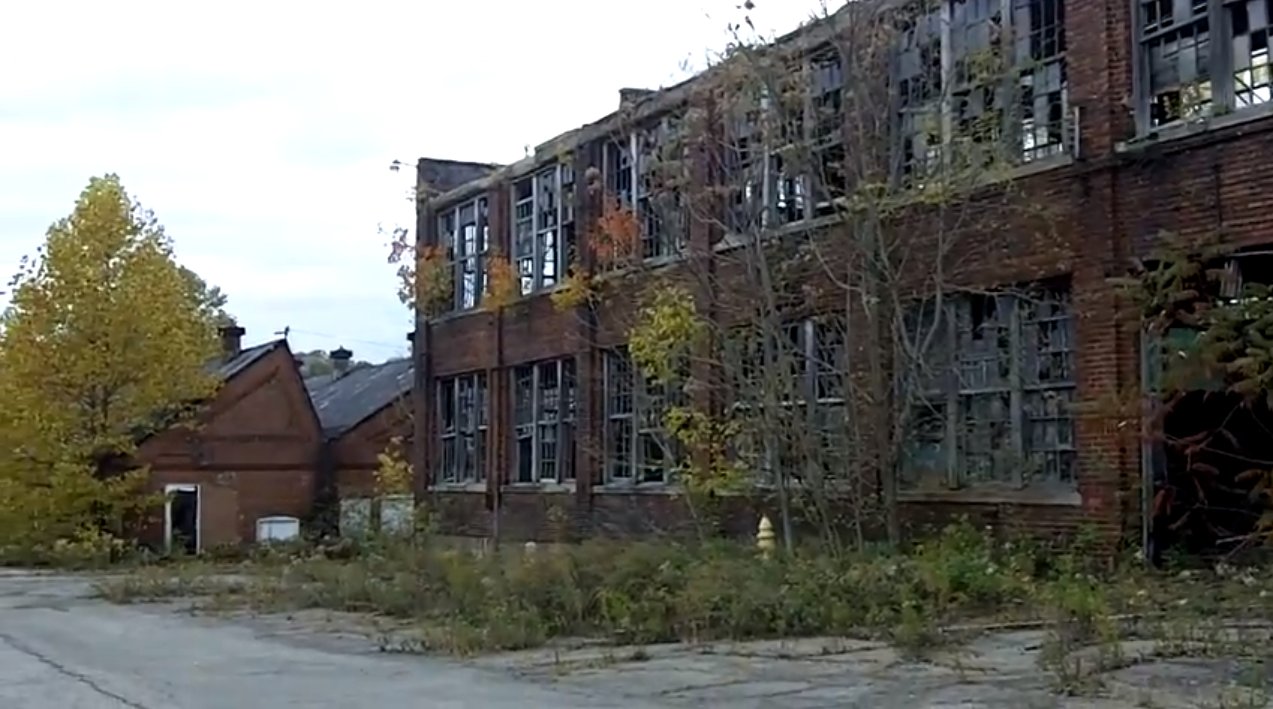
Occupying the Rust BeltAn abandoned building in Youngstown, Ohio

The surefire method to find occupations in small cities is to head for the center of town. After leaving Philadelphia on our Occupy America tour, we drive an hour north to Allentown. Pennsylvania’s third-largest city at 118,000 residents, Allentown has been weathered by years of deindustrialization in the steel, cement and textile industries that once made it an economic powerhouse.

Along MacArthur Boulevard, one of Allentown’s main drags, tidy but weary brick row homes line outlying neighborhoods. Close to Center Square, site of the requisite Civil War monument, the neighborhoods are heavily Latino and buildings exhibit signs of disrepair.

Occupy Allentown has taken up residence in Center Square, inhabiting one of the four red-brick plazas on each corner. There are a handful of tents, a well-supplied kitchen pavilion and an information desk. A large blue and gray nylon tent, which 12 people crammed into the first night of the occupation, has laundry hanging off a clothesline in back and a cardboard sign on the front that reads “Zuccotti Arms,” in reference to the original Wall Street occupation.

We’ve come in search of Adam Santo, said to be the local leader of a leaderless movement. A handsome, boxy-glassed youth a few years out of college, Santo says he knew about the planning for Occupy Wall Street prior to Sept. 17.

“I wanted to go to New York, but I’ve been unemployed and finances were tight, so I thought wouldn’t it be cool to have an occupation in the Lehigh Valley,” where Allentown is nestled. Eight months earlier he and three co-workers were laid off from their jobs at a local bank because of a “lack of work.”

Santo says when Occupy Wall Street “really took off. I thought, I’m going to make this take off in the Lehigh Valley, gather support, get people into the streets.” Santo set up a Facebook page on Sept. 30, the day before the 700 arrests on the Brooklyn Bridge, and “harassed my friends to join.” Next, he designed, photocopied and handed out thousands of fliers to spread the word.

I mention Asmaa Mahfouz, the woman who helped ignite Egypt’s uprising with powerful video blogs and by handing out thousands of fliers in the Cairene slums. He wasn’t familiar with her story but he does take Egypt’s revolution as inspiration.

Occupy Allentown is very much defined by the local. According to Davina DeLor, a 39-year-old freelance artist who is painting slogans on her tent when we encounter her, residents initially assumed the occupation was in protest of a planned hockey arena, which she says “they are using our tax money for.”

It’s one of those familiar enterprises of our time: socialism for the well-to-do. Allentown is using eminent domain to buy up businesses next to the encampment – including a Wells Fargo branch – that will be demolished to build an 8,500-seat arena for the Phantoms, a minor league hockey team. The city has authorized borrowing up to $175 million to pay for the multi-use facility, while the Phantoms’ team owners are willing to throw in perhaps 10 percent of the cost.

While anger is widespread over what is seen as shady political dealings for a taxpayer-funded stadium that will displace dozens of local businesses, many residents are more consumed just trying to survive the grinding economic crisis. Allentown’s official poverty level in 2009 was 24 percent, twice the state average.

In a departure from big-city occupations like the one in New York City, beat cops are openly supportive, says Santo. “They drive by, they wave, they honk. They give us handshakes and hugs … because they realize they are part of the 99 percent.” Local clergy are encouraging their congregations to donate goods and “[supply] us with warm bodies, which we definitely need,” says Santo.

At the same time, local conditions have limited the growth of the occupation. DeLor says many supporters have to juggle multiple part-time jobs, which limits the time they can spend protesting. During the week the number of campers and occupiers dwindles. This also may be why the day we were there, Oct. 18, the occupiers were mostly unemployed or retired.

Despite a Latino community that comprises 41 percent of Allentown residents, few appear to be involved in the occupation. Santo speculates that newer Latino communities aren’t as active possibly due to fears of immigration status and cultural divides, while younger Latinos are not involved simply because “it’s just not the cool thing to do.”

Occupation with an expiration date

Youngstown, Ohio, is an elegiac city a few hundred miles to the west of Allentown. What was once the manufacturing district  is a mausoleum of industry. A brick smokestack stands sentinel over acres of cavernous shells that once poured out streams of goods. Crumbling brick buildings sprout trees two stories up, while inside pancakes of concrete drip toward the ground, suspended precariously by a bramble of rusted rebar.

Demolition is one of the few signs of economic life. Starting in 2006, the city tripled its budget for razing abandoned buildings. In an open-air yard in the industrial quarter, heavy machines whine and billow exhaust as they pound large concrete slabs, surrounded by small mountains of rubble sorted according to size.

With more than 43 percent of the land vacant, Youngstown is slowly being erased. In some neighborhoods boarded-up houses and empty lots island the remaining inhabited homes, which shrink behind spreading foliage lest they be next.

Since 1950, the population has declined from a high of 218,000 to less than 67,000 today. The poverty rate is a stratospheric 32 percent, and the median value of owner-occupied homes is a paltry $52,900. Manufacturing dropped from 50 percent of the workforce in 1950 to 16 percent in 2007. This includes a staggering loss of 31 percent of manufacturing jobs in the region from 2000 to 2007 – and that was before the economy fell off the cliff.

At the downtown crossroads, Occupy Youngstown has taken up position in the shadow of three different banks, including a Chase branch. The occupation is a latecomer, having started on Oct. 15, with a rally more than 400 strong at its peak, according to Chuck Kettering Jr., an aspiring actor who has been unemployed for a year from his previous position as an HVAC technician.

“We were once a huge steel city for America,” says the cherubic, 27-year-old Kettering. “In the 1970s they started closing up all our steel mills, taking all the jobs and shipping them down south and overseas where labor is cheaper. Youngstown’s been a city that has been going through this economic struggle for almost 40 years now, and I think we have a valid voice of addressing these issues on a national scale.”

His family is living proof of the toll of deindustrialization. In a phone interview, Chuck Kettering Sr. calls himself “the poster boy for the Rust Belt.” A Youngstown native, he went to work in 1973 at age 19 and worked at two local U.S. Steel plants that shuttered, one in 1979, the other in 1982. Next, he landed a position with Packard Electronics in 1985 making electrical components for GM cars. After GM spun off Delphi in 1999, Packard was subsumed by the auto-parts maker. The company started moving jobs overseas.

“Local operations were pressured by wages, and most operations moved south of the border” because of NAFTA, he says. Following Delphi’s bankruptcy in 2008, Kettering and some co-workers were given a one-time chance to work for GM itself and keep their wages, benefits and pensions.

“It was a no-brainer,” he says, but their seniority did not transfer to plant assignments. Despite nearly 25 years at Packard and Delphi, Kettering says, “I found myself at the age of 54 starting at the bottom, working alongside 21-year-olds trying to keep up on the line. Many of us who transferred were not spring chickens and it was hard to keep up.”

His wife, hired by Packard in 1979, worked her way into management, was forced to retire after 30 years with a monthly pension that was slashed in half to $1,600 and with expectations of further cuts. Now he’s on disability.

“I’m really proud of our local guys,” he says. “The police and the firefighters really support the occupy movement. Our mayor supports it. We have a united front here in Ohio.”

Unlike the seven other occupations I have visited, Occupy Youngstown embraces electoral issues. Kettering and other occupiers wave signs and wear buttons opposing Issue 2, which would strip some 350,000 public sector workers of collective bargaining rights.

Karen Joseph, a soft-spoken 59-year-old mother of two whose family spends one-third of its household income on health insurance, is by no means the only one who is against Issue 3, which would exempt Ohio from the incoming national healthcare law.

Everyone is against privatizing the Ohio Turnpike, which is being pushed by Republican Gov. John Kasich. All the occupiers we talk to express dismay at the prospect of hydrofracking in Mill Creek Park, which Kettering describes as “the jewel of the area with waterfalls, streams and lots of wildlife.”

This occupation comes with an expiration date. The city asked the occupiers to “take down the tents before business hours on Monday, Oct. 17, when the banks were opening,” according to Chuck Kettering Jr. He says they complied, but Occupy Youngstown still maintains a 24-hour presence and has pledged to do so until Nov. 8, Election Day.

Toledo blues

In Toledo, Ohio,  occupiers are struggling with trying to live outdoors in a harsh climate because the city is making life difficult for them. Christopher Metchis, an energetic 19-year-old student who will be attending the Musicians Institute in L.A. next spring, explains that City Hall has denied them use of tents and generators, and dispatched city crews to cut off their access to electricity. He has just spent the last two nights outdoors in a wind- and rainstorm, huddling under tarps with a few hardy souls on a grass plaza in the downtown business district near the baseball stadium for the AAA Toledo Mud Hens.

While we talk, a few people come by to help with consolidating supplies, folding tarps, stuffing blankets into a crib and kitchen work. A local pastor has also stopped by with words of support. Candice Milligan, a 30-year-old trans woman, says the living conditions make it “difficult for people who aren’t able bodied.” She also admits that concrete support is not as forthcoming because much of the public does not know what Occupy Toledo is trying to accomplish. And they have to contend with a police force that is indifferent at best and a local media that is hostile at times.

Awareness of the occupation movement coexists with despair. During dinner one evening at an Italian restaurant in Toldeo, our waitress, Dawn, tells us she supports it because “the people need a voice, not just the corporations and politicians.” A few minutes earlier, she lit up in excitement when she found out we are from New York, but her face crumpled instantly, exclaiming quizzically, “But now you’re here?!”

It has been a common sentiment on the trip so far. After decades of economic decline, Americans in this part of the country are beaten down. Their prospects are limited. Civic embarrassment is more prevalent than pride. They lament the end of the “American Dream,” the notion that hard work and sacrifice would be rewarded with a comfortable retirement and a better life for their children and grandkids. But in the hundreds of occupations around the country they have found a space where they can speak of their struggles, burdens and aspiration. People listen and they hear similar stories, creating a genuine sense of community. They say it is giving them dignity. And perhaps most important, it is giving them hope.

Arun Gupta, a New York writer and co-founder of Occupy the Wall Street Journal, covers the Occupy movement for Salon.

Dissent, à la Québécoise

The student strike in Quebec has generalized, and solidarity is spreading in the U.S.

  • more
    • All Share Services

Dissent, à la QuébécoiseDemonstrators in Montreal on Tuesday. (Credit: Reuters/Christinne Muschi)

For the past eight months, when chants of “Anti-Capitalista!” have echoed through New York streets, they’ve tended to emanate from crowds with a penchant for black clothing. But on Tuesday night, when once again a march of around 300 snaked through the streets around Washington Square Park, the color scheme was different: red flags, red banners, red clothes, red masks and little red felt square pins adorned the marchers — a mixture of long-term Occupy participants, students and others taking the streets and donning some red in solidarity with the Quebec student strike.

Reminiscent of ad hoc Occupy actions last fall, the march in Manhattan blocked streets and confused police attempting erratic, aggressive arrests. It was, however, just a small nod to the action taking place in Montreal. There, up to 500,000 people took to the streets on Tuesday in what’s being called the largest act of civil disobedience in Canadian history, marking the 100th day of a powerful student strike.

The situation in Quebec has escalated since February from a student strike over planned tuition hikes — effectively shutting down universities — to a state of generalized insubordination and anger at a government adopting draconian measures to stifle dissent. A year and a half ago, the Quebec government decided to raise university tuition fees — currently the lowest in Canada — by 75 percent over a five-year period (a plan that, despite negotiation efforts by student unions, was revised to an 82 percent rise over seven years). In response, thousands of students and faculty members went on strike and struck a blow to the province beyond the university gates, taking to the streets and building numbers.

“I don’t think many people, including the [Quebec] government, anticipated that this would escalate and continue everyday since March 22,” Danna Vajda, 29, a former student of Concordia University Montreal, who attended the New York solidarity march, told me via email. She noted: “By the time the government was willing to negotiate with appropriate student associations, earlier this month, the position of many students had already fermented into something much more committed to achieving the goals of the strike than getting back to business as usual and finishing the semester, and the deal offered by the government was rejected by over 80 percent of the student associations.” Vajda added too that the strike is widening its nets, with students in neighboring Ontario considering striking in the fall semester and numerous unions in Quebec potentially joining “what is now becoming an ‘unlimited general strike.’”

In a move indicative of a leadership grasping for control, the provincial government passed Law 78 in mid-May. Attempting to end the strikes and force the reopening of the universities, the law in no uncertain terms makes protest illegal. Groups planning demonstrations with more than 50 expected participants, according to Law 78, must inform the police in writing at least eight hours in advance of the protest with details of time, location, size and duration. More perturbing still, expressing support for demonstrations and strikes deemed unpermitted under Law 78 renders one guilty of that offense and liable to face the same steep fines. Québécoise have been targeted, tear-gassed and arrested by police for the mere act of wearing the red-felt square on their clothes (the symbol of solidarity with the strike). But on Tuesday, the response to Law 78 in the streets of Quebec was unequivocal: a 500,000-strong middle finger.

What the Quebec uprising means this side of the border is yet to be seen. As was the case with the Arab Spring and mobilizations in public squares and streets in Greece and Spain, how actions in Canada might shape or inspire actions in the U.S. becomes a question of resonance. And the grounds for resonance here are strong: relative to U.S. education costs, the proposed tuition hikes in Canada seem almost negligible. The red square of the student strike — symbolic of “being in the red” because of student debt — might resonate more profoundly with students in the U.S. than anywhere else worldwide. Aside from Occupy efforts to build student debt strike campaigns, the student occupations at the University of California in 2009 over tuition hikes laid much of the ground from which Occupy emerged.

Writing on AlterNet last week, two student activists from the City University New York argued that the lesson to import from Quebec lies in the importance of institutionalizing student power: “We believe that if students in the United States hope to have the kind of impact on our universities that we witnessed in Montreal, we will need to first establish radical, federated student unions here at home, organizations capable of replacing our currently weak systems of student participation.” For many student organizers, this will be the take-away from Quebec.

I want to urge a different lesson entirely. Vajda noted, “Many students did not think at the outset that they would be sacrificing the semester worth of work, tuition, fees, but I think increasingly it is becoming clear that the stakes are high and those sacrifices can create leverage to work toward shaping a different future that will not follow the neoliberal model of debt-fueled education.” Crucially, the increasingly radical strike has been — and continues to be –  a daring experiment for those involved, far surpassing the assumed remit of the original student walkout. The conviction and strength of the strike, according to Vajda, grows every day as people continue to meet and act in the streets. Law 78 only served to galvanize and generalize this experimental dissent.

The powerful message from Quebec, for me, is not the importance of strong student leadership. Rather, it is that thousands of individuals have taken risks, broken with their daily routines and found each other in the streets (despite numerous social and political divisions) to engage in a radical political experiment with no clear endpoint. One of the main Twitter hashtags relating the Quebec actions is #manifencours, an abbreviation of “manifestation en cours, meaning simply “demonstration in the streets.” As the proliferation of the phrase suggests, the situation in Quebec is no longer just about negotiating tuition fees; it’s a manifestation with an open trajectory.

Occupy for many months was a radical experiment in challenging business-as-usual and reclaiming space as public. And at times it too was emboldened by police repression. Although police response may not have been codified into a measure like Law 78, the crackdowns on Occupy encampments and actions — even legal, subdued demonstrations on sidewalks — made clear that dissent in this country would be treated as illegal. But the lack of something as concrete as Law 78 here is important: The attempts to control protest have thus been more insidious, although no less brutal, coordinated and consistent. If people in this country look to Canada and see the defiance of Law 78 as strong grounds for hitting the streets, they too should see those grounds in the various crackdowns and in the persecution of Occupy participants and anarchists. It goes without saying that if there are grounds for radical student action anywhere, they are in the U.S. We — students and non-students alike — are “in the red” as much as and more than our neighbors to the North; and we, like them, should be in the streets.

Continue Reading Close

Natasha Lennard covers the Occupy movement for Salon. A British-born, Brooklyn-based journalist, she has been covering Occupy Wall Street since before the first sleeping bag was unrolled in Zuccotti Park. One of the first journalists arrested at an Occupy action, she has managed to enrage Andrew Breitbart, Rush Limbaugh and Glenn Beck. You can follow her on Twitter (@natashalennard), and email her any Occupy updates/videos/ideas to natasha.lennard@gmail.com

Protest music’s odd conservative turn

A 100-track, four-CD Occupy collection assembles generations of icons. So why does it sound shapeless and safe?

  • more
    • All Share Services

Protest music's odd conservative turn

“In this hour of the ever-changing season, may our tears not douse the fire in our hearts.”

That’s a guy named Michael Pless singing “Something’s Got to Give.” Even without hearing the song, you can surely imagine the essential elements: Plaintive acoustic strumming, an earnest vocal, and an air of polite outrage to match the stilted syntax and hoary platitudes. Welcome to “Occupy This Album,” the collection of protest-minded songs released by Occupy Wall Street. Sprawling across four CDs and a slew of bonus digital tracks, this behemoth set includes 100 (why not 99?) new and previously released tracks from artists representing a range of generations, genres, backgrounds, settings, and styles. Folkies join hands with rappers; ominous post-rock marches alongside peppy radio pop. There’s spoken-word poetry, tribal percussion, earnest singer-songwriter fare. Even a bit of jazz.

Especially with Occupy reaching a crossroads in summer 2012 — a time when it needs to reassess its ideals, its accomplishments, its methods and its artifacts — “Occupy This Album” plays like a state-of-the-field survey of the protest song. From Jeff Mangum covering the Minutemen to the anonymous drum circles that soundtracked the demonstrations in real time, music has been a constant presence in the movement, although it’s not quite clear what role it has played. The new album portrays a movement with a broad scope and an admirably varied constituency, but the same criticisms that have been leveled against Occupy can also be applied to “Occupy This Album:” There is general unease but no clear direction forward. There is outrage but no plan. There is deep feeling but no clear message.

Ostensibly, there should be something on “Occupy This Album” for everyone to love, but that also means there is more than enough here for everyone to hate. It’s an unwieldy tracklist, almost daring you play it front to back. Of course, it’s pointless to review a 100-track release the same way you would approach a studio album, where functionality and some sense of logical progression are crucial. But there’s no consistent development of political or musical ideas weaving these songs together, nothing to link them or to justify this particular sequencing. As a result, “Occupy This Album” cannot make a statement as an album. In one sense, this release mirrors the leaderless ethos of the movement, which stridently preserves the democracy of the demonstrations. While that idea has certainly energized the Occupy protest, it makes for an amorphous blob of music and a messy, often frustrating listening experience.

But they mean well, right? It’s a charity album after all, with each disc sold separately and with all proceeds benefiting Occupy directly. You’d probably be better off contributing directly to the cause and just making your own mix of politically minded music. You might even have some of these songs in your iTunes already, although why you’d want to include Lucinda Williams’ drippy “Blessed” or Mogwai’s interchangeable “Earth Division” is beyond me.

The music that actually is new — that purports to find direct inspiration in either the righteousness of the demonstrators or the plight of the 99 percent — is generally unimaginative, hokey, disappointingly safe. Most of these artists address these economic issues either through narrative or through high-minded rhetoric. The latter produces the most lackluster results: Jackson Browne’s “Which Side Are You On?” which he has been touting for several months now, turns out to be political white noise, a gentle fist bump to the like-minded that barely puts across either side of the debate. At least it’s better than My Pet Dragon’s epiphany on “Love Anthem”: “Only love can save us now.” To their credit, they sing it like they might actually believe it.

The storytellers have more success, if only because they’re willing to entertain a bit more grit, a bit less blind hope. Featuring Joan Baez and Steve Earle, James McMurtry’s “We Can’t Make It Here” sounds downright curmudgeonly as it surveys the state of the working class in an economy that regularly sends its manufacturing jobs overseas. The song, however, goes a bit overboard when the trio decry litterbugs and graffiti artists.

One of the true standouts among these 100 tracks is Richard Barone’s ditty “Can I Sleep on Your Futon?” about a veteran-turned-singer who couch-surfs from one generous soul to the next. The verses are specific and soulful, as through he’s derived them explicitly from lived experience, and in that regard, the song could function as commentary on the music biz. But Barone stumbles over that massively awkward chorus, “Can I sleep on your futon?” It’s hard to imagine a crowd of protesters singing along.

If there is one overarching theme here, it is, vaguely, “history.” The past informs and even defines this music. Even the very idea of this type of compilations seems like a throwback to the CD’s heyday in the 1990s, when seemingly every charity, from NARAL to the Red Hot Organization, had its own release. It’s an impression reinforced by much of the music, especially hip-hop tracks by Born I Music and George Martinez & the Global Block Collective, whose lyrics and beats sound like they were scavenged from 1994. (For a better example of how hip-hop can address political themes, check out Killer Mike’s new track “Reagan.”)

Of course, there is a lot of folk music on “Occupy This Album.” That style has proved one of the most politicized musical forms of the 20th century, as lefties in the 1930s and 1940s adopted labor songs as battle cries. Clean-scrubbed, buttoned-up folkies like the Kingston Trio had some chart success in the 1950s, but they were quickly rendered obsolete by the Village bohemians reimagining the music as a vehicle for countercultural sentiments. That’s the model so many Occupyers are reverently appropriating, never suspecting that it might not be a natural fit for 21st-century dissent. The folk revivalists of the 1960s drew from the past as well, but took pains to update the music to the times: The mere fact that Dylan wrote new songs in this old style was revolutionary, alienating an older generation of folkie purists.

“Occupy This Album” obviously represents a counterculture, but too many of the artists are too caught up in role playing the past, which seems like an especially boomer enterprise. Michael Moore (yes, that Michael Moore) performs the most chipper version of “The Times They Are A-Changin’” imaginable, one that seems wholly unaware of the gritty realities of 2012, much less of 1964. (The less said about his skiffle version of the song, a hidden track on disc four, the better.) Perhaps the one artist who understands how to plumb history for present-day relevance is Loudon Wainwright III, whose wry “The Panic Is On” updates an 80-year-old tune originally penned by Hezekiah Jenkins (the cover originally appeared on Wainwright’s album “Ten Songs for the New Depression”). It’s an unusual artifact from the early 1930s, but there’s a sneaky observation about class disparity that sounds more disgusted and potent than anything else on the album.

Perhaps the worst thing that can be said about “Occupy This Album” is that the music is deeply conservative. There are so few moments that grab your attention or make you see the world differently. When Occupy already seems to be in danger of losing momentum, it’s hard to say whether the movement has failed to inspire these artists or the artists have failed to document the movement.

Continue Reading Close

First NATO protest targets Obama

A small rally kicks off a week of protests in Chicago and makes clear the president is a target in his city

  • more
    • All Share Services

First NATO protest targets ObamaRahm Emanuel and President Obama (Credit: Reuters/John Gress)

In the first week of November 2008, tens of thousands of people gathered in Chicago to watch dewy-eyed as Barack Obama won the presidential election, believing, as the then-president-elect said in his victory speech, that “this time must be different.” This week, the Windy City is welcoming large crowds again — but as was made clear by a small protest action Monday — the president is not the sweetheart of these Chicago masses, which are assembling for a week of actions and protests surrounding the NATO summit.

Eight people were arrested Monday during a protest at Obama’s 2012 campaign headquarters. The rally, organized by social justice and anti-war group Catholic Workers, was the first organized demonstration — and the first instance of arrests — relating to the NATO counter-protests. It was small (just over two dozen participants assailed security and stormed the campaign headquarters and read a statement inside) but set a tone for actions later this week in asserting that the president and Democratic Party are protest targets alongside NATO generals and corporations like Boeing, who receive large government defense contracts.

For months the question has hovered over Occupy supporters, many of whom are attending NATO protests, partly organized by Occupy Chicago, from across the country: How many of them will manifest as Democratic voters come November? Will the energy that has brought hundreds of thousands into streets and parks across the country over the past half year be co-opted by the party machine? Of course, the small Catholic Workers demonstration is no indication either way. It will be interesting to watch, however, as the week of permitted and unpermitted protest actions continue in the city Obama calls home, the ways in which Mayor Rahm Emanuel and the president are willing to crack down on the dissenting crowds whose support they will ask for in November.

Continue Reading Close

Natasha Lennard covers the Occupy movement for Salon. A British-born, Brooklyn-based journalist, she has been covering Occupy Wall Street since before the first sleeping bag was unrolled in Zuccotti Park. One of the first journalists arrested at an Occupy action, she has managed to enrage Andrew Breitbart, Rush Limbaugh and Glenn Beck. You can follow her on Twitter (@natashalennard), and email her any Occupy updates/videos/ideas to natasha.lennard@gmail.com

Occupy: A Tea Party for the left?

The Mississippi Freedom Democratic Party didn't succeed by electing candidates. Occupy doesn't need to either

  • more
    • All Share Services

Occupy: A Tea Party for the left?An Occupy Wall Street demonstrator chants during a march to celebrate the protest's sixth month, Saturday, March 17, 2012, in New York. (AP Photo/John Minchillo) (Credit: AP)
This article originally appeared on AlterNet.

As long as there has been a thing called Occupy Wall Street, there have been people who’ve suggested it should become the left’s version of the Tea Party. Josh Harkinson’s piece is a notable contribution to the conversation because it comes after eight months of in-depth reporting on the movement. Harkinson, like Jennifer Granholm, suggests that Occupy should recruit and run candidates, so the left has champions in Congress and can credibly threaten less ideologically aligned Democrats. According to this logic, it doesn’t matter if Occupy does this itself or essentially outsources the job to our progressive allies — the point is to find ways to elect more good Democrats.

AlterNetThe idea of a progressive Tea Party was totally my jam before Occupy started. Like Harkinson, I didn’t see how the left could create real change in America without taking control of the Democratic Party. Now I think it’s important to recognize that the problems we face as a country can’t be solved by electing more Democrats, or even by electing more good Democrats. A progressive Tea Party would be a welcome addition, but it wouldn’t be nearly enough to create the kind of change we need.

If Occupy tried to start a left Tea Party, we would be following in the footsteps of several progressive movement efforts that came up short. Howard Dean’s presidential campaign turned into Democracy for America to reclaim the “Democratic wing of the Democratic Party,” the Progressive Change Campaign Committee explicitly references the DCCC, andRebuild the Dream originally billed itself as the progressive Tea Party. I have worked for each of these organizations and have lots of respect for their work. But unfortunately, none of these projects, despite their many successes, have managed to mount a serious national effort to take out bad Democrats and replace them with good ones. They are constrained by the lack of a grassroots base in many congressional districts and big donors reluctance to fund challenges to Democrats. Even big, collaborative efforts to take out bad Democrats have a relatively poor record (See Sheyman, Ilya; Halter, Bill; or Lamont, Ned).

Occupy is less well suited than the Progressive movement to overcome these challenges. Most occupiers I know aren’t interesting in learning how to raise money, knock on doors, or run campaigns. Starting a progressive Tea Party is a completely legitimate, useful goal — but it’s something for the progressive institutions to take on. New York state and city provide a good model for how this can work harmoniously: the Working Families Party is a unified progressive block within the Democratic party. They support Occupy and we support them on the issues. Together, we won a huge, unexpected victory for the millionaires tax.

Despite the hard work of our progressive allies, the unfortunate reality is that our political system as presently constructed is simply incapable of responding to people’s needs. The election of the most progressive Democratic nominee of the past 30 years and a Democratic super majority in Congress resulted in relatively little change in American political economy, even during a time of massive economic crisis. The tepid response showed our political system was designed to serve the whims of the market, and no politician has the power to do much about it.

My generation doesn’t put all, or even most, of the blame for this state of affairs on President Obama. We don’t hate the player, so much as we hate the game. I believe Democrats are better than Republicans, because Democrats care more about the lives of gays, women, and people of color. I also believe everyone should all vote, because not voting would hurt people that I care about. That being said, we won’t just win by getting new players — we need to change the game. The system is fundamentally incapable of healing itself.

Occupy is hardly alone in believing our political system is in a state of crisis. Congress’ approval is at 9 percent. Many have written that our 18th Century political system has proven itself uniquely incapable of responding to external circumstances, including noted radicals likeJames FallowsEzra Klein and Matt Yglesias. The presidential system is prone to gridlock (and, frankly, falling apart) and our byzantine, bicameral legislative system makes it incredibly difficult for even winning parties to put their agenda into law. The crisis of parliamentary democracy taking place in Europe is happening in America as well.

Occupy grew at such an exponential rate because it spoke to people’s sense that the rules of our society are deeply unfair and the political system couldn’t do anything about it. In the midst of systemic failure, only Occupy was talking about systemic change. Occupy transformed the public debate by naming the problem — inequality of wealth and power — and the cause – the power of Wall Street. More important than our discursive accomplishments, we showed what an independent, citizen-led social movement for equality and democracy could look like in America. I don’t want to argue we’ve yet built that movement, because it’s still very much a work in progress. By giving people the space to connect, Occupy showed that people power is the only force capable of shaking the foundation of our corrupt system.

Only Occupy can provide the space, literally and figuratively, for this conversation. The Occupy movement would derelict of duty if we focused on the electoral at the expense of putting pressure on the system as a whole. The entirety of civic life can not be reduced to a get out the vote campaign. The left needs strategies that take aim at all the ways neo-liberalism breaks down our communities. The inherent conservatism of America government, and the limitations of electoral organizing, means we need inside and an outside strategies.

Occupy has already inspired a new generation of social justice leaders to build an inclusive, radical movement that also speaks to the mainstream. We continue to push institutional groups towards more confrontational forms of resistance, bring new people into the struggle and provide a unifying message. Like the civil rights, women’s rights, environmental movements before us, we can’t afford to ignore the electoral realm, but we also shouldn’t expect to succeed by voting alone. The Mississippi Freedom Democratic Party didn’t succeed by electing candidates — it succeeded showing the limitations of the electoral system. Occupy should aim to do the same.

Max Berger is an organizer with the Occupy movement.

Continue Reading Close

“Occupy Cop” under attack

Retired Philadelphia Police Capt. Ray Lewis could lose his life insurance for wearing his uniform to a protest

  • more
    • All Share Services

Ray Lewis (Credit: AP/Joseph Kaczmarek)

On Occupy Wall Street’s Nov. 17 Day of Action, the NYPD arrested nearly 250 protesters. Ray Lewis, however, stuck out: the retired Philadelphia Police captain was dressed in uniform. He was holding a sign that on one side encouraged people to watch the Charles Ferguson financial crisis documentary “Inside Job.” On the other: “NYPD Don’t Be Wall Street Mercenaries.”

“You have to get rid of corporate America,” Lewis told occupiers in Zuccotti Park. “You have to get rid of the powers that they have … As long as they have the power they are going to continue to exploit and manipulate the working class.”

The blowback from the police establishment was swift: A Nov. 23 letter from Philadelphia Police Commissioner Charles Ramsey demanded that Lewis “immediately cease and desist wearing, using or otherwise displaying any official Philadelphia Police Department uniform, badges or facsimiles thereof or any official departmental insignia.”

Ramsey soon backed down, citing Lewis’ First Amendment rights. Not so for the politically powerful Fraternal Order of Police Lodge 5, led by president John McNesby, which has continued its campaign against Lewis.

FOP pension director Henry Vannelli has filed a grievance that could prompt Lewis’ expulsion from the FOP, cutting him off from the life insurance and free legal support offered to current and retired officers.

The FOP, which frequently and vociferously defends police accused of excessive force and other misdeeds, must really hate Lewis. As Philadelphia Daily News reporter William Bender put it in a recent story,

It’s usually tough to get kicked out of Philadelphia’s Fraternal Order of Police.

You really have to screw up.

Worse than, say, the cop who allegedly beat his girlfriend with a closed fist and left her a voice mail threatening to ‘stomp your f—ing heart out.’ Or the officer convicted of child endangerment for pointing a loaded Glock at a kid who changed the radio station in his truck at the Police Academy.

Or the cop who allegedly forced a suspect to perform oral sex on him in his police cruiser.

Indeed. The FOP, which did not respond to a request for comment, makes no secret of the fact that its attack on Lewis is an extraordinary one: “It’s quite unusual,” Vannelli told the Daily News. “We had to dig into the books to see what we could do and and couldn’t do … We don’t want that guy around.”

McNesby even continues to insist that Lewis should be arrested, even though Commissioner Ramsey has long since clearly acknowledged that one is not “impersonating a police officer” if they are “not pretending to be a cop.”

“That is so egregious of a thing to say, because what he’s telling all of those officers in Philadelphia is that they should violate the law,” Lewis tells Salon. “There’s enough violation of people’s rights already.”

The same day that Bender’s report was published, the Daily News’ Jason Nark wrote a companion article on an eccentric lawyer and donor to police causes named Jimmy Binns, who, well, likes to dress up like a cop. A lot. It’s even alleged that he once illegally sported a handgun — but was not arrested by Margate, N.J., police because he’s a friend of the police chief. According to the Daily News, that crime carries a mandatory three- to five-year sentence. And Binns has illegally parked his car with an “Official Business” placard from the commissioner’s office lying across the dash, according to Temple University journalism professor George Miller.

Lewis continues to protest. In uniform. Last week he was in Center City Philadelphia, protesting outside police and FOP headquarters. He says that FOP leadership , a major force in city politics, depends on corporate donations to finance its union election campaigns and quarterly magazine.

“The major part of the movement is to hold corporations accountable and to stop them from having so much control over lives and the earth,” he says. “If John McNesby is a receiver of the favors of corporate America, then I’m going to be the number one enemy. Because I’m a tactical warhead.”

Continue Reading Close

Daniel Denvir is a staff writer at Philadelphia City Paper and a contributing writer for Salon. You can follow him at Twitter @DanielDenvir.

Page 1 of 67 in Occupy Wall Street