
European Financial Crisis

Should Greece reject the bailout?

The referendum lets citizens decide their country's fate. If only we'd been able to vote on bailing out Wall Street

  • more
    • All Share Services

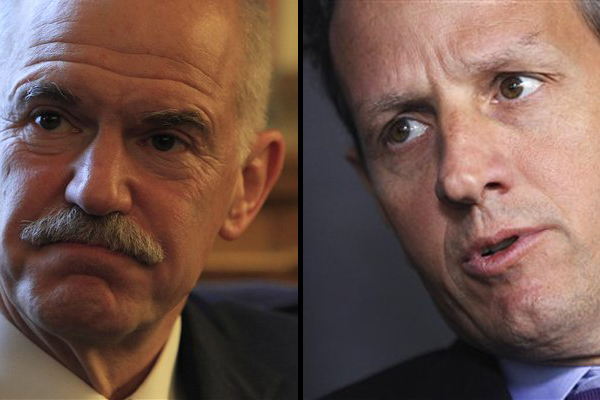
Should Greece reject the bailout? Left: Greek Prime Minister George Papandreou; Right: Tim Geithner (Credit: AP)
This originally appeared on Robert Reich's blog

Which do you trust more: democracy or financial markets?

Greek Prime Minister George Papandreou decided in favor of democracy Monday when he announced a national referendum on the draconian budget cuts Europe and the IMF are demanding from Greece in return for bailing it out.

(Or, more accurately, the cuts Europe and the IMF are demanding for bailing out big European banks that have lent Greece lots of money and stand to lose big if Greece defaults on those loans – not to mention Wall Street banks that will also suffer because of their intertwined financial connections with European banks.)

If Greeks accept the bailout terms, unemployment will rise even further in Greece, public services will be cut more than they have already, the Greek economy will contract, and the standard of living of most Greeks will deteriorate further.

If Greeks reject the terms and the nation defaults, it will face far higher borrowing costs in the future. This may reduce the standard of living of most Greeks, too. But it doesn’t have to. Without the austerity measures the rest of Europe and the IMF are demanding, the Greek economy has a better chance of growing and more Greeks are likely to find jobs.

Shouldn’t Greeks be able to make this decision for themselves?

Of course, if Greek defaults on its loans, global investors (fearing that a default in Greece sets a dangerous precedent) may yank their money out of Italy. This would almost certainly bust several big European banks – and generate panic on Wall Street. That’s why Tim Geithner has been pressing Europe to bail out Greece.

We’ve been here before, remember? Here in the United States, at the end of 2008 and start of 2009. Wall Street had made lots of bad loans, and the question we faced then was whether to bail out the Street.

The difference is, we didn’t hold a referendum. Instead, the Bush administration told Congress the nation risked “economic Armageddon” if it didn’t immediately authorize a giant bailout of the Street – with no strings attached. Of course Congress hastily agreed. Hank Paulson, Ben Bernanke and Tim Geithner (as head of the New York Fed) then doled out the money. And the Obama administration (with Geithner installed as Treasury Secretary) gave out more.

So instead of allowing the Street to live with the consequences of its negligence, we bailed it out – and allowed the Main Streets of America to suffer the consequences.

If Americans had been consulted about the bank bailout, I doubt it would have happened the way it did. At the very least, strict conditions would have been placed on the banks in return for the money. The banks would have had to eat the losses of the predatory mortgages they sold, and help homeowners reduce those mortgages. They’d be required to improve the capitalization of small banks in communities across the country. They’d be forced to accept stringent new regulations, including resurrection of Glass-Steagall.

But Americans weren’t really consulted. It was an inside job.

As a result, Wall Street has prospered but the rest of the nation hasn’t. One out of four homeowners is underwater, owing more on their homes than the homes are worth.

And with the worst economy since the Great Depression, we’re now embarking on fiscal austerity. Either Congress’s super-committee comes up with $1.2 trillion of federal budget cuts that Congress agrees to – going into effect a little over thirteen months from now – or $1.5 trillion of cuts are made across the board. Meanwhile, states and cities have been slashing public services for the past three years.

So which is it? Rule by democracy or by financial markets? Based on what’s happened in America, I’d choose the former.

Robert Reich, one of the nation’s leading experts on work and the economy, is Chancellor’s Professor of Public Policy at the Goldman School of Public Policy at the University of California at Berkeley. He has served in three national administrations, most recently as secretary of labor under President Bill Clinton. Time Magazine has named him one of the ten most effective cabinet secretaries of the last century. He has written 13 books, including his latest best-seller, “Aftershock: The Next Economy and America’s Future;” “The Work of Nations,” which has been translated into 22 languages; and his newest, an e-book, “Beyond Outrage.” His syndicated columns, television appearances, and public radio commentaries reach millions of people each week. He is also a founding editor of the American Prospect magazine, and Chairman of the citizen’s group Common Cause. His widely-read blog can be found at www.robertreich.org.

Obama faces Armageddon

The trouble in Greece may be Mitt Romney's best shot at winning the White House

  • more
    • All Share Services

Obama faces ArmageddonPresident Obama, Angela Merkel and Francois Hollande

September 2008: The collapse of Wall Street giant Lehman Brothers provokes a worldwide economic meltdown.

May 2012: Barack Obama is warned before the Camp David G-8 summit that the financial maelstrom seizing Europe could turn out even worse. If much of Europe slides back into double-dip recession, as Britain has done, millions of Americans will be smacked hard, from Toyota workers in Kentucky to lettuce pickers in sunny California. And almost certainly, Mr. Obama will have turned over the keys to the White House come next January to the “vulture capitalist” Mitt Romney.

Here is the dreadful scenario that growing numbers of analysts fear: Long lines of Greeks, Spaniards and Portuguese pound on bank doors demanding to pull their money out before it is replaced by devalued drachmas, pesetas, escudos. Long-suffering Greek voters fail on June 17 to elect political parties that can form a governing coalition, and Greece takes a messy exit from the Euro. Europe’s already faltering financial system then collapses, sending the entire world into a long-lasting global depression for the new President Romney to tackle.

As one European insider put, the damage could be somewhere “between catastrophic and Armageddon,” while Mexico’s former central banker, Guillermo Ortiz, who was a leading candidate to head the International Monetary Fund (IMF), warned that a Greek exit from the Euro could have “an even bigger impact” globally than the Lehman bankruptcy. “If Greece leaves the eurozone, it could detonate a global financial crisis even worse than the 2008 credit crunch, dry up global trade financing and spur another U.S. recession.”

Seeing all this before the Camp David summit, President Obama joined with France’s mildly socialist president François Hollande in calling for new measures to stimulate European growth, against German Chancellor Angela Merkel’s insistence on austerity über alles. Obama went even further after the NATO summit in Chicago and urged European leaders to recapitalize their notoriously weak banks — and quickly. But his foresight will mean little if they do not come up with a hard-hitting and fast-moving plan of action, which their Wednesday night summit in Brussels failed to do.

Except for minor concessions toward growth, Merkel is standing firm on growth-destroying budget cuts. The “growth agenda” that Hollande and his Italian and Spanish allies put on the table looks like far too little and much too late to stop a global train wreck. And the bleary-eyed announcement early Thursday morning that European Council president Herman von Rompuy would draft a new plan for greater economic unification to back up the Euro looks like a belated step in the right direction that Europe should have taken years ago, preferably before creating the single currency, as American economists warned at the time.

In the meantime, the Euro is falling, investors are dumping Euro assets, and all eyes are on the June 17 do-over of Greek legislative elections, in which European leaders are playing a double game that will come back to haunt them. Publicly, they reaffirm their commitment to “do everything” to keep Greece from leaving the eurozone while framing the elections as “a referendum” for the Greeks to decide whether or not they wish to remain on the Euro. The major media echo the referendum line, and the once-great Le Monde even ran a front-page editorial by its director boldly proclaiming: “The Euro or the Drachma? It’s up to the Greeks to choose.”

In fact, all this poses a premeditated and not at all disguised threat to Greek voters: Back the conservative New Democracy and the Greek Socialist Party (PASOK), who conspired with Northern European banks and exporters to create the Greek mess and then agreed to the no-hope bailout deal forced on them by the European Union, the European Central Bank and the International Monetary Fund (IMF). Back the corrupt old guard who will do our bidding, the European leaders threaten, or we’ll push you even harder. And stay away from the left-wing SYRIZA coalition and its surprisingly effective leader Alexis Tsipras, a 37-year-old former student protest leader and Euro-communist.

Why threaten the Greeks? In their first election on May 6, SYRIZA came in second, and the latest polls now show them winning, but still without sufficient votes to form a government. They would, however, have the votes to make it impossible once again for the old guard to form a governing coalition. The party’s growing strength terrifies investors and poses a problem for European leaders, especially those from nominally socialist or social democratic parties that face similar challenges from a more radical Left.

Contrary to the pretense that Tsipras and SYRIZA want to leave the Euro, they have said again and again that they want to keep the Euro. They know that as many as 75 to 80 percent of the Greeks favor both the common currency and the European Union, and they might well refuse to leave even if the rest of Europe wants them out. Nothing in existing treaties permits expelling any country from the eurozone, and this gives Tsipras and SYRIZA a powerful threat of their own in rejecting the bailout deal, which has destroyed the Greek economy and squeezed ordinary Greeks beyond all endurance.

“We want to force European leaders to face reality,” Tsipras said Monday in Paris in the company of Jean-Luc Mélenchon, the leader of France’s Left Front, which is challenging Hollande’s party in legislative elections on June 10 and 17. “We want to raise awareness that we cannot drive any people in Europe into voluntary suicide.” If not stopped in Greece, Tsipras warned, the same treatment “will be exported to other European countries.”

In refusing even to renegotiate the “hellish” bailout deal, Tsipras is demanding that Europe and the IMF back down, an alternative that European leaders and their friends in the media portray as completely beyond reason. “It is not acceptable for a small country, by its refusal to play by the rules of the game, to continue to put the whole continent in danger,” concluded the front-page editorial in the pro-Hollande Le Monde. “It’s up to the Greeks to choose.” But if they make the wrong choice, the consequences will follow. And “without any qualms.”

That, in all its imperial splendor, is the threat Greek voters now appear to be ignoring. As Tsipras insists, Europe and the IMF will back down, and elements of their retreat are already visible. Hollande, who refuses even to meet with Tsipras, has suggested a willingness to give the Greeks additional time to cut their public spending, while a senior adviser to the German finance ministry suggests that Merkel will blink and make concessions to both Hollande and the Greeks after the elections. But nothing we’ve seen is anywhere near enough to put the Greeks – or the rest of Europe – back on the path to growth and away from leaving the Euro. That would take more than anything now on the table, and the smart money is betting Greece will leave the Euro by New Years Day 2013, with all the damage that will bring.

Continue Reading Close

Former BBC investigative journalist Steve Weissman is at work on a book, "Big Money: How Global Banks, Corporations, and Speculators Rule and How to Break Their Hold."

Frank Browning reported for nearly 30 years for NPR on sex, science and farming. He is the author of, among other books, "A Queer Geography" and "Apples."

Euro bonds to the rescue?

France's new president, Francois Hollande, believes he's found a solution to the euro crisis -- but others disagree

  • more
    • All Share Services

Euro bonds to the rescue?In this May 15, 2012 file photo, German Chancellor Angela Merkel, left, talks to new French President Francois Hollande in Berlin. (Credit: AP Photo/Markus Schreiber, File)
This article originally appeared on GlobalPost.

BRUSSELS – French President Francois Hollande thinks he’s found a solution to the euro zone crisis: the name’s Bonds. Euro bonds.

Unfortunately, Angela Merkel’s still playing Dr. No.

Global PostAt a euro zone summit on Wednesday, the new French leader plans to revive proposals for bonds that would be jointly issued by euro zone countries to spread national debt burdens across the whole currency bloc.

Hollande knows however that there is little chance the German chancellor will warm to the idea, even faced with the mounting concern that, without drastic action, the euro zone is headed toward a disastrous breakup.

“We spoke about it and both sides confirmed their well-known positions,” said France’s Finance Minister Pierre Moscovici, after meeting with his German counterpart on Monday to prepare the summit.

“Francois Hollande plans to put everything on the table … even those proposals that cannot be agreed immediately,” Moscovici added.

As the euro zone’s strongest economy, Germany knows that euro bonds will mean its taxpayers end up taking on debts incurred by Greece, Spain, Italy and other troubled economies.

That would ease the immediate pain in the southern Europe and the risk of the euro’s early demise. But, critics argue, euro bonds would reward financial sloppiness and relax pressure on the southerners to purse the painful reforms and fiscal discipline needed to get their economies back in shape.

And if the euro bonds didn’t work, paying out for the south could undermine Germany’s financial stability.

“That’s a prescription that comes at the wrong time and carries the wrong side effects,” Germany’s Deputy Finance Minister Steffen Kampeter told Deutschlandfunk radio over the weekend.

He contended that common financing was unlikely to be in place for a decade or more, and certainly would not be decided when Hollande holds his first meeting with other euro zone leaders at Wednesday dinnertime summit in Brussels.

Hollande is expected to get support for euro bonds from the leaders of Spain, Italy and many smaller members of the 17-nation currency bloc, as well as the European Union’s head office which put forward a plan for jointly issued debt last year.

“It would make economic sense to create a deep, liquid and stable market for government bonds with the joint issuance of common debt — euro bonds — at least, once we have reinforced our economic governance further to ensure fiscal prudence,” EU Economics Commissioner Olli Rehn said at a speech in Oxford last week.

Even were the Germans to agree, the legal complexities involved in introducing jointly-issued debt would mean that euro bonds are years away. However, supporters say an agreement to work on their creation could help calm jittery markets and convince voters in Greece and Ireland to support European debt-fighting plans when they go to the polls in the coming weeks.

A “no” vote in Ireland’s May 31 referendum on the new EU fiscal discipline treaty could leave the country cut off from further European rescue funding. However polls show a significant number of voters, disgruntled with the austerity that came as a condition for a 67 billion euro bailout in 2010, are considering rejection.

Greece is holding a fresh election on June 17, six weeks after a nationwide vote produced political stalemate after a surge in support for parties on the far left and far right who oppose austerity measures attached to a 130 billion euro rescue plan.

Polls show most Greeks want to keep the euro, but they are deeply dissatisfied with mainstream politicians and what they view as foreign-imposed hardship.

Although other European leaders have lined up to say they want Greece to stay in the euro zone, the Greeks have been warned that could be impossible if they vote for parties that refuse to implement the bailout conditions.

“There is a choice: you can either vote to stay in the euro, with all the commitments you’ve made, or if you vote another way you’re effectively voting to leave,” British Prime Minister David Cameron told the Greeks Sunday on the sidelines of the NATO summit in Chicago.

Britain is outside the euro zone, but like other world leaders, Cameron is acutely aware of the potentially catastrophic impact a Greek exit could have on the global economy – through the risk it could also force out larger economies such as Spain and Italy, causing the collapse of the euro.

With that in mind, Wednesday’s meeting of euro zone presidents and prime ministers is expected to place new emphasis on pro-growth policies.

Merkel, Hollande and other leaders are working to find common ground on ideas such as frontloading EU funding lines to support job-creation projects in Greece and other hard hit nations, or leveraging up to 60 billion euros in funding from the EU’s investment bank.

Hollande wants a “growth pact” to complement the EU’s new fiscal discipline treaty, and there’s talk of easing austerity by giving countries like Spain, France and Italy more time to cut budget deficits.

The hope is that a more growth-friendly agenda and some signs of compromise from Merkel will produce an “Hollande-effect” on Greek voters, boosting mainstream parties who support the bailout and euro membership.

Continue Reading Close

Europe faces difficult search for growth

European leaders desperately want to end their debt crisis. 2½ years in, they're still searching for solutions

  • more
    • All Share Services

Europe faces difficult search for growthFrench President Francois Hollande, left, talks with German Chancellor Angela Merkel at the North Atlantic Council meeting in Chicago during the NATO 2012 Summit Sunday, May 20, 2012. French Defense Minister Jean-Yves Le Drian is at back center. (AP Photo/Christophe Ena)(Credit: AP)

WASHINGTON (AP) — On paper at least, European leaders agree: They need stronger growth measures to help their economies expand out of their 2½-year-old government debt crisis. Figuring out exactly what those new steps might be will be the hard part.

Persistent political divisions — neatly bridged by a Group of Eight summit statement that advocates a mix of austerity and growth promotion — and lack of money stand in the way of a comprehensive European growth strategy. Analysts said markets were likely to look past the verbal deal, with news about Greece’s struggle to stay in the eurozone and an informal European Union summit Thursday in Brussels more likely to set the tone.

At Saturday’s G-8 summit, German Chancellor Angela Merkel — under urging from U.S. President Barack Obama and French President Francois Hollande — signed onto a statement that called for mixing painful cutbacks with growth-promoting measures to deal with a crisis that threatens the global economy.

The leaders warned that budget deficits have to come down. But they also acknowledged that an approach that’s based mostly on austerity and longer-term reforms can’t help countries out of recessions this year or next. That’s the approach that has dominated the continent’s German-led attack on the crisis since it erupted in late 2009, when Greece admitted its finances were broken.

“Our imperative is to promote growth and jobs,” leaders said in their final declaration after Saturday’s summit. While they “commit to fiscal responsibility,” the leaders also supported spending on education and public works. They also said heavily indebted countries should have the chance to fix their budgets in ways that take into account how well their economies are doing at the moment and support “confidence and economic recovery.”

They said little about specific steps and left exactly what to do up to individual countries, saying they recognize “the right measures are not the same for all of us.”

The statement comes as markets look ahead to an informal European summit meeting Thursday, and to a June 17 election in Greece. An indecisive poll May 6 left no Greek party with enough votes to govern. A new government that rejects the austerity required under bankrupt Greece’s €130 billion bailout from other eurozone countries could lead to it leaving the euro and spreading financial chaos.

Cornell University economist Eswar Prasad said the statement splits the difference among the leaders positions and said Merkel, a chief advocate of austerity, had not altered her stance. The language “is cautious and guarded and leaves much room for difference of opinion so that each of the G-8 leaders can go back and say they got the other leaders to agree.”

“Market expectations for the summit were quite low and those expectations have been met,” he said. “I don’t think this is going to make much difference for markets.”

At the summit, Merkel openly rejected any sense that a pro-growth stance meant stimulus spending. It’s a stance fed by annoyance among voters at home that Germany, which backs the biggest share of the European bailout fund, is helping rescue countries that were not careful with their finances. Germany faces national elections next year.

So where will growth come from?

In their summit fudge, European leaders were in effect recognizing limited steps that are already taking place in a modest and informal growth program. It’s clear that the slack economy in Spain, for instance, means the country will not reach its target deficit of 3 percent of gross domestic product by next year, in effect taking more time to meet EU budget rules.

The slipping target underlines the austerity trap: To keep borrowing money by selling bonds to investors, Spain must show it is reducing its deficit, which was 8.9 percent of GDP last year. So it is severely cutting back spending. That removes stimulus from the economy. Partly as a result, the economy sank into recession. And as companies and people make less money, they pay less in taxes. The cutbacks make balancing the budget even harder.

In addition to letting deficit targets slip, European officials have talked about adding money to the European Investment Bank, a development bank that loans money for public projects, and finding ways to make quicker use of unspent EU aid funds that are typically used for things like roads, water treatment plants and ports to help poorer EU members catch up.

Prasad said such spending of EU funds could be “potentially useful if they can be packaged in a way that is politically acceptable in Germany.”

Another trend happening in the background is larger wage settlements in Germany. Germany dominates as an exporter because it kept labor costs down with reforms in 2004. Some think less restraint on pay could boost consumption and spending on imports at home and even out trade imbalances within the eurozone. The top industrial union, IG Metall, won a deal for a 4.3 percent raise over 13 months in a key region in southwestern Germany over the weekend.

It’s a trend that officials can bless, but it doesn’t require action on their part.

Yet economists say that emerging measures such as slower deficit reduction and more EU infrastructure spending, while helpful, will not enough. Not enough money is involved.

A bolder growth strategy could include movement toward some form of group borrowing among all 17 eurozone countries to pay for public works projects, said Marc Ostwald, strategist at Monument Securities in London. That could be a prelude to eurobonds — collective borrowing and central control of budget spending. “The thing they absolutely have to decide is how they’re going to move toward fiscal union,” said Ostwald. “Germany may not want eurobonds right now, but there are going to be eurobonds.”

Ostwald and other economists say dealing with Europe’s banking system, on shaky ground for several years, would be one of the strongest measures Europe could take now.

An EU-wide guarantee for bank deposits could shore up depositors’ confidence their money is safe no matter what happens at the national level. An EU-wide banking regulator with the power to force banks to restructure would improve the flow of credit and boost confidence. Europe’s shakier banks are heavily dependent on emergency credit from the European Central Bank, a situation that has persisted for several years, starting with the onset of the global financial crisis.

“We have had a damaged financial system since 2007 and 2008 but it has never been addressed,” said Nicolas Veron, senior fellow at economic think tank Bruegel in Brussels. He advocates a task force to restructure troubled banks along the lines of the one that led a restructuring of the U.S. automobile industry, in which General Motors and Chrysler shed debt and reshaped their businesses under bankruptcy court protection.

“As long as we have a sick financial system, it will be very tough to get investment and consumption back to levels compatible with robust growth in the eurozone,” Veron said.

Yet all those more decisive solutions face obstacles. Germany is against collective borrowing to help more indebted countries, fearing it will pay the freight as the biggest eurozone member. National governments are reluctant to give up control over banks, wanting to promote their own financial industries. Letting countries slow down deficit reduction will only roil markets unless it is seen as part of a genuine effort to fix finances in the long term.

“There is no miracle,” said Veron. “It is going to be a long hard slog in the best of scenarios.”

Continue Reading Close

Greek party most extreme of Europe’s far right

Greece's far-right Golden Dawn is part of a long tradition of post-war ultra-conservative European parties

  • more
    • All Share Services

Greek party most extreme of Europe's far rightMembers of parliament from the extreme right-wing Golden Dawn party, intermingled with other new lawmakers as they are sworn in during a ceremony at the Greek parliament in Athens, Thursday, May 17, 2012. Among the deputies to take their seats for a day are 21 from the Golden Dawn, which rejects the neo-Nazi label. It campaigned on pledges to rid Greece of immigrants and clean up neighborhoods. (AP Photo/Thanassis Stavrakis)(Credit: AP)

Twenty-one members of Golden Dawn were sworn into Greece’s Parliament on Thursday, making it arguably the most far-right party to enter a European national legislature since Nazi-era Germany. Europe’s financial crisis is changing the tone across the continent, with frustrated voters turning to extremists on both the right and left. None seem as extreme as Golden Dawn, whose leaders claim that the Nazis did not use gas chambers to kill death camp inmates during the Holocaust. The party — which won 7 percent of the vote in a May 6 election — says it wants to rid Greece of immigrants and plant landmines along the border with Turkey.

The new parliament will hold power just one day because the election left no party with enough votes to form a government, forcing repeat elections next month. Recent polls show falling support for Golden Dawn, so it’s not certain to make it into parliament again. Still, many people across Europe are troubled.

“The Golden Dawn party is a dark stain on European politics,” said Moshe Kantor, president of the European Jewish Congress. “For the first time in over six decades a seemingly long hidden Nazi ideology returned to power.”

Here are other far right parties that have won parliamentary seats and pushed their views into mainstream policies and discourse in Europe, sometimes in ways that have impacted immigrants and Muslims.

FRANCE

France’s anti-immigrant National Front was in parliament until 1986, when new rules made it harder for small parties to make it in. Its leaders, first Jean-Marie Le Pen and now his daughter Marine, have featured prominently in presidential elections and maintained a national following. Marine Le Pen came in a strong third place in presidential elections this month, earning more than 6 million votes, and is angling to get National Front candidates back in parliament in legislative elections next month.

While Jean-Marie Le Pen has been convicted and fined a few times for racism and anti-Semitism, Marine Le Pen has sought to soften the party’s message, and turned its anger toward what she calls the “Islamization” of France. Those ideas have entered the mainstream discourse, notably in former President Nicolas Sarkozy’s push to ban face-covering Islamic veils and keep halal meat out of public cafeterias. He also made reducing immigration a pillar of his presidency.

AUSTRIA

The right-wing Freedom Party consistently polls a close second in popularity to the leading Social Democrats, reflecting the resonance of its anti-immigrant, Euro-skeptic message. It counts the neo-Nazi fringe among its supporters and its leaders’ occasional anti-Semitic comments are widely condemned by other parties. Its main draw with voters is Islamophobia. It holds 34, or 1.5 percent of the seats in parliament compared to the nearly 27 percent won in 1999. That result catapulted it into a government coalition — and led to EU sanctions against Austria. In response to their gains, the federal government has toughened asylum rules and introduced compulsory German courses for immigrants.

NETHERLANDS

The Freedom Party of anti-Islam lawmaker Geert Wilders became the third largest bloc in the Dutch Parliament in 2010 elections with 24 seats. The result turned Wilders into a kingmaker who agreed to support the minority coalition of Prime Minister Mark Rutte on crucial votes in return for concessions such as a crackdown in immigration and a ban on the Islamic veil, the burqa. Wilders, a Euro-skeptic, brought down Rutte’s government last month when he refused to support an austerity package aimed at cutting the country’s budget deficit to within the EU norm of 3 percent of GDP.

ITALY

The Italian Social Movement, which saw itself as the heir of Benito Mussolini’s Fascist party, was Italy’s fourth largest party in the decades after the war, gaining up to 6 percent in some cases. But mainstream parties refused any alliance with it so it was kept out of the postwar governing coalitions. It campaigned against immigration and sought tough law enforcement, and some fringe members were linked to right-wing violence. In the early 1990s it morphed into the National Alliance and under party leader Gianfranco Fini moved into the mainstream: It shed its hardline roots, decried anti-Semitism and Mussolini’s racial laws, and became a major ally of ex-Premier Silvio Berlusconi. Fini had to pull back from a statement in a newspaper interview that Mussolini was one of the greatest statesmen of the 20th century.

HUNGARY

Hungary’s Jobbik party — The Movement for a Better Hungary — won nearly 17 percent of the national vote in the 2010 parliamentary elections and is currently the second-largest opposition party in the legislature, behind the Socialists. Jobbik’s popularity is highest in Hungary’s northeast region, the country’s poorest, and some of its support came from its pledge to fight what it calls “Gypsy crime.” From 2009, uniformed groups closely tied to Jobbik, such as The Hungarian Guard, set up patrols in countryside villages to “protect” residents from Gypsies, but such activities have been banned under the current, center-right government of Prime Minister Viktor Orban. The Guard and several other such groups use some colors, slogans and symbols of the far-right nationalist parties of the 1930s, and its rhetoric is sometimes anti-Semitic, racist and anti-gay. Racist comments by Jobbik deputies have drawn condemnation from the rest of the parties and Orban’s governing Fidesz party’s two-thirds majority has allowed it to not make any concessions to Jobbik in the legislature. At the same time, some of the themes Jobbik promotes can also be found to a smaller or larger degree in Orban’s policies.

DENMARK

The anti-immigrant Danish People’s Party is Denmark’s third largest party and has pushed the country to adopt some of Europe’s strictest immigration laws, leading to a drastic cut in the number of refugees seeking shelter there to just over 5,000 in 2011, from 13,000 in 2001. Last year, it also pushed through a plan to reinstate custom checks at Denmark’s borders with Germany and Sweden. Both the European Union and Germany sharply criticized the move, with the EU accusing Denmark of violating the spirit of EU rules on free movement for goods and people.

___

Associated Press writers Elena Becatoros in Athens, Angela Charlton in Paris, George Jahn in Vienna, Victor Simpson in Rome, Mike Corder in Amsterdam, Pablo Gorondi in Budapest and Louise Nordstrom in Stockholm contributed to this report.

Continue Reading Close

THE RACE: Politics a factor in weekend summits

While Obama hosts back-to-back world summits, Romney tries to frame the president as a Euro-centric spender

  • more
    • All Share Services

THE RACE: Politics a factor in weekend summitsPresident Barack Obama, and SBA Administrator Karen Mills, sitting across from Obama, participate in a roundtable discussion with local small business owners at Taylor Gourmet in the U Street neighborhood in Washington, Wednesday, May 16, 2012. From left are, Taylor Gourmet Co-owners David Mazza, and Casey Patten, the president, Kathy Rachels, President of Yes Organic Market and Brian J. Smith, of Francis Lee Contracting. (AP Photo/Pablo Martinez Monsivais)(Credit: AP)

President Barack Obama is taking a break from active campaigning for a few days to host back-to-back world summits. Yet U.S. presidential politics will be lurking just offstage at both.

First, leaders of eight wealthy democracies gather at Camp David on Friday and Saturday for the annual Group of Eight meeting, where Europe’s spiraling debt is Topic No. 1. Then, it’s to Chicago for a NATO meeting. The alliance’s troop withdrawal from Afghanistan and the European financial crisis will share the spotlight.

Europe’s woes have a direct bearing on the U.S. economy and thus Obama’s re-election prospects. American economic growth depends on the success of the 27-nation European Union, a bloc that is America’s biggest trading partner.

The outlook is gloomy, with prospects of a Greece collapse looming and eight of the 17 eurozone countries mired in recession.

Republican presidential contender Mitt Romney regularly accuses Obama of trying to transform the U.S. into “a European-style social welfare state.” Obama is leading the nation down the same path as Greece, Romney says, a claim he’s likely to expand as Greece’s banking crisis deepens.

Obama will have a hard sell in persuading hard-pressed European NATO members in Chicago to increase support for Afghan security forces. Romney has criticized Obama for announcing a troop withdrawal timetable— but also suggests he’d bring U.S. troops home as soon as possible.

One sign that U.S. presidential politics is at play may be in who’s not coming.

Russian President Vladimir Putin, facing unrest at home, is skipping the Camp David summit. Putin has signaled he’ll hold off on any major new cooperation with the United States until he knows who will be president.

Romney has called Russia an “enemy.”

He campaigned Thursday in Jacksonville, Fla. Preparing for the summits, Obama scheduled no public appearances.


Continue Reading Close

Page 1 of 15 in European Financial Crisis