
Tea Party

What happens in Arizona doesn’t stay in Arizona

Russell Pearce, influential ideologue of the right, is retired by a resurgent citizens movement

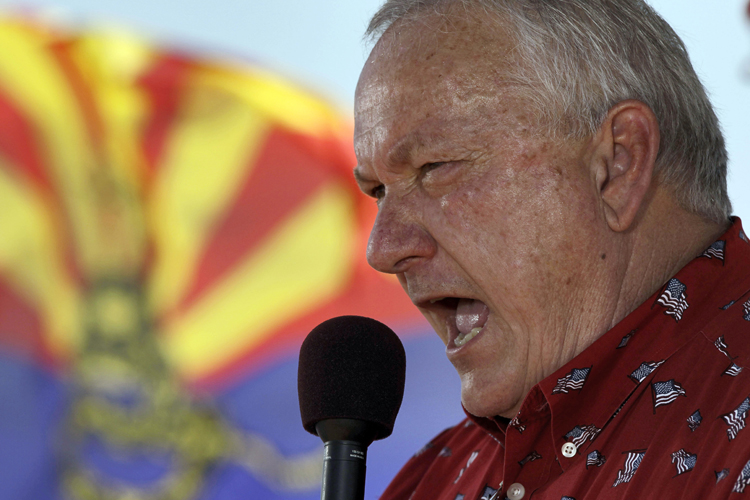
The forcibly retired Russell Pearce, Tea Party leader (Credit: AP/Matt York)

MESA, Ariz. — Almost a year to the day after he took power as the self-proclaimed “Tea Party president” and thrust Arizona’s hard-line immigration and anti-federal laws into the national arena, state Senate president Russell Pearce watched in bewilderment yesterday as an extraordinary citizens campaign of Democrats, Independents and moderate Republicans dethroned him in a historic recall election.

“Today marks the beginning of a new era in Arizona politics,” declared Randy Parraz, the co-founder of the Citizens for a Better Arizona, which spearheaded the recall campaign to great derision last January. “The reign of Senate president Russell Pearce has finally come to an end.”

As the darling of the right-wing  American Legislative Exchange Council and an influential ideologue in the nativist-tinged anti-immigrant movement, however, Pearce is not the only loser in the election upset.  With more than 90 percent of his campaign funds coming from corporate lobbyists and out-of-district contributions, allowing him to vastly outspend his opponent, Pearce lost by a nearly 10 percent margin — 53.4 percent to 45.3 percent — to Republican newcomer Jerry Lewis, a moderate Mormon leader who largely ran his grass-roots campaign as a referendum on Pearce’s extremist views.

What happens in Arizona doesn’t stay in Arizona

Pearce’s downfall serves as the opening salvo for the 2012 presidential election and places the hotly charged issue of immigration policy back onto the front burner. Pearce was the architect of the state’s controversial SB 1070 immigration law, which has been embraced by the front-runners in the Republican presidential primary and replicated in states like Georgia and Alabama.

“This is a huge shift for the Republicans as much as the Democrats,” Parraz said last night, in front of the Citizens office in Mesa.  “But it will only have a sustainable impact if we continue to get out and do the work, and not sit back and wait for the change.”

Without the support of major organizations or political parties, Parraz and his co-founder Chad Snow launched their recall campaign less than 10 months ago in what many viewed as a quixotic venture.  Invoking the “si se puede” spirit of Arizona-native labor leader Cesar Chavez , the Citizens for a Better Arizona inspired a  bipartisan campaign of disaffected Republicans, demoralized Democrats who had lost every statewide campaign in 2010, and a bevy of Independents.  With an estimated 500 campaign volunteers taking part in door-to-door canvassing efforts, and a full-scale get-out-the-vote operation, the Citizens group signed up 1,150 new voters.

“Immigration issues are not Republican or Democratic,” said Parraz, who went to great lengths over the past several months to stress that the recall transcended a single issue and showcased Pearce’s leadership role in cutting education and healthcare, and overseeing the state’s economic decline. “We have to work together to make effective change.”

Despite Gov. Jan Brewer’s public face on Arizona’s immigration policies, Pearce was largely seen as the de facto governor, who had railed about an “invasion” from Mexico and an immigration crisis on the border to ram through his openly anti-federal and states’ rights agenda on healthcare and gun laws, and an effort to even “nullify” federal jurisdiction.  Less than a year ago, Pearce called for the impeachment of President Obama, and claimed the White House was waging “jihad”on the country.

“Russell Pearce is too extreme, but he is not alone,” Parraz said, who has often chastised state and national leaders for allowing the Tea Party figurehead and other hard-liners like Maricopa County Sheriff Joe Arpaio to go unchallenged.  “This election shows that such extremist behavior will not be rewarded, and will be held accountable.”

Galvanizing a huge turnout of voters, including largely overlooked Latino communities, which make up more than 30 percent of the electorate, Parraz and his Citizens group have emerged as a powerful political force in the state.

Arizona’s progressive past

On the eve of Arizona’s centennial celebration in February, the recall is a reminder of Arizona’s often-forgotten history. Arizona’s first citizens movement was founded to counter the role of outside corporations and carpetbaggers in the formation of the state in 1912. The movement rallied for the right to recall elected officials who no longer represented their interests in the writing of the state’s constitution.  After President Taft approved the progressive Arizona constitution, the state Legislature’s first act made electoral recall an enduring part of Arizona’s legacy.

Today’s slogans about the 99 percent would not have been a surprise to Arizonans a century ago.

“The working class, plus the professional class, represent 99 percent,” said Arizona’s first governor, George W. Hunt, after a major labor showdown in 1916. “The remaining 1 percent is represented by those who make a business of employing capital.”

“It will be a happy day for the nation when the corporations shall be excluded from political activity … and vast accumulations of capital cannot be employed in an attempt to control government,” he declared

With the retirement of Russell Pearce, Arizona is slightly closer to that happy day.

Jeff Biggers, the author most recently of "Reckoning at Eagle Creek: The Secret Legacy of Coal in the Heartland," is currently at work on a new book on Arizona politics and history.

Joseph McCarthy reborn

GOP Rep. Allen West told supporters that 78 to 81 Democrats in Congress are "members of the Communist Party"

Rep. Allen West, R-Fla. (Credit: Gage Skidmore / CC BY-SA 2.0)

We’ve talked at times about George Orwell’s classic novel “1984,” and the amnesia that sets in when we flush events down the memory hole, leaving us at the mercy of only what we know today. Sometimes, though, the past comes back to haunt, like a ghost. It happened recently when we saw U.S. Rep. Allen West of Florida on the news.

A Republican and Tea Party favorite, he was asked at a local gathering how many of his fellow members of Congress are “card-carrying Marxists or International Socialists.”

He replied, “I believe there’s about 78 to 81 members of the Democrat Party who are members of the Communist Party. It’s called the Congressional Progressive Caucus.”

By now, little of what Allen West says ever surprises. He has called President Obama “a low-level socialist agitator,” said anyone with an Obama bumper sticker on their car is “a threat to the gene pool,” and told liberals like Harry Reid and Nancy Pelosi to “get the hell out of the United States of America.” Apparently, he gets his talking points from Fox News, Rush Limbaugh or the discredited right-wing rocker Ted Nugent.

But this time, we shook our heads in disbelief: “78 to 81 Democrats … members of the Communist Party?” That’s the moment the memory hole opened up and a ghost slithered into the room. The specter stood there, watching the screen, a snickering smile on its stubbled face. Sure enough, it was the ghost of Sen. Joseph McCarthy, the Wisconsin farm boy who grew up to become one of the most contemptible thugs in American politics.

Back in the early 1950s, the Cold War had begun and Americans were troubled by the Soviet Union’s rise as an atomic superpower. Looking for a campaign issue, McCarthy seized on fear and ignorance to announce his discovery of a conspiracy within: Communist subversives who had infiltrated the government.

In speech after speech, McCarthy would hold up a list of names of members of the Communist Party he said had burrowed their way into government agencies and colleges and universities. The number he claimed would vary from day to day, and when pressed to make his list public, McCarthy would stall or claim he accidentally had thrown it away.

His failure to produce much proof to back his claims never gave him pause, as he employed lies and innuendo with swaggering bravado. McCarthy, wrote historian William Manchester, “realized that he had stumbled upon a brilliant demagogic technique … others deplored treachery, McCarthy would speak of traitors.”

And so he did, in a fearsome, reckless crusade that terrorized Washington, destroyed lives, and made a shambles of due process.

Millions of Americans lapped it up, but in the end, Joe McCarthy would be done in by the medium that he had used so effectively to spread his poison: television. In 1954, the legendary broadcaster Edward R. Murrow bravely exposed McCarthy’s tactics on the CBS program “See It Now.”

“This is no time for men who oppose Senator McCarthy’s methods to keep silent,” Murrow declared. “We can deny our heritage and our history, but we cannot escape responsibility for the result. There is no way for a citizen of a Republic to abdicate his responsibilities.”

Later that same year, for 36 days on live TV, during Senate hearings on charges McCarthy had made questioning the loyalty of the U.S. Army, we saw the man raw, exposed for the lout and cowardly scoundrel he was. The climactic moment came as the Boston lawyer Joseph Welch, defending the Army, reacted with outrage when McCarthy accused Welch’s young associate Fred Fisher of communism. “Let us not assassinate this lad further, Senator,” Welch said as he shook his head in anger and sadness. “You’ve done enough. Have you no sense of decency, sir, at long last? Have you left no sense of decency? … If there is a God in heaven it will do neither you nor your cause any good.”

McCarthy never recovered. His tactics had been opposed from the outset by a handful of courageous Republican senators. Now they pressed their case with renewed vigor. One of them, Sen. Ralph Flanders of Vermont, introduced a motion to censure Joseph McCarthy. When it eventually passed 67 to 22, McCarthy was finished. He soon disappeared from the front pages. Three years later, he was dead.

All of this came rushing back as West summoned his foul spirits from the vast deep. The ghost stepped out of the past.

Like McCarthy, the more Allen West is challenged about his comments, the more he doubles down on them. Now he’s blaming the “corrupt liberal media” for stirring the pot against him – a trick for which McCarthy taught the master class. And the congressman’s latest fusillades continue to distort the beliefs and policies of those he smears – no surprise there, either.

To help him continue his fight for “the heart and soul” of America he’s asking his supporters for a contribution of $10 or more. There could even be a super PAC in this – with McCarthy’s ghost as its honorary chairman.

Plenty of kindred spirits are there to sign on. Like the author of the book “The Grand Jihad,” who wrote that whether Obama is Christian or not, “the faith to which Obama actually clings is neocommunism.” Or the blogger who claims Obama is running the country into the ground “by way of the same type of race-baiting and class warfare Communism cannot exist without,” and that his policies are “unbecoming to an American president.”

From there it’s only a short hop to the kind of column that popped up on the right wing website Newsmax hinting of a possible coup “as a last resort to resolve the ‘Obama problem.’” Military intervention, the author wrote, “is what Obama’s exponentially accelerating agenda for ‘fundamental change’ toward a Marxist state is inviting upon America.” The column was quickly withdrawn but not before the website Talking Points Memo exposed it.

So beware, Rep. West, beware: In the flammable pool of toxic paranoia that passes these days as patriotism in America, a single careless match can light an inferno. You would serve your country well to withdraw your remarks and apologize for them. But if not, perhaps there are members of your own party, as possessed of conscience and as courageous as that handful of Republicans who took on Joseph McCarthy, who will now abandon fear and throw cold water on your incendiary remarks.

Continue Reading Close

Bill Moyers is managing editor of the new weekly public affairs program, "Moyers & Company," airing on public television. Check local airtimes or comment at www.BillMoyers.com.

Michael Winship is senior writing fellow at Demos and a senior writer of the new series, Moyers & Company, airing on public television.

The surprising new alliance between the Tea Party and labor

Could an anti-union bill in Georgia erase right-wing protesters too? Tea Partiers aren't taking any chances

(Credit: AP/Al Grillo/Salon)

When Republicans rode Tea Party anger to large majorities in Georgia’s state Legislature in 2010, it seemed inevitable that sooner or later some of these restive constituents would turn against them. Few, though, would have predicted the cause of an uprising that went down this week: an anti-picketing bill aimed at silencing union members.

On March 7, the Georgia Senate passed SB 469, a bill backed by the state’s Chamber of Commerce and introduced by state senators including Waffle House executive Don Balfour. Along with a battery of other anti-union measures, the bill bans picketing that targets private residences and causes “intimidation” or disturbs the “quiet enjoyment” of local residents. (“Quiet enjoyment” apparently being a more fundamental right than freedom of speech.) SB 469 would increase potential punishments for picketing or “conspiracy,” and it would make it easier for companies to request and receive injunctions from judges halting demonstrations. In a letter to Balfour, Ted Jackson, the sheriff of Georgia’s largest county, wrote that “The role of law enforcement shouldn’t be to police free speech but the intent of this bill seems to be just that.” (Balfour did not respond to Salon’s request for comment.)

Unions began rallying in opposition to the bill shortly after it was introduced last month and have been active ever since. They’ve been joined by several non-labor groups that also see the bill as a threat to their right to demonstrations. Occupy, environmentalist and civil rights activists have warned for weeks that the broadly written bill put their protest rights at risk as well. On Monday, so did the Atlanta Tea Party.

“We were extremely excited when they showed up,” says Georgia AFL-CIO president Charlie Flemming. “We [had] reached out to them, not knowing that they would.”

As Dave Jamieson reported for the Huffington Post, the Atlanta Tea Party sent a message Monday to its 50,000-person email list calling SB 469 “a gross violation of the First Amendment.” That day, Tea Partyers joined union members and others in packing a House Industrial Relations Committee hearing on the bill. Debbie Dooley, whom Teamsters Local 728 political director Eric Robertson calls “the most well-known Tea Party activist in Georgia,” was among those testifying against the bill.

“Labor unions have First Amendment rights just like Tea Parties,” Dooley says. “I don’t see how you can say it’s OK for one group to go and protest in front of CNN but a labor union can’t.”

Her testimony, along with the Tea Party revolt, may have made a difference. The next day, the 35th day of Georgia’s 40-day legislative session, the Industrial Relations Committee canceled a planned vote on SB 469.  There’s not much time left for the House to pass the measure.  Dooley thinks, based on conversations with Republican legislators, SB 469 is already dead.

“They’re traditionally the Republicans’ allies,” says Flemming, and so if SB 469 is defeated, Tea Party opposition “might be the reason, and then again, it might just be the final straw.”

But labor is still aggressively lobbying to stop it.  ”This is a test case,” says Robertson.  If SB 469 passes, “they’re going to roll it out everywhere else.” He and Flemming say labor and the Tea Party have discussed working together to target Balfour and other SB 469 supporters in Republican primaries, though Dooley says “469 would not be one of our criteria” in determining which incumbents to oppose. And while Dooley notes that SB 469 is not the first time the Atlanta Tea Party has clashed with Republicans, the cooperation with labor does not signal the start of a long and happy friendship.

For starters, labor and the Tea Party opposed the bill for different reasons. Robertson sees a bill from “the corporate far right” that’s “designed to crush dissent and to mortally cripple the labor movement.” Certainly, labor is far more constrained in its right to picket than Occupy or Tea Party groups. Union members are bound by the 1947 Taft-Hartley Amendments to the National Labor Relations Act, which restrict what legal scholars call “secondary boycotts”  pulling suppliers or customers into disputes. And when the Supreme Court affirmed that anti-gay activists are free to picket military funerals with signs that say “God Hates Fags,” it left untouched an earlier precedent excluding union picketing from the same protections. So union activists in Georgia see SB 469 as yet another attempt to tie their hands behind their backs.

Tea Party opposition does not run nearly as deep. Dooley says she wouldn’t object to banning protests in “strictly residential” neighborhoods, but the bill as written “would have affected a lot of our protests, because the language was so broad.” Another Tea Party leader, Virginia Galloway, the Georgia state director for Americans for Prosperity, says of the House, “If they would fix some of the details, we would have a good deal.”

Dooley also says she supports other recent union-busting actions like those against public workers’ collective-bargaining rights by Gov. Scott Walker in Wisconsin. “Any time taxpayer dollars are involved, I think there should be tighter restrictions.” But SB 469 is a reminder that labor rights are a First Amendment issue, not just the fiscal one that many conservatives have painted it to be. “This was within our core values,” Dooley says, “because it would limit our right to protest.”

Continue Reading Close

Josh Eidelson is a freelance journalist and a contributor at The American Prospect and In These Times. After receiving his MA in Political Science, he worked as a union organizer for five years.

Romney, the true Tea Party candidate

Despite the desperate search for an alternative, no one represents the movement better than Mitt

(Credit: AP Photo/Charles Dharapak)
This originally appeared on TomDispatch.

Dear Tea Party Movement,

For the last few months, the world has been fascinated by your frenzied search for a presidential candidate who is not Mitt Romney. We know that you find the man inauthentic and that you have buoyed up a string of anti-Mitts in the Iowa polling — Michele Bachmann, Rick Perry, Herman Cain, Newt Gingrich — buffoons all, preposterous figures whom you have rightfully changed your minds about as soon as you got to know them.

It was quite a spectacle, your quest for the non-Romney — and I think we all know why you undertook it. In ways that matter, Romney is clearly a problem for you. His views on abortion, for example, change with the winds. Ditto, gay rights. He designed the Massachusetts health insurance system that was the model for Obamacare. And he’s even said that he approved of the TARP bank bailout, the abomination that ignited the Tea Party uprising in the first place.

Grievous offenses all, I have no doubt. Still, my advice to you idealists of the right is this: Get over it. Not for sell-out reasons like: Romney has the best chance of beating Obama. No. You should get behind the charging Massachusetts RINO (your favorite term for a Republican-In-Name-Only sellout type) because, in a certain paradoxical way, he may turn out to be the truest of all the candidates to the spirit of your movement.

After all, given everything you represent, why wouldn’t you line up behind this quarter-billionaire who’s calling for just a little human love and sympathy for billionaires? I’m sure you already understand me perfectly well, but just to be certain, let me make the case.

The Gimme Candidate of 2012

Start with those issues where Romney’s positions so offend the sensibilities of you Robespierre Republicans. First, of course, the social issues. If nothing else, you in the Tea Party movement have spent the last three years teaching Americans that they no longer matter — not when we’re supposedly in a battle for the very soul of capitalism.

And here comes Mitt Romney, the soul of American capitalism in the flesh. Look back over his career as a predator drone at Bain Capital: Isn’t it the exact sort of background you always insist politicians ought to have? Isn’t it the sort of titanic enterprise for which you lust, as you wave your copy of “Atlas Shrugged” in the air?

You accuse the former Massachusetts governor of opportunism, but from where I stand, the bad faith is all on your side. What offends you about Romney’s Massachusetts healthcare plan, for example, isn’t that it crushes human liberty, but that it provided the model for President Obama’s own healthcare overhaul, which you spent the last two years decrying as the deed of a power-grabbing socialist.

If the public ever learns about the Republican provenance of Obamacare — and if Romney is the candidate, they most certainly will — it will become obvious that your movement was not telling the truth about all that Kenyan Stalinist death-panel stuff. It is indeed a moment to fear, that day when the nation finds out that you were, ahem, exaggerating in your bullhorn pronouncements about the communist in the White House. Still, if the Tea Party movement is all about truth-telling and straight shooting, then you need to face it like a patriot.

And yes, Mitt Romney has also said that the bank bailouts of 2008-2009 were necessary, while you regard them as a mortal sin against free-market principles. (To his credit though, at least in your eyes, he was also a total hardliner about the auto industry bailouts, displaying the pointless meanness you seem to admire in nearly any other politician.) In truth, though, the candidate’s only offense on the bailout question was his candor. He merely admitted what should be obvious to any billionaire from a study of bank history: that conservatives have no problem doling out, or grabbing for, government money when the chips are down.

After all, President Herbert Hoover himself distributed bank bailouts in the early years of the Great Depression. Calvin Coolidge’s vice president, Charles Dawes, helped out in Hoover’s bailout operation, later changing hats and grabbing a big slice of the bailout pie for his own bank. Ronald Reagan’s administration rescued Continental Illinois from what was then the largest bank failure in our history.

Citibank’s market-worshiping CEO Walter Wriston begged for (and of course received) the assistance of big government when Citi needed it — after making loans to the troubled Penn Central Railroad. And don’t forget, every single one of you is guilty of taking a government bailout any time you make a withdrawal from a bank that’s been rescued by the Federal Deposit Insurance Corporation.

The reason they — I mean, you — do these things should be as obvious as it is simple: “Free market” has always been a high-minded way of saying “gimme,” and when the heat rises, the “market” is invariably replaced by more direct methods, like demanding bailouts from the government you hate. Banks get bailouts for the simple reason that they want bailouts and have the power to insist on them — the same circumstances that got them deregulated in wave after wave in the Eighties, Nineties and Aughts.

In this sense, Romney, who is loud and proud when it comes to the need for further deregulation, has actually been more consistent than you. He’s the gimme candidate of 2012 and so he should really be your guy.

Promethean Job Creators and Heroes of Venture Capital

You say Romney is an unprincipled faker. Fair enough — he is. He’s so plastic he’s almost animatronic. But have you looked in the mirror recently? Aren’t you the ones who fall for it every time Fox News wheels out some Washington hack to confuse this or that corporate issue with the sacred cause of freedom or states rights or man’s inalienable right to mine uranium in his backyard? Aren’t you the ones who thought that Glenn Beck’s tears were markers of emotional sincerity? And for Pete’s sake, your populist Tea Party movement was actually launched from the floor of the Chicago Board of Trade!

I know, I know: For almost three years now you’ve dazzled the world with your proclamations that we’re being dragged into “tyranny,” that the country is being “destroyed,” that America needs to be “saved” — and now here comes Mitt, with his fondness for workaday compromise, ruining your carefully contrived atmosphere of panic.

That must be disappointing, but don’t lose the faith! Give the man credit: He has tried. He’s no stranger to the core Tea Party myth of the noble businessman persecuted by big government. Indeed, at the Conservative Political Action Congress in 2009, he opened his talk as a stand-up comic this way: “I gotta get through this speech before federal officials come here and arrest me for practicing capitalism.”

Meanwhile, he has the perfect Tea Party sense of social class. A centimillionaire who made his pile as a venture capitalist, Romney has both deplored class warfare — meaning, certain criticisms of Wall Street — and practiced it, taunting President Obama as a modern version of Marie (“let them eat cake”) Antoinette.

There’s no contradiction in any of this, either for him or you. When someone has made his way in life via academia, like the president, he is, of course, a snob, and part of the ruling elite. When, on the other hand, a person’s multi-millions were visited upon him by open-market actions directed from the C-suite, he is automatically a man of the people, a horny-handed son of toil. In fact, Romney takes this kind of market populism a step farther than you ordinarily dare: Corporations, he has famously announced, are themselves people.

And keep in mind that, with Mitt Romney, venture capitalist, carrying your banner in 2012, you will finally get to submit your capsized vision of social class to the verdict of the people — the actual flesh-and-blood people, that is, not the corporate “people” who make up the S&P 500. You will get to defend exactly the sort of “person” your movement has longed to defend since it was birthed by a CNBC reporter almost three years ago to the cheers of a bunch of derivatives traders in Chicago.

You will get to explain your peculiar conviction that the way to react to a gigantic slump brought on by frenzied finance is to unshackle Wall Street. You will get to line up behind a heroic businessman, like those rugged, resourceful fellows in the Ayn Rand novels you love. You will get to go into battle for the job creators, which is what all capitalists are, right? (Well, okay, maybe not the guys at Bain Capital, the particular outfit where Romney made his pile, but the theory is all that really matters, isn’t it?)

Indeed, your leadership cadre is already playing up the inevitable criticisms of Romney as a job decimator as a way of launching a grand debate about capitalism — by which they mean, of course, freedom itself. When Newt Gingrich criticized Romney a few weeks ago for his career in private equity, the airwaves of your winger-tainment world exploded with outrage. “This is the kind of risk-taking, free-market capitalism that most people who call themselves conservatives applaud,” intoned Brit Hume on Fox News. If Newt had a problem with Bain’s operations, announced syndicated columnist Jonah Goldberg, “then Gingrich really doesn’t believe in capitalism at all.”

Washington Post columnist George Will declared that what Romney did in his venture capitalist days was an “essential social function,” that his company was “indispensable for wealth creation.” (Just whose wealth was being created he left discreetly undefined.) Yaron Brook, head of the Ayn Rand Center and a familiar figure at Tea Party events, is no fan of Romney’s, but he had this to say about Romney’s career: “Private equity serves an incredibly important productive function in our economy… Private equity is in my view a heroic activity.”

“Heroic”: That’s exactly the word! In Romney we have finally found a quarter-billionaire to cry for. And so Suzy Welch, author and wife of Jack, appeared on Fox Business to wonder why Romney wasn’t defending himself aggressively against criticism of his business career. Romney, she announced, is “an American hero to people who believe in free enterprise, or he should be.”

And that combination of tragedy and heroism, my friends, is why you will soon be signing up for the Romney juggernaut. In him you will see the saintly victimhood of Sarah Palin melded with the Promethean job-creator who was the cult object of your 2010 efforts. Social issues be damned! Romney will ensure that we get the one thing that this country can’t do without on its path to hell: further deregulation of Wall Street.

The nation’s all-powerful elitist socialists will, of course, disagree, and you’ll have a field day, raging and weeping at the way they are going to set out to persecute this noble, wealth-creating soul.

Pity the billionaire: It will be a powerful rallying cry for 2012.

Yours in petulant individualism,

Tom

To stay on top of important articles like these, sign up to receive the latest updates from TomDispatch.com here.

Continue Reading Close

Thomas Frank's most recent book is "Pity the Billionaire." He is also the author of "One Market Under God" and the founding editor of "The Baffler" magazine.

The Tea Party’s “utopian market populism”

Tom Frank on the dream that fueled the right wing's improbable comeback

Thomas Frank

In his new book, “Pity the Billionaire,” Tom Frank turns his mordant eye on the unlikeliest political development of the Obama presidency: how the crash of 2008 served to strengthen the political right. The deregulation of Wall Street, championed for 30 years by right-wing leaders, had led to an economic catastrophe so frightening that the country elected a liberal Democrat to the presidency. Yet two years later, the most conservative faction of the Republican Party, the Tea Party, had taken effective control of the House of Representatives, the regulation of Wall Street had stalled, and the champions of economic deregulation in Washington had emerged stronger than ever.

Frank, author of the bestselling book “What’s the Matter With Kansas?” provides a pithy and nuanced explanation of what he calls the “hard-times swindle.” He spoke with Salon from his father’s home in Kansas City, Mo.

Early in the book, you describe the moment in the spring of 2009 when free-market economics had been so thoroughly discredited that Newsweek could run a cover story proclaiming, “We’re all socialists now.” What happened? Why did that moment dissipate?

I saw that cover so many times [at Tea Party events]. For these people, that rang the alarm bell. I think the AIG moment [when the bailed-out insurance behemoth used taxpayer relief to dole out huge bonuses to its executives] was in some ways the high point of the crisis, when [the politics] could have gone either way. There was this amazing public outrage, and that for me was the turning point. Newsweek had another cover, “Thinking Man’s Guide to Populism,” and I remember this feeling around the country, that people were just furious. Somehow the right captured the sense of anger. They completely captured it. You could say they had no right to it, but they did. And one of the reasons they were able to do it was because the liberals were not interested in that anger.

I’m speaking here of the liberal culture in Washington, D.C. There was no Occupy Wall Street movement [at that time] and there was only people like me on the fringes talking about it. The liberals had their leader in Barack Obama … they had their various people in Congress. But these people are completely unfamiliar with populist anger. It’s an alien thing to them. They don’t trust it, and they have trouble speaking to it. I like Barack Obama, but at the end of the day he’s a very professorial kind of guy. The liberals totally missed the opportunity, and the right was able to grab it.

Looking back on it, I feel like people like myself were part of the problem. We sort of assumed with the Democrats in power, the system would correct itself.

One of the problems with liberalism in this country is that it’s headquartered in Washington and its leaders are a very comfortable class of people. Washington is one of the richest cities in the country, maybe the richest. It’s not a place that feels the crisis, that feels the economic downturn. By and large, the real estate market stayed OK. The city continued to boom. The contracts continued to flow. What we’re talking about here is the failure of modern liberalism. At one time it was a movement of working-class people. The idea that liberals wouldn’t feel economic pain was ridiculous. That’s who liberals were. No more. 

You write that after Obama took office, “market populism was the only utopian scheme available to disgruntled Americans.” There was no liberal utopian scheme that said, “Here’s how we get out of this.”

There wasn’t even a Rooseveltian scheme, which was not utopian but very practical. Just to talk about Roosevelt would have been fantastic. One of the research points in the book that I thought was really interesting … was the history of the bailouts in 1932 and 1933 — when the Hoover administration did a lot of bailouts. We don’t remember that. [These bailouts] were massively unpopular for the same reason they were unpopular this time around: really blatant cronyism. We don’t remember that a big part of Franklin Roosevelt’s campaign [in 1932] was to be against these bailouts. There were maybe five newspaper articles in 2008 that mentioned this pre-history of the bailouts. It just never came up.

It was like the party’s muscle memory of the New Deal was lost. With Obama the muscle memory of the Democratic Party is the Clintonian technocracy of the 1990s.

That’s exactly right. Their message was: The technocratic way is going to solve our problems. Just leave it up to the experts who are going to figure a way out. [Obama and the Democrats]  seemed to think they didn’t need to dirty their hands by making a populist appeal. They did a lot of good things — the stimulus package of 2008 was good thing — but they didn’t realize you have to sell something like that. They were like, “We know what the answer is: Keynesian stimulus. So let’s just do it.” They didn’t understand that this nation only adopted Keynesian stimulus spending back in the 1930s amidst this terrible wrenching experience, the Depression, and an enormous campaign [by FDR] to tell the nation why this was necessary.

If you don’t sell it — if you just do this spending — well, people have a lot of suspicion of government handouts. Government debt bothers people for very obvious reasons. [Obama] didn’t make any effort to make the argument. It was just “listen to the experts.” I have a quote from [Obama economic advisor] Christy Roemer where she says, “Things would be better if we listened to the experts.” And she’s one of the good guys, one of the best people in the Obama administration. That’s their view.

You have an interesting discussion about how the Tea Party movement mimics what was once the left-wing style. This seems to be the dominant mode: The right is saying, “We’re the revolutionaries. We’re taking on the powers that be.”

At first I thought it was a peculiarity of Glenn Beck, and then I noticed it across the board. They picked up this 1930s style and language, complete with utopianism, with this intense faith in an economic system that will solve all your problems and that represents you perfectly, this miraculous economic system … So [the right] is constantly talking about this infernal elite that controls  government, controls corporations, and controls the academy, and that we have to wrench ourselves free.

So maybe it is true that the Obama technocracy is the infernal elite. Maybe not in the hellish way it is portrayed on the right, but in the sense that these are the defenders of bailouts, the defenders of the system.

I wouldn’t go too far with that, because I don’t think that is a way of understanding our modern world that can bear a lot of the weight. It is true that the Democrats completely imagine themselves as being the party of the professional class, and that is an elite. It’s not the elite, but it is an elite. The Democrats very definitely identify with academia. That’s the home of the professions, where they come from.

Still, I think that the conservative idea of revolting against the ruling class by holding up the market as an ideal is completely backwards. There is a ruling class in this country. But the notion that the free market is an act of rebellion against it seems pretty fanciful.  I can say it stronger than that. It is absolutely preposterous.

At one point you talk about “a cognitive withdrawal from the shared world.” It seems like the modern digital communication revolution encourages this. “A cognitive withdrawal from the shared world” — that sounds like a description of the Internet.

This is where we’re going. You can now believe things that are demonstrably false and never be challenged, directly or indirectly. You can withdraw. That’s the end that the Internet is constantly pushing us toward. That’s what modern marketing is all about.

So it’s a technological phenomenon, but it’s also an ideological phenomenon, a product of the times we’re in. You saw this in the ’30s, especially on the left. People would be so committed to this economic utopia [communism]. They believed in it, and their faith in it was so great … It is a product of economic collapse. People are desperate. They think their entire way of life is crumbling around them, and they reach for … a utopian system where everything is explained.

This is the genius of Fox News. It is fun to watch, and if you agree with them, it’s very gratifying to watch — and on a level deeper than most TV entertainment. The message is “You’ve worked really hard. You played by the rules and now they’re disrespecting you. They won’t let you say the word ‘Christmas.’”

You finished this book around the time Occupy Wall Street started. Were you surprised by the emergence of the movement?

I was surprised. I thought the left’s moment had passed. That was almost exactly three years after the crash of September 2008, and it seemed like the expiration date had come and gone. I’m very pleased, but in a lot of ways the horse has already left the barn.

Is it possible for the Occupy movement to reverse the gains of the right?

I hope so, but I honestly don’t know. At the end of the day I doubt it. My liberal friends have been doubting the right for decades. They’re always saying, “There’s no way these guys can recover now after this screw-up. People will never come back to them after this.” But they keep coming back.

The right does seems to be a little bit on the defensive at the moment. The dominant narrative of last summer — government spending is the problem — has been lost. Occupy Wall Street has injected a change in discourse. People aren’t defensive when they talk about inequality.

Tell me about it. When I started writing about inequality 10 years ago, it … was not something for NPR Book Talk. It was not quite within the bounds of the acceptable. Now it is. And that’s a huge change.

The main thing that has to change is that Democrats and liberals have to be able to speak to the outrage, and that requires a complete change in the way they look at the world. The problem is that they’ve been going the other direction for 30 years. Ever since the right-wing backlash began, liberals have been making their own move to professionalism. [To voice outrage] would require them to reverse course. I would like to see that happen, but I don’t know how it’s going to happen.

I think one thing has happened: Middle-class or upper-middle-class liberals in Washington, all of a sudden we realize we are insecure. The system is not just screwed up for people out there who we sympathize with. It’s screwed up for us. Economic insecurity is now pervasive even in the professional class.

Professionals are feeling the heat. They’re not insulated from market forces, like the way the professions are supposed to be. The system is not working like that anymore. Maybe that is where the change will come from.

Another thing that I think changed things was the debt-ceiling debacle last summer. That scared everybody, and it was so patently the doing of the Tea Party Republicans in the House. That was a huge turning point.

The hostage taking?

They were holding a gun to the head of the nation’s economy. They did ruin the nation’s bond rating. And you could have had an unthinkable catastrophe if they had done what they were threatening to do. Things like that should be off the table in our politics. That was an outrage in its own way as great as the bailouts. It was a shocking moment.

Yet at the end of the book, you contemplate the right wing in power, and you suggest they might do exactly that — take actions they know would ruin the economy.

They might. They see the financial crisis as something we deserve, that we’ve spent beyond our means, and now we have to pay. In their minds, we need a recession to get back on track. They think we’re due for something like the 1930s, so why not make it happen?

You conclude by saying say that the problems that editorialists fret about — inequality, global warming and financial bubbles — will endure, but so will this utopian market populism, which you describe as chasing “the dream more vivid than life itself.” You have shown how entrenched those impulses are in American politics. Maybe part of the American pursuit of happiness is to “chase the dream more vivid than life itself. “

The right has discovered the magic against relativism. They have long inveighed against relativism, but now they’ve discovered they can say anything. They can endlessly withdraw into this world of utopian fiction and everything can be explained away. It’s like some kid discovering a new video game. It’s so awesome.

So what gives you hope?

I was out in Wisconsin earlier this year, when you had thousands of people surrounding the capitol every day. There were big days when they had a hundred thousand people, and then there were the off days where you had “only” a couple of thousand — and this went for day after day. That was really a hopeful moment for me. It was the predecessor to the Occupy movement. Let’s see if they can make a comeback when it gets warm again. I would love to see it happen.

Continue Reading Close
Jefferson Morley

Jefferson Morley is a staff writer for Salon in Washington and author of the forthcoming book, Snow-Storm in August: Washington City, Francis Scott Key, and the Forgotten Race Riot of 1835 (Nan Talese/Doubleday).

The GOP’s dangerous divide

White Southern radicals are threatening to take over the party once and for all

(Credit: AP Photo/Charlie Riedel)
This originally appeared on Robert Reich's blog.

Two weeks before the Iowa caucuses, the Republican crackup threatens the future of the Grand Old Party more profoundly than at any time since the GOP’s eclipse in 1932. That’s bad for America.

The crackup isn’t just Romney the smooth versus Gingrich the bomb-thrower.

Not just House Republicans who just scotched the deal to continue payroll tax relief and extended unemployment insurance benefits beyond the end of the year, versus Senate Republicans who voted overwhelmingly for it.

Not just Speaker John Boehner, who keeps making agreements he can’t keep, versus Majority Leader Eric Cantor, who keeps making trouble he can’t control.

And not just venerable Republican senators like Indiana’s Richard Lugar, a giant of foreign policy for more than three decades, versus primary challenger state treasurer Richard Mourdock, who apparently misplaced and then rediscovered $320 million in state tax revenues.

Some describe the underlying conflict as Tea Partiers versus the Republican establishment. But this just begs the question of who the Tea Partiers really are and where they came from.

The underlying conflict lies deep into the nature and structure of the Republican Party. And its roots are very old.

As Michael Lind has noted, today’s Tea Party is less an ideological movement than the latest incarnation of an angry white minority – predominantly Southern, and mainly rural – that has repeatedly attacked American democracy in order to get its way.

It’s no mere coincidence that the states responsible for putting the most Tea Party representatives in the House are all former members of the Confederacy. Of the Tea Party caucus, twelve hail from Texas, seven from Florida, five from Louisiana, and five from Georgia, and three each from South Carolina, Tennessee, and border-state Missouri.

Others are from border states with significant Southern populations and Southern ties. The four Californians in the caucus are from the inland part of the state or Orange County, whose political culture has was shaped by Oklahomans and Southerners who migrated there during the Great Depression.

This isn’t to say all Tea Partiers are white, Southern or rural Republicans – only that these characteristics define the epicenter of Tea Party Land.

And the views separating these Republicans from Republicans elsewhere mirror the split between self-described Tea Partiers and other Republicans.

In a poll of Republicans conducted for CNN last September, nearly six in ten who identified themselves with the Tea Party say global warming isn’t a proven fact; most other Republicans say it is.

Six in ten Tea Partiers say evolution is wrong; other Republicans are split on the issue. Tea Party Republicans are twice as likely as other Republicans to say abortion should be illegal in all circumstances, and half as likely to support gay marriage.

Tea Partiers are more vehement advocates of states’ rights than other Republicans. Six in ten Tea Partiers want to abolish the Department of Education; only one in five other Republicans do. And Tea Party Republicans worry more about the federal deficit than jobs, while other Republicans say reducing unemployment is more important than reducing the deficit.

In other words, the radical right wing of today’s GOP isn’t that much different from the social conservatives who began asserting themselves in the Party during the 1990s, and, before them, the “Willie Horton” conservatives of the 1980s, and, before them, Richard Nixon’s “silent majority.”

Through most of these years, though, the GOP managed to contain these white, mainly rural and mostly Southern, radicals. After all, many of them were still Democrats. The conservative mantle of the GOP remained in the West and Midwest – with the libertarian legacies of Ohio Senator Robert A. Taft and Barry Goldwater, neither of whom was a barn-burner – while the epicenter of the Party remained in New York and the East.

But after the Civil Rights Act of 1964, as the South began its long shift toward the Republican Party and New York and the East became ever more solidly Democratic, it was only a matter of time. The GOP’s dominant coalition of big business, Wall Street, and Midwest and Western libertarians was losing its grip.

The watershed event was Newt Gingrich’s takeover of the House, in 1995. Suddenly, it seemed, the GOP had a personality transplant. The gentlemanly conservatism of House Minority Leader Bob Michel was replaced by the bomb-throwing antics of Gingrich, Dick Armey and Tom DeLay.

Almost overnight Washington was transformed from a place where legislators tried to find common ground to a war zone. Compromise was replaced by brinkmanship, bargaining by obstructionism, normal legislative maneuvering by threats to close down government – which occurred at the end of 1995.

Before then, when I’d testified on the Hill as Secretary of Labor, I had come in for tough questioning from Republican senators and representatives – which was their job. After January 1995, I was verbally assaulted. “Mr. Secretary, are you a socialist?” I recall one of them asking.

But the first concrete sign that white, Southern radicals might take over the Republican Party came in the vote to impeach Bill Clinton, when two-thirds of senators from the South voted for impeachment. (A majority of the Senate, you may recall, voted to acquit.)

America has had a long history of white Southern radicals who will stop at nothing to get their way – seceding from the Union in 1861, refusing to obey Civil Rights legislation in the 1960s, shutting the government in 1995, and risking the full faith and credit of the United States in 2010.

Newt Gingrich’s recent assertion that public officials aren’t bound to follow the decisions of federal courts derives from the same tradition.

This stop-at-nothing radicalism is dangerous for the GOP because most Americans recoil from it. Gingrich himself became an object of ridicule in the late 1990s, and many Republicans today worry that if he heads the ticket the Party will suffer large losses.

It’s also dangerous for America. We need two political parties solidly grounded in the realities of governing. Our democracy can’t work any other way.

Continue Reading Close

Robert Reich, one of the nation’s leading experts on work and the economy, is Chancellor’s Professor of Public Policy at the Goldman School of Public Policy at the University of California at Berkeley. He has served in three national administrations, most recently as secretary of labor under President Bill Clinton. Time Magazine has named him one of the ten most effective cabinet secretaries of the last century. He has written 13 books, including his latest best-seller, “Aftershock: The Next Economy and America’s Future;” “The Work of Nations,” which has been translated into 22 languages; and his newest, an e-book, “Beyond Outrage.” His syndicated columns, television appearances, and public radio commentaries reach millions of people each week. He is also a founding editor of the American Prospect magazine, and Chairman of the citizen’s group Common Cause. His widely-read blog can be found at www.robertreich.org.

Page 1 of 3 in Tea Party

www.salon.com/topic/tea_party/