
Occupy Oakland
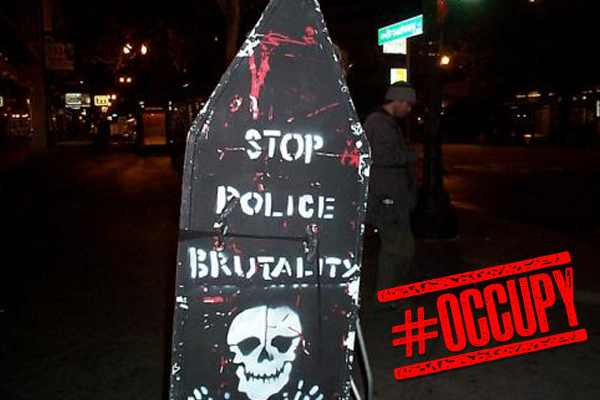
Report from the Occupy Oakland raid
After days of fear-mongering, the police evicted us from our camp. But they underestimate our conviction
(Credit: Kevin Army) Have you ever spent time waiting for someone close to you to die? Then you know the feeling of being mired in an unknown void, where one doesn’t know if it will be that weekend, that afternoon, that hour. That sickened feeling in your gut, the premonition that something very bad will happen, an imminent threat staring you in the face, mixing up all your thoughts and emotions, holding you hostage, stealing the hours spent waiting and waiting.
I think the Oakland Police department and city officials understand those feelings well, and spent this holiday weekend exploiting them fairly effectively. At least on me. A feeling of dread crept in as I read the items that were leaked out, like the following email that was circulated on Sunday:
A highly coordinated law enforcement raid to clear out OO is planned to take place Monday morning early. Significant public safety mutual aid is being called in from neighboring jurisdictions. The goal is to permanently clear out the OO encampment of illegal activities. Expect to see overwhelming use of force by police directed to occupiers who refuse to comply.
Peaceful protesters are advised by police to stand down until the situation stabilizes. The general public is advised to stay away from the area during the action to avoid potential personal injury from incidental contact with conflicts.
No one has been able to verify the exact origins of the email, but all weekend I saw similar intimations of actions like on Twitter feeds, Facebook pages and the news. Each day of the holiday weekend eviction notices were handed out to the residents of the encampment. It felt like a war of fear, an attempt to break the protesters before any raid could happen.
The weekend started with a fatal shooting near the encampment on Thursday evening. Reports of whether and how this was related to Occupy Oakland are still a bit conflicted, so I’ll keep out of that. The shooting shined an unfortunate light on one of Oakland’s largest problems, the murder rate; there have been 91 killings so far this year. Rather than focusing on this, city leaders seized on the fatal shooting as an opportunity to justify evicting the camp, blaming Oakland’s endemic issues on the protesters.
At a press event on Friday, Mayor Jean Quan made a sad attempt to pacify all sides by releasing a dove at a church where she had attended an interfaith Thanksgiving prayer breakfast. She said, “We need to peacefully close the encampment at City Hall and we’re asking people to leave.”
Has anyone called to close down neighborhoods in Oakland where the other 90 murders happened? Of course not. People recognize that a small element makes life difficult for the vast majority of good residents in the neighborhoods where these murders typically occur.
At around 4:30 a.m., a few cops showed up. It was pretty close to 5 a.m. when the riot police arrived. Not in the huge numbers I expected, but enough. I’m entirely not sure since we couldn’t get close to most of them, but I could see around three or four hundred. There may have been more standing by where I couldn’t see them.
They blocked off the encampment and Broadway below 14th. By 6 a.m. they had arrested the people in the camp, and had begun tearing down the tents. By 7 a.m., the crowd had dwindled to maybe 100 people.
This all happened peacefully, at least as far as any of us could see. Once things were winding down, I tried to get into the camp to take pictures but was barred from entering, even with my mock press pass. At one point a handful of more “official” press was briefly permitted in. I spoke with a cameraman for the local ABC affiliate KGO, and he told me he was allowed in for two minutes and then had to leave.
There was no tear gas, no shooting of anything, no throwing of things. Though I’m saddened by the actions taken by the city and the police coalition, I’m grateful that both sides maintained a peaceful composure throughout.
Many people are mystified by why the continued occupation of public space is so important to this movement. I’m sure there are many answers. For me, by sharing space with the homeless, the movement begins to break down the barriers society has erected between different economic classes; it starts to bring about a new sort of equality.
By feeding the homeless, the camps illustrate the type of wealth redistribution OWS preaches: that those who have enough are willing to donate goods and time to help those that have nothing. I spoke with an Occupier named Toby, and he told me the Occupy Oakland Kitchen had been serving somewhere between 750 and 1,000 meals a day. On my list of good things to do, feeding the hungry is right up there at the top, whether it’s through churches, or the Occupy movement.
The Occupiers plan to reconvene at the nearby Oakland Public Library at 4 p.m. today. Snow Park, the smaller and auxiliary camp, was allowed to stand. I drove by and saw about 20 tents there.
This morning I watched the camp end for the second time. I’m not going to declare it dead, not at all. They are a force unlike anything I have ever experienced. I’m sure the Occupiers will find the strength and means to resurrect themselves again. Very soon. Whether it’s in Frank Ogawa Plaza or somewhere else, or in some other form that has yet to be seen, I’m sure somehow, someway, they will continue. As this will across the country, around the world.
What to expect on May Day
No one knows quite what Occupy's general strike will look like, but police are reportedly preparing for action
(Credit: AP/Paul Sakuma) With just one day to go until May Day, the Occupy-planned general strike remains a largely unknown quantity. How many people will skip work to take to the streets? The Occupy call, which has gained support from numerous labor and immigrant justice groups, reads “No Work, No School, No Housework, No Shopping. Take the Streets!” It’s just a matter of hours before we see whether and how it will be answered.
I have written here at some length against judging this May Day by standards of traditional general strikes — not seen in the U.S. since the 1940s — or contemporary mass strikes in Europe, where unions have not been politically pummeled into weakness, as they have in this country. And although pundits are looking at May Day as a referendum on Occupy’s relevance, it’s unclear what success in this case means or would look like. Marches (both permitted and un-permitted), free meals, teach-ins, college student and high-school walkouts and roving dance parties have been scheduled in 115 cities around the country. Rage Against the Machine guitarist Tom Morello and other well-known musicians will be joining a “guitarmy” — 1,000 guitarists marching (and strumming) from New York City’s midtown to Union Square. Clearly, the general strike organizers in New York are less interested in affirming the strength or relevance of a movement than they are in experimenting with new tactics. Still, there’s a feeling that somehow, and in some bold way, it’s got to be big.
Continue Reading CloseNatasha Lennard covers the Occupy movement for Salon. A British-born, Brooklyn-based journalist, she has been covering Occupy Wall Street since before the first sleeping bag was unrolled in Zuccotti Park. One of the first journalists arrested at an Occupy action, she has managed to enrage Andrew Breitbart, Rush Limbaugh and Glenn Beck. You can follow her on Twitter (@natashalennard), and email her any Occupy updates/videos/ideas to natasha.lennard@gmail.com More Natasha Lennard.
The truth about violence at Occupy
In Oakland, the camp coincided with a significant drop in crime. But that wasn't the story we were told
Members of the Oakland Police Department arrest an Occupy Oakland demonstrator in Downtown Oakland, California January 28, 2012 (Credit: Reuters/Stephen Lam) When you fall in love, it’s all about what you have in common, and you can hardly imagine that there are differences, let alone that you will quarrel over them, or weep about them, or be torn apart by them — or if all goes well, struggle, learn, and bond more strongly because of, rather than despite, them. The Occupy movement had its glorious honeymoon when old and young, liberal and radical, comfortable and desperate, homeless and tenured all found that what they had in common was so compelling the differences hardly seemed to matter.
Continue Reading CloseRebecca Solnit grew up in California public libraries and is thrilled to be revisiting them all over the state as part of the Cal Humanities California Reads project, which is now featuring five books, including her A Paradise Built in Hell: The Extraordinary Communities That Arise in Disaster. More Rebecca Solnit.
Occupy Oakland protesters denied medication in jail
Detainees say medical treatment was conditioned on remaining in jail
You can forget about your meds (Credit: AP/Beck Diefenbach) The Alameda County Sheriff’s Department in California has earned itself a reputation for heavy-handed responses to Occupy Oakland. Since Tuesday, allegations of abusive treatment by officers have escalated as arrestees detained during Saturday’s mass Occupy actions in Oakland were released after up to three-day stints in holding cells at the department’s Santa Rita Jail.
Salon has received three firsthand accounts, corroborated by reports from Occupy Oakland’s media team and the National Lawyers Guild, that ill and injured inmates were denied medication including anti-retroviral treatments for HIV-positive detainees.
Continue Reading CloseNatasha Lennard covers the Occupy movement for Salon. A British-born, Brooklyn-based journalist, she has been covering Occupy Wall Street since before the first sleeping bag was unrolled in Zuccotti Park. One of the first journalists arrested at an Occupy action, she has managed to enrage Andrew Breitbart, Rush Limbaugh and Glenn Beck. You can follow her on Twitter (@natashalennard), and email her any Occupy updates/videos/ideas to natasha.lennard@gmail.com More Natasha Lennard.
“It looked like a trap”
An Open Salon blogger gives a firsthand account of how the police beat and teargassed protesters at Occupy Oakland
A young Occupy Oakland protester is arrested on Saturday, January 28th, 2011 (Credit: Kevin Army) On Saturday, Occupy Oakland held their largest action since the Port Shutdown in December. It was “Move In Day,” and the goal was to Occupy a vacant building. I wasn’t really sure how I felt about this action, in part because the Occupiers had to keep the identity of the building secret. I wasn’t necessarily against, but let’s just say I was undecided.

The case for making a storm in the ports
A Salon writer claims it doesn't hurt the 1 percent. Here's how he's wrong
Protestors leave the Port of Oakland after successfully blocking the entrances on December 12. (Credit: AP/Beck Diefenbach) The Occupy movement is sailing into murky waters. The coordinated West Coast port shutdown wasn’t just risky because of police violence against occupiers. Shutting down the ports of Longview, Wash., Portland, Ore., and Oakland, Calif., as the protesters did (along with more limited shut-downs in Vancouver, Seattle, Bellingham, Wash., San Diego, Los Angeles, and at a Walmart distribution center in Colorado), has had the result of taking some work hours away from port and shipping laborers who are in a very precarious situation. Actions in Ventura, Calif., Tacoma, Wash., Houston and Anchorage targeted the ports as well, but for this reason did not actually attempt to shut them down.
Continue Reading CloseAaron Bady, graduate student at UC Berkeley, is an occupant of Oakland. His work has appeared in the Guardian, Technology Review, the Chronicle of Higher Education, American Literature, Possible Futures, and his blog zunguzungu. More Aaron Bady.
Page 1 of 3 in Occupy Oakland


