
Occupy Wall Street
Occupy’s next frontier: Foreclosed homes
A campaign to defend families from evictions and protest foreclosure fraud launches next week
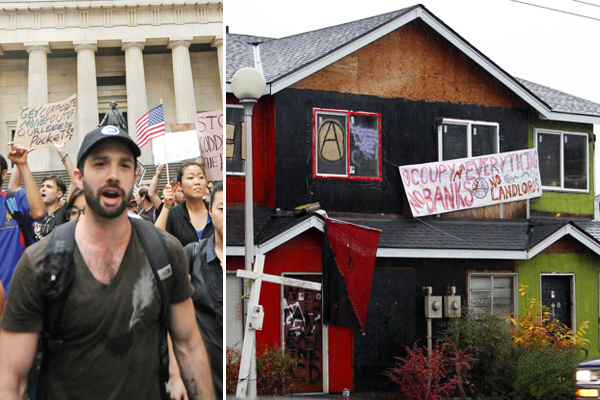
Occupy protesters (left) and a formerly boarded-up duplex taken over by protesters in Seattle's Central District this month. (Credit: AP/Louis Lanzano/Elaine Thompson) Occupy Wall Street is promising a “big day of action” Dec. 6 that will focus on the foreclosure crisis and protest “fraudulent lending practices,” “corrupt securitization,” and illegal evictions by banks.
The day will mark the beginning of an Occupy Our Homes campaign that organizers hope will energize the movement as it moves indoors as well as bring the injustices of the economic crisis into sharp relief.
Many of the details aren’t yet public, but protesters in 20 cities are expected to take part in the day of action next Tuesday. We’ve already seen eviction defenses at foreclosed properties around the country as well as takeovers of vacant properties for homeless families. Occupy Our Homes organizer Abby Clark tells me protesters are planning to “mic-check” (i.e., disrupt) foreclosure auctions as well as launch some new home occupations.
“This is a shift from protesting Wall Street fraud to taking action on behalf of people who were harmed by it. It brings the movement into the neighborhoods and gives people a sense of what’s really at stake,” said Max Berger, one of the Occupy Our Homes organizers and a member of Occupy Wall Street’s movement-building working group.
The backdrop for all this is a new study suggesting the foreclosure crisis is only half over, with 4 million homes in some stage of foreclosure. Meanwhile, reports of illegal or questionable behavior by banks and mortgage lenders continue to stream in.
Like many of the Occupy actions that have focused on specific policy questions, this one is being organized by established progressive and labor-affiliated groups along with their allies in the movement. Among the allied groups listed on Occupy Our Homes’ website, for example, are the New Bottom Line and New York Communities for Change. On the Occupy Wall Street side of things, members of the direct action working group and the movement-building group in New York have been involved in the project.
Occupy Our Homes’ website (which was registered by a former SEIU official staffer) has the trappings of a slick professional campaign, with videos featuring the stories of families facing foreclosures and a pledge visitors are encouraged to sign stating:
… that until the banks do their part to help homeowners and to fix the economy, by writing down mortgage principal to current home values, I will:
- I will support homeowners resisting wrongful foreclosure evictions.
- I will resist any attempt by the bank to take my home.
- If they come to foreclose, I will not go.
A network of groups organized as Take Back the Land has been doing eviction defenses and related actions around the country for five years, according to organizer Max Rameau.
“Now with this Occupy movement ramping up, I think we have a significant chance to keep large numbers of people in their home,” Rameau told Democracy Now earlier this month. “[The goal is to] not only force the banks to allow the family to stay in the home. But also then force policy changes that would help thousands of other people for whom we’re not doing eviction defenses.”
We saw a similar dynamic in the preexisting campaign to extend the millionaire’s tax in New York, which has benefited from new energy and a new banner offered by the Occupy movement.
Will the new Occupy push on foreclosures pick up any steam? I’ll be covering whatever happens on Dec. 6, so stay tuned to find out.
Justin Elliott is a reporter for ProPublica. You can follow him on Twitter @ElliottJustin More Justin Elliott.
Dissent, à la Québécoise
The student strike in Quebec has generalized, and solidarity is spreading in the U.S.
Demonstrators in Montreal on Tuesday. (Credit: Reuters/Christinne Muschi) For the past eight months, when chants of “Anti-Capitalista!” have echoed through New York streets, they’ve tended to emanate from crowds with a penchant for black clothing. But on Tuesday night, when once again a march of around 300 snaked through the streets around Washington Square Park, the color scheme was different: red flags, red banners, red clothes, red masks and little red felt square pins adorned the marchers — a mixture of long-term Occupy participants, students and others taking the streets and donning some red in solidarity with the Quebec student strike.
Continue Reading CloseNatasha Lennard covers the Occupy movement for Salon. A British-born, Brooklyn-based journalist, she has been covering Occupy Wall Street since before the first sleeping bag was unrolled in Zuccotti Park. One of the first journalists arrested at an Occupy action, she has managed to enrage Andrew Breitbart, Rush Limbaugh and Glenn Beck. You can follow her on Twitter (@natashalennard), and email her any Occupy updates/videos/ideas to natasha.lennard@gmail.com More Natasha Lennard.
Protest music’s odd conservative turn
A 100-track, four-CD Occupy collection assembles generations of icons. So why does it sound shapeless and safe?
“In this hour of the ever-changing season, may our tears not douse the fire in our hearts.”
That’s a guy named Michael Pless singing “Something’s Got to Give.” Even without hearing the song, you can surely imagine the essential elements: Plaintive acoustic strumming, an earnest vocal, and an air of polite outrage to match the stilted syntax and hoary platitudes. Welcome to “Occupy This Album,” the collection of protest-minded songs released by Occupy Wall Street. Sprawling across four CDs and a slew of bonus digital tracks, this behemoth set includes 100 (why not 99?) new and previously released tracks from artists representing a range of generations, genres, backgrounds, settings, and styles. Folkies join hands with rappers; ominous post-rock marches alongside peppy radio pop. There’s spoken-word poetry, tribal percussion, earnest singer-songwriter fare. Even a bit of jazz.
Continue Reading CloseFirst NATO protest targets Obama
A small rally kicks off a week of protests in Chicago and makes clear the president is a target in his city
Rahm Emanuel and President Obama (Credit: Reuters/John Gress) In the first week of November 2008, tens of thousands of people gathered in Chicago to watch dewy-eyed as Barack Obama won the presidential election, believing, as the then-president-elect said in his victory speech, that “this time must be different.” This week, the Windy City is welcoming large crowds again — but as was made clear by a small protest action Monday — the president is not the sweetheart of these Chicago masses, which are assembling for a week of actions and protests surrounding the NATO summit.
Continue Reading CloseNatasha Lennard covers the Occupy movement for Salon. A British-born, Brooklyn-based journalist, she has been covering Occupy Wall Street since before the first sleeping bag was unrolled in Zuccotti Park. One of the first journalists arrested at an Occupy action, she has managed to enrage Andrew Breitbart, Rush Limbaugh and Glenn Beck. You can follow her on Twitter (@natashalennard), and email her any Occupy updates/videos/ideas to natasha.lennard@gmail.com More Natasha Lennard.
Occupy: A Tea Party for the left?
The Mississippi Freedom Democratic Party didn't succeed by electing candidates. Occupy doesn't need to either
An Occupy Wall Street demonstrator chants during a march to celebrate the protest's sixth month, Saturday, March 17, 2012, in New York. (AP Photo/John Minchillo) (Credit: AP) As long as there has been a thing called Occupy Wall Street, there have been people who’ve suggested it should become the left’s version of the Tea Party. Josh Harkinson’s piece is a notable contribution to the conversation because it comes after eight months of in-depth reporting on the movement. Harkinson, like Jennifer Granholm, suggests that Occupy should recruit and run candidates, so the left has champions in Congress and can credibly threaten less ideologically aligned Democrats. According to this logic, it doesn’t matter if Occupy does this itself or essentially outsources the job to our progressive allies — the point is to find ways to elect more good Democrats.
Continue Reading Close“Occupy Cop” under attack
Retired Philadelphia Police Capt. Ray Lewis could lose his life insurance for wearing his uniform to a protest
Ray Lewis (Credit: AP/Joseph Kaczmarek) On Occupy Wall Street’s Nov. 17 Day of Action, the NYPD arrested nearly 250 protesters. Ray Lewis, however, stuck out: the retired Philadelphia Police captain was dressed in uniform. He was holding a sign that on one side encouraged people to watch the Charles Ferguson financial crisis documentary “Inside Job.” On the other: “NYPD Don’t Be Wall Street Mercenaries.”
Continue Reading CloseDaniel Denvir is a staff writer at Philadelphia City Paper and a contributing writer for Salon. You can follow him at Twitter @DanielDenvir. More Daniel Denvir.
Page 1 of 67 in Occupy Wall Street
