Fox News

Who’s winning the Fox primary?

The conservative cable channel treads carefully in Gingrich-Romney race

  • more
    • All Share Services

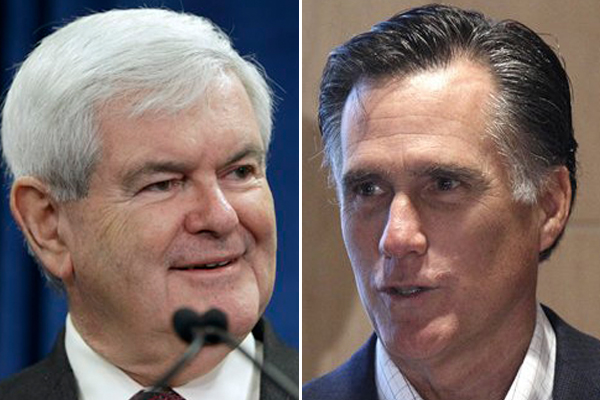
Who's winning the Fox primary?Newt Gingrich and Mitt Romney (Credit: AP)

The Republican primary campaign has become a two-man race, with unloved ostensible front-runner Mitt Romney currently suffering the indignity of trailing in the polls to self-satisfied serial adulterer Newt Gingrich. Where does the unofficial communications arm of the conservative movement stand on the race? They’re noncommittal, thus far.

We all know the basic facts: A lot of conservatives see Romney as completely unacceptable. The more pragmatic ones see Gingrich as wholly unelectable. Fox News is run by consummate conservative elite Roger Ailes. Ailes has two objectives: Generate ratings and elect Republicans. The Gingriches of the world excite Fox viewers, because of their shamelessness. Romney excites no one, but he’ll need Fox’s support if he ends up the beneficiary of a Gingrich collapse.

Fox has indulged its audience’s brief surges of affection for unelectable fringe candidates, from Trump through Cain, but the channel’s always been careful to remind the base that they may eventually have to hold their noses and vote for Romney. Karl Rove, who’s already running a shadow campaign against Obama, has made this point explicitly during his Fox appearances.

Romney went from trailing in the Fox News appearances list to getting more uninterrupted airtime over the last week than any other candidate. But Gingrich beat him in minutes the week before. And Newt was just on Hannity last night, where he seemed much more comfortable than Romney did in his earlier sit-down with Bret Baier, a tougher interviewer by any standard.

Watching Fox this morning, clips of Gingrich’s Hannity interview were replayed multiple times. Ron Paul’s devastating anti-Gingrich ad was excerpted for a minute, followed by a clip of Romney sounding like he believed in anthropogenic climate change.

The network seems, in other words, undecided at the moment, or at least willing to see if Gingrich can pull this out without humiliating himself like he always does. The Rovians may yet win the day, but for now Fox seems to be joining the GOP base in convincing itself that Gingrich is electable.

Alex Pareene

Alex Pareene writes about politics for Salon and is the author of "The Rude Guide to Mitt." Email him at apareene@salon.com and follow him on Twitter @pareene

Communist accusations matter

O'Reilly says I secretly adore Karl Marx -- and provides another example of how Fox ruins the national dialogue

  • more
    • All Share Services

Communist accusations matter Bill O'Reilly (Credit: Wikipedia)
This originally appeared on Robert Reich's blog.

Bill O’Reilly, the tumescent personality of Fox News, said on his Friday show “Robert Reich is a communist who secretly adores Karl Marx.”

It’s an odd charge. If we were living in the 1950s, amid Senator Joe McCarthy’s communist witch-hunts, O’Reilly’s accusation might have some bite and cause me real injury. But these days it’s hard to find a full-throated communist anywhere in the world.

O’Reilly’s accusation isn’t even logical. How can he know if I secretly adore Karl Marx, if it’s a secret?

For the record, I’m not a communist and I don’t secretly adore Karl Marx.

Ordinarily I don’t bother repeating anything Bill O’Reilly says. But this particular whopper is significant because it represents what O’Reilly and Fox News, among others, are doing to the national dialogue.

They’re burying it in doo-doo.

O’Reilly based his claim on an interview I did last week with Jon Stewart on the Daily Show, in which I argued that because America’s big corporations were now global we could no longer rely on them to make necessary investments in human capital or to lobby for public investments in education, infrastructure, and basic R&D. So, logically, government has to step in.

Since when does an argument for public investment in education, infrastructure, and basic R&D make someone a communist or a secret adorer of Karl Marx?

But obviously, O’Reilly has no interest in arguing anything. Ad hominem attacks are always the last refuges of intellectual boors lacking any logic or argument.

This is what’s happening to all debate all over America: It’s disappearing. All we’re left with is a nasty residue.

In Washington, Democrats and Republicans no longer even talk. They just vent charges and counter-charges.

The 2012 election doesn’t seem likely to clarify any issue. At this moment the candidates and their surrogates are debating the treatment of dogs.

Across the nation, conservatives right-wingers and liberal or progressive lefties have stopped debating their respective views, or even listening to anyone they disagree with. They just find broadcasters and bloggers who confirm their views.

We’re even sorting by belief according to where we live. Today your neighbors are more likely to agree with your politics than disagree. We’ve settled into like-minded enclaves where we don’t need to think because everyone we meet confirms what we assume we already know.

It’s not that the nation is more polarized than it’s been in the past. America has been through searing conflicts, some within the living memories of most of us. The communist witch-hunts of the 1950s were followed by the civil rights movement, the Vietnam War, battles over womens’ reproductive rights and gay marriage.

What makes our current conflicts remarkable isn’t their severity but our utter lack of engagement debating them.

So many Americans are so angry and frustrated these days – vulnerable to loss of job and healthcare and home, without a shred of economic security – they’re easy prey for demagogues offering simple answers and ready scapegoats. Take, for example, Bill O’Reilly and his colleagues on Fox.

But people can only learn from others who disagree with them — or at least from witnessing debates between people who respectfully and civilly disagree. Without respect and civility, it’s not a debate – it’s just back to name-calling.

A democracy depends on public deliberation and debate. Without it, the members of a society have no means of understanding what they believe or why. The Lincoln-Douglas debates were notable not because they solved anything but because they helped Americans clarify where they agreed and disagreed on the wrenching issue of slavery.

Hence the danger today – when deliberation has stopped.

This morning I left a message on Bill O’Reilly’s office phone asking him to invite me onto his show to debate whether public investments in education and infrastructure are needed.

What are the odds he’ll invite me on?

Continue Reading Close

Robert Reich, one of the nation’s leading experts on work and the economy, is Chancellor’s Professor of Public Policy at the Goldman School of Public Policy at the University of California at Berkeley. He has served in three national administrations, most recently as secretary of labor under President Bill Clinton. Time Magazine has named him one of the ten most effective cabinet secretaries of the last century. He has written 13 books, including his latest best-seller, “Aftershock: The Next Economy and America’s Future;” “The Work of Nations,” which has been translated into 22 languages; and his newest, an e-book, “Beyond Outrage.” His syndicated columns, television appearances, and public radio commentaries reach millions of people each week. He is also a founding editor of the American Prospect magazine, and Chairman of the citizen’s group Common Cause. His widely-read blog can be found at www.robertreich.org.

Fox: “Glee” makes you trans

Bill O'Reilly thinks the show is coming for your children -- and once again misunderstands inequality VIDEO

  • more
    • All Share Services

Fox: (Credit: Wikipedia)

“Here we go again,” says the blond lady from Fox. Gretchen Carlson, I assure you I feel exactly the same way.

On Thursday’s “O’Reilly Factor,” Bill O’Reilly grappled with the terrible, terrible paradox that while “Glee” may have some merits, it also sends the message “that alternative lifestyles for children may be positive.” And then, oh no, he showed a clip of the character Unique performing a KC and the Sunshine Band song in a dress and heels. O’Reilly, who is terribly concerned that America’s youth “might go out and experiment with this stuff,” next welcomed Carlson, along with Judge Jeanine Pirro, for an old-fashioned round of pearl-clutching. “Here we go again,” said Carlson, “pandering to .3 percent of the American population that consider themselves transgender. Now I get to explain this to my 8-year-old, if I just wanted to watch a nice family show with some nice music?”

Sound familiar? Wasn’t it this time last year that a Fox affiliate was stressing out that “Glee” might turn our children gay? Wasn’t it just this week that Tennessee moved to eradicate any mention of homosexuality from the elementary school curriculum because, as Rep. Joey Hensley put it, “I have two children — in the third and fourth grade — and don’t want them to be exposed to things I don’t agree with.” It’s the old LA LA LA I DON’T WANT TO SEE YOU ploy, one that assumes whatever “these dopey kids” know about, they will “experiment” with. It’s the same kind of faulty logic that insists that abstinence-only programs will keep kids from having sex. (Spoiler: They will not.)

It’s fortunate that Pirro was on hand to gape, “Do you really think that this is the kind of thing that’s contagious?” and explain that “We all parent our kids but you can’t parent their sexuality.” Sadly, it didn’t seem to penetrate O’Reilly’s or Carlson’s brain. That “.3 percent” that Carlson so sneeringly refers to takes an overwhelmingly disproportionate amount of abuse and harassment. That’s why it’s awesome when they can see positive images of themselves on television. And as one of the teens in a powerful new clip from Illinois Safe Schools explains, “Just because you’re gay doesn’t mean you want to go sleep with every guy or turn all straight people gay.” It’s about being visible; it’s about moving from the darkness of ignorance to basic respect.

Frankly, I don’t let my own 8-year-old watch “Glee” because I think it’s too racy for her – and I question any high and mighty moralizer who thinks it’s just “a nice family show with some nice music.” But my daughter knows that there are gay and lesbian and transgender people in the world – she even knows gay and lesbian and transgender people! And yes, sometimes it’s confusing for kids to get their heads around identity and sexual orientation. But I’m here to tell Gretchen Carlson it’s a lot easier teaching a child that some boys feel they were meant to be girls than it is answering their questions about gravity or the nature of time or how big God is. To paraphrase Louis CK on the hand-wringing over what to tell The Children, it’s your kid, you figure it out.

Like Carlson, I care about what my kids watch. I don’t want my children exposed to images or ideas that would influence them to be mean or cold or desensitized to violence and its consequences. I likewise don’t want my daughters to pick up any notions from the media that they have to be skinny or sexy or downplay their intelligence to be liked.

But I don’t believe for a second that gay and trans kids are trying to ruin anybody’s Tuesday evening musical entertainment with an agenda of indoctrination. They’re not trying to entice America’s little boys to put on dresses. Good entertainment is just about understanding the human condition, about empathy for characters whose lives and experiences may be just like ours, or completely different from them. I’m about as non African-American transgender male teenager as it gets, and I can honestly say that having one on television poses exactly zero threat to my family or the identity of any member within it. “Glee’s” Unique isn’t out to change your kids or mine. Unique is just a fellow human being, with dreams and disappointments and dignity, whose boogie shoes just happen to be silver, and very, very high.

Continue Reading Close
Mary Elizabeth Williams

Mary Elizabeth Williams is a staff writer for Salon and the author of "Gimme Shelter: My Three Years Searching for the American Dream." Follow her on Twitter: @embeedub.

Fox’s misinformation effect

It's not just the programming. Conservatives are more likely to seek out outlets that affirm their views

  • more
    • All Share Services

Fox's misinformation effect Bill O'Reilly (Credit: AP/Charles Sykes)
This article originally appeared on AlterNet. It is an excerpt from Chris Mooney’s new book "The Republican Brain: The Science of Why They Deny Science and Reality."

In June of last year, Jon Stewart went on air with Fox News’ Chris Wallace and started a major media controversy over the channel’s misinforming of its viewers. “Who are the most consistently misinformed media viewers?” Stewart asked Wallace. “The most consistently misinformed? Fox, Fox viewers, consistently, every poll.”

AlterNetStewart’s statement was factually accurate, as we’ll see. The next day, however, the fact-checking site PolitiFact weighed in and rated it “false.”In claiming to check Stewart’s “facts,” PolitiFact ironically committed a serious error—and later, doubly ironically, failed to correct it. How’s that for the power of fact checking?

There probably is a small group of media consumers out there somewhere in the world who are more misinformed, overall, than Fox News viewers. But if you only consider mainstream U.S. television news outlets with major audiences (e.g., numbering in the millions), it really is true that Fox viewers are the most misled based on all the available evidence—especially in areas of political controversy. This will come as little surprise to liberals, perhaps, but the evidence for it—evidence in Stewart’s favor—is pretty overwhelming.

My goal here is to explore the underlying causes for this “Fox News effect”—explaining how this station has brought about a hurricane-like intensification of factual error, misinformation and unsupportable but ideologically charged beliefs on the conservative side of the aisle. First, though, let’s begin by surveying the evidence about how misinformed Fox viewers actually are.

Based upon my research, I have located seven separate studies that support Stewart’s claim about Fox, and none that undermine it. Six of these studies were available at the time that PolitFact took on Stewart; one of them is newer.

The studies all take a similar form: These are public opinion surveys that ask citizens about their beliefs on factual but contested issues, and also about their media habits. Inevitably, some significant percentage of citizens are found to be misinformed about the facts, and in a politicized way—but not only that. The surveys also find that those who watch Fox are more likely to be misinformed, their views of reality skewed in a right-wing direction. In some cases, the studies even show that watching more Fox makes the misinformation problem worse.

So with that, here are the studies.

Iraq War

In 2003, a survey by the Program on International Policy Attitudes (PIPA) at the University of Maryland found widespread public misperceptions about the Iraq war. For instance, many Americans believed the U.S. had evidence that Saddam Hussein’s Iraq had been collaborating in some way with al-Qaida, or was involved in the 9-11 attacks; many also believed that the much touted “weapons of mass destruction” had been found in the country after the U.S. invasion, when they hadn’t. But not everyone was equally misinformed: “The extent of Americans’ misperceptions vary significantly depending on their source of news,” PIPA reported. “Those who receive most of their news from Fox News are more likely than average to have misperceptions.” For instance, 80 percent of Fox viewers held at least one of three Iraq-related misperceptions, more than a variety of other types of news consumers, and especially NPR and PBS users. Most strikingly, Fox watchers who paid more attention to the channel were more likely to be misled.

Global Warming

At least two studies have documented that Fox News viewers are more misinformed about this subject.

In a late 2010 survey, Stanford University political scientist Jon Krosnick and visiting scholar Bo MacInnis found that “more exposure to Fox News was associated with more rejection of many mainstream scientists’ claims about global warming, with less trust in scientists, and with more belief that ameliorating global warming would hurt the U.S. economy.” Frequent Fox viewers were less likely to say the Earth’s temperature has been rising and less likely to attribute this temperature increase to human activities. In fact, there was a 25 percentage point gap between the most frequent Fox News watchers (60 percent) and those who watch no Fox News (85 percent) in whether they think global warming is “caused mostly by things people do or about equally by things people do and natural causes.”

In a much more comprehensive study released in late 2011 (too late for Stewart or for PolitiFact), American University communications scholar Lauren Feldman and her colleagues reported on their analysis of a 2008 national survey, which found that “Fox News viewing manifests a significant, negative association with global warming acceptance.” Viewers of the station were less likely to agree that “most scientists think global warming is happening” and less likely to think global warming is mostly caused by human activities, among other measures.

Health Care

In 2009, an NBC survey found “rampant misinformation” about the healthcare reform bill before Congress — derided on the right as “Obamacare.” It also found that Fox News viewers were much more likely to believe this misinformation than average members of the general public. “72 percent of self-identified Fox News viewers believe the healthcare plan will give coverage to illegal immigrants, 79 percent of them say it will lead to a government takeover, 69 percent think that it will use taxpayer dollars to pay for abortions, and 75 percent believe that it will allow the government to make decisions about when to stop providing care for the elderly,” the survey found.

By contrast, among CNN and MSNBC viewers, only 41 percent believed the illegal immigrant falsehood, 39 percent believed in the threat of a “government takeover” of healthcare (40 percentage points less), 40 percent believed the falsehood about abortion, and 30 percent believed the falsehood about “death panels” (a 45 percent difference!).

In early 2011, the Kaiser Family Foundation released another survey on public misperceptions about healthcare reform. The poll asked 10 questions about the newly passed healthcare law and compared the “high scorers”—those that answered 7 or more correct—based on their media habits. The result was that “higher shares of those who report CNN (35 percent) or MSNBC (39 percent) as their primary news source [got] 7 or more right, compared to those that report mainly watching Fox News (25 percent).”

“Ground Zero Mosque” 

In late 2010, two scholars at the Ohio State University studied public misperceptions about the so-called “Ground Zero Mosque”—and in particular, the prevalence of a series of rumors depicting those seeking to build this Islamic community center and mosque as terrorist sympathizers, anti-American, and so on. All of these rumors had, of course, been dutifully debunked by fact-checking organizations. The result? “People who use Fox News believe more of the rumors we asked about and they believe them more strongly than those who do not.”

The 2010 Election

In late 2010, the Program on International Policy Attitudes (PIPA) once again singled out Fox in a survey about misinformation during the 2010 election. Out of 11 false claims studied in the survey, PIPA found that “almost daily” Fox News viewers were “significantly more likely than those who never watched it” to believe of them, including the misperceptions that “most scientists do not agree that climate change is occurring” (they do), that “it is not clear that President Obama was born in the United States” (he was), that “most economists estimate the stimulus caused job losses” (it either saved or created several million), that “most economists have estimated the healthcare law will worsen the deficit” (they have not), and so on.

It is important to note that in this study—by far the most critiqued of the bunch—the examples of misinformation studied were all closely related to prominent issues in the 2010 midterm election, and indeed, were selected precisely because they involved issues that voters said were of greatest importance to them, like healthcare and the economy. That was the main criterion for inclusion, explains PIPA senior research scholar Clay Ramsay. “People said, here’s how I would rank that as an influence on my vote,” says Ramsay, “so everything tested is at least a 5 on a zero-to-10 scale.”

Politifact Swings and Misses

In attempting to fact-check Jon Stewart on the subject of Fox News and misinformation, PolitiFact simply appeared out of its depth. The author of the article in question, Louis Jacobson, only cited two of the studies above–“Iraq War” and “2010 Election”—though six out of seven were available at the time he was writing. And then he suggested that the “2010 Election” study should “carry less weight” due to various methodological objections.

Meanwhile, Jacobson dug up three separate studies that we can dismiss as irrelevant. That’s because these studies did not concern misinformation, but rather, how informed news viewers are about basic political facts like the following: “who the vice president is, who the president of Russia is, whether the Chief Justice is conservative, which party controls the U.S. House of Representatives and whether the U.S. has a trade deficit.”

A long list of public opinion studies have shown that too few Americans know the answers to such basic questions. That’s lamentable, but also off point at the moment. These are not politically contested issues, nor are they skewed by an active misinformation campaign. As a result, on such issues many Americans may be ill-informed but liberals and conservatives are nevertheless able to agree.

Jon Stewart was clearly talking about political misinformation. He used the word “misinformed.” And for good reason: Misinformation is by far the bigger torpedo to our national conversation, and to any hope of a functional politics. “It’s one thing to be not informed,” explains David Barker, a political scientist at the University of Pittsburgh who has studied conservative talk-radio listeners and Fox viewers. “It’s another thing to be misinformed, where you’re confident in your incorrectness. That’s the thing that’s really more problematic, democratically speaking—because if you’re confidently wrong, you’re influencing people.”

Thus PolitiFact’s approach was itself deeply uninformed, and underscores just how poorly our mainstream political discourse deals with the problem of systematic right wing misinformation.

Fox and the Republican Brain

The evidence is clear, then—the Politifact-Stewart flap notwithstanding, Fox viewers are the most misinformed. But then comes the truly interesting and important question: Why is that the case?

To answer it, we’ll first need to travel back to the 1950s, and the pioneering work of the Stanford psychologist and cult infiltrator, Leon Festinger.

In his 1957 book “A Theory of Cognitive Dissonance,” Festinger built on his famous study of a doomsday cult called the Seekers, and other research, to lay out many ramifications of his core idea about why human beings contort the evidence to fit their beliefs, rather than conforming those beliefs to the evidence. That included a prediction about how those who are highly committed to a belief or view should go about seeking information that touches on that powerful conviction.

Festinger suggested that once we’ve settled on a core belief, this ought to shape how we gather information. More specifically, we are likely to try to avoid encountering claims and information that challenge that belief, because these will create cognitive dissonance. Instead, we should go looking for information that affirms the belief. The technical (and less than ideal) term for this phenomenon is “selective exposure”: what it means is that we selectively choose to be exposed to information that is congenial to our beliefs, and to avoid “inconvenient truths” that are uncongenial to them.

If Festinger’s ideas about “selective exposure” are correct, then the problem with Fox News may not solely be that it is actively causing its viewers to be misinformed. It’s very possible that Fox could be imparting misinformation even as politically conservative viewers are also seeking the station out—highly open to it and already convinced about many falsehoods that dovetail with their beliefs. Thus, they would come into the encounter with Fox not only misinformed and predisposed to become more so, but inclined to be very confident about their incorrect beliefs and to impart them to others. In this account, political misinformation on the right would be driven by a kind of feedback loop, with both Fox and its viewers making the problem worse.

Psychologists and political scientists have extensively studied selective exposure, and within the research literature, the findings are often described as mixed. But that’s not quite right. In truth, some early studies seeking to confirm Festinger’s speculation had problems with their designs and often failed—and as a result, explains University of Alabama psychologist William Hart, the field of selective exposure research “stagnated” for several decades. But it has since undergone a dramatic revival—driven, not surprisingly, by the modern explosion of media choices and growing political polarization in the U.S. And thanks to a new wave of better-designed and more rigorous studies, the concept has become well established.

“Selective exposure is the clearest way to look at how people create their own realities, based upon their views of the world,” says Hart. “Everybody knows this happens.”

Indeed, by 2009, Hart and a team of researchers were able to perform a meta-analysis—a statistically rigorous overview of published studies on selective exposure—that pooled together 67 relevant studies, encompassing almost 8,000 individuals. As a result, he found that people overall were nearly twice as likely to consume ideologically congenial information as to consume ideologically inconvenient information—and in certain circumstances, they were even more likely than that.

When are people most likely to seek out self-affirming information? Hart found that they’re most vulnerable to selective exposure if they have defensive goals—for instance, being highly committed to a preexisting view, and especially a view that is tied to a person’s core values. Another defensive motivation identified in Hart’s study was closed-mindedness, which makes a great deal of sense. It is probably part of the definition of being closed-minded, or dogmatic, that you prefer to consume information that agrees with what you already believe.

So who’s closed-minded? Multiple studies have shown that political conservatives—e.g., Fox viewers–tend to have a higher need for closure. Indeed, this includes a group called right-wing authoritarians, who are increasingly prevalent in the Republican Party. This suggests they should also be more likely to select themselves into belief-affirming information streams, like Fox News or right-wing talk radio or the Drudge Report. Indeed, a number of research results support this idea.

In a study of selective exposure during the 2000 election, for instance, Stanford University’s Shanto Iyengar and his colleagues mailed a multimedia informational CD about the two candidates—Bush and Gore—to 600 registered voters and then tracked its use by a sample of 220 of them. As a result, they found that Bush partisans chose to consume more information about Bush than about Gore—but Democrats and liberals didn’t show the same bias toward their own candidate.

Selective exposure has also been directly tested several times in authoritarians. In one case, researchers at Stony Brook University primed more and less authoritarian subjects with thoughts of their own mortality. Afterwards, the authoritarians showed a much stronger preference than non-authoritarians for reading an article that supported their existing view on the death penalty, rather than an article presenting the opposing view or a “balanced” take on the issue. As the authors concluded: “highly authoritarian individuals, when threatened, attempt to reduce anxiety by selectively exposing themselves to attitude-validating information, which leads to ‘stronger’ opinions that are more resistant to attitude change.”

The psychologist Robert Altemeyer of the University of Manitoba has also documented an above average amount of selective exposure in right wing authoritarians. In one case, he gave students a fake self-esteem test, in which they randomly received either above average or below average scores. Then, everyone—the receivers of both low and high scores—was given the opportunity to say whether he or she would like to read a summary of why the test was valid. The result was striking: Students who scored low on authoritarianism wanted to learn about the validity of the test regardless of how they did on it. There was virtually no difference between high and low scorers. But among the authoritarian students, there was a big gap: 73 percent of those who got high self-esteem scores wanted to read about the test’s validity, while only 47 percent of those who got low self-esteem scores did.

Authoritarians, Altemeyer concludes, “maintain their beliefs against challenges by limiting their experiences, and surrounding themselves with sources of information that will tell them they are right.”

The evidence on selective exposure, as well as the clear links between closed-mindedness and authoritarianism, gives good grounds for believing that this phenomenon should be more common and more powerful on the political right. Lest we leap to the conclusion that Fox News is actively misinforming its viewers most of the time—rather than enabling them through its very existence—that’s something to bear in mind.

Disinformation Passing as “News”

None of which is to suggest that Fox isn’t also guilty of actively misinforming viewers. It certainly is.

The litany of misleading Fox segments and snippets is quite extensive—especially on global warming, where it seems that every winter snowstorm is an excuse for more doubt-mongering. No less than Fox’s Washington managing editor Bill Sammon was found to have written, in a 2009 internal staff email exposed by MediaMatters, that the network’s journalists should:

. . . refrain from asserting that the planet has warmed (or cooled) in any given period without IMMEDIATELY pointing out that such theories are based upon data that critics have called into question. It is not our place as journalists to assert such notions as facts, especially as this debate intensifies.

And global warming is hardly the only issue where Fox actively misinforms its viewers. The polling data here, from the Project on International Policy Attitudes (PIPA) are very telling.

PIPA’s study of misinformation in the 2010 election didn’t just show that Fox News viewers were more misinformed than viewers of other channels. It also showed that watching more Fox made believing in nine separate political misperceptions more likely. And that was a unique effect, unlike any observed with the other news channels that were studied. “With all of the other media outlets, the more exposed you were, the less likely you were to have misinformation,” explains PIPA’s director, political psychologist Steven Kull. “While with Fox, the more exposure you had, in most cases, the more misinformation you had. And that is really, in a way, the most powerful factor, because it strongly suggests they were actually getting the information from Fox.”

Indeed, this effect was even present in non-Republicans–another indicator that Fox is probably its cause. As Kull explains, “even if you’re a liberal Democrat, you are affected by the station.” If you watched Fox, you were more likely to believe the nine falsehoods, regardless of your political party affiliation.

In summary, then, the “science” of Fox News clearly shows that its viewers are more misinformed than the viewers of other stations, and are indeed this way for ideological reasons. But these are not necessarily the reasons that liberals may assume. Instead, the Fox “effect” probably occurs both because the station churns out falsehoods that conservatives readily accept—falsehoods that may even seem convincing to some liberals on occasion—but also because conservatives are overwhelmingly inclined to choose to watch Fox to begin with.

At the same time, it’s important to note that they’re also disinclined to watch anything else. Fox keeps constantly in their minds the idea that the rest of the media are “biased” against them, and conservatives duly respond by saying other media aren’t worth watching—it’s just a pack of lies. According to Public Policy Polling’s annual TV News Trust Poll (the 2011 run), 72 percent of conservatives say they trust Fox News, but they also say they strongly distrust NBC, ABC, CBS and CNN. Liberals and moderates, in contrast, trust all of these outlets more than they distrust them (though they distrust Fox). This, too, suggests conservative selective exposure.

And there is an even more telling study of “Fox-only” behavior among conservatives, from Stanford’s Shanto Iyengar and Kyu Hahn of Yonsei University, in Seoul, South Korea. They conducted a classic left-right selective exposure study, giving members of different ideological groups the chance to choose stories from a news stream that provided them with a headline and a news source logo—Fox, CNN, NPR, and the BBC—but nothing else. The experiment was manipulated so that the same headline and story was randomly attributed to different news sources. The result was that Democrats and liberals were definitely less inclined to choose Fox than other sources, but spread their interest across the other outlets when it came to news. But Republicans and conservatives overwhelmingly chose Fox for hard news and even for soft news, and ignored other sources. “The probability that a Republican would select a CNN or NPR report was around 10%,” wrote the authors.

In other words Fox News is both deceiver and enabler simultaneously. First, its existence creates the opportunity for conservatives to exercise their biases, by selecting into the Fox information stream, and also by imbibing Fox-style arguments and claims that can then fuel biased reasoning about politics, science, and whatever else comes up.

But at the same time, it’s also likely that conservatives, tending to be more closed-minded and more authoritarian, have a stronger emotional need for an outlet like Fox, where they can find affirmation and escape from the belief challenges constantly presented by the “liberal media.” Their psychological need for something affirmative is probably stronger than what’s encountered on the opposite side of the aisle—as is their revulsion towards allegedly liberal (but really centrist) media outlets.

And thus we find, at the root of our political dysfunction, a classic nurture-nature mélange. The penchant for selective exposure is rooted in our psychology and our brains. Closed-mindedness and authoritarianism—running stronger in some of us than in others—likely are as well.

But nevertheless, it took the emergence of a station like Fox News before these tendencies could be fully activated—polarizing America not only over politics, but over reality itself.

Continue Reading Close

Chris Mooney is the author of four books, including "The Republican War on Science" (2005). His next book, "The Republican Brain: The Science of Why They Deny Science—and Reality," is due out in April.

How billionaires destroy democracy

Wealthy Wall Streeters have rigged the economy and the government against the people. Here's how they did it

  • more
    • All Share Services

How billionaires destroy democracyKenneth Griffin, Philip Falcone, Jim Simons and John Paulson testify before a House Oversight and Government Reform Committee hearing on the regulation of hedge funds in 2008. (Credit: Reuters/Jonathan Ernst)

There are many words that could be used to describe Barack Obama, but one adjective decidedly doesn’t fit: Aggressive. So it was more than passing strange when a prominent member of Wall Street — Stephen Schwarzman, chairman of the private equity giant Blackstone Group — compared actions by President Obama to one of the most notoriously aggressive acts by one of history’s most aggressive villains. Speaking to the board of a nonprofit group, Schwarzman fiercely denounced initiatives by the Obama administration: “It’s war. It’s like when Hitler invaded Poland in 1939.”

In the arena of political commentary, few things are considered more clearly below-the-belt than comparing an opponent to Hitler. So there was a small stir in August 2010 when it was reported that Schwarzman — whom Time magazine had included on its 100 most influential people list only three years earlier — had likened Obama to the Nazi strongman. Schwarzman acknowledged making the remark and then apologized for it, while reaffirming the sentiment behind it. But what was striking about the Hitler comment — besides its sheer viciousness and absurdity — was what had provoked it. Schwarzman wasn’t complaining about undue military force, torture, or ethnic cleansing. He was likening the president to the most reviled man in history on the grounds that Obama was trying to close a tax loophole that allowed hedge fund and private equity managers (like Schwarzman) to pay tax at a rate that Warren Buffett famously noted was lower than that paid by their secretaries.

In an era marked by gluttony and hubris, Steve Schwarzman has still managed to stand out.

His 60th birthday party in Manhattan in 2007 was so lavish — with live performances by Rod Stewart and Martin Short — it became Wall Street legend. Then there’s Schwarzman’s 35-room Park Avenue residence, his sprawling estate in Saint-Tropez, a spectacular spread in Jamaica, and his massive Palm Beach estate, where the executive chef says it typically costs about $3,000 a weekend to feed just Schwarzman and his wife.

Schwarzman is a major figure in private equity, part of the surging field of “alternative asset” financial institutions that, along with hedge and real estate funds, appeared on the horizon two decades ago and now control trillions of dollars in assets. While hedge funds are well-known for contributing to the subprime mortgage crash, private equity funds are notorious for taking over established firms with borrowed money and essentially pillaging them. The bought-out companies are typically saddled with increased debt from the takeover and forced to make massive dividend and fee payouts to the private equity managers and their investors, while employees are shedded and union contracts gutted. The companies are usually chopped up into smaller pieces and sold soon afterwards at inflated prices, creating another windfall for the private equity managers. By 2007, the Blackstone Group had taken control of more than 112 companies worth nearly $200 billion. In 2011, Schwarzman ranked 169th on Forbes’ worldwide billionaire list, worth an estimated $5.9 billion.

Schwarzman may be rougher at the edges than most of the hedge fund and private equity crowd. But his outburst against Obama reminds us of the “war” he and others — by themselves or by proxies — have been engaged in to minimize their contribution to the public treasury. It’s an all-too-familiar tale of how effective the rich are at getting their way, even when the battle is being played out in a very public arena where a small group of billionaires advancing their own self-interest would seem a very tough sell.

- – - – - – - – - – - -

Victor Fleischer didn’t set out to be a 21st-century Robin Hood. His real aim was just to get tenure.

Fleischer joined the New York law firm Polk Davis in the late 1990s, working on the formations of private equity and venture capital funds. He was struck by the very low rates of tax paid by fund managers, even compared to the already low tax rates being paid by executives receiving corporate stock options. Fleischer wasn’t discovering something new; the rules had been in place since 1954. Nor was he outraged or even particularly interested in the question of tax fairness. At the time, he was simply interested in the impact that the tax rules governing so-called “carried interest” might have on the law firm’s clients.

The question stayed in Fleischer’s mind after he left Polk Davis in 2001 and became a law professor specializing in taxation. Hoping to get a paper published to improve his chances of securing tenure, Fleischer put together his thoughts on the taxation of private equity funds. Now that he was no longer constrained by working for people in the private equity field, he started to pay attention to what seemed to him to be a “quirk” in the law that distorted tax principles while undermining distributive justice.

He identified the fact that managers of private equity, venture capital and hedge funds were claiming a significant part of their incomes as capital gains (taxed at 15 percent), rather than treating them as regular income (taxed at 35 percent). That substantial difference in rates was magnified by the enormity of the incomes in question. A private equity manager receiving, say, $600 million as a capital gain would pay $90 million in tax. If the same income were treated as income from salary, it would be taxed at 35 percent (and also be subject to a 2.9 percent payroll tax), bringing the private equity manager’s tax bill to $227.4 million — almost $140 million more.

The ostensible purpose of the lower capital gains rate is to compensate investors for the risk they take in investing their capital. But private equity and fund managers aren’t investing their own capital. They’re investing other people’s capital. They’re simply money managers. By claiming capital gains treatment, they are passing off regular income as capital gains, simply to save themselves taxes.

The fund managers insist that their compensation is still very risky; while some deals may lead to huge profits, others prove disastrous. True. But risk is hardly confined to fund managers. And at lower income levels, the risks are far larger. Indeed, in the last 30 years, vast swaths of the economy could be designated as risky for those needing to earn a living. The sort of stable, lifelong jobs that were common a generation ago have been largely replaced by contract or part-time work, with little or no security. A layoff can mean the loss of the family home or health benefits, or even destitution — far more serious plights than anything likely to befall a hedge fund manager. (For that matter, no one ever seems to argue for special low tax rates for the real risk-takers among us — miners, oil-rig workers, acrobats, firemen, window washers working on tall buildings.)

The so-called “carried interest” loophole enjoyed by hedge fund and private equity managers raises the larger question of whether capital gains — even real ones — should ever be taxed at lower rates. On the face of things, the lower rate seems patently unfair. Why should someone earning income by investing their fortune be taxed at a substantially lower rate than those earning income from the sweat of their brows or from using skills they’ve spent years acquiring? The fairness argument has essentially been set aside, however, as business has relentlessly promoted the notion that such preferential treatment is necessary to coax those with capital to invest it. But do investors really need coaxing? Warren Buffett, one of the world’s savviest investors, doesn’t think so. “I have worked with investors for 60 years and I have yet to see anyone — not even when capital gains rates were 39.9 percent in 1976-77 — shy away from a sensible investment because of the tax rate on the potential gain,” Buffett argues.

Our business culture tends to portray investors as modern-day heroes who put their hard-earned capital into worthy high-risk ventures that lead to path-breaking discoveries that enrich the lives of all of us. Sadly, the vast majority of investments don’t fit into this category (and those that do qualify for additional tax incentives). Rather, as former mutual fund manager John C. Bogle notes, “most capital gains are made from gambling in the stock market.” So the ultimate function of the special low rate on capital gains is to save our wealthiest citizens billions of dollars a year on their winnings in the Wall Street casino.

- – - – - – - – - – - -

Fleischer’s paper found its way into the hands of congressional Democrats at a time when they were looking for fresh sources of revenue to pay for the expansion of the State Children’s Health Insurance Program and the Earned Income Tax Credit. The juxtaposition of high-flying hedge fund managers and children without health care seemed like a public relations nightmare for the Wall Street crowd.

Schwarzman himself helped put an unsavory face on the fund manager set with his plan to turn Blackstone into a publicly traded company in the spring of 2007. The plan would not only allow Schwarzman and other top Blackstone executives to continue to qualify for the low capital-gains rate as fund managers, but would also allow their new multi-billion-dollar publicly traded company to largely avoid paying corporate taxes. If Schwarzman won the approval of SEC regulators, he and Blackstone co-founder Peter Peterson would receive billions of dollars worth of stock, plus hundreds of millions in cash. And this would surely set a precedent, enticing other private equity funds, as well as investment banks — including giants like Goldman Sachs and Morgan Stanley — to reorganize themselves along similar lines, making the paying of corporate taxes almost optional for Wall Street institutions.

Schwarzman’s move had pushed the issue of sweetheart taxation for private equity kings from law school reviews to the front pages of newspapers. A bill to stop Schwarzman — dubbed the Blackstone bill — quickly appeared in Congress.

Momentum seemed to be building against the Blackstone deal and more broadly for a bill, sponsored by Democratic congressman Sander Levin that would shut down the fund manager loophole completely. But Wall Street quickly organized a counterattack. Some of the largest private equity firms formed the Private Equity Council, and, within six months, the Council had retained four top lobby firms to handle the case. Labor and public interest groups lobbied from the other side, presenting a letter to Congress signed by more than a hundred organizations across the country urging that the loophole be closed. But private equity had resources that were probably 1,000 times greater, according to Steve Wamhoff, legislative director of the Washington-based group Citizens for Tax Justice.

No argument seemed too extreme or silly to advance in defense of maintaining the loophole. Lobbyists insisted, for instance, that the tax break was crucial in the fight against cancer, pointing to the fact that the loophole also applied to those running venture capital funds, which sometimes invest in high-risk start-up firms — including those developing products to fight cancer. Private equity was trying to make the case that showering tax breaks on all fund managers, some of whom might be investing their funds in firms involved in fighting cancer, was an effective way to subsidize the fight against cancer — rather than simply increasing direct subsidies to cancer researchers or start-up firms.

In the end, the weakness of the case for maintaining the loophole didn’t matter. In three years of Congressional battles over the issue — with the Democrats mostly voting to shut down the loophole, and Republicans voting to keep it alive — the House passed a bill to shut it down three times. But Democrats finally abandoned attempts to overcome Republican obstacles in the Senate in June 2010. So, even with the Democrats holding the White House, the House and the Senate (including 60 seats for a while), “they were still incapable of closing the most indefensible loophole in existence,” notes Wamhoff.

- – - – - – - – - – - -

In the run-up to the debt-ceiling crisis in the summer of 2011, the most indefensible loophole in existence was once again in the spotlight. Figures from the Congressional Budget Office showed that closing the loophole could save $21 billion over 10 years. That wouldn’t eliminate the debt, of course, but given the scope of the debt problem, it seemed a lot of money to simply ignore. New York Times columnist Nicholas Kristof devoted a column to the tax break, awarding it the grand prize for the “Most Unconscionable Tax Loophole.” The president himself zeroed in on it again. “How can we ask a student to pay more for college before we ask hedge fund managers to stop paying taxes at a lower rate than their secretaries?” Obama said in an address to Congress in July.

But the Tea Party crowd now becoming power players in the Republican Party was as resistant to compromise as Obama was prone to it. They blamed the mounting deficit entirely on Obama (even though George W. Bush had added $5.07 trillion to the debt, primarily due to his tax cuts and military spending, while Obama had added just $1.44 trillion, mostly fighting the recession). Spotting an opportunity to use the deficit to achieve deep spending cuts, hard-line Republicans refused to raise the debt ceiling without a long-term strategy for debt reduction, which they insisted be entirely achieved through spending cuts. In the final deal, signed into law just hours before the deadline for a Latin American–style default, the hijackers appeared to win, with $917 billion in deficit-reduction measures all to come from spending cuts (and another $1.5 trillion to be worked out by a bipartisan committee). The radical Republicans had turned the fairly routine business of raising the debt ceiling — something Republicans had agreed to 87 times since World War II — into a bloodbath of spending cuts.

An observer could easily conclude that all this simply shows how resistant Americans have become to tax increases. But in fact it shows no such thing. In the years leading up to the debt-ceiling showdown, Americans have repeatedly told pollsters that they support higher taxes on the rich as a way to reduce the deficit. A Washington Post-ABC News poll reported in July 2011, as the crisis reached a crescendo, found that 72 percent supported raising taxes on those earning more than $250,000 a year.

What the debt-ceiling fiasco really showed was how a band of Republican extremists had effectively taken the U.S. political system hostage and were moving to enact the Right’s long-time fantasy of dismantling popular New Deal programs — particularly Social Security — which had been politically untouchable since the 1930s. Americans were told that these programs were simply no longer affordable — even though the country had grown considerably richer over the decades. In fact, what had changed was not the affordability of the programs but the intransigence of the nation’s elite to paying taxes.

So while programs helping students, the elderly, and the poor were to be picked over by deficit-cutting politicians with surgical precision, private equity and hedge fund mangers were to be spared any increase in taxes. They could get back to work pillaging companies and destabilizing financial markets with full peace of mind, knowing they’d continue to enjoy a tax rate lower than the mechanics who service their private jets.

Indeed, only a month after the debt-ceiling crisis, Stephen Schwarzman was back on the offensive, no longer just defending the special tax break that saved him millions of dollars a year, but now insisting on the need for broad tax reform — so that low-income people would pay more. Schwarzman’s concern was that many Americans manage to avoid paying income tax at all because their incomes are so low. His solution was a flat tax, so that everyone would pay some income tax. “If some people are left out and some people have special deals, it doesn’t feel like the kind of situation where everyone’s going to get on board,” Schwarzman told CNBC.” For Schwarzman, “special deals” aren’t loopholes for billionaires but exemptions for those with low incomes — mostly the elderly, people with children, and the poor — who’ve been dubbed “lucky duckies” by the Wall Street Journal for their apparent tax-free status.

Having rebuffed Obama’s invasion, the Wall Street crowd was now itching to launch a counter-invasion. No longer was the goal just to protect their own loopholes. They now sought to solve the deficit crisis, which they had greatly contributed to with their reckless financial speculation, by digging into the empty pockets of low-income Americans. It wasn’t that the rich weren’t paying enough tax; it was that others weren’t paying enough. It was time to go after the lucky duckies. A new rallying cry could be heard rumbling from the boardrooms of Wall Street: Make the Poor Pay!

- – - – - – - – - – - -

Barely a month after Barack Obama had been sworn in as the 44th U.S. president, riding a wave of immense popular support with his “Yes, we can” rallying cry echoing around the country and the world, a voice seemed to appear from nowhere saying, “No, actually you can’t.” Ostensibly, it came first from Rick Santelli, a relatively obscure investment manager-turned-commentator on CNBC, who denounced Obama’s plans to help struggling American homeowners as “promoting bad behavior.” In a wide-ranging rant from the floor of the Chicago Mercantile Exchange on February 19, 2009, Santelli said, “We’re thinking of having a Chicago Tea Party in July. All you capitalists that want to show up to Lake Michigan, I’m gonna start organizing.” Within hours, a protest movement had swung into action on the Internet, talk radio, and cable TV, and rallies were scheduled across the country for the following week.

The apparently spontaneous outburst of disaffected Americans was greatly helped along by an organized and sophisticated campaign ultimately funded by two of America’s richest men, Charles and David Koch.

In many ways, the emergence of the Tea Party as a potent force in American politics can be seen as the culmination of almost four decades of behind-the-scenes effort on the part of the billionaire brothers. The political views of the Koch brothers have always been on the extreme right, nurtured by their father, Fred Koch, a cofounder of the ultra-right-wing John Birch Society. Since inheriting his massive privately held oil fortune in the late 1960s, the brothers have been pouring untold millions of dollars into promoting libertarian causes. The probing of Ames and Levine, as well as a comprehensive, investigative piece by Jane Mayer in the New Yorker in August 2010, have shown that the brothers established a vast network of ultra-conservative political organizations, advocacy groups, publications, and think tanks. Included in this network is the high-profile Cato Institute, which has aggressively pushed for an end to Social Security, and the Mercatus Center, located at George Washington University, which has been a leading advocate of environmental deregulation and inaction on climate change.

The brothers have mostly stayed out of politics directly (apart from David Koch’s stint as the vice presidential candidate for the Libertarian Party in 1980, positioned to the right of Ronald Reagan). Perhaps the Kochs sensed how politically toxic a couple of billionaires could be to a movement whose central aim has been slashing taxes on the rich and dismantling programs, like Social Security, that keep millions of Americans out of poverty.

In fact, the Kochs were really just one — although a leading one — of the ultra-rich U.S. families that in the 1970s turned their attention and directed their wealth to the task of pushing American politics sharply to the right and putting in place policies that more clearly favored their own interests.

The business elite is and always has been the most powerful force in U.S. politics, by virtue of its dominant role in the economy. But what is striking — and perhaps inspiring to revisit — is the extent to which the power of business was somewhat curtailed in the 1930–1970 period, and the extent to which this allowed policies favoring other members of society to flourish.

But by the early 1970s, with postwar growth starting to stall, business had an opening. It also had a growing sense that it was losing ground to a broader anti-business movement that came out of the mass student protests over U.S. involvement in Vietnam. The movement’s ostensible leader, Ralph Nader, was attracting widespread support and sympathetic media coverage for this freewheeling campaign against “corporate power.” The threat felt by business leaders was captured well in an eight-page memorandum written in 1971 for the U.S. Chamber of Commerce by Lewis Powell, a prominent Virginia, attorney who served on a number of corporate boards (and later on the Supreme Court). The memo, expressed a feeling of being under siege. It amounted to a manifesto warning business that “the American economic system is under broad attack” and the assault was gaining influence “from the college campus, the pulpit, the media, the intellectual community . . . and from politicians.” Powell echoed Goldwater’s earlier condemnation of “scared-e-cat” businessmen, urging them to “stop suffering in impotent silence, and launch a counter-attack.”

Powell laid out a comprehensive plan that bears an uncanny resemblance to what actually happened. He argued that business largely owned, funded, or had influence over the key media, religious, and academic institutions in society, and should use its leverage to counter what he perceived as the liberal, anti-business bias of these institutions. He advocated explicit business intervention in the political sphere, where he said the American businessman had become “truly the forgotten man.” This had to be countered with concrete steps — expanding the “role of lobbyist for the business point of view” — in order to regain political clout with governments. It was time, wrote Powell, for business to learn that “political power is necessary; it must be used aggressively and with determination — without embarrassment and without reluctance which has been so characteristic of American business.”

Powell’s manifesto reverberated powerfully within business circles. Along with the Koch brothers, a number of America’s biggest corporate dynasties came forward to inject massive funds into the cause of pushing the country sharply to the right. The Olin family, owner of a giant chemical and munitions business, provided tens of millions of dollars to think tanks, organizations, and programs at major universities aimed at inculcating right-wing ideas and policy solutions. Huge financial support for libertarian and conservative causes (and later the attempt to impeach Bill Clinton) also came from Richard Mellon Scaife, heir to the massive Mellon banking, aluminum, and oil fortune. Joseph Coors, who had inherited the brewery fortune, described how he was “stirred up” by reading the Powell memo and wondered why businessmen were “ignoring a crisis.”

Freshly stirred by Powell’s call to arms, Coors became a key figure in establishing the Heritage Foundation, which was to become an influential promoter of radical pro-capitalist ideas as well as “the Judaeo-Christian moral order.” The foundation quickly attracted major corporate funding from Dow Chemical, General Motors, Pfizer Mobil, Chase, and the Manhattan Bank. Du Pont CEO Charles McCoy became one of the instigators of the Business Roundtable, an exclusive group of CEOs of leading U.S. companies, who planned to use their economic clout to gain access to top government and congressional leaders.

The war chest of funds from wealthy families and corporations provided the seed money for a huge new infrastructure of organizations, think tanks, publications, and “astro-turf” campaigns funded by the wealthy but designed to appear as grass-roots movements. With this massive effort to reshape the debate and politics of America, the wealthy elite was investing in a deliberate long-term strategy — exactly what Powell had called for — realizing that institutions shaped by liberal values wouldn’t change over night, but could be completely overhauled over time through determined push-back from business. The media, owned by business interests, quickly became a helpful collaborator, and the buzzwords of free-market ideology were soon dominating the airwaves. The rightward drift accelerated after media mogul Rupert Murdoch hired former Republican strategist Roger Ailes to launch Fox News in 1996 with an aggressive conservative message that pushed the media concept of balanced coverage ever farther to the right.

The impact on the Republican Party has been the most profound, with conservative money ensuring that moderates in the style of Dwight Eisenhower — or even George H. W. Bush — are increasingly blocked from winning their party’s nominations. The impact of conservative money on the Democratic Party has also been immense. With increasingly expensive political campaigns in the TV age, business gained a huge advantage with cash-hungry Democratic candidates, particularly after labor’s economic clout and financial contributions diminished. As labor faded, the well-financed voices of business grew louder and more persistent, aggressive, and ubiquitous. Democrats became the new scared-e-cats, retreating in lockstep as the conservative juggernaut advanced, putting up scant resistance as the goalposts were moved ever farther to the right. The Democrats largely abandoned support for important labor policies, allowing the minimum wage to languish, supporting trade deals that encouraged privatization and favored corporate interests, and even emerging as the leading proponents of financial deregulation in the 1990s. This brought in huge campaign support from the financial industry, realigning the party with Wall Street, particularly under the influence of powerful Democratic senators Charles Schumer and Joseph Lieberman.

- – - – - – - – - – - -

The campaign to roll back the postwar egalitarian advances, starting in the 1970s, gained momentum in the following decades as the rich got vastly richer and invested heavily in a sophisticated political infrastructure to advance their cause. Their political victories not only enriched themselves further but weakened other segments of society, creating economic insecurity for millions of Americans. That insecurity left ordinary Americans frightened, short of resources, and no longer inclined to trust and rely on unions, which seemed increasingly impotent in the face of rising business wealth.

The 2008 financial crash and its brutal aftermath has raised the possibility that the pendulum might swing back, once again diminishing the wealth and power of the elite. This hasn’t happened yet — although the Occupy Wall Street demonstrations in the fall of 2011 point to a building storm.

So far, however, the privileged elite have mostly managed to protect and even enhance their financial position, with the Wall Street crowd using its clout to win a massive $4.7 trillion bailout. The elite have also managed to derail attempts to raise their taxes. The very rich seem poised to dismantle programs that are vital to the well-being of millions of ordinary Americans and that for decades seemed politically untouchable.

Mark Hanna may well have identified a crude truth about American politics when he said “There are two things that are important in politics. The first is money and I can’t remember what the second is.” Perhaps the second thing, which the Republican strategist so casually forgot, is that it matters how widely money is distributed. We therefore offer up a corollary to Hanna’s rule: When money is distributed more equally in society, ordinary citizens speak with louder voices, making meaningful democracy possible.

Excerpted from “Billionaires’ Ball: Gluttony and Hubris in an Age of Epic Inequality” by Linda McQuaig and Neil Brooks. Copyright 2012. Excerpted with permission by Beacon Press.

Continue Reading Close

Linda McQuaig, the author of seven best sellers and winner of a National Newspaper Award, has been a national reporter for the Globe and Mail, a senior writer for Maclean's magazine, and a political columnist for the Toronto Star.

The author of three books, Neil Brooks is director of the graduate program in taxation at Osgoode Hall Law School in Toronto. He has participated in building projects relating to income tax in Lithuania (through the Harvard Institute for International Development), Vietnam (Swedish International Development Agency), Japan (Asian Development Bank), China (AUSAid) and Mongolia (AUSAid).

Geraldo’s hilarious non-apology

The pundit says he's sorry -- even though "one prominent black conservative" thinks he's right

  • more
    • All Share Services

Geraldo's hilarious non-apologyGeraldo Rivera (Credit: AP)

Ah, the non-apology apology. It’s a classic. But leave it to Geraldo Rivera to take it to a whole new level.

In a gesture of appeasement after the outcry over his stunning assertion last week that “Trayvon Martin’s hoodie killed him as surely as George Zimmerman did,” the mustachioed Fox pundit sent an email to Politico in which he offered a “sincere and heartfelt apology” for his words. On his radio show, he added that his “own family and friends believe I have obscured or diverted attention from the principal fact, which is that an unarmed 17-year-old was shot dead by a man who was never seriously investigated by local police.” And then he went and threw in, “And if that is true, I apologize.” If it’s not, suck on it, I guess.

But the best line in Rivera’s mea culpa was his explanation that “I apologize to anyone offended by what one prominent black conservative called my ‘very practical and potentially life-saving campaign urging black and Hispanic parents not to let their children go around wearing hoodies.’” See that? Geraldo is sorry if you, a no doubt hoodie-wearing tiny brain, were offended by Mr. Rivera’s AWESOMENESS. But an actual black person was not, so, maybe it’s on you.

The old, “I’m sorry you feel that way” (a variation of “but it’s your fault anyway”) is familiar to anyone who’s ever wiped the bootprints of passive-aggressiveness off his or her face. Stop me if you’ve heard this before: “Oh, I’m sorry if you can’t take a joke/didn’t understand/were bothered by me just being me.”

Last year, Kobe Bryant explained that “What I said last night should not be taken literally” after he called a referee a “faggot.” He then went on to say, “The words expressed do NOT reflect my feelings towards the gay and lesbian communities and were NOT meant to offend anyone.” After throwing a tantrum on the set of “Good Morning America” last year, Chris Brown explained that “I got very emotional, and I apologize for acting like that.” He also felt the need to add that he felt the appearance was calculated to “exploit” him and that “I took it very, very hard. When I got back, I just let off steam in the back.” See? He was just letting off steam.

Remember Scott Adams, who, after declaring that “society is organized in such a way that the natural instincts of men are shameful and criminal while the natural instincts of women are mostly legal and acceptable,” graciously apologized “for any lack of clarity on my part that was deemed offensive” – an apology he extended, by the way, solely “to the women who are not batshit crazy.” And then there was Michigan mayor Janice Daniels, who after declaring she was tossing her “I love NY” tote bag “now that queers can get married there,” said that she was sorry but it “was meant to be a joke, silly, a funny thing.”

The backpedaled apology has been getting quite a workout just this week. Tuesday, Red Sox pitcher John Lackey apologized for tossing off the word “retarded” in a Boston Globe interview, explaining that he was sorry and “I meant no harm.” And after accusing Rep. Carolyn Maloney of “an outright lie” when she asked, “Where are the women? When I look at this panel, I don’t see one, single woman,” about last month’s contraception hearing, House Oversight and Government Reform Chairman Darrell Issa sent a letter saying, “I regret that my choice of words … did not reflect the collegial relationship and open communication you and I have long enjoyed.” Calling someone an outright liar: It’s just a choice of words, yo.

So how do you do an apology right? Take a tip from the liquored-up folks. After running a rape-promoting Facebook ad featuring a man in what looks like mid-assault of a frightened woman last week, Belvedere vodka hastily withdrew it, officially saying, “We sincerely apologize to any of our fans who were offended by our recent post and related comments. As always, we continue to be an advocate of safe and responsible drinking.” But then the company’s president Charles Gibb did one better. “I would like to personally apologize for the offensive post that recently appeared on our Facebook page,” he wrote. “It should never have happened. I am currently investigating the matter to determine how this happened and to be sure it never does so again. The content is contrary to our values and we deeply regret this lapse. As an expression of our regret over this matter we have made a donation to RAINN (America’s largest anti-sexual violence organization).”

Clear. Concise. The word “if” appears nowhere in the statement. Instead, there’s a gesture of atonement. You wouldn’t necessarily expect something like that from Ego Gone Wild Geraldo Rivera, but it’s a good template for anyone who’s planning on screwing up and saying something stupid ever again in life. Just say you’re sorry. Don’t say that you were provoked or that other people thought you were right.

Say you’re sorry. And then shut up.

Continue Reading Close
Mary Elizabeth Williams

Mary Elizabeth Williams is a staff writer for Salon and the author of "Gimme Shelter: My Three Years Searching for the American Dream." Follow her on Twitter: @embeedub.

Page 1 of 81 in Fox News