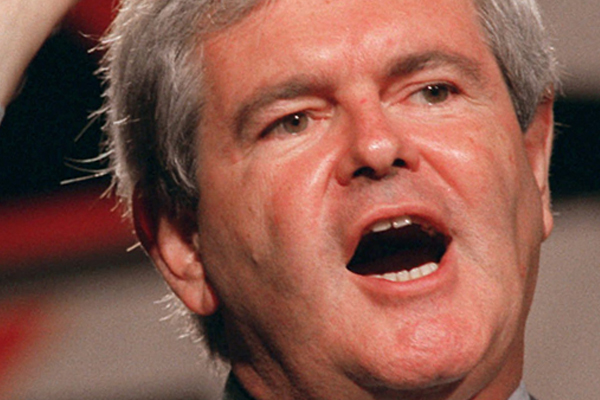

Newt Gingrich
A look back: Newt’s most outlandish positions
Gingrich once called for children of welfare mothers to be shipped off to orphanages
Newt Gingrich (Credit: AP) Newt Gingrich is up 31 points in Florida, according to one poll, and he is openly predicting that he will be the Republican nominee for president.
We’ll see.
In the meantime, it’s worth revisiting some of the lesser-known areas in Gingrich’s record. In his three-plus decades in public life, the former House speaker has racked up an impressive record not only of flip-flops, but also of policy positions that are profoundly unorthodox, some would say outlandish.
This is by no means a comprehensive list – if I’m missing any Gingrichian gems, email me or leave a comment.
1981: Gingrich co-sponsors a measure in the House “to provide for the therapeutic use of marijuana in situations involving life-threatening or sense-threatening illnesses and to provide adequate supplies of marijuana for such use.”
A year later, he writes a letter to the Journal of the American Medical Association reiterating his view: “We believe licensed physicians are competent to employ marijuana, and patients have a right to obtain marijuana legally, under medical supervision, from a regulated source.” He later disavows the stance.
1994: As part of his push for welfare reform, Gingrich proposes that states end aid to poor single mothers and their children be sent to orphanages that would be built with the saved money. Responding to criticism of the plan by then-first lady Hillary Clinton, Gingrich cites a 1938 Hollywood film.
“I’d ask her to go to Blockbuster and rent the Mickey Rooney movie about ‘Boys Town,’” he says.
1995: Gingrich proposes the death penalty for those involved in the drug trade, drawing a parallel to the draconian policies of Singapore and Malaysia.
“We want to stop all drug traffic. If you bring in a commercial quantity of illegal drugs, we will execute you,” he says during a book tour (via the San Diego Union-Tribune on Nexis).
But Gingrich’s Drug Importer Death Penalty Act of 1996 ultimately goes nowhere. Asked by Yahoo News in November if he stands by this position, Gingrich responded, “I think if you are, for example, the leader of a cartel, sure.”
2005: Gingrich calls for “universal but confidential DNA testing” as part of healthcare reform, according to an account in a South Carolina newspaper. (Via National Review)
2005: During the Ward Churchill affair, Gingrich suggests tenure should be abolished at state universities.
“We ought to say to campuses, it’s over … We should say to state legislatures, why are you making us pay for this? Boards of regents are artificial constructs of state law. Tenure is an artificial social construct,” he says. “Tenure did not exist before the twentieth century, and we had free speech before then. You could introduce a bill that says, proof that you’re anti-American is grounds for dismissal.”
2006: Gingrich suggests the U.S. should pursue a counter-terrorism strategy that would curtail terrorists’ free speech rights, predicting “a serious debate about the First Amendment.”
“My prediction to you is that either before we lose a city, or if we are truly stupid, after we lose a city, we will adopt rules of engagement that use every technology we can find to break up their capacity to use the internet, to break up their capacity to use free speech, and to go after people who want to kill us,” he says. (Via NR)
2009: In a speech to the American Israel Public Affairs Committee (AIPAC) police conference, Gingrich declares an electromagnetic pulse (EMP) attack to be one of the gravest threats to U.S. national security. He cites a fictional thriller to bolster his case:
“What I’m about to say to you is from my heart, and from everything I’ve learned in almost fifty-one years, we are on the edge of catastrophic problems. If you get a chance, read my friend Bill Forstchen’s novel, One Second After, which describes the fate of a small town, after an electromagnetic pulse attack.”
2010: Gingrich argues that the United States should not allow construction of the “ground zero mosque” because Saudi Arabia does not allow construction of churches or synagogues – effectively endorsing Saudi-style religious discrimination.
“There should be no mosque near Ground Zero in New York so long as there are no churches or synagogues in Saudi Arabia,” he says. “The time for double standards that allow Islamists to behave aggressively toward us while they demand our weakness and submission is over.”
2011: Angered by the liberal 9th Circuit Court of Appeals, Gingrich says he’d like to empower the president to fire judges.
“I would do no more than eliminate Judge Berry in San Antonio and the Ninth circuit. That’s the most I would go for,” he says. “But let me say this because I think this has to be part of our national debate. That’s not a rhetorical comment. I believe the legislative and executive branches have an obligation to defend the Constitution against judges who are tyrannical and who seek to impose un-American values on the people of the United States.”
2011: In an appearance at Harvard, Gingrich challenges child labor laws, floating the idea of replacing pricey unionized janitors with kids:
“Most of these schools ought to get rid of the unionized janitors, have one master janitor and pay local students to take care of the school,” he says. “The kids would actually do work, they would have cash, they would have pride in the schools, they’d begin the process of rising.”
Justin Elliott is a reporter for ProPublica. You can follow him on Twitter @ElliottJustin More Justin Elliott.
Gingrich Inc: Out of business
Newt stayed in the race too long -- and now even his old private companies are struggling. Will Romney rescue him?
Newt Gingrich (Credit: Reuters/Benjamin Myers) When the House of Representatives censured Newt Gingrich in 1997 for ethics violations — the first time ever for a sitting Speaker in 200 years — the vote was 395 to 28, with 196 Republicans joining. “Newt has done some things that have embarrassed House Republicans and embarrassed the House,” said then-Rep. Peter Hoekstra, R-Mich., who is now running for a Senate seat in Michigan. Gingrich resigned a year later, “in disgrace,” as Mitt Romney said in January.
Continue Reading CloseAlex Seitz-Wald is Salon's political reporter. Email him at aseitz-wald@salon.com, and follow him on Twitter @aseitzwald. More Alex Seitz-Wald.
SPIN METER: Rivals airbrush anti-Romney words
After the nastiness of the Republican primary race, former candidates have collective amnesia about Romney disses
FILE - In this Jan. 26, 2012 file photo, Republican presidential candidates, former House Speaker Newt Gingrich and former Massachusetts Gov. Mitt Romney talk during a commercial break at the Republican presidential candidates debate in Jacksonville, Fla. Remember Gingrich calling Romney a liar? Michele Bachmann saying Romney's unelectable? Rick Santorum calling Romney "the worst Republican in the country" to run against Obama? They're hoping you don't. And acting like it never happened _ even though most of their words are just clicks away online. (AP Photo/Matt Rourke, File)(Credit: AP) WASHINGTON (AP) — Remember Newt Gingrich calling Mitt Romney a liar? Michele Bachmann saying Romney’s unelectable? Rick Santorum calling Romney “the worst Republican in the country” to run against President Barack Obama?
They’re hoping you don’t. And acting like it never happened (even though most of their words are just clicks away online.)
One by one — with the exception of holdout Ron Paul — the GOP also-rans have coughed up endorsements of their onetime rival. And as they do, they’re pulling rhetorical backflips to distance themselves from their former harsh assessments of Romney.
Continue Reading CloseGoodnight, sweet Newt
The rise and fall, rise and fall, and rise and fall of the Gingrich 2012 campaign
(Credit: AP/David Duprey) Today is another fine day for Newt Gingrich, although not his best. After months of neglect, he’ll get the political media to pay attention to him for a final 10 or so minutes. “All of us have an obligation, I think,” he said in Tuesday’s video announcing his announcement of his resignation today, which he first announced last week, “to do everything we can to defeat Barack Obama.” For Gingrich, this typically would mean attacking Mitt Romney. But Newt seems serious about dropping out this time, as shameful as that is for the erstwhile “definer of civilization,” as he called himself in some early-1990s doodles.
Continue Reading CloseJim Newell has covered politics for Wonkette and Gawker and is a contributor to the Guardian. More Jim Newell.
How much gasoline is a GOP primary voter worth?
Gas prices have barely budged compared to the cost of buying votes in the GOP primaries
Republican presidential candidate former House Speaker Newt Gingrich speaks at his primary night election rally with wife Callista on Tuesday, March 13, 2012, in Birmingham, Ala. (Credit: AP/Butch Dill) The rising price of gas has become a pressing political concern, with Republicans hammering President Obama for not finding some way to bring prices down. Newt Gingrich has promised to bring the cost of gas down to $2.50, using space technology borrowed from native Martians at our Lunar Trading Post, and he has forced his followers to carry large totems featuring “gas pump” icons.
But as gas prices have soared since the beginning of the year, the cost of a Republican primary vote has plummeted. A few months ago, campaigns were spending a fortune in ad buys and organizations in the small early states. In Iowa, Mitt Romney and the PACs affiliated with his campaign spent around $144 for each vote received. By Florida that number was down to $19. On Super Tuesday, only $2.89 was spent by each campaign for each vote cast nationwide.
Continue Reading Close
Alex Pareene writes about politics for Salon and is the author of "The Rude Guide to Mitt." Email him at apareene@salon.com and follow him on Twitter @pareene More Alex Pareene.
Will Newt give up if he starts losing the Old South?
He can't keep this up forever, right?
Republican presidential candidate and former U.S. Speaker of the House Newt "Rocket Man" Gingrich is seen during a campaign event in Manchester, New Hampshire December 21, 2011. (Credit: Jessica Rinaldi / Reuters) Newt Gingrich’s “path to the nomination” is basically a Billy-from-The Family Circus-style dotted line through his rich fantasy life, but he’s remaining in the race for the time being, because he performs well in the Old South, where likely nominee Mitt Romney does not. There is also a weird casino billionaire who keeps funding his campaign, maybe in part because he thinks it aids Mitt Romney by hurting Rick Santorum.
Well, Newt Gingrich remaining in the race might be hurting Rick Santorum, but by no means would Rick Santorum be winning if Gingrich wasn’t around. Give Santorum all of Gingrich’s delegates, he’s still losing to Mitt Romney. More realistically, as Nate Silver wrote earlier this morning, no Newt would mean more delegates for Rick and Mitt.
Continue Reading Close
Alex Pareene writes about politics for Salon and is the author of "The Rude Guide to Mitt." Email him at apareene@salon.com and follow him on Twitter @pareene More Alex Pareene.
Page 1 of 55 in Newt Gingrich