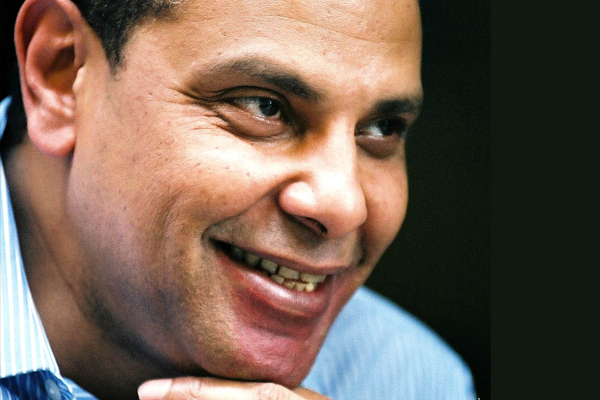

CAIRO — On the morning of my appointment with Alaa Al Aswany, the Islamists were out in full force. The roar of “Allahu akbar!” rose at 5:30 a.m. from Tahrir Square. The response from hundreds of thousands of agitated men in white jalabiyas and knit caps, filling the square down to the Nile, reverberated through the surrounding Downtown streets.
By late afternoon, the crowd had spilled onto El Kasr El Aini Street, past the Soviet-built Mogamma building (the heart of Egyptian bureaucracy), the Ministry of Transport and the People’s Assembly to Al Aswany’s office in Garden City. Dozens of bearded men with welting prayer marks on their foreheads — bused in from around the country in the dead of night — slept on the dusty pavements.
Al Aswany’s office is in a fairly rundown building on Diwan Street. There is a sign with mismatched lettering hanging from the building over the sidewalk. It reads:
Dr. Alaa EL Aswany
Dentist
D.D.S (Cairo University)
M.S. University of ILLINOIS
4th FlOOR
Al Aswany’s tiny waiting area leads into a slightly larger examining room. The floor was covered in a pinkish Formica, reflecting lines of fluorescent light. In a darkened alcove stood his dentists’ chair. An over-sized ashtray was arranged in the middle of a glass coffee table. After a few minutes he walked in, dressed in gray trousers and a striped shirt.
“So the Islamists had their day,” he said by way of a greeting. We moved to his small desk made of the same pinkish Formica in a corner of the room.
Alaa Al Aswany is one of Egypt’s best living writers. He’s probably the most known Arab novelist in the West since the 2002 publication of “The Yacoubian Building,” which was made into Egypt’s most expensive film. It tells the story of the thoroughly corrupt Mubarak-era through debased characters who are tortured, sexually harassed and crushed by poverty. It is the story of an aging playboy, a wealthy protagonist longing for the cosmopolitan splendor of pre-Nasser Downtown. The characters live in the Yacoubian — a once grand apartment block on Talaat Harb Street.
Despite the fame it brought him, Al Aswany continues to fix ordinary Egyptians’ teeth. He’s caring for patients as he listens to their desperate stories. His latest book, “The State of Egypt,” a collection of his newspaper columns, describes in painful detail the coming social explosion against Mubarak and his cronies, whom he eviscerates on every page. The only plausible explanation for why the authorities never arrested Al Aswany is that his international notoriety would have caused Mubarak more trouble than it was worth.
The book disproves a widely held belief in the West that no one saw the uprising coming. In February 2010, 11 months before the January 25th Revolution began, Al Aswany wrote: “We have to move to the confrontation stage. It is no longer any use begging for our rights by appealing to the regime, because it will not listen. But if a million Egyptians went out to the streets in protest or announced a general strike, if that happened, even once, the regime would immediately heed the people’s demands. Change … is possible and imminent, but there is a price we have to pay for it.”
Then in April 2010, nine months before Tahrir Square was occupied, he wrote: “I don’t know how President Mubarak thinks, though I imagine, based on the theory of ‘dictator solitude,’ that his conceptions are completely detached from the reality of what is happening in Egypt. The reality is liable to produce an explosion at any moment.”
As it turned out, Al Aswany was in the Square during the crucial — and most violent days — of that explosion. “We participated in this revolution from the very first moment, and I faced myself death, three times,” he told me in his examining room. “Once early in the morning of the 26th, and twice on the 28th. I was about to suffocate because on the 26th they became crazy. They were bombing us with [tear] gas bombs.”
“I ran with the people, but I was really about to suffocate,” he said. “I could stand some gas, but not too much. I smoke and have problems already with my lungs. We were running in Tahrir Square, but they were putting soldiers in our way just to put us again in the field of bombs.”
Al Aswany’s intimate knowledge of every warden of Downtown, the setting of the Yacoubian Building, may have saved his life. “I was lucky, because I know downtown very well,” he told me. “I went through a very little street. And I said to myself, ‘They don’t know the area very well, so probably they did not block this street.’ They didn’t block it, and that’s why I escaped.”
Two days later they brought in the snipers. The killing had already begun around the country, in Alexandria and Suez, but it was the first time live ammunition was used in the capital.
“In Cairo they were shocked at the numbers, and they tried to control it without killing and it didn’t work,” he told me. “For the first time I saw soldiers from the Central Security running away because there were 20,000 people coming from Darb Ibn al-Baba — a very popular neighborhood. When they absorbed the shock of what was happening, they began to act at 12:30 a.m. on the 26th.”
As Al Aswany stood in the crowded Square at that moment, a man approached him. “He said, ‘You must write about this revolution.’ And I said, ‘Yes.’ He said, ‘Promise?’ And I said, ‘Promise.’” The man then stepped away and his head exploded in front of Al Aswany. “I mean it’s one bullet,” he said. “They were very professional snipers.”
* * *
Al Aswany was born in Cairo in 1957, the son of Abbas Al Aswany, himself a celebrated novelist and lawyer. He gave his son a cosmopolitan upbringing. He also advised him to get another job to support his writing habit. Al Aswany chose dentistry, which he studied in Chicago. It became the setting of his second novel. “Chicago” is a story of American race relations and Egyptian conservatism colliding with American liberalism. When Al Aswany returned to Egypt after 17 years practicing in America, he set up his dental clinic in the same building where his father had his law office: the Yacoubian.
“You cannot be a novelist if you are not a storyteller,” Al Aswany said. And the story he was now telling me was about the perilous future of Egypt’s ongoing revolution.
In “The State of Egypt,” he takes aim at the religious hypocrisy of Egyptians who supported Mubarak’s murderous regime. “The doctors and nurses who mistreat poor patients in public hospitals, the civil servants who rig election results in the government’s favor, and the students who cheat en masse, most of them are devout about performing their ritual obligations,” he writes.
“It is even more amazing to see what happens on security premises where detainees are tortured to extract the required confessions,” Al Aswany goes on. “In these human slaughterhouses, which belong to the darkness of the Middle Ages, there is always a prayer room where the torturers can perform their prayers at the appointed times.”
He sees the opposite of empty ritual as the bigger threat to the revolution: religious fanaticism. Al Aswany does not put all Islamists in the same basket, making distinctions that may try Western perceptions. For instance, he excludes the largest Islamist group — the Muslim Brotherhood — as a threat because it renounced violence in the 1970s. After it did, two violent groups rejected the renunciation and broke away: the Egyptian Islamic Jihad and al-Gama’a al-Islamiyya. These were the groups that assassinated Anwar al-Sadat in 1981 for making peace with Israel. They also took part in killing 58 Western tourists in Luxor in 1997.
Today nominally nonviolent, these Salafists nevertheless threaten the revolution with their intolerance, he says. They are influenced by the ultra-conservative Wahhabism of Saudi Arabia — the one country Al Aswany is convinced is most responsible for trying to kill the Egyptian revolution.
Egypt was the most advanced Arab country in the early 20th century, while the Saudis were an undeveloped Bedouin tribe in the wasteland of the Arabian Peninsula, he said.
“The difference between us and Saudis is we had a very early democratic experience,” Al Aswany told me. “Our first Parliament was during the 19th century and [among Arabs] we had the first of everything: the first elections, the first constitution, the first Parliament, the first elected government in 1924,” he says animatedly. “As far as the women are concerned, we had very, very early movements to liberate women. And [the Saudis] are fighting now to give the women the right to drive cars. We had the first race of automobiles in Egypt for females in 1927.”
Saudi influence reaches into Egyptian homes via 10 Saudi cable television stations preaching Wahhabism. “They are giving a very fine line of interpretation of religion and preaching against democracy and women,” he said.
Al Aswany repeated what is widely believed here — that Saudi Arabia, with Kuwait and the Emirates, have poured billions of Egyptian pounds into the operations of these seven newly formed Salafist parties, which may represent as many as 10 percent of Egyptians. The Saudis, says Al Aswany, want to suffocate democracy in Egypt lest it spread to the Arabian Peninsula.
“We have evidence that they are absolutely supported by these three countries,” he told me. A local paper, al Wafd, reported that these Gulf countries sent the groups 2 billion Egyptian pounds. “These new parties bought 33 apartments in Alexandria in two months,” Al Aswany said. “For today’s demonstration … they used 3,000 buses from all over Egypt. So you are talking about an open budget.”
The Salafists have also shown extreme intolerance to Egypt’s sizable community of 8 million Coptic Christians, resulting in several violent clashes and church burnings since Mubarak’s downfall. In the bloodiest, on Oct. 9, military vehicles mowed down and soldiers shot dead 27 Copts at the state television building in Cairo during a protest of a church burning in Aswan. A military probe cleared all soldiers of wrongdoing. A result is that the Christian-Muslim unity forged in the early days of the revolution is now threatened by what appeared on that day to be a Salafist-military alliance. Al Aswany fears that if the Salafists were allowed to reach power, the international community would intervene, as it did in Sudan, to give Christian separatists their own state, dividing Egypt. Some Copts have sought an independent state since the early 1900s.
By contrast, the Muslim Brotherhood, expected to win the most seats in Parliament short of a majority, “is much more moderate,” and does not pose the same threat, Al Aswany says. Founded in Egypt in 1928 as a reaction against the Western cosmopolitanism of Downtown Cairo under King Farouk, the Brotherhood was suppressed by the Nasser, Sadat and Mubarak military regimes. Though the Brotherhood renounced violence 40 years ago, Mubarak played the Islamophobia card, exaggerating the threat of the Brotherhood (in addition to smaller, violent groups) to squeeze the U.S. for military aid that has reached $1.3 billion a year, Al Aswany says.
It was this exaggerated Islamic threat coupled with keeping Egypt on board with the Camp David peace treaty with Israel, he says, that allowed Washington to violate its proclaimed goal of exporting democracy to instead support an insidious dictator. “The American foreign policy was catastrophic for Egypt,” Al Aswany said. “You have been talking all the time very beautiful words about democracy, and you have been supporting the most terrible dictators on earth.” This dual policy of supporting democratization while underwriting a strongman to his bitter end, came to an excruciating head in Tahrir Square as it had with Ferdinand Marcos in 1986 and the Shah of Iran in 1979. Washington lifted its support for Mubarak at the last second, when it became clear he could not survive the wrath of his people.
* * *
Al Aswany reserves his deepest suspicion however for the military council, which has run the country since Mubarak was deposed on Feb. 11. It did not take long for him to attack it with the same vehemence as he did the Mubarak regime.
Al Aswany condemns the military for arresting bloggers, using violence on protestors, for not having yet lifted the old regime’s state of emergency and for manipulating the electoral law and the constitutional process to favor the continuance of its own dominance and the survivors of Mubarak’s clique. He finds it ironic that Mubarak, a military man, is on trial in a civilian court, while civilians stand before the military. Since Jan. 28, 12,000 civilians have been tried in military courts and 8,000 have been sentenced, including 18 to death. Most of these are activists, journalists and demonstrators protesting military rule.
“The revolution is at risk because of the military council,” Al Aswany said. Instead of protecting the revolution, they have continued the repression and instituted only piecemeal reforms that he says are designed to preserve the existing regime — minus Mubarak.
“When you reform in a time of revolution, you put the revolution in very high risk. Why? Because a revolution is the final battle for the old regime. The remnants, the counter-revolution, know very well that they must fight once more desperately. Either they win and they abort the revolution, or they fail and they will be in jail.”
* * *
During their first months in power, the military called in intellectuals to gauge the mood of post-Mubarak society. “They invited me once to listen to me,” Al Aswany said. “I explained to them for three hours the difference between a revolution and reform. How it is very dangerous to not protect the revolution with revolutionary decisions. I gave them examples in every domain of Egypt: with the police, with the judges, the economy. And they did nothing. We had a wonderful dinner.”
Fears that the military will not relinquish power even with an elected civilian government are reflected in the process for writing a new constitution that the council has proposed. Instead of the elected parliament picking a 100-member council to write the constitution, the military proposes that it pick 80 of the members, and the Parliament only 20.
In an atmosphere of this political intrigue, it’s little surprise that theories about impending conspiracies are rife. Al Aswany is not immune from such speculation. “I believe that behind closed doors there are some deals or some games going on,” he said.
A rumor hatched over the summer and still current is that the military council, working with the corrupt judges who fixed Mubarak’s elections, would allow the Islamists to win a majority, after which the Americans, Saudis and Israelis would tell the military council they must ignore the results and stay in power to prevent an Islamist takeover.
That’s exactly what took place in Algeria in 1992. It led to seven years of civil war that killed 150,000 people. There’s no indication that would happen in Egypt, but Al Aswany, in an understatement, said, “That is a very bad scenario.”
U.S. and Israeli officials have relied for 30 years on the Egyptian military, more interested in business than war, to uphold the Camp David accord. An Islamist government, even with the more moderate Muslim Brotherhood at the helm, would create uncertainty on the Egyptian-Israeli border. For Washington and Tel Aviv, military rule might in that case be preferable to democracy.
* * *
Being a realist doesn’t stop Al Aswany from dreaming about the Egypt he wants to see. In a country of 80 million people with 17 percent living below the national poverty line and 26 percent illiterate, it is fanciful to imagine a Swedish-style social democracy. So Al Aswany looks back for a starting point to Downtown Cairo’s golden age, the one his protagonist in “The Yacoubian Building” also yearned for.
Started from a boom in Egyptian cotton prices caused by the embargo on the American Civil War South, Downtown Cairo, with its wrought-iron balconies, elaborate pilasters and grand marble staircases was mostly completed by 1919, the year a popular revolution established a constitutional monarchy. The next 30 years brought a functioning parliament, independent judiciary, highly acclaimed, critical newspapers and tolerance of foreigners. But there was also mass poverty, illiteracy and corruption. And legendary Egyptian pride built on centuries was still pierced by British political interference.
A strong measure of that dignity returned with the ouster of Mubarak. “This is an irreversible phenomenon,” Al Aswany said. “This is part of what the old regime can’t understand.”
“Our heritage is huge, over 6,000 years, so we have a stratified identity,” he said.
“And this is part of our problem with the Islamists. You cannot subsume our identity in Islam, which is a mere component. We have been Muslims for 1,500 years, but for 4,500 years before that we were part of the Roman, Greek and Persian empires, and before that we were ruled by the Pharaohs.
“You have everything in the Egyptian identity,” he said. “But most importantly we have a very early — and this is the difference between us and Saudis — democratic experience,” one Al Aswany and millions of other Egyptians are risking their lives to recapture and build on.
“My country will never be fanatic,” Al Aswany said — “will never be ruled by the Saudis. Egypt, the Egyptian formula, has been for centuries, and that means everybody is accepted: Jews, Armenians, Italians, Muslims, Copts. This is the Egyptian consciousness. The real Egypt.”
CAIRO, Egypt — Egyptian protesters set fire last night to the campaign headquarters of Ahmed Shafiq, the controversial presidential contender, following the official announcement of Egypt’s first round of presidential elections in Cairo.
Hundreds of demonstrators took to Cairo’s iconic Tahrir Square to rally against Shafiq, a member and unabashed supporter of the regime of former President Hosni Mubarak, toppled last year following a wave of popular protests. At least eight people were arrested, but no injuries or deaths were reported.
Campaigning on law and order and a heavy-handed crackdown on anti-regime protesters, Shafiq secured second place in last week’s vote. In what many Egyptians say is the most polarizing outcome of the elections, Shafiq will face the Muslim Brotherhood’s candidate, Mohamed Morsi, in a run-off that pits Islamists against a Mubarak holdover on June 16.
Both Shafiq and Morsi scored surprise, upset victories against the other candidates, after trailing considerably in pre-election polls behind secular-liberal candidate, Amr Moussa, and independent Islamist, Abdel Meneim Aboul Fotouh.
Analysts and observers of Egyptian politics are reeling from the results, cautioning that right now the Egyptian electorate is so dynamic — with alliances and voter sentiment shifting so rapidly and unpredictably — that attempting to accurately forecast a winner of next month’s run-off is ultimately futile.
“Everything I thought I knew about this country has collapsed,” said Hisham Kassem, independent publisher and longtime opposition activist, of the divisive election results. “All analyses of the polls are so far unconvincing. The game has changed considerably.”
Indeed, for weeks preceding the elections — the first free, multi-candidate polls in Egypt’s history — both local and international think-tank surveys put Moussa, a former minister of foreign affairs and centrist figure, in the lead, with as much as 40 percent of the vote.
In the final tally, Moussa scored just under 11 percent.
In another bombshell, Hamdeen Sabbahi, a leftist-socialist candidate who, along with Morsi, never broke 10 percent in pre-election surveys, won both of Egypt’s most populated governorates — Cairo and the Islamist stronghold of Alexandria — to land in third place nationally.
Morsi, with the strong electoral machine of the Brotherhood behind him, was catapulted to first place with the most votes, after being written off as a weak candidate with only 8 percent of the vote prior to the vote.
The Brotherhood flourished for years as Egypt’s largest and most organized opposition force.
Some observers blamed the gross miscalculations on the difficulties of conducting research in Egypt, particularly in gauging voter sentiment in rural areas.
The government-affiliated Al Ahram Center for Strategic Studies, for example, conducted face-to-face interviews with 1,200 respondents for their surveys, but did not publish the socio-economic breakdown of the survey’s subjects.
“But sometimes in face-to-face interviews, villagers are influenced by having a village elder nearby,” said Rasha Hassan, a social researcher with Harassmap, an Egyptian, online social initiative that tracks sexual harassment trends through text messaging. “You have to take [things like this] into account.”
Telephone polls are also misleading, because most rural village households do not have landlines — only mobile phones.
Still, the polls, including one from the DC-based Brookings Institution that was in fact quite rigorous, could not capture the tumult and fluidity of voter sentiment in Egypt’s transition period, said Michael Hanna, a fellow at The Century Foundation in New York.
Similar to other countries that have made the transition from authoritarian to democratic rule, the Egyptian political landscape is likely to change drastically from one election to the next in the immediate post-revolution period, experts say.
There are many factors that could have swayed the vote, even at the last minute.
Least surprising was Morsi’s jump to first place, buoyed by the mammoth grassroots network of the Muslim Brotherhood that energized voters to go to the polls, analysts say. Many of their core ideological voters, particularly in Egypt’s impoverished southern region, may not have been represented accurately in the surveys.
Kassem said he had predicted there would be two strong voting currents — Islamist and pro-stability — but that the so-called “stability” vote would be represented by Moussa, who echoed many ordinary Egyptians’ sentiments by chiding demonstrators for spreading chaos.
Shafiq, as a member of the old regime who emphasized his military credentials during the campaign, did not have a true constituency among Egyptian voters, he said.
Shafiq was indeed ranking low in the polls, until a last-minute surge at the end of May, when several surveys from the Cabinet Information Decision and Support Center, a government-linked research group, put Shafiq in the lead.
Hanna credits his rise to violent clashes between protesters and military police at the ministry of defense in the Abbaseya neighborhood of Cairo earlier this month, and state media still controlled by Mubarak holdovers.
“Obviously the control of state media, the law and order narrative put forward by SCAF” — the Supreme Council of Armed Forces, made up of Egypt’s ruling generals — “is potent in combination with Abbaseya,” Hanna said. “It had a big impact on the election, drawing the stability vote from Moussa to Shafiq, whom some state-run polls were putting in the lead in the last days of the campaign period.”
But to draw a linear plot from secular and Islamist voter choices in the first round to the run-off would be a mistake, Hanna and Kassem say.
Saleh Ali Ahmed, a 39-year-old voter and self-described devout Muslim from the Brotherhood stronghold of Ismailia province, exemplifies the complexity of the Egyptian electorate.
“If the run-off is between Morsi and Shafiq, I will vote for Shafiq,” he said on the first day of the polls, before the official results were announced. “Morsi is very weak within the Brotherhood, and he will have no real power.”
Kassem said one can assume that those who voted for Moussa, a non-Islamist, will switch to Shafiq, who has promised to curb rising Islamist power.
“But it is just a guess,” he said. “And anyone’s guess is as good as mine.”
Continue Reading
Close
CAIRO (AP) — After a lifetime of being told who will rule them, Egyptians dove enthusiastically into the uncertainty of the Arab world’s first competitive presidential election Wednesday. Up to the last minute, voters wrestled with a polarizing choice between secularists rooted in Hosni Mubarak’s old autocracy and Islamists hoping to enfuse the state with religion.
The choices in the race raised worries among many whether real democracy will emerge in Egypt. And the final result, likely to come only after a runoff next month, will only open a new chapter of political struggle.
But in the lines at the polls, voters were palpably excited at the chance to decide their country’s path in the vote, which is the fruit of last year’s stunning popular revolt that overthew Mubarak after 29 years in power. For the past 60 years, Egypt’s presidents running unchallenged have largely been re-affirmed in yes-or-no referendums that few bothered to vote in.
Mohammed Salah, 26, emerged grinning from a poll station, fresh from casting his ballot. “Before, they used to take care of that for me,” he said. “Today, I am choosing for myself.”
Medhat Ibrahim, 58, who suffers from cancer, had tears in his eyes. “I might die in a matter of months, so I came for my children, so they can live,” he said, waiting to vote in a poor Cairo district. “We want to live better, like human beings.”
Adding to the drama, this election is up in the air. The reliability of polls is unsure, and four of the 13 candidates candidates have bounced around the top spots, leaving no clear single front-runner. None is likely to win outright in Wednesday and Thursday’s balloting, so the top two vote-getters enter a run-off June 16-17, with the victor announced June 21.
The two secular front-runners are both veterans of Mubarak’s regime — former prime minister Ahmed Shafiq and former foreign minister Amr Moussa.
The main Islamist contenders are Mohammed Morsi of the powerful Muslim Brotherhood and Abdel-Moneim Abolfotoh, a moderate Islamist whose inclusive platform has won him the support of some liberals, leftists and minority Christians.
The debate went right up to the doorsteps of schools around the country where polls were set up.
Some voters backed Mubarak-era veterans, believing they can bring stability after months of rising crime, a crumbling economy and bloody riots. Others were horrified by the thought, believing the “feloul” — or “remnants” of the regime — will keep Egypt locked in dictatorship and thwart democracy.
Islamists, particularly the Muslim Brotherhood, saw their chance to lead a country where they were repressed for decades and to implement their version of Islamic law. Their critics recoiled, fearing theocracy.
Some saw an alternative to both in a leftist candidate, Hamdeen Sabahi, who has claimed the mantle of Egypt’s first president, the populist Gamal Abdel-Nasser.
An Islamist victory, particularly by Morsi, will likely mean a greater emphasis on religion in government. His Muslim Brotherhood, which already dominates parliament, says it won’t mimic Saudi Arabia and force women to wear veils or implement harsh punishments like amputations. But it says it does want to implement a more moderate version of Islamic law, which liberals fear will mean limitations on many rights.
Many of the candidates have called for amendments in Egypt’s 1979 peace treaty with Israel, which remains deeply unpopular. None is likely to dump it, but a victory by any of the Islamist or leftist candidates in the race could mean strained ties with Israel and a stronger stance in support of the Palestinians in the peace process.
The candidates from the Mubarak’s regime — and, ironically, the Brotherhood, which has already held multiple talks with U.S. officials — are most likely to maintain the alliance with the United States.
A looming question is whether either side will accept victory by the other. Islamists have warned of new protests if Shafiq wins, which they say can only happen by fraud. Many are convinced the ruling military wants a victory by Shafiq, a former air force commander.
“Over my dead body will Shafiq or Moussa win. Why not just bring back Mubarak?” said Saleh Zeinhom, a merchant backing Abolfotoh. “I’m certain we’ll have a bloodbath after the elections cause the military council won’t hand power to anyone but Shafiq.”
Shafiq was met by several dozen protesters screaming “down with the feloul” as he arrived to vote in an upscale neighborhood east of Cairo. Some protesters showed their contempt by holding up their shoes in his direction.
Shafiq, who was Mubarak’s last prime minister until he too was forced out of his post by protests, has been openly disparaging of the pro-democracy youth groups who led the anti-Mubarak uprising. Critics view him as too close to the generals who took over from Mubarak and whose own reputation is tainted by human rights abuses and authoritarian tendencies.
But with his strongman image, he has appealed to Egyptians who crave stability and fear Islamists.
“The country is going under. We need a president that implements justice and brings back security. Bottom line,” said Essam el-Khatib, a government employee voting in the Cairo suburb of Maadi.
Nearby another man, Sayed Attiya, shouted, “What Shafiq? We didn’t have a revolution to bring back Shafiq!”
The Muslim Brotherhood, meanwhile, faced a backlash of its own.
The group was the biggest winner in parliament elections late last year, winning nearly half the seats. But it disillusioned some by seeming too power hungry, demanding to be allowed to form a government and trying to dominate a panel created to draft a new constitution. The panel was scrapped and the process of writing the vital new charter is on hold as politicians struggle over forming a new one.
The image it has cultivated as an advocate of tolerance and piety was damaged by its campaign to discredit Abolfotoh, who quit the Brotherhood to run for president, and its edict that it is a sin to vote for anyone not advocating implementation of Islamic Shariah law.
Outside a polling station in the village of Ikhsas, outside Cairo, a group of neighbors got into a friendly but frank debate.
“I voted Brotherhood for parliament but I find they are inflexible in their opinions and want to take everything. I can’t now find them in the country’s top job,” Bassem Saber, a 31-year-old accountant dressed in the traditional local robes, told the circle of men. He now backs Abolfotoh.
Khaled el-Zeini, a Brotherhood backer, said people were being unfair.
Fares Kamel, a local trader, interjected with a shout against the Brothers, “We loved them and wanted them but we realized they are all about monopolizing power.”
But the group has a powerful electoral machine.
In the Mediterranean city of Alexandria, Brotherhood vans ferried women supporters to the polls in the poor neighborhood of Abu Suleiman, one of the group’s strongholds. The women, in headscarves or covered head to toe in black robes and veils that hid their faces, filed into the station.
“I want to give the Brotherhood a chance to rule,” said Aida Ibrahim, a veteran Brotherhood member who was helping voters find their station. “If it doesn’t work, they will be held accountable,” she said.
Some Brotherhood supporters cited the group’s years of providing charity to the poor — including reduced-price meat, and free medical care.
“Whoever fills the tummy gets the vote,” said Naima Badawi, a housewife sitting on her doorstep watching voters in Abu Sir, one of the many farming villages near the Pyramids being sucked into Cairo’s urban sprawl.
There were only a few reports of overt violations of election rules Wednesday, mainly concerning candidates’ backers campaigning near polling stations. Three international monitoring organizations, including the U.S.’s Carter Center, were observing the vote. Former President Jimmy Carter, the center’s head, visited a polling station in the ancient Cairo district of Sayeda Aisha.
The election’s winner will face a monumental task. The economy has been sliding as the key tourism industry dried up — though it starting to inch back up. Crime has increased. Labor strikes have proliferated.
And the political turmoil is far from over. The generals who took over from Mubarak have promised to hand authority to the election winner by the end of June. But many fear it will try to maintain a considerable amount of political say. The fundamentals of Mubarak’s police state remain in place, including the powerful security forces.
“We will have an elected president but the military is still here and the old regime is not dismantled,” said Ahmed Maher, a prominent activist from the group April 6, a key architect of last year’s 18-day uprising against Mubarak.
“The pressure will continue,” he said. “People have finally woken up. Whoever the next president is, we won’t leave him alone.”
___
Associated Press writers Sarah El Deeb, Maggie Michael and Matt Ford in Cairo and Aya Batrawy in Alexandria, Egypt, contributed to this report.
Continue Reading
Close
CAIRO (AP) — Determined to end decades of authoritarian rule, millions of Egyptians waited patiently in long lines outside polling stations across the nation on Wednesday to freely choose their first president since last year’s ouster of longtime ruler and close U.S. ally Hosni Mubarak.
“I can die in a matter of months, so I came for my children, so they can live,” a tearful Medhat Ibrahim, 58, who suffers from cancer, said as he waited to vote in a poor district south of Cairo. “We want to live better, like human beings.”
Thirteen candidates, who include Islamists, liberals and Mubarak regime figures, are contesting the election. No outright winner is expected to emerge from the two-day vote starting Wednesday. So, a runoff between the two top finishers will be held June 16-17. The winner will be announced on June 21.
“It’s a miracle,” said Selwa Abdel-Malik, a 60-year-old Christian from the Mediterranean port city of Alexandria as she was about to vote. “And it’s a beautiful feeling too.”
For most of his 29-year rule, Mubarak — like his predecessors — ran unopposed in yes-or-no referendums. Rampant fraud guaranteed ruling party victories in parliamentary elections. Even when, in 2005, Mubarak let challengers oppose him in elections, he ended up not only trouncing his liberal rival but jailing him.
Egypt’s next president will be the nation’s fifth since the monarchy was toppled following a 1952 coup that ushered in six decades of de facto military rule. Like his three predecessors — Anwar Sadat, Gamal Abdel-Nasser and Mohammed Naguib — Mubarak has a military background.
Many of the candidates in the race have called for amendments in Egypt’s 1979 peace treaty with Israel, which most Egyptians continue to view as their nation’s number one enemy. Though none will likely to dump the pact, a victory by any of the Islamist or leftist candidates could mean strained ties with Israel and a stronger backing for the Palestinians in the peace process.
The generals who have taken over from Mubarak after an 18-day uprising forced him to step down 15 months ago have promised to hand over power by July 1, ending a turbulent transitional period defined by deadly street clashes, a faltering economy, a dramatic surge of crime and human rights abuses.
The military has said it has no intention to cling on to power, but it is not clear what authority it wants to retain after the election of a new president. The generals have said they have no preferred candidate, but they are widely thought to be favoring Ahmed Shafiq, a former air force commander and Mubarak’s last prime minister who has steadily gained in opinion polls over the past week.
Other front-runners are Mubarak’s foreign minister of 10 years Amr Moussa, Mohammed Morsi of the powerful Muslim Brotherhood and Abdel-Moneim Abolfotoh, a moderate Islamist whose inclusive platform has won him the support of some liberals, leftists and minority Christians.
The election comes less than two weeks before Mubarak, 84, is due to be sentenced after he was tried on charges of complicity in the killing of some 900 protesters during the uprising against his rule. He also faced corruption charges, along with his two sons, one-time heir apparent Gamal and wealthy businessman Alaa.
Whoever wins will face the unenviable task of having to tackle a host of formidable problems, ranging from economic, a tenuous security and soaring unemployment. The next president will serve a four-year term.
“May God help the new president,” said Zaki Mohammed, a teacher in his 40s as he waited to vote in a district close to the Giza Pyramids. “There will be 82 million pair of eyes watching him.”
Another voter in line, tour agent Salah Ali, said: “We need someone who works more than he talks.”
___
Associated Press writer Aya Batrawy contributed to this report from Alexandria, Egypt.
Continue Reading
Close
CAIRO — It was the middle of the night in Cairo when Ragia Omran, one of the country’s most prominent human rights lawyers, rushed to C-28, Egypt’s notorious military court, where almost 300 civilian detainees were being held without lawyers.
Omran, a self-described feminist and human rights activist, was there attempting to legally represent the protesters, including 26 female detainees — one as young as 14-years old — all accused by the military prosecution of attacking military personnel.
But she was barred from entry, an insult added to injury by the military, a powerful and patriarchal institution that has been accused of many violations, including the sexual assault of its own female prisoners and aggressive indifference to the rights of women on a wide scale.
“They were denying me entry because it was 2 a.m., with the excuse that I am a female so it is ‘too late’ for me to enter the premises,” she told GlobalPost. “I stood there regardless and continued to demand to enter because each detainee has the right to a lawyer.”
Fifteen months after the fall of Hosni Mubarak, Egyptians head to the polls Wednesday and Thursday to choose the country’s first-ever civilian president. This election and the constitution to be framed in its aftermath will set a course for Egypt’s fledgling democracy, and there is almost no one who has more at stake than the country’s women.
As the debate continues about how much power the new president will have relative to the Supreme Council of the Armed Forces (SCAF) and how much influence the majority Islamist parliament will exert on society, women like Omran who were on the forefront of the revolution say they’re now being pushed out of public and political life, at best an afterthought to two rival and very male camps — Mubarak’s “old guard” and the Islamists.
None of the presidential candidates — all men after former television presenter Bothaina Kamel failed to qualify for the ballot — have demonstrated significant interest in women’s issues, advocates say, while many women have been targeted for violence and intimidation by the ruling military. But many women are pushing back against this campaign of marginalization, fighting to secure a role in Egyptian society at a pivotal time in the country’s history.
“Not a single candidate made efforts to sit down with the female coalition’s movement during his campaign, except for Amr Moussa,” said Fatma Emam, who is currently a researcher at Nazra for Feminist Studies and an activist blogger.
Emam, an outspoken 29-year-old woman from Nubia in Southern Egypt, said she is disappointed by the current front-runners, which include Moussa, the Muslim Brotherhood’s Mohamed Morsi, Abdel Moniem Aboul Fotouh and the Nasserite candidate Hamdeen Sabahy.
“What’s happening now in the elections shows that women’s rights are not a concern,” she said.
Emam believes economic and security concerns have trumped social issues — including women’s rights, fair laws and education reform — in voters’ minds. Recent Pew Research Center polling confirms that 81 percent of Egyptians consider economic improvement to be “very important” in the election — more than any other issue.
However, according to Egypt’s National Council for Women, 33 percent of Egyptian households are headed by women.
“Up until recently, five years or so ago, women were not given tax cuts by the tax authority because they were not considered heads of households, even though now at least 33 percent of women are breadwinners,” Emam said.
Though women are currently a crucial part of the Egyptian economy, the society still lacks a fair legal system that would guarantee the rights of all citizens, according to Mozn Hassan, a self-described women rights defender and head of Nazra for Feminist Studies.
From “virginity tests” allegedly administered by the army upon Samira Ibrahim and dozens of other women, to excessive violence strategically targeting female protesters like the “girl in the blue bra,” the women’s struggle has been closely tied to a larger movement against military rule in Egypt.
“A huge part of the idea of militarization in society involves targeting women,” said Hassan. “All of these events, including the virginity tests, are a part of it all, [and] this won’t end with presidential elections.”
The Women’s Vote
While many Egyptians hope that significant change will come with a newly elected president, Egyptian women say they must retrieve their rights themselves.
Dalia Ziada, one of the country’s most active women’s rights advocates, is currently leading a study at the Ibn Khaldun Center for Democratic Studies that focuses on the situation of women after the Arab Spring.
Ziada, director for the Ibn Khaldun in Egypt, will be working closely with the center’s researchers to monitor this week’s elections in 22 governorates across the country, including Cairo, Alexandria and Upper Egypt.
As an Egyptian woman, Ziada believes that many of today’s candidates have failed to address female voters, which make up 52 percent of society.
“Although he is associated with remnants of the old regime and he may easily prolong military rule behind the scenes, [Amr] Moussa, as a liberal, is the only candidate who has reasserted that women’s rights would be a priority,” she said.
But Ziada believes even Moussa exhibits a chauvinism that is pervasive in Egyptian politics.
“When asked about the role of the first lady, all of the candidates said they do not want their wives to be involved in politics,” said Ziada.
“If a president does not respect his wife and does not see that she can play a role in politics, then how will he respect the average Egyptian woman?”
Women Taking Action
Shortly after Hosni Mubarak’s ouster in February 2011, a few hundred women marched on International Women’s Day hoping to protest against sexual harassment, which has been a social epidemic in the Arab world’s most populous country for years.
But the women were attacked and harassed by small groups of men in Tahrir Square, the epicenter of the country’s uprising. The men yelled “now is not the time” for trivial demands.
Later in December 2011, images of soldiers slapping elderly women on the face, stripping young female protesters, and dragging women by their hair quickly circulated.
Despite evidence of violence, many people brought blame on the women, criticizing their presence in the streets and, in some cases, their “provocative” clothing.
This time, thousands of determined women of all ages and social backgrounds marched in unprecedented numbers to protest the Egyptian army’s excessive use of force and sexual harassment against pro-democracy protesters. As the women marched, male protesters made a human cordon around them, fearing that the women might be attacked again.
Meanwhile, the SCAF defended the soldiers’ actions, stating that they were acting “according to the circumstances.”
In March 2012, a court ruled against Samira Ibrahim, who accused a military doctor of forcefully administering a virginity test after she was detained by the military while protesting against the SCAF’s prolonged rule on March 9, 2011.
Although military generals had publicly admitted that the military conducts virginity tests as a safeguard against allegations of sexual assault or rape in military confinement, the court stopped short of assigning specific blame.
Many advocates see it as their role to denounce the autocratic regime, which is still “very much in place” and without much female representation.
Just 10 women won seats in Egypt’s parliamentary elections earlier this year. Women’s representation in the constituent assembly, which will be tasked with drafting Egypt’s new constitution, remains a contested issue.
“We have drafted a list of amendments in the constitution that need to be adjusted immediately, said Emam.
“The Egyptian Young Feminist Movement has also provided the speaker of parliament with a list of women who are eligible to serve on the constituent assembly who can help draft a constitution, but all of these efforts have been overlooked,” she added.
The Struggle with Legal Reform
With Islamists making up as much as 70 percent of the people’s assembly, Hassan fears that women’s voices will continue to be stifled.
“Till this day, the parliament has not passed a single progressive decision regarding the past incidents of violence,” she said. “There is also no law till now that would protect women from domestic violence.”
As the country’s ruling powers fail to hold accountable those responsible for such violence, society follows suit.
“The Nadim Center [for Rehabilitation of Victims of Violence] recently drafted a petition hoping to include a law that would support victims of domestic violence, but only 2,000 citizens actually signed the petition,” Emam said.
Parallel to legal reform, Emam strongly believes there must be societal and governmental restructuring so that women can successfully work to achieve their rights.
“I hoped they would discuss these issues in parliament, but instead they discuss our age of marriage,” Hassan said, referring to parliament’s controversial debates regarding a bill that would lower a woman’s legal age of marriage from 16 to 14.
However, Hassan believes that while the current people’s assembly ignores women’s concerns, the military institution does not even hear them.
“Even if Islamists are aggressive in their decisions regarding women’s rights, the military does not even see us,” she said.
Despite these obstacles, however, Egyptian women are proving that they are doers, not victims.
“I’m against the idea of victimizing women,” Hassan stressed. “You are in a patriarchal society, they already see you as victims. But if we are subjected to violence, we are not looking to be consoled. We are aiming to empower ourselves and to to be in positions that would allow us to put an end to these problems.”
Although they both work independently, Ziada from Ibn Khaldun shares Hassan’s sentiment when it comes to the threat of rising extremism.
“The rising Islamism gave a justification for the patriarchal mentality,” said Ziada. “Everything in the past was inappropriate for women to do; now it is not only inappropriate, it is haram, or a sin. Before, it was not right to challenge society; but now you can’t challenge God, according to Islamists.”
Taking matters into her own hands, Ziada is currently working with Ibn Khaldun on a program that aims to empower women from Egypt, Yemen, Tunisia and Saudi Arabia.
Still in the works, the program will choose women activists from the region and provide them with the tools that would allow them to compete for positions of power.
“We are going to start this initiative in two or three months. It will take about a year, and we hope to recruit women who have potential to lead in legal, religious, economic or political fields,” said Ziada.
By starting from the grassroots level and equipping Arab women with the skills of communication and international relations, the project aims to give them the opportunity to be part of the decision-making process.
“Our aim is to empower young women. This is what will achieve real change,” she added.
Continue Reading
Close