
(updated below – Update II – Update III [Fri.] – Update IV [Fri.])
There are several relatively brief items worth noting today:
(1) There are two new must-read articles on one of the worst legacies of the Obama presidency thus far: the failure to prosecute Wall Street executives for the criminal behavior that precipitated the 2008 financial crisis. The first is from Jeff Connaughton, the former chief of staff to former Democratic Sen. Ted Kaufman, who chaired Senate oversight hearings on financial fraud prosecutions; Connaughton documents what he calls the “misleading” statements and multiple actions of President Obama designed to shield those executives from accountability. The second is from Rolling Stone‘s Matt Taibbi who, commenting on Connaughton’s piece, writes that “what makes Obama’s statements so dangerous is that they suggest an ongoing strategy of covering up the Wall Street crimewave.”
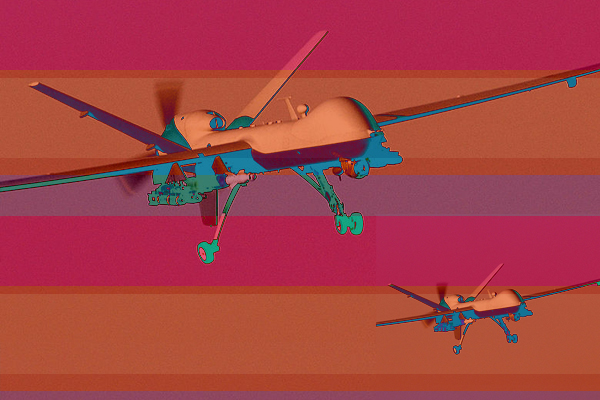
(2) A New York Times article yesterday examined the sometimes severe psychological stress experienced by the long-distance, remote-controlled operators of America’s drones. In one sense, that story angle is perverse: whatever stress these drone pilots experience is a tiny fraction of that continuously suffered by those who live with the falling bombs and missiles launched by these drones near their homes and children. But the articles makes one interesting point: while long working hours are the principal cause of the stress (necessitated by America’s massive increase in drone usage under President Obama), one source of stress for at least a small portion of these pilots is having to confront the images of the “collateral damage” they cause — meaning the innocent human life they extinguish with their joysticks and video game buttons:
In one surprising finding that challenged some of the survey’s initial suppositions, the authors found limited stress related to a unique aspect of the operators’ jobs: watching hours of close-up video of people killed in drone strikes. After a strike, operators assess the damage, and unlike fighter pilots who fly thousands of feet above their targets, drone operators can see in vivid detail what they have destroyed. . . .
Both Dr. Chappelle and Colonel McDonald said that 4 percent or less of operators were at high risk of developing post-traumatic stress disorder, the severe anxiety disorder that can include flashbacks, nightmares, anger, hypervigilance or avoidance of people, places or situations. In those cases, the authors suggested, the operators had seen close-up video of what the military calls collateral damage, casualties of women, children or other civilians. “Collateral damage is unnerving or unsettling to these guys,” Colonel McDonald said.
The doctors conducting the study were actually surprised that the psychological injuries from seeing this was as limited as it is. Still, at least some of these drone pilots have enough of a conscience to be seriously disturbed by the horrific results of these strikes. If only the general citizenry — who are typically kept blissfully unaware of the human devastation their government is causing — were as affected.
Along those lines, CNN.com, to its credit, today has a stomach-turning story of a 4-year-girl Pakistani girl who was severely burned by an American drone strike back in 2009, when she was a year old, complete with horrifying videos of her injuries:
She has eyelashes but no eyebrows. She has all her fingers but is missing four nails. Her skin is so taut now that she can no longer frown.
But she can still smile.
Her face tells a story of suffering. . . .Shakira, believed burned in a U.S. drone strike in Pakistan, will undergo reconstructive surgery in January. . .
In 2009, [Hashmat] Effendi was on a medical mission with Texas-based House of Charity in Pakistan’s Swat Valley. The region’s natural beauty was once compared to Switzerland’s, but by then it was a Taliban-infested area rife with violence.
One of the doctors found three little girls left in a trash bin. They’d suffered horrific injuries.
“Who are they?” the doctor asked.
Nobody knew.
Where were their parents? Where were they from?
Shakira, 4, is believed to have been burned in a U.S. drone strike in Pakistan in 2009.
All anyone could say is that there had been a U.S. drone attack.
The doctor, who was traveling with House of Charity, took them back with him. They were in grave condition. Two of the girls died, but the littlest one had a chance of making it if she were treated right away.
She was only a year old, Effendi guessed, but small for her age. She was skinny. Dirty. Very bloody. She had fresh burns all over her face, her scalp and on her arms.
This repeats itself over and over. And yet, it could hardly be less controversial in the country responsible for these attacks, largely because there is no partisan gain to be had from caring about it (merely to mention the irony that the GOP candidate currently leading most Iowa polls is the only major candidate from either party who opposes all of this is to trigger all sorts of recriminations; apparently, the ongoing slaughter of innocent men, women and children is far too insignificant an issue even to make the agenda of discussion). In fact, literally every time I even raise the horrors of the Obama drone program and the secrecy and lawlessness under which it’s conducted, I’m bombarded with arguments that drones are not an important issue or, from the most pathological Obama apologists, even fun drone humor designed to mock concerns about these attacks (such frivolity follows in the footsteps of their leader himself and his top aides). Contrary to the outright lie told by John Brennan, the President’s top counter-terrorism adviser, the fact is that the U.S. is continuously blowing up, burning, and killing innocent people, including numerous children, in the Muslim world. The program under which that is done is shrouded in almost complete secrecy. And it not only continues, but does so with little controversy.
(3) In response to the criticism I voiced a couple of weeks ago of NPR’s largely one-sided news story on domestic drones (criticism apparently expressed as well by numerous NPR listeners), that outlet’s Ombudsman defended the coverage but said “the complaints raise good—even intriguing—points for a second story that focuses exclusively on the privacy concerns surrounding potential police use of drones here at home.” Yesterday, the generally excellent Tom Ashbrook devoted a full hour on his NPR On Point Show to the proliferation of drones, featuring an ACLU staff attorney specializing in privacy issues. TPM’s Jillian Rayfield also has a good article on the growth of domestic drones and the unique dangers they pose.
(4) In Salon, Jordan Michael Smith compiles substantial evidence to argue that “the media consensus on Israel is collapsing.” Few developments are as imperative: The Australian reports today how the U.S., yet again, is alienating itself from the world consensus, and angering even close allies, by standing alone once again to shield Israel from even the mildest rebuke for the most egregious misconduct. To be sure, the smear campaigns are as concerted as ever toward those who question this bipartisan Israel orthodoxy — Time‘s Joe Klein this week responded to some of those smears aimed at him for doing so: see his Point 7 and the update – but, as Smith documents, they are increasingly ineffective.
(5) In The New Yorker, George Packer, who vocally supported the attack on Iraq but criticized it when it starting failing, writes about Christopher Hitchens, who never deviated from full-throated support. Most of what Packer writes is, as one would expect, little more than the now-trite reminiscing about Hitchens we’ve heard from his thousands of media friends which Neal Pollack parodied so brilliantly here, but Packer’s concluding paragraph struck me as something worth highlighting:
Iraq led Hitchens to some of his worst indulgences—the propaganda trip to Iraq in Wolfowitz’s entourage, the pose of Byronic heroism. But perhaps the war and the enemies it made him helped give Hitchens the courage of his last years and months—the atheist in the foxhole. Hitchens was one of the very few people who could slash and burn you in print, then meet for drinks and talk in the true warmth of friendship, discussing a writer we both admired, garrulous to the very last. It was a sign of his essential decency that he didn’t make it personal.
Is it really “a sign of decency” to refuse to view any political ideas as not merely wrong in some abstract intellectual sense, but as a reflection of the person’s character? Obviously, there are many political disagreements — most — which can and should be conducted in perfectly good faith without the need for personal animus. Conversely, though, aren’t there some political views so repellent and sociopathic that “a sign of essential decency” is to make it personal, rather than refusing to do so? This line of thought strikes me as anything but essentially decent:
Sure, he was and remained a fervent, unrepentant public cheerleader for an aggressive, baseless attack on another country that killed hundreds of thousands of innocent people and displaced millions more, and sure, he was very eager to fuel an Endless War that resulted in the deaths of countless innocent men, women and children that he himself never fought in, but I’m not going to hold any of that against him. I’ll argue with him as part of entertaining, invigorating political debate, but then will be happy to go out for drinks with him — he’s a really fun guy — and will proudly call him my friend.
In what sense does “decency” compel — or even permit — that line of thought? Packer, as he usually does, is simply giving voice to the standard mindset of Washington’s political and media class. As Charles Davis put it to me by email a couple of days ago when discussing David Corn’s expressed admiration for Hitchens — the irony that the Washington Bureau Chief of Mother Jones, of all places, waxed so effusive about one of the nation’s leading war zealots:
That’s Washington. Issues of war and peace — life and death — are just something you argue about from 9 to 5, and only when the cameras are on. Disagreeing on the wisdom of invading and occupying other nations is like disagreeing on whether the minimum wage should be $9.50 or $9.25: nothing serious enough to end a relationship over (see: Lake, Eli). And what’s a few hundred thousand dead brown people between friends?
The bottomless willingness of political and media elites to forgive each other of their sins, insulate personal relationships from everything else, and subordinate all other considerations to loyalty to their shared membership in those circles is not “a sign of essential decency.” It’s one of the leading causes of Washington’s rot.
(6) Physics Professor, noted atheist, and author Mano Singham has an interesting review of With Liberty and Justice for Some.
UPDATE: For a thoughtful, nuanced, very smart examination of the specific issue of Ron Paul and the newsletters, and more so, the general issue of Ron Paul’s candidacy, read this from The Atlantic‘s Conor Friedersdorf. It’s long, but well worth the time.
UPDATE II: George Packer — who wrote in the very Hitchens piece of his which I quoted here: “He and I argued a lot about the [Iraq] war. We had both supported it” — emails to object to my characterization of him as a “vocal supporter” of the war:
Dear Mr. Greenwald:
You write that I “vocally supported the attack on Iraq.” This is false. I never took a public position before the war. Instead, I wrote about the various arguments about the coming war in a series of articles in The New York Times Magazine. Long after the war went wrong, and after I started making regular trips to Iraq for The New Yorker, I wrote that I had been an ambivalent supporter. In other words, I outed myself when it could only do me harm–exactly the opposite of the opportunism you attribute to me. A quick review of my work would have made this clear. By not bothering, you’ve made your column a kind of echo chamber–not the same one as that of the “political and media elite,” but just as lazy.
I expect a correction.
George Packer
The distinction he’s apparently drawing — between being an unacknowledged supporter of the war and an admitted one — does not seem particularly significant, nor particularly flattering: if he thought his war support was significant enough to mention in 2005, why wasn’t it significant in 2002 and 2003? Beyond that, I did not suggest that Packer’s change of heart was opportunistic: I simply described, accurately, that it occurred (he “vocally supported the attack on Iraq but criticized it when it starting failing”). Moreover, my former Salon colleague, Gary Kamiya, calling Packer a “liberal hawk,” wrote a long and largely flattering review in 2005 of Packer’s Iraq War book detailing his pro-war stance and how it manifested; I’ll leave it to readers to judge for themselves whether Packer’s pre-war reporting was fairly deemed “pro-war.” But, as Kamiya noted, even Packer’s change of heart was quite limited:
Packer presumably knows all this, but he refuses to admit that the idea of invading Iraq was wrong — only the execution. “Since America’s fate is now tied to Iraq’s, it might be years or even decades before the wisdom of the war can finally be judged,” Packer writes. “The Iraq War was always winnable; it still is.” In other words, it is too soon to say if our national interest has been harmed by the war.
Under the Slate headline “Liberal Hawks Reconsider the War,” here’s what Packer was saying about Iraq in 2004. The point in dispute is extremely ancillary to anything I’ve raised here, but I’ll acknowledge that Packer’s pre-war reporting, though accompanied by admitted support for the attack, was presented in the language of journalistic neutrality, rendering “vocal support” an overstatement. As was true even for the most war-enabling journalists of the time, the war support was more “concealed” than explicit.
UPDATE III [Fri.]: Regarding the last point: in 2009, The New York Times assigned Packer to review a book by former New Yorker writer Mark Danner, and Danner wrote a response to that review suggesting that their vehement disagreements over the Iraq War prior to its commencement influenced the review; Danner’s response included this passage:
I strongly believed — as I first argued to George, my old New Yorker colleague and friend, in a discussion he and I had at a meeting of a small reading group to which we both belonged in January 2003, shortly before the war — that the invasion would be a catastrophic mistake that would bring in its wake a great deal of sectarian violence and score-settling. Packer, an ardent supporter of going to war in Iraq, argued that the United States should invade and occupy the country for humanitarian reasons. As the war ground on, he and I rejoined the debate intermittently in a number of forums.
Danner further attributes some of Packer’s criticisms of his book to the fact “that I disagreed with him when he argued that our country should invade and occupy Iraq.” At least according to Danner, Packer was hardly hiding his support for the war. Nor, according to Danner, was Packer’s support “ambivalent,” but rather “ardent.” I was willing to post Packer’s response and concede the point without doing much work to disprove his claims because the point was so ancillary to what I was writing here, but the picture Packer painted of himself in his demand for a correction (one he repeated in his reply to Danner) is, to put it mildly, quite disputable.
UPDATE IV [Fri.]: For a real sense of the mindset Packer was propagating back then, see this New York Times Op-Ed from late September, 2001, where he declares in the first sentence: “Sept. 11 made it safe for liberals to be patriots.” Apparently, said Packer, liberals were unwilling to be patriotic ever since the Vietnam War: “the instinct for battlefield virtue went underground.” He then added: “Our civilization is, of course, decadent, but it is also free enough for us to wake up to that fact. What I dread now” — is not another attack — but rather: ”is a return to the normality we’re all supposed to seek: instead of public memorials, private consumption; instead of lines to give blood, restaurant lines.” As Corey Robin says: “One reason Packer might defend Hitchens is that their response to 9/11 was so similar. . . . In short, both Hitchens and Packer welcomed 9/11 as a deliverance from the decadence of the US.” Those two were hardly alone in their 9/11-is-Good celebrations:
Less than a month after people jumped from the World Trade Center’s north tower to avoid burning to death, David Brooks asked, “Does anybody but me feel upbeat, and guilty about it?” “I feel upbeat because the country seems to be a better place than it was a month ago,” Brooks explained, “I feel guilty about it because I should be feeling pain and horror and anger about the recent events. But there’s so much to cheer one up.”
Here’s how Packer concluded his Op-Ed:
I don’t desire war — but I know that patriotic feeling makes individuals exceed themselves as the bland comforts of peace cannot. ”The only thing needed,” William James wrote in ”The Moral Equivalent of War,” ”is to inflame the civic temper as past history has inflamed the military temper.” I’ve lived through this state, and I like it.
Packer may think that he concealed his war fervor, but he did a nice job helping to spread it.
(updated below – Update II – Update III)
There is one important passage from yesterday’s big New York Times article on President Obama’s personal issuance of secret, due-process-free death sentences that I failed to highlight despite twice writing about that article. The fact that I did not even bother to highlight it among all the other passages I wrote about is itself significant, as it reflects how rapidly true extremism becomes normalized:
That record, and Mr. Awlaki’s calls for more attacks, presented Mr. Obama with an urgent question: Could he order the targeted killing of an American citizen, in a country with which the United States was not at war, in secret and without the benefit of a trial?
The Justice Department’s Office of Legal Counsel prepared a lengthy memo justifying that extraordinary step, asserting that while the Fifth Amendment’s guarantee of due process applied, it could be satisfied by internal deliberations in the executive branch.
Mr. Obama gave his approval, and Mr. Awlaki was killed in September 2011, along with a fellow propagandist, Samir Khan, an American citizen who was not on the target list but was traveling with him.
Please just re-read that bolded part. This is something that we already knew. The New York Times‘ Charlie Savage had previously reported that Obama OLC lawyers David Barron and Marty Lederman had authored a “secret document” that ”provided the justification for acting despite an executive order banning assassinations, a federal law against murder, protections in the Bill of Rights and various strictures of the international laws of war” (“The memo concluded that what was reasonable, and the process that was due, was different for Mr. Awlaki than for an ordinary criminal”). Attorney General Eric Holder then publicly claimed: “‘Due process’ and ‘judicial process’ are not one and the same, particularly when it comes to national security. The Constitution guarantees due process, not judicial process.” Both of those episodes sparked controversy, because of how radical of a claim it is (Stephen Colbert brutally mocked Holder’s speech: “Due Process just means: there’s a process that you do”).
But that’s the point: once something is repeated enough by government officials, we become numb to its extremism. Even in the immediate wake of 9/11 — when national fear and hysteria were intense — things like the Patriot Act, military commissions, and indefinite detention were viewed as radical departures from American political tradition; now, they just endure and are constantly renewed without notice, because they’ve just become normalized fixtures of American political life. Here we have the Obama administration asserting what I genuinely believe, without hyperbole, is the most extremist government interpretation of the Bill of Rights I’ve heard in my lifetime — that the Fifth Amendment’s guarantee that the State cannot deprive you of your life without “due process of law” is fulfilled by completely secret, oversight-free “internal deliberations by the executive branch” — and it’s now barely something anyone (including me) even notices when The New York Times reports it (as the ACLU’s Jameel Jaffer asked yesterday: “These Dems who think executive process is due process: Where were they when Bush needed help with warrantless wiretapping?” — or his indefinite detention scheme?)
A couple of months ago, I spoke at Purdue University in Indiana about civil liberties in the post-9/11 era, and several high school students drove from Kentucky to attend. They were aspiring journalists who worked on their high school newspaper and were battling their county School Board officials who were attempting to censor some of their articles on gay equality; they interviewed me after my speech in the hope that I would provide critical quotes about those officials (which I happily supplied). One of the student-journalists, a girl in the 11th grade, said something to me that was striking, something I knew rationally but had not quite internalized viscerally: she pointed out that much of my speech was grounded in post-9/11 erosions of civil liberties, but that for people her age — she was 6 years old at the time of the 9/11 attack — the post-9/11 era is basically all they know.
The post-9/11 era comprises the entirety of their political experience. They have no different American political culture to which they can compare it, at least from personal experience. The post-9/11 U.S. Government is the only one they know. The rights that have been abridged in the name of Terrorism are ones they never experienced, never exercised, and thus do not expect.
Every year that these assaults on core liberties are entrenched and expanded further — the Firth Amendment guarantee of due process “can be satisfied by internal deliberations in the executive branch” – the more normalized they become, the more invulnerable to challenge they are, the more unlikely it is that they will ever be reversed. In 2006, Al Gore gave a speech on the Bush/Cheney assault on the Constitution and asked: “If the president has the inherent authority to eavesdrop on American citizens without a warrant, imprison American citizens on his own declaration, kidnap and torture, then what can’t he do?” What prompted Gore’s denunciation was mere eavesdropping and detention without judicial review. That’s no longer controversial. Now we have this question: if the U.S. President can openly declare the power to order even the nation’s own citizens executed by the CIA in total secrecy, without charges or a whiff of transparency or oversight, what can’t he do?
* * * * *
I was on Democracy Now this morning discussing all of this, as well the rejection by the British High Court this morning of Julian Assange’s appeal of his extradition order to Sweden, and will post those segments here when they are available. In the meantime, there are two related articles on all of this worth reading:
(1) New York Times Editorial Editor Andy Rosenthal today writes:
Whenever I raise questions about President Obama’s “targeted killing” policy, and the cavalier way his aides dismiss criticism of it, administration officials tell me that I wouldn’t worry so much if I understood the program’s inner workings. But the more that comes to light, the more worried I feel.
He adds that “if Mr. Obama wants to authorize every drone strike, fine—but even the president requires oversight (remember checks and balances?) which he won’t allow.” And then the key conclusion:
Apologists for the president’s “just trust me” approach to targeted killings emphasize that the program is highly successful and claim that the drone strikes are extraordinarily precise. John Brennan, the president’s counter-terrorism adviser, said in a recent speech that not a single non-combatant had been killed in a year of drone strikes in Afghanistan and Pakistan. And today’s Times article quoted a senior administration official who said that civilian deaths were in the “single digits.”
But it turns out that even this hey-it’s-better-than-carpet-bombing justification is rather flimsy. The Times article says “Mr. Obama embraced a disputed method for counting civilian casualties …It in effect counts all military-age males in a strike zone as combatants, according to several administration officials, unless there is explicit intelligence posthumously proving them innocent.”
The logic, such as it is, is that people who hang around places where Qaeda operatives hang around must be up to no good. That’s the sort of approach that led to the false imprisonment of thousands of Iraqis, including the ones tortured at Abu Ghraib. Mr. Obama used to denounce that kind of thinking.
That’s not only something Mr. Obama used to denounce, but also his Democratic and progressive followers, who are largely — and disgracefully — silent about all of this, when they’re not cheering it (the very first comment to Rosenthal’s post demands that he stop criticizing Obama on the ground that doing so helps Romney).
(2) The Philadelphia Daily News‘ Will Bunch makes a very provocative though important point about that last passage. As I wrote about yesterday, the most significant new revelation from The New York Times article is that the Obama administration now considers “all military-age males in a strike zone as combatants,” on the ground that such individuals “are probably up to no good.” As Bunch points out, this was the exact language used by George Zimmerman in his 911 call about Travyon Martin (“it looks like he’s up to no good”). Moreover, at exactly the time that President Obama was poignantly observing that Martin looks like a son that Obama might have had, he was classifying all males in the vicinity of suspected Terrorists in Pakistan, Yemen and Somalia — including teenagers — as “militants” and “combatants,” and deeming them fair game to be killed solely by virtue of their physical location, gender and age. Those are someone’s actual sons. Bunch writes: “Since they chanted ‘Drill, baby, drill!’ at the 2008 RNC, maybe they could chant ‘Kill, baby, kill’ at the 2012 DNC when they re-nominate President Obama.”
UPDATE: Here’s the Democracy Now segment I did this morning on Obama’s kill list (can also be seen here):
And here’s the segment on the ruling in Assange’s extradition challenge (can also be seen here):
UPDATE II: The Washington Post today points out the obvious:
Across the vast, rugged terrain of southern Yemen, an escalating campaign of U.S. drone strikes is stirring increasing sympathy for al-Qaeda-linked militants and driving tribesmen to join a network linked to terrorist plots against the United States.
After recent U.S. missile strikes, mostly from unmanned aircraft, the Yemeni government and the United States have reported that the attacks killed only suspected al-Qaeda members. But civilians have also died in the attacks, said tribal leaders, victims’ relatives and human rights activists.
“These attacks are making people say, ‘We believe now that al-Qaeda is on the right side,’ ” said businessman Salim al-Barakani, adding that his two brothers — one a teacher, the other a cellphone repairman — were killed in a U.S. strike in March.
Who would have guessed that continually dropping bombs on a country using remote-controlled sky robots and killing their civilians would breed hatred and a desire to attack back? Not only do these constant Obama attacks extinguish the lives of innocent people, but they also exacerbate the very threat they are ostensibly designed to address.
UPDATE III: Some unknown citizens decided to use the White House petition system today to start a petition asking for the creation of a “Do-Not-Kill” list, “in which American citizens can sign up to avoid being put on the president’s ‘kill list’ and therefore avoid being executed without indictment, judge, jury, trial or due process of law.”
Continue Reading
Close
(updated below)
“I am not going to play in this dirty game. This is not democracy. These elections are a joke” — Abdel Fattah, Egyptian subway worker, explaining why he cannot support either Mohamed Morsi, the Muslim Brotherhood candidate, or Ahmed Shafik, President Hosni Mubarak’s final prime minister, in the two-candidate election runoff to determine Egypt’s next President (NYT, “Some Disdain Both Options in Egypt’s Narrowed Race,” May 26, 2012).
* * * * * *
Last week, the journal Foreign Policy published an extraordinary article – not extraordinary because of what it says, but because of who said it. It was written by Aaron David Miller, a lifelong D.C. foreign policy bureaucrat who served as a Middle East adviser to six different Secetaries of State in Democratic and GOP administrations. Miller’s article, which compared Barack Obama and Mitt Romney on foreign policy, was entitled “Barack O’Romney,” and the sub-headline said it all: “Ignore what the candidates say they’ll do differently on foreign policy. They’re basically the same man.” It began this way: “If Barack Obama is reelected, he ought to consider making Mitt Romney his new secretary of state” because “despite his campaign rhetoric, Romney would be quite comfortable carrying out President Obama’s foreign policy because it accords so closely with his own.”
Miller devotes himself to debunking one of the worst myths in Washington, propagated out of self-interest by conservatives and progressives alike: namely, that there is a vast and radical difference between the parties on most key issues and that bipartisanship is so tragically scarce. In the foreign policy context which is his expertise, Miller explains that — despite campaign rhetoric designed to exaggerate (or even invent) differences in order to motivate base voters — the reality is exactly the opposite:
That brings up an extraordinary fact. What has emerged in the second decade after 9/11 is a remarkable consensus among Democrats and Republicans on a core approach to the nation’s foreign policy. It’s certainly not a perfect alignment. But rarely since the end of the Cold War has there been this level of consensus. Indeed, while Americans may be divided, polarized and dysfunctional about issues closer to home, we are really quite united in how we see the world and what we should do about it.
Ever wondered why foreign policy hasn’t figured all that prominently in the 2012 election campaign? Sure, the country is focused on the economy and domestic priorities. And yes, Obama has so far avoided the kind of foreign-policy disasters that would give the Republicans easy free shots. But there’s more to it than that: Romney has had a hard time identifying Obama’s foreign-policy vulnerabilities because there’s just not that much difference between the two.
A post 9/11 consensus is emerging that has bridged the ideological divide of the Bush 43 years. And it’s going to be pretty durable. . . . As shown through his stepped-up drone campaign, Barack Obama has become George W. Bush on steroids.
None of this is new to anyone paying attention (people like former Bush DOJ official Jack Goldsmith long ago gleefully pointed out that Obama was doing more to entrench Bush/Cheney Terrorism policies than anything his GOP predecessors could have dreamed of achieving on their own). But what’s remarkable here is that it’s coming from someone like Aaron David Miller, a long-time member in good standing of America’s Foreign Policy Community. A proven devotee of Israeli interests, Miller is not lamenting this bipartisan consensus but celebrating it: “ I, for one, am ecstatic about it.” And he does so by repudiating a standard D.C. trope — that bipartisanship is woefully lacking and the parties are so very far apart — because, in the age of Obama, that trope, at least when it comes to foreign policy, Terrorism and civil liberties, has become so glaringly false as to be unsustainable (Matt Taibbi, among others, has made similar arguments in the domestic policy context: namely, that the two parties adopt wildly disparate Election Year rhetoric and campaign vows but end up serving the same interests).
Today, the New York Times has a long, detailed article about the personal role played by President Obama in the massive amount of death and destruction the U.S. has brought to the Muslim world at his direction. The article, by Jo Becker and Scott Shane, is based on interviews with “three dozen of his current and former advisers” and thus uses sources who — with a couple of exceptions — attempt to cast the Commander-in-Chief in the best and most glorious possible light. Nonetheless, the article provides as clear a picture of the character of this individual politician as any stand-alone article in some time. Earlier today, I wrote about one specific revelation from the article that I most wanted to highlight — the way in which Obama, in order to conceal the civilian casualties he causes and justify the raining down of death he orders, has re-defined “militant” to mean “all military-age males in a strike zone” – but there are numerous other revealing passages in this article meriting attention.
* * * * *
The article describes in detail how “Mr. Obama has placed himself at the helm of a top secret ‘nominations’ process to designate terrorists for kill or capture, of which the capture part has become largely theoretical” — an actual presidential-led death panel (as always in American media parlance, “Terrorist” means: individuals alleged by the U.S. Government — with no evidence, transparencey or due process — to be Terrorists). Specifically, Obama himself “insisted on approving every new name on an expanding ‘kill list,’ poring over terrorist suspects’ biographies on what one official calls the macabre ‘baseball cards’ of an unconventional war.” In total secrecy — with no transparency or oversight of any kind — he then selects who will live and who will die. The ugliest detail about this may be the presence of one of the attendees at these death sentence meetings:
It is the strangest of bureaucratic rituals: Every week or so, more than 100 members of the government’s sprawling national security apparatus gather, by secure video teleconference, to pore over terrorist suspects’ biographies and recommend to the president who should be the next to die. . . . David Axelrod, the president’s closest political adviser, began showing up at the “Terror Tuesday” meetings, his unspeaking presence a visible reminder of what everyone understood: a successful attack would overwhelm the president’s other aspirations and achievements.
In other words, the person in charge of Obama’s political fortunes attends the meetings where the Leader decrees who lives and dies. Just think about how warped that is, or what progressives would be saying if Karl Rove did that with George Bush. Here are some of the fabulous results of Obama’s sophisticated wisdom and progressive judgment that come from his death panel, including one incident that took place a mere two months after he was awarded the 2009 Nobel Peace Prize:
The very first strike under his watch in Yemen, on Dec. 17, 2009, offered a stark example of the difficulties of operating in what General Jones described as an “embryonic theater that we weren’t really familiar with.”
It killed not only its intended target, but also two neighboring families, and left behind a trail of cluster bombs that subsequently killed more innocents. It was hardly the kind of precise operation that Mr. Obama favored. Videos of children’s bodies and angry tribesmen holding up American missile parts flooded You Tube, fueling a ferocious backlash that Yemeni officials said bolstered Al Qaeda.
Beyond telling a fun joke about his drone strikes, here’s how Obama responded to the carnage he caused in Yemen:
In Pakistan, Mr. Obama had approved not only “personality” strikes aimed at named, high-value terrorists, but “signature” strikes that targeted training camps and suspicious compounds in areas controlled by militants.
But some State Department officials have complained to the White House that the criteria used by the C.I.A. for identifying a terrorist “signature” were too lax. The joke was that when the C.I.A. sees “three guys doing jumping jacks,” the agency thinks it is a terrorist training camp, said one senior official. Men loading a truck with fertilizer could be bombmakers — but they might also be farmers, skeptics argued.
Now, in the wake of the bad first strike in Yemen, Mr. Obama overruled military and intelligence commanders who were pushing to use signature strikes there as well. . . .
Mr. Obama had drawn a line. But within two years, he stepped across it. Signature strikes in Pakistan were killing a large number of terrorist suspects, even when C.I.A. analysts were not certain beforehand of their presence. And in Yemen, roiled by the Arab Spring unrest, the Qaeda affiliate was seizing territory.
Today, the Defense Department can target suspects in Yemen whose names they do not know. Officials say the criteria are tighter than those for signature strikes, requiring evidence of a threat to the United States, and they have even given them a new name — TADS, for Terrorist Attack Disruption Strikes. But the details are a closely guarded secret — part of a pattern for a president who came into office promising transparency.
In the wake of massacres like the December, 2009 slaughter of dozens of women and children in Yemen, Obama has steadily escalated his drone attacks in multiple countries — not just numerically, but in terms of how indiscriminate they can be.
Many Obama fans claimed during the 2008 election that his background as a constitutional lawyer would ensure reversal of the most extremist Bush/Cheney policies, but he has instead used that background for the opposite goal:
When he applies his lawyering skills to counterterrorism, it is usually to enable, not constrain, his ferocious campaign against Al Qaeda — even when it comes to killing an American cleric in Yemen, a decision that Mr. Obama told colleagues was “an easy one.” . . . .
Asked what surprised him most about Mr. Obama, Mr. Donilon, the national security adviser, answered immediately: “He’s a president who is quite comfortable with the use of force on behalf of the United States.”
No late-night wrestling with conscience for this Nobel Peace laureate. Even his most radical decision — ordering an American citizen assassinated without a whiff of due process or transparency — is “easy” for him, and he’s so very “comfortable” with ordering people killed, say his aides who believe this to be a compliment.
No article about Obama’s Terrorism policies would be complete without noting the extensive continuity between Bush/Cheney and the progressive Democratic leader:
A few sharp-eyed observers inside and outside the government understood what the public did not. Without showing his hand, Mr. Obama had preserved three major policies — rendition, military commissions and indefinite detention — that have been targets of human rights groups since the 2001 terrorist attacks.
Nor would it be complete without the most extremist right-wing Bush officials lavishing praise on Obama for this continuity:
Mr. Hayden, the former C.I.A. director and now an adviser to Mr. Obama’s Republican challenger, Mr. Romney, commended the president’s aggressive counterterrorism record, which he said had a “Nixon to China” quality. . . .
No one would have imagined four years ago that his counterterrorism policies would come under far more fierce attack from the American Civil Liberties Union than from Mr. Romney.
One of the most glaring myths progressives like to tell themselves and others is that the GOP refuses to praise Obama no matter what he does. This is patently false. Virtually every one of the most far-right neocon Bush officials — including Dick Cheney himself — has spent years now praising Obama for continuing their Terrorism policies which Obama the Senator and Presidential Candidate once so harshly denounced. Every leading GOP candidate except Ron Paul wildly praised Obama for killing U.S. citizen Anwar Awlaki without a shred of due process and for continuing to drop unaccountable bombs on multiple Muslim countries.
But the most amazing thing about the quotes from Gen. Hayden — who implemented George Bush’s warrantless eavesdropping program while NSA chief and then became Bush’s CIA Director — is that he actually thinks Obama has gone much too far in his secrecy obsessions:
But, [Hayden] said, “secrecy has its costs” and Mr. Obama should open the strike strategy up to public scrutiny.
“This program rests on the personal legitimacy of the president, and that’s not sustainable,” Mr. Hayden said. “I have lived the life of someone taking action on the basis of secret O.L.C. memos, and it ain’t a good life. Democracies do not make war on the basis of legal memos locked in a D.O.J. safe.” . . .
As the ACLU’s Jameel Jaffer put it today: “That Hayden, of all people, is complaining about secrecy is one measure of how far Obama has strayed from his commitment to transparency.” Of course, that Hayden — George Bush’s handpicked NSA and CIA chief — has spent two years lavishing Obama with praise on the substance of his Terrorism policies demonstrates even more about who Obama is.
And then finally we have this, the most consequential aspect of the Obama legacy:
Moreover, Mr. Obama’s record has not drawn anything like the sweeping criticism from allies that his predecessor faced. John B. Bellinger III, a top national security lawyer under the Bush administration, said that was because Mr. Obama’s liberal reputation and “softer packaging” have protected him. “After the global outrage over Guantánamo, it’s remarkable that the rest of the world has looked the other way while the Obama administration has conducted hundreds of drone strikes in several different countries, including killing at least some civilians,” said Mr. Bellinger, who supports the strikes.
As I’ve written about many times before, Obama — by leading blind-partisan Democrats and progressives to cheer for these policies rather than denounce them — has converted what were just recently highly divisive and controversial right-wing Assaults on Our Values into fully entrenched bipartisan consensus. But worse than that, he has put a prettier and more palatable face on extremely ugly policies.
Recall the 2010 CIA Report, leaked to WikiLeaks, which discussed how Barack Obama was the key asset for preventing Western European populations from abandoning war policies in Afghanistan. That’s because with Obama, rather than the swaggering cowboy George Bush, as the face of these wars, they would be more effectively marketed. That is precisely what Obama has done to the American citizenry with regard to what was recently known in Democratic Party circles as the Radical Bush/Cheney Terrorism agenda.
Just to underscore the level of right-wing extremism which Obama has normalized, consider his deceitful re-definition of the term “militant” to encompass ”all military-age males in a strike zone as combatants,” which I wrote about earlier today. In 2006, the pro-Israel activist Alan Dershowitz created a serious scandal when he argued – mostly in order to justify Israeli aggression — that “civilian causalties” are a “gray area” because many people in close proximity to Terrorists — even if not Terrorists themselves — are less than innocent (“A new phrase should be introduced into the reporting and analysis of current events in the Middle East: ‘the continuum of civilianality’ . . . . Every civilian death is a tragedy, but some are more tragic than others”).
Even more repellent was John Podhoretz’s argument in 2006 that “the tactical mistake” which “we made in Iraq was that we didn’t kill enough Sunnis in the early going to intimidate them and make them so afraid of us they would go along with anything,” specifically that the real error was that the U.S. permitted “the survival of Sunni men between the ages of 15 and 35.” In other words, “all military-age males” in Sunni areas should have been deemed “combatants” and thus killed. Podhoretz’s argument created all sorts of outrage in progressive circles: John Podhoretz is advocating genocide!
But this is precisely the premise that President Obama himself has now adopted in order to justify civilian deaths and re-classify them as “militants.” Here is the rationale of Obama officials as described by the NYT: “people in an area of known terrorist activity, or found with a top Qaeda operative, are probably up to no good.” Probably up to no good. That’s a direct replica of Dershowitz’s argument, and is closely related to Podhoretz’s. They count someone as a “militant” — worthy of death — based purely on the happenstance of where they are and the proximity they’re in to someone else they suspect is a Bad Person. If such a person is killed by a U.S. missile, then, by definition, they are “militants,” not “civilians” — even if we don’t know the first thing about them, including their name.
That’s official Obama policy. It won’t even be reported on most MSNBC shows, and won’t even be acknowledged, let alone denounced, by the vast majority of Democrats, including progressives. That’s the Obama legacy.
And it’s all justified by this definitively warped premise: we have to keep doing things we know will result in large-scale civilian deaths in order to stop the Terrorists, who are really terrible because they keep killing civilians. Besides, continuously killing a bunch of foreigners is hardly some reflection on our President’s character, especially in an Election Year.
* * * * *
Note how the Obama administration clearly wanted this discussion to appear in the New York Times — believing that depictions of Obama as Brave Warrior would result in political gain – even as they continue to insist to federal courts that their actions cannot be subject to judicial review because national security would be jeopardized if they were forced to acknowledge these programs in a judicial proceeding.
UPDATE: As John Santore correctly notes — and he confirmed it with both Shane and Becker — Axelrod attends the “Tuesday Terror” meetings where decisions are made about who will die, not the larger teleconference calls where “nominations” are made. It doesn’t change the point at all, but the way I quoted the NYT article gave the incorrect impression that Axelrod attends the latter, not the former. It’s the other way around.
Continue Reading
Close
(updated below – Update II)
Yesterday, I wrote about the rotted workings of the Imperial Mind, but today presents a tragic occasion to examine its close, indispensable cousin: the Authoritarian Mind. From CNN today:
A suspected NATO airstrike killed eight civilians — including six children — in eastern Afghanistan, a provincial spokesman said.
The airstrike took place Saturday night in Paktia province, said Rohullah Samoon, spokesman for the governor of Paktia. He said an entire family was killed in the strike.
The LA Times identified the victims as “Mohammed Shafi, his wife and his six children,” and cited the statements from the spokesman for the Paktia governor’s office that “there is no evidence that Shafi was a Taliban insurgent or linked with Al Qaeda.” The Afghan spokesman blamed the incident on the refusal of NATO to coordinate strikes with Afghan forces to ensure civilians are not targeted (“If they had shared this with us, this wouldn’t have happened”). Also yesterday:
An American drone fired two missiles at a bakery in northwest Pakistan Saturday, killing four suspected militants, officials said, as the U.S. pushed ahead with its drone campaign despite Pakistani demands to stop. This was the third such strike in the country in less than a week. . . .
The officials said the victims were buying goods from a bakery when the missiles hit. Residents were still removing the debris, officials said. All of the dead were foreigners, but the officials did not have any information on their identities or nationalities.
All of this is so widely tolerated, even cheered, among large factions of the American citizenry due to three premises:
(1) I have absolutely no idea who my government is continuously bombing to death by drone, but I assume they deserve it;
(2) when my government extinguishes the lives of entire families, including small children, as it often does, I know it’s all for a just and important cause even if I can’t identify it; and,
(3) we have to stop the Terrorists, because they keep killing innocent civilians.
That’s the Authoritarian Mind, and it appears everywhere the Imperial Mind does.
* * * * *
The Washington Post yesterday reported that “on the periphery of Bagram Airfield, farmers, scrap-metal collectors and sheep herders have been crippled, blinded and burned by U.S. military ammunition on an unfenced and poorly marked training ground.” Because “there is no barrier between nearby villages and the range — it is unclear where the dusty townships end and the vast military training area begins,” Afghan villagers routinely stumble into unexploded ordnance and are severely injured or even killed, all because the U.S. military never bothered to demarcate the base. In 2009, its Commander-in-Chief, President Barack Obama, was awarded the Nobel Peace Prize.
UPDATE: This contrast from MSNBC’s home page, as it appears right now, speaks volumes about the mindset of the American government and its establishment media:
For why this is exactly the reverse of what a responsible U.S. media outlet would do, see here.
UPDATE II: ABC News‘ Jake Tapper this morning interviewed Defense Secretary Leon Panetta and asked him about civilian deaths caused by U.S. drones: specifically, whether the U.S.’s relentless air strikes in multiple Muslim countries are exacerbating rather than containing the problem of anti-American Terrorism:
TAPPER: President Obama recently said that — recently told John Brennan, his counterterrorism adviser at the White House that he wanted a little bit more transparency when it comes to drones, which are the – is one of the approaches that you’re alluding to in Yemen.
And “The Times of London” reported last week that the civilian casualties in Yemen as a result of drone strikes have, quote, “emboldened Al Qaeda.”
Is there not a serious risk that this approach to counterterrorism, because of its imprecision, because of its civilian casualties, is creating more enemy than it is killing?
PANETTA: First and foremost, I think this is one of the most precise weapons that we have in our arsenal. Number two, what is our responsibility here? Our responsibility is to defend and protect the United States of America.
And using the operations that we have, using the systems that we have, using the weapons that we have, is absolutely essential to our ability to defend Americans. That’s what counts, and that’s what we’re doing.
Note that Panetta studiously ignored, rather than addressed, the question of whether the U.S. — by continuously killing Muslim civilians and thus intensifying anti-American animus — is creating more Terrorists than it is killing and thus making the U.S. less safe. That’s because there is no answer. Continuously bombing Muslim countries and killing civilians ostensibly as a means of combating anti-American Terrorism is exactly like smoking six packs of cigarettes a day to treat emphysema: one would do it only if one wanted to make the problem worse, or, at best, was recklessly indifferent to the outcome.
Continue Reading
Close
Americans of all types — Democrats and Republicans, even some Good Progressives — are just livid that a Pakistani tribal court (reportedly in consultation with Pakistani officials) has imposed a 33-year prison sentence on Shakil Afridi, the Pakistani physician who secretly worked with the CIA to find Osama bin Laden on Pakistani soil. Their fury tracks the standard American media narrative: by punishing Dr. Afridi for the “crime” of helping the U.S. find bin Laden, Pakistan has revealed that it sympathizes with Al Qaeda and is hostile to the U.S. (NPR headline: “33 Years In Prison For Pakistani Doctor Who Aided Hunt For Bin Laden”; NYT headline: “Prison Term for Helping C.I.A. Find Bin Laden”). Except that’s a woefully incomplete narrative: incomplete to the point of being quite misleading.
What Dr. Afridi actually did was concoct a pretextual vaccination program, whereby Pakistani children would be injected with a single Hepatitis B vaccine, with the hope of gaining access to the Abbottabad house where the CIA believed bin Laden was located. The plan was that, under the ruse of vaccinating the children in that province, he would obtain DNA samples that could confirm the presence in the suspected house of the bin Laden family. But the vaccine program he was administering was fake: as Wired‘s public health reporter Maryn McKenna detailed, “since only one of three doses was delivered, the vaccination was effectively useless.” An on-the-ground Guardian investigation documented that ”while the vaccine doses themselves were genuine, the medical professionals involved were not following procedures. In an area called Nawa Sher, they did not return a month after the first dose to provide the required second batch. Instead, according to local officials and residents, the team moved on.”
That means that numerous Pakistani children who thought they were being vaccinated against Hepatitis B were in fact left exposed to the virus. Worse, international health workers have long faced serious problems in many parts of the world — including remote Muslim areas — in convincing people that the vaccines they want to give to their children are genuine rather than Western plots to harm them. These suspicions have prevented the eradication of polio and the containment of other preventable diseases in many areas, including in parts of Pakistan. This faux CIA vaccination program will, for obvious and entirely foreseeable reasons, significantly exacerbate that problem.
As McKenna wrote this week, this fake CIA vaccination program was “a cynical attempt to hijack the credibility that public health workers have built up over decades with local populations” and thus “endangered the status of the fraught polio-eradication campaign, which over the past decade has been challenged in majority-Muslim areas in Africa and South Asia over beliefs that polio vaccination is actually a covert campaign to harm Muslim children.” She further notes that while this suspicion “seems fantastic” to oh-so-sophisticated Western ears — what kind of primitive people would harbor suspicions about Western vaccine programs? – there are actually “perfectly good reasons to distrust vaccination campaigns” from the West (in 1996, for instance, 11 children died in Nigeria when Pfizer, ostensibly to combat a meningitis outbreak, conducted drug trials — experiments — on Nigerian children that did not comport with binding safety standards in the U.S.).
When this fake CIA vaccination program was revealed last year, Doctors Without Borders harshly denounced the CIA and Dr. Afridi for their “grave manipulation of the medical act” that will cause “vulnerable communities – anywhere – needing access to essential health services [to] understandably question the true motivation of medical workers and humanitarian aid.” The group’s President pointed out the obvious: “The potential consequence is that even basic healthcare, including vaccination, does not reach those who need it most.” That is now clearly happening, as the CIA program “is casting its shadow over campaigns to vaccinate Pakistanis against polio.” Gulrez Khan, a Peshawar-based anti-polio worker, recently said that tribesman in the area now consider public health workers to be CIA agents and are more reluctant than ever to accept vaccines and other treatments for their children.
For the moment, leave to the side the question of whether knowingly administering ineffective vaccines to Pakistani children is a justified ruse to find bin Laden (just by the way, it didn’t work, as none of the health workers actually were able to access the bin Laden house, though CIA officials claim the program did help obtain other useful information). In light of all the righteous American outrage over this prison sentence, let’s consider what the U.S. Government would do if the situation were reversed: namely, if an American citizen secretly cooperated with a foreign intelligence service to conduct clandestine operations on U.S. soil, all without the knowledge or consent of the U.S. Government, and let’s further consider what would happen if the American citizen’s role in those operations involved administering a fake vaccine program to unwitting American children. Might any serious punishment ensue? Does anyone view that as anything more than an obvious rhetorical question?
There are numerous examples that make the point. As’ad AbuKhalil poses this one: “Imagine if China were to hire an American physician who would innocently inject unsuspecting Americans with a chemical to obtain information for China. I am sure that his prison term would be even longer.” Or what if an American doctor of Iranian descent had done this on behalf of the Quds Force, in order to find a member of the designated Iranian Terror group MeK who was living in the United States (one who, say, has been working with Israel to help assassinate Iranian nuclear scientists and wound their wives, or one who was trained by the U.S.), after which Iranian agents invaded his American home, pumped bullets in his skull and shot a few others (his wife and a child) and then dumped his corpse into the Atlantic Ocean? Or take the case of Orlando Bosch, the CIA-backed anti-Cuban Terrorist long harbored by the U.S.; suppose a Cuban-American doctor sympathetic to Castro had injected American children as part of a fake vaccination program in order to help Cuba find and kill Bosch on U.S. soil; he’d be lucky to get 33 years in prison.
In fact, the U.S. Government tries to impose the harshest possible sentences on Americans who do far less than Dr. Afridi did in Pakistan. The Obama administration charged former NSA official Thomas Drake with espionage and tried to imprison him for decades merely because he exposed serious waste, corruption and illegality in surveillance programs — without the slightest indication of any harm to national security. Right now, they’re charging Bradley Manning with “aiding the enemy” — Al Qaeda — and attempting to impose life imprisonment on the 23-year-old Army Private, merely because he leaked information to the world showing serious war crimes and other government deceit (something The New York Times does frequently) which nobody suggests was done in collaboration with or even with any intent to help Al Qaeda or any other foreign entity. Given all that, just imagine how harshly they’d try to punish an American who secretly collaborated with a foreign intelligence service — who created a fake vaccine program for American kids — to enable secret military action on U.S. soil without their knowledge.
But of course none of these comparisons is equivalent. It’s all different when it’s done to America rather than by America. That’s the great prize for being the world’s imperial power: the rules you impose on others don’t bind you at all. I’m quite certain that none of the people voicing such intense rage over Pakistan’s punishment of Dr. Afridi would voice anything similar if the situation were reversed in any of the ways I’ve just outlined. Can you even imagine any of them saying something like: yes, this American doctor injected American kids with ruse vaccines in order to help the intelligence service of Iran/Pakistan/China/Cuba conduct clandestine operations on U.S. soil without the knowledge of the U.S. Government, but I think that’s justified and he shouldn’t be punished.
If you read or watch any accounts of life in the Roman empire, what you will frequently witness is someone being severely punished for an act against a Roman citizen. That was the most severe crime and the one most harshly punished: one could do any manner of bad things to non-citizens, but not so much as raise a hand to a Roman citizen.
Watch how often that formulation is used in our political discourse: he tried to kill Americans, people will emphasize when justifying all sorts of U.S. government actions. In other words, there are ordinary, pedestrian crimes (like this one, from today: “An American drone fired two missiles at a bakery in northwest Pakistan Saturday and killed four suspected militants, officials said, as the U.S. pushed on with its drone campaign despite Pakistani demands to stop. This was the third such strike in the country in less than a week”). But then there is the supreme crime: he tried to kill Americans! It’d be one thing if this outrage were honestly expressed as self-interest (we give massive aid to Pakistan so they should do our bidding), but instead, it is, as usual, couched in moral terms.
That is the imperial mind at work. Its premises are often embraced implicitly rather than knowingly: American lives are inherently more valuable; foreign lives are expendable in pursuit of American interests; the U.S. has the inalienable right to take action in other countries that nobody is allowed to take in the U.S. (just imagine: “An Iranian drone fired two missiles at a bakery in the northwest U.S. Saturday and killed four suspected militants, Iranian officials said, as Iran pushed on with its drone campaign despite American demands to stop. This was the third such strike in the country in less than a week” or “Thirty five women and children were killed by a Yemeni cruise missile armed with cluster bombs which struck an alleged Marine training camp in Texas”).
These self-venerating imperial prerogatives are the premises driving the vast bulk of American foreign policy and military discourse. It is certainly what’s driving the spectacle of so many people pretending that the punishment of Dr. Afridi is some sort of aberrational act which the U.S. and other Decent, Civilized Countries would never do.
* * * * *
Two related points:
(1) NPR emphasizes what appear to be the genuine due process deficiencies in the punishment imposed on Dr. Afridi, though he certainly is receiving more due process than those informally and secretly accused of Treason by the U.S. Government and given the Anwar Awlaki treatment, or accused of Terrorism and targeted with a U.S. drone or locked for a decade or so in a cage without charges of any kind.
(2) Zaid Jilani, formerly of Think Progress, asks a really good question about the Hollywood Election Year film depicting the bin Laden raid being produced by Sony Pictures with the help of the Obama administration: “Will the movie feature Pakistani kids tricked into getting fake vaccines? Probably not.” If the film does mention this, I’d bet it will be to marvel at and celebrate the James-Bond-like ingenuity of the CIA.
Continue Reading
Close