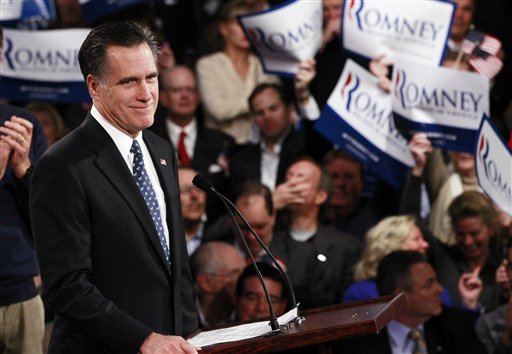

Republican presidential candidate, former Massachusetts Gov. Mitt Romney, celebrates his New Hampshire primary election win in Manchester, N.H., Tuesday, Jan. 10, 2012. (AP Photo/Charles Dharapak) (Credit: AP)
I’ve got to admit it: Liberals are at a disadvantage when it comes to judging where the GOP primary is headed. Last week I was sure that conservatives were settling on Rick Santorum, and his supposed blue-collar family values, as the official not-Mitt Romney candidate after his strong Iowa showing. Not quite yet. Sunday I was sure Newt Gingrich’s slashing “King of Bain” ad, attacking Romney as a looter and a job destroyer for his Bain Capital record, would be devastating in a country where the economy is the top issue and unemployment remains high.
It was devastating, all right. To Gingrich. The former House speaker got a beatdown from fellow conservatives this week, with Rush Limbaugh mocking him as an Occupy Wall Street supporter and the National Review harrumphing at the notion that Gingrich targeted Romney’s Bain success because he “apparently expect(s) Republican voters to regard that as a liability.” By the time he made his “I’m tied for fourth place!” speech in New Hampshire Tuesday night, Gingrich looked broken. He abandoned his slashing attacks on Romney’s career and stuck to decrying the “years of decay” under President Obama, recounting his alleged successes as House speaker in the ’90s, and rambling wearily about “innovation.” A few minutes later, over on Fox, a disapproving Sean Hannity smacked sixth-place loser Rick Perry for his attacks on Romney, and echoed Limbaugh’s sneering comparison with Occupy Wall Street ideology.
It’s an interesting moment. Multiple news organizations reported that even close allies are telling Gingrich to cut out the attacks on Romney, but he’s already purchased an estimated $1.5 million in South Carolina airtime for his “House of Bain” spots, plus a nasty ad claiming Romney had “governed pro-abortion” in Massachusetts. What’s Gingrich going to do? He hates Romney, but he loves predatory capitalism as much as Limbaugh does. He doesn’t believe his own Bain Capital attacks. Can he continue to hurt Romney without damaging his own chances to return to the right-wing gravy train when he goes down to defeat? Trust me, the monied interests are not interested in hiring anti-capitalist “historians” to not-lobby for them. Gingrich is torn between vengeance and greed. Sucks to be him. Fun to watch.
It’s also fun to watch conservative Republicans rally around Romney not because they like him but because he’s become the face of the hallowed free market. As he headed to conservative South Carolina, hotbed of Tea Party radicalism, Romney got a boost from its extremist Sen. Jim DeMint, who predicted the former Massachusetts governor would win the Jan. 21 primary. DeMint is staying neutral, he told radio host Mark Steyn Tuesday night, “because Republicans are not yet united and I want to focus on the Senate.” But he praised Romney’s victory speech for “hitting a lot of the hot buttons for me about balancing the budget,” adding “Frankly, I’m a little concerned about the few Republicans who have criticized some of what I consider free market principles here.” He went on: “Some of the others who might have had an advantage here have really crossed paths, crossed ways with some Republicans as they have criticized free enterprise concepts.” DeMint’s remarks could give other Tea Party leaders an excuse to back Romney, though they don’t trust him, in the name of defending capitalism.
I still think there’s a possibility the Bain attacks will resonate with some Republican voters, and maybe in South Carolina, which has a 9.9 percent unemployment rate, compared to under 6 percent in Iowa and New Hampshire. It’s possible Gingrich and Perry’s attacks will open up political space for Santorum, who’s been careful not to attack capitalism as he sticks to his blue-collar platitudes and culture-war campaign. It was great to see New Hampshire voters chasten Santorum by repeatedly challenging his homophobia in public forums and giving him a fifth place finish. But his campaign told the Huffington Post he’ll spend at least $1 million on advertising in South Carolina. Maybe he’s still got a chance.
It’s a tiny one. Super PACs connected to Romney are set to spend $6 million in South Carolina and Florida in the next three weeks. Meanwhile, as every non-Romney candidate vows to head to South Carolina, they split the conservative vote and increase the chances that Romney gets the victory. Perry claimed he’s soldiering on. So did Jon Huntsman, despite a third-place showing that wasn’t enough to make him a serious candidate, since he bet everything on New Hampshire. “Third place is a ticket to ride, ladies and gentlemen,” Huntsman told the crowd, but nobody believes that. Late Tuesday night, Huntsman’s father and financier reportedly hadn’t decided whether to keep bankrolling his son’s bid. (And people mock Romney for his wealth.)
If it weren’t for Ron Paul’s foreign policy views, we might be talking about whether conservatives could coalesce around his candidacy. He underperformed expectations in Iowa but he came in a strong second Tuesday night. As much as I loathe his domestic politics, I enjoyed hearing the crowd chanting “Bring them home” when he promised to get troops out of Afghanistan. Paul will stay in the race and, given his caucus strategy, he could rack up delegates. I don’t know where that will take him – is he dreaming of Vice President Rand Paul? – but it’s great to think about the Ron Paul crowd heckling Mitt Romney when he doubles down on his hawkish, expansionist foreign policy promises in Tampa.
Romney’s heading into a scorched-earth South Carolina primary, but he’s got to be feeling pretty good about his first two outings. In New Hampshire, he won the ultra-rich, of course, but he also got Tea Party members and evangelicals, according to exit polls. He gave a much better victory speech than he did a week ago, because this time he used his teleprompter. He hit not only Obama but his Republican rivals for practicing “the bitter politics of envy,” which has more zing than the standard GOP class warfare line.
The private equity mogul can’t understand that criticism of his Bain career — “restructuring” companies, cutting their workforce and forcing almost a quarter into bankruptcy — isn’t about jealousy, but justice. People are starting to understand that finance capitalism works for the top 1 percent, but not the rest of us. So while Gingrich’s attacks aren’t likely to help his candidacy, they’re a boost to the man he presumably wants to defeat more than Romney. President Obama has to look forward to running against a guy his GOP rivals called a looter and a vulture capitalist. The fact that all of those rivals are fighting on after New Hampshire helps Romney win the nomination, but it could also help the Democrats hold the White House.
You’ve got to hand it to Mitt Romney. For someone who’s usually as steadfast as a “perfectly lubricated weathervane,” in the words of former foe Jon Huntsman, sometimes he’s got a lot of brass. This week he released an ad blaming the student debt crisis on President Obama, when in fact out-of-control student loans were gobbling up graduates’ paychecks by the time Obama took office in 2009. In fact, Romney himself played a starring role in the crisis, cutting higher-education funding and hiking tuition back when he was Massachusetts governor (or, as he’d rather put it, during the lost years).
Broadcast in New Hampshire, the swing state that also leads the nation in per capita student debt, the ad highlighted “the fact that the president has not been able to help students deal with this crushing debt,” according to Romney spokesman Ryan Williams. Unfortunately, the ad used footage of New Hampshire students complaining about their loan burden without their permission, and one of them happens to plan to vote for Obama. “Considering I am not a supporter of Mitt Romney, this is not exactly sitting well with me,” said Southern New Hampshire University sophomore Matt Raso. The campaign pulled the footage when a local television station objected, but Ryan Williams told the Associated Press that the campaign plans to run ads blaming the student loan crisis on Obama in other swing states.
That takes a kind of chutzpah Romney rarely exhibits. He won’t stand up to birther bully Donald Trump or the misogynist Rush Limbaugh, but he apparently has the cojones to blame student debt on Obama. We’ll see how it goes. In fact, American student debt is a scandal in which state and national lawmakers in both parties share some blame. But by far the lion’s share of responsibility for the debacle belongs to Republicans. The roots of the crisis go back to California Gov. Ronald Reagan, who imposed the first “fees” on the formerly free University of California system in 1968, declaring “the state should not subsidize intellectual curiosity.” As president, Reagan helped nationalize that disdain for well-funded public higher education in the 1980s.
But it took a long roster of Republican governors to turn the problem into a crisis, and Massachusetts Gov. Mitt Romney led the way a decade ago, dramatically slashing public higher-education funding and hiking fees during his one term. According to the Boston Globe, from 2003 to 2007, fees and tuition jumped 63 percent at Massachusetts’s once-stellar system of public higher education as Romney slashed state funding year after year, for a total of $140 million, or 14 percent, in four years. Not surprisingly, average student debt in Massachusetts jumped 25 percent while Romney was governor. Between 2001 and 2011, tuition and fees have more than doubled at the state’s community college, state university and UMass campuses, but the bulk of the added burden piled up under Romney.
Romney also wanted to spin off the flagship UMass-Amherst and privatize three other colleges, including the medical school, a harbinger of what he says he’ll do as president. That agenda failed in Massachusetts, but it would be a shame to give him a second chance as president.
It’s tragic that Republicans have become the dismantlers of public universities, since it was Abraham Lincoln who signed the Morrill Act in 1862, creating the system of land-grant colleges that made the U.S. a country of unusually broad opportunity. (Of course, today’s GOP has betrayed Lincoln in many other ways.) “Abraham Lincoln is weeping today,” university president Graham Spanier told reporters when Pennsylvania’s Republican Gov. Tom Corbett slashed Penn State funding by $182 million last year. It was the aggressive expansion of college education access after World War II that helped create the vast American middle class. In 1946, only one in eight college-aged student got higher education; by 1970, one in three did. And the balance of enrollment shifted to public institutions: In the 1940s, most students attended private colleges; by 1970 three-quarters were enrolled in public ones.
Presidents from Truman through Eisenhower and Nixon to Carter continued to endorse and enable broad college access, but the tide began to turn in the 1960s as universities became hotbeds of political protest and the new educated generation began to use its college smarts to question society rather than become cogs in the corporate machine. But we can make too much of Reagan’s resentment of Berkeley radicals as a factor in his push to end free UC tuition. He and his backers were anxious to dismantle the public sector and the tax structure that made it possible as well as to privatize all sorts of formerly public institutions, creating lucrative new money-making opportunities for their wealthy friends.
The result: University tuition is up 128 percent nationwide since 1980, the year Reagan became president (and coincidentally, the year I graduated from the University of Wisconsin, when I paid less than $400 a semester). Public university tuition has tripled since then. In that same period, the middle class has shrunk, the poor have gotten poorer and the rich have gotten richer. Is it all connected to our breaking our promises to our kids about higher education? Not entirely, but it’s not a random coincidence, either.
The Romney-Reagan approach to higher education has a lot in common with their overall approach to the economy. Let’s take jobs as an example. Under Reagan, median wages for the working and middle classes began to stagnate and fall – but household debt began to rise. It was as if the GOP-unleashed private sector figured out how to make money lending families the money that they were no longer making in income. Republicans have the same approach to higher education: They slashed public funding and then let their banker friends “help” students afford higher tuition by lending them the cash to pay for it. Now, of course, the nation’s student loan debt is larger than its credit card debt, and graduates leave college carrying about $25,000 in loans. It’s like a mortgage, but without the house.
Andrew Leonard wrote a great piece Tuesday about Romney’s ties to the for-profit education industry and his commitment to relax Obama administration regulations on that high-profit, low-student-success sector. That’s the other key to Romney’s higher education agenda: slash public funding, increase the student loan burden and privatize the whole system as much as possible. Leonard explains what’s wrong with Romney’s priorities more succinctly than I could:
The biggest for-profit schools generate 80 to 90 percent of their revenue from federally guaranteed student loans. Only one out of every ten American college students attends a for-profit institution, but these students account for a quarter of all student debt and almost half of all student loan dollars in default. There’s no sugar-coating it: The booming for-profit industry is one of the worst possible examples of the “free market” in action that one can find in the entire U.S. educational sector. For-profits charge higher tuition rates than their public school competitors, graduation rates are lower, and the entire business would not exist without massive government subsidization in the form of cheap student loans.
Romney is also pledging to undo one of Obama’s most progressive reforms: his overhaul of the student loan system, taking banks (and their gouging) out of the middle of the government-guaranteed loan relationship.
It’s against that backdrop that Romney is trying to blame Obama for the student loan crisis. It won’t work. Democrats need to pay much more attention to Romney’s higher education record in Massachusetts. It’s no wonder he doesn’t like to talk about those years.
Mitt Romney never called Federal Reserve Chairman Ben Bernanke a traitor to his country or threatened to string him up in a Texas lynching. That was Rick Perry. Nor did he label the mild-mannered economist “the most inflationary, dangerous and power-centered chairman of the Fed in history.” That was Newt Gingrich. Nor did he sign a letter demanding that the Fed do absolutely nothing that might conceivably stimulate economic growth (and thereby enhance President Obama’s reelection chances). That was the entire GOP congressional leadership.
But he did say, when asked directly during a debate last September, that he would not reappoint Bernanke as chairman of the Fed. As Romney clunkily explained it back then, Bernanke’s monetary stimulus “has over-inflated the amount of currency that he’s created” and “did not get Americans back to work.”
With those words in mind, how should we interpret a report from the Wall Street Journal indicating that, as far as Romney’s top economic advisor, Glenn Hubbard, is concerned, “if there’s a hero in this story, it’s the Fed and Chairman [Ben] Bernanke.”
The “story” being the great narrative of financial crisis, recession and recovery. Hubbard is someone whom we should probably take seriously on the topic of Bernanke. Both men served as chair of Bush’s Council of Economic Advisors. Presumably, Hubbard is one of the people whose opinion on whether to reappoint Bernanke or pick someone else would be important. (Hubbard is also a prime candidate for the job himself.) But if Hubbard is publicly labeling Bernanke a hero, why wouldn’t Romney reappoint him?
Hubbard’s comments provoked some unkind tweets from financial journalists about Romney’s new Etch-a-Sketch drawing of Bernanke. And not without merit. The truth is, the real reason Romney turned against Bernanke had nothing to do with his policies. Bernanke is much more vulnerable to criticism from the left for not doing enough to address unemployment than he is from the right for stoking nonexistent inflation. As recently as January 2010, Romney was complimenting Bernanke on the great job he was doing.
But the GOP base hates Bernanke. The Tea Party sees him as an unelected tyrant, busily bailing out the banks while creating oodles of “fiat” currency that will ultimately destroy the nation. The audience at a CNN debate in which Michele Bachmann was asked if she supported Rick Perry’s accusation of treasonous behavior cheered wildly at the mere raising of the topic. During the primary campaign, Romney tailored his Federal Reserve policy points to appeal to the crowd that sees central banking as just one step to the right of the antichrist.
But that’s all over now. As of Tuesday night, Romney has officially acquired sufficient delegates to clinch the Republican nomination for president. He no longer is under any requirement to pander to the Republican base and is now free to act like the moderate Republican that he’s always been.
And make no mistake, if there’s one thing that Romney will dedicate himself to as president, it will be keeping Wall Street and investors in financial markets happy. That will mean continuing, without change, to support a Federal Reserve that is eager and willing to flood the monetary system with cheap cash every time it looks like the stock market is about to crash. Bernanke is the perfect guy for that, or, failing that, someone who can be depended on to do exactly what Bernanke would do.
Republican presidential candidate, former Massachusetts Gov. Mitt Romney, speaks during a campaign event at the Somers Furniture warehouse in Las Vegas, Tuesday, May 29, 2012. (AP Photo/Mary Altaffer)(Credit: AP)
LAS VEGAS (AP) — Mitt Romney has won the Republican presidential nomination after years of fighting, though his triumph was partially overshadowed by the celebrity businessman who helped him along the way.
As primary voters in Texas on Tuesday pushed him past the 1,144-delegate threshold he needed to win the nod, Romney was raising money in Las Vegas with Donald Trump, the real estate mogul who has stoked doubts about whether President Barack Obama was born in America.
It’s the start of a weeklong push to raise millions of dollars during a West Coast swing as Romney looks to bring in as much cash as possible ahead of a ramped-up campaign schedule later this summer.
“Mr. Trump, thank you for letting us come to this beautiful hotel and being with so many friends. Thank you for twisting the arms that it takes to bring a fundraiser together,” Romney told the approximately 200 people who paid thousands to attend the event at the Trump International Hotel. “I appreciate your help.”
The Trump event and surrounding controversy overshadowed the Texas primary win that officially handed Romney the nomination, a triumph of endurance for a candidate who came up short four years ago and had to fight hard this year as voters flirted with a carousel of GOP rivals. According to the Associated Press count, Romney surpassed the 1,144 delegates needed to win the nomination by winning at least 97 delegates in the Texas primary.
The former Massachusetts governor reached the nomination milestone with a steady message of concern about the U.S. economy, a campaign organization that dwarfed those of his GOP foes and a fundraising operation second only to that of Obama, his Democratic general election opponent. He outlasted a half-dozen Republican opponents to clinch the nomination later in the calendar than any recent GOP nominee.
Romney must now fire up conservatives who still doubt him while persuading swing voters that he can do a better job fixing the nation’s struggling economy than Obama. In Obama, he faces a well-funded candidate with a proven campaign team in an election that will be heavily influenced by the economy.
Romney will continue his push to raise money with fundraisers this week in wealthy California enclaves like Hillsborough, near San Francisco, and Beverly Hills. He has at least one major fundraising event every day for the rest of the week, as well as a series of smaller events.
But the focus Tuesday was on Trump, who once led polls of GOP primary voters. He endorsed the former Massachusetts governor just before the February Nevada caucuses, offering his support at a morning endorsement event in ballroom in the hotel that bears his name. In the same room Tuesday night for the fundraiser, Trump introduced Romney. He steered clear of the “birther” issue as he spoke to donors, though just hours earlier he had repeated his doubts about the authenticity of the birth certificate that shows Obama was born in Hawaii.
“A lot of people do not think it was an authentic certificate,” Trump told CNN of Obama’s birth certificate. Such allegations have been repeatedly proven false. The state of Hawaii recently re-affirmed that Obama was born there.
Trump’s comments, repeated in several media interviews Tuesday, overshadowed Romney’s attempts to focus on failed stimulus projects and federal money given to companies like Solyndra, the green energy company that received millions from the government only to go bankrupt.
Romney hasn’t condemned Trump’s assertions. On Monday night, he told reporters aboard his campaign plane that Trump is entitled to his opinion. Even as Trump-related criticism from Democrats and Republicans intensified in recent days, Romney showed no sign of distancing himself from the polarizing figure.
“I don’t agree with all the people who support me. And my guess is they don’t all agree with everything I believe in,” Romney said. “But I need to get 50.1 percent or more.”
Trump remains popular among the conservative base and boasts ties to deep-pocketed donors. He has recorded automated phone calls for Romney, hosted a fundraiser with Romney’s wife, Ann, in New York, and pressed the candidate’s case as a television surrogate.
The Obama campaign released a video Tuesday criticizing what it considers Romney’s unwillingness to stand up to Trump and the more extreme elements in his party.
Former House Speaker Newt Gingrich, once a rival for the GOP nomination and now a Romney supporter, suggested that the Trump issue will not derail Romney’s campaign.
“Gov. Romney’s not distracted. The Republican Party’s not distracted,” said Gingrich, who attended the Trump fundraiser. “We believe that this is an American-born job-killing president. Other people may believe that he was born somewhere else and still kills jobs.”
Gingrich was one in a series of rivals who challenged Romney during the prolonged primary fight.
FILE - In this Feb. 2, 2012, file photo, Donald Trump greets Republican presidential candidate and former Massachusetts Gov. Mitt Romney during a news conference in Las Vegas. Romney is set to clinch the Republican nomination for president on Tuesday with a win in the Texas primary, a feat of endurance for a candidate who came up short four years ago and watched this year as voters flirted with a carousel of front-runners before eventually warming to him. (AP Photo/Julie Jacobson, File) (Credit: AP)
- Mitt Romney may just win this thing: Surprising no one, the candidate officially captured the last of the 1,144 delegates he needs to secure the GOP nomination last night in Texas, despite months of punditry about the possibility that the race could go all the way to the GOP convention.
But maybe Romney shouldn’t even bother. As Reuters reports, astrologists foresee that Obama will be reelected. Still, it may not be easy: “The ingress of Saturn into Scorpio may trouble him,” one said. “It won’t cost him the election, but it may indicate difficulties in the first half of his second term.”
- In case there was any doubt that Romney’s embrace of Donald Trump was a nod to birthers: The candidate released his birth certificate just minutes before a joint appearance with the reality TV star in Las Vegas last night. “Birther queen” Orly Taitz will be pleased, as she told me yesterday that Romney should disclose the document.
Most pundits assume Trump, acting as Romney’s surrogate and fundraiser, is “off message,” but the timing of the birth certificate release seems to add further evidence to the alertnate theory that the candidate is quietly trying to appeal to Republican voters who are still not convinced that Obama was born in the United States, without having to actually say a word about Obama’s birth certificate himself. Why else would Romney unexpectedly release the document last night when no one had been demanding to see it?
Still, budding Romney birthers may point out that it’s not actually a birth certificate but a “certificate of live birth.” Someone call Sheriff Joe Arpaio!
- Donald Trump went on his third televised birther rant in 24 hours last night: After taking his message to CNBC in the morning and CNN in the afternoon, he stopped by Fox News to tell host Greta Van Susteren that he wants “good solid proof” that Obama was born in the U.S. Asked what kind of proof might satisfy him, Trump replied, “Let’s get back to jobs.” And while many speculate the Obama campaign is liking all this birther talk, Trump insisted, “I actually semi-know for a fact that they hate this subject.” At least “semi-know” is closer to a fact than Trump usually gets.
But the Christian Science Monitor’s Liz Marlantes argues the focus on Trump has obscured the “most important meeting” Romney had in Vegas yesterday — with casino mogul Sheldon Adelson, who single-handedly kept Newt Gingrich’s campaign afloat for several months in the GOP primary and could send big money Romney’s way.
That total includes previously undisclosed plans for newly aggressive spending by the Koch brothers, who are steering funding to build sophisticated, county-by-county operations in key states. POLITICO has learned that Koch-related organizations plan to spend about $400 million ahead of the 2012 elections – twice what they had been expected to commit.
Restore Our Future, the super PAC backing Romney, plans to spend another $100 million, while Rove’s American Crossroads and its dark-money sister group Crossroads GPS will spend a combined $300 billion. Thank you Citizens United.
- What would Mitt Romney’s foreign policy look like? Foreign Policy magazine’s Daniel Drezner sketches out the first year of a Romney administration if the candidate “had to implement every foreign policy campaign promise he’s ever made in every foreign-policy white paper, op-ed, campaign statement, or random utterance that came from his campaign.”
- Mitt Romney loves “A-M-E-R-C-I-A”: The Romney campaign rolled out a nifty little iPhone app last night with one big embarrassing glitch: It doesn’t know how to spell America. “Here’s how the free app works: You take a photo, then are able to lay one of 14 ‘I’m With Mitt’ banners over the image … The problem? One of the 14 options reads, in fact, ‘A Better Amercia.’ Yes, Amercia,” Mashable reports.
- Tea Party victory in Texas: Tea Party-favorite Ted Cruz was able to force a runoff in last night’s Texas GOP Senate primary against lieutenant governor David Dewhurst. Experts who spoke with Salon think the July runoff will favor Cruz, who has more dedicated supporters willing to go to the polls on a hot Texas summer day when turnout will likely be extremely low.
The Tea Party movement isn’t about purging moderates; that happened a long time ago. It’s about forcing the entire GOP to embrace a partisan warfare style of governance. When it comes to the Senate and House, that means electing candidates who will shun compromise with Democrats and exploit every possible legislative tool to advance their own agenda and stall the other party’s. It is about absolutism.
- Dirty tricks in Wisconsin recall: Milwaukee Mayor Tom Barrett’s (D) gubernatorial campaign was inundated with calls that clogged phone lines and caused headaches yesterday after a mysterious text message went out to thousands of Wisconsinites calling Barrett a “union puppet” and urging people to call his office. The campaign blamed allies of Republican Governor Scott Walker, whom Barrett will face in a recall election next week.
“That was a big steaming plate of shit spaghetti Trump just deposited on CNN for his supposed friend Romney,” apostate Republican David Frum wrote on Twitter Tuesday afternoon. I couldn’t say it any better.
On the day he’s hosting a supposed $2 million fundraiser for Mitt Romney in Las Vegas, Donald Trump doubled down – wait, is it tripled down? – on his birther nonsense in a hilarious interview with CNN’s Wolf Blitzer. The normally deferential Blitzer wound up telling Trump: “Donald, Donald, you’re beginning to look a little ridiculous.”
Obviously Blitzer could have cut “beginning to look a little” from his put-down, but those were harsh words coming from Blitzer. Trump had already insulted the CNN anchor’s ratings, telling him, “Frankly, if you would report [the birther conspiracy] accurately, I think you would probably get better ratings than you’re getting, which are pretty small.”
So Obama surrogates Hilary Rosen and Cory Booker were almost universally denounced for ill-chosen words on behalf of the president, but Trump gets to insult not just Obama but an influential cable news anchor on behalf of Romney with no reprisals? That’s the old IOKIYAR double standard at work, but this time, it might actually backfire and hurt Romney.
For his part, Romney refused to either cut ties with Trump or denounce him. And his refusal to do so was a craven exercise in electoral groveling. “You know,” he told reporters Monday night, “I don’t agree with all the people who support me, and my guess is they don’t all agree with everything I believe in. But I need to get 50.1 percent or more, and I’m appreciative to have the help of a lot of good people.” What else will Romney do to get to 50.1 percent? Stay tuned.
Of course, that’s not the first time Romney has refused to denounce or distance himself from a Republican supporter. When Rush Limbaugh called Sandra Fluke a “slut” and a “prostitute,” he merely said it was “not the language I would have used.” When Ted Nugent said “if Barack Obama becomes the president in November, again, I will be either be dead or in jail by this time next year,” Romney simply asked for more civility in politics. When a supporter said Obama should be “tried for treason,” Romney didn’t challenge her at all and later told reporters: “I don’t correct all of the questions that get asked of me. Obviously I don’t agree that he should be tried.” Romney keeps getting served big fat pitches to let him take a swing at a defining moment of political courage, pitches that he could knock out of the park. He just watches them float by.
Maybe Romney thinks he needs the birther loons to get elected. The base isn’t crazy about him. And Salon’s Alex Seitz-Wald reveals that Orly Taitz and Joseph Farah are thrilled that Trump continues to advance their cause. But this can’t end well. For better or worse, independents are likely to decide this election, and birther nonsense isn’t going to win them over.
I’ve probably reached my own personal low when I’m fact checking Trump’s lies, but today he consistently claimed – referencing a Breitbart.com story – that Obama’s “publisher” wrote that he was born in Kenya; in fact, the dubious story makes clear it was his literary agent, in a publicity brochure about her clients. (A former agency assistant quickly took the blame for the mistake and said the information didn’t come from Obama.)
Also, when talking about the agent’s brochure to the Daily Beast, Trump said it was a mistake made by a young man who “didn’t know he was running for president, so he told the truth.” But when dismissing Blitzer’s reference to the Honolulu Star Bulletin’s Barack Obama birth announcement just days after he was born, Trump argues “many people put those announcements in because they wanted to get the benefit of being so-called born in this country.” So his parents knew enough to fake a birth announcement, but the young Harvard Law Review president threw all their hard work away to sell a book? Uh oh, I’m trying to find consistency in a Donald Trump argument. Time to close. Romney owns everything Trump says, and it will cost him in November.
The Breitbart.com empire must be proud Trump is using their story as “proof” of his birther nonsense. Even as they printed the allegation, they stressed that Breitbart himself didn’t support birtherism, and they insisted that they only published the story about the agent’s brochure just to prove the media didn’t vet Obama. Let’s get this straight: So they’re chiding the media for not publishing something that they themselves believe to be false. That’s awesome journalism.
In related news: Regarding the revival of Trump birtherism, I said Friday on “Hardball” that Breitbart’s journalistic proteges were “bottom feeders,” and one of them quickly proved it. I appreciate all the support I got on Twitter, but to me it was a dog bites man story, and utterly predictable. (I apologize to dogs everywhere for that unfair comparison.)
I talked about how Trump hurts Romney on MSNBC’s “Politics Nation” Tuesday afternoon: