
Election 2012

Sorry, Republicans: It’s too late for new presidential candidates

A "white knight" candidate would have no shot at winning enough delegates to secure the GOP nomination

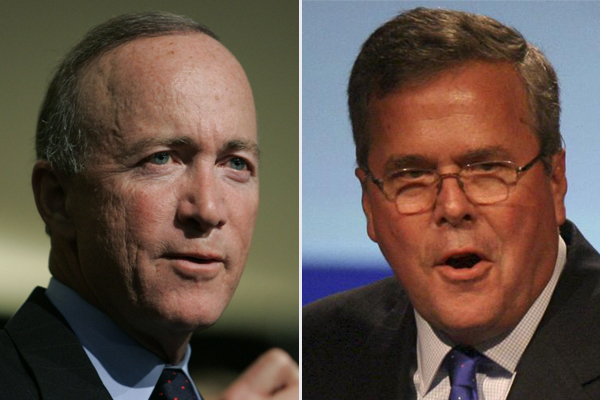
Mitch Daniels and Jeb Bush (Credit: AP)

We all owe a great big thanks to political scientist Josh Putnam. Putnam actually went to the trouble of looking up the filing deadlines for all the coming primaries and caucuses in order to see whether it would be possible for a new candidate to enter the Republican presidential race and actually win the nomination. Short answer: Sure, if they entered today and won enough write-ins and uncommitted delegates. But by tomorrow, it would be effectively impossible to win the nomination before the convention.

To sum up:

If the list is constrained more simply to the states where filing deadlines have not passed, the total delegates open to a late entrant drops to 1157. After Tuesday, when Kentucky’s (and Indiana’s petition — see footnote 17 above) deadlines pass that total will drop below 1144 to 1066.

A candidate needs 1,144 delegates to win the Republican presidential nomination.

Tomorrow, when Florida votes, the door for any magical new non-Romney (or non-Newt) candidate will have closed. No one will be able to show up and ride a wave of elite and base enthusiasm to the nomination, even if a character who generated that enthusiasm existed instead of being an idle George Will daydream. Mitch “Mr. Excitement” Daniels cannot possibly enter the race now and make it onto enough ballots to win the nomination without taking the fight all the way to the first Republican National Convention without a predetermined nominee since 1976. (A convention that would, as Jonathan Bernstein argues, be “deadlocked” and not “brokered,” because there is not much “brokering” possible when each delegate is allowed to vote for whomever he or she likes rather than beholden to a boss.)

Please keep this in mind when you read (and you will read) pundits still imagining or praying for some current non-candidate to enter the race. It would only be possible to win, at this point, by specifically planning to turn the Republican National Convention into an unpredictable free-for-all, something I’m not sure even Ron Paul would be willing to do, let alone some staid figure like Daniels.

Or, for that matter, Jeb Bush, whom Fred Barnes theorizes could “emerge as an acceptable compromise nominee” at the convention, assuming Gingrich has enough delegates to deny Romney the nomination. (His other Bush theories: A VP nod or some sort of vague “kingmaker role” in which he instructs Republicans to select either Romney or Gingrich, and they listen to him, because he … is a hypnotist? It’s not clear.)

Imagine thousands of delegates, free to support whomever they choose at a wide-open convention, all magically coalescing around Jeb Bush as the Republican nominee — in late August, following months of bruising battle between Newt Gingrich and Mitt Romney — and then feel free to imagine the outfit you’ll wear to Obama’s second inauguration.

Newt Gingrich is doing everything in his power to ensure that Mitt Romney will have a difficult time winning the number of delegates necessary to ensure the nomination, but even if Gingrich manages to make good on his threat to drag this out, math has already effectively eliminated the possibility that someone else less insane could take advantage of his work. And the candidates credible enough to make a serious “deadlocked convention” play would be too sensible to attempt it, because the result of denying Romney the nomination would be utter chaos.

There’s no white knight. Voters seem to be beginning to realize this, as Jamelle Bouie and Jonathan Chait have anecdotal evidence of conservatives making their peace with Mitt Romney. But even if Romney fails to seal the deal tomorrow, paid professional political analysts should not mislead people into thinking that some unknown person could still make a serious play for the nomination at this late date.

Alex Pareene

Alex Pareene writes about politics for Salon and is the author of "The Rude Guide to Mitt." Email him at apareene@salon.com and follow him on Twitter @pareene

Susana Martinez’s veep suicide

The New Mexico governor is an unlikely running mate for Romney after speaking out on immigration

Susana Martinez (Credit: AP/Susan Montoya Bryan)

While Newsweek touted New Mexico Gov. Susana Martinez as a possible running mate for Mitt Romney, the erstwhile beneficiary of the hype all but killed her chances of getting the job by opening her mouth.

“I absolutely advocate for comprehensive immigration reform,” Martinez  told reporter Andrew Romano. “Republicans want to be tough and say, ‘Illegals, you’re gone.’ But the answer is a lot more complex than that.”

With those words, Martinez inflicted multiple wounds on whatever slender chance she had to join the national ticket. First, she indicated support for the immigration agenda that President Obama promises to pursue if he defeats Romney in November. Second, the reforms the 43-year-old first-term Republican favors are opposed by every Republican member of the Senate (even those like John McCain, who used to support it) and a solid majority in the House. (In case there was any doubt, the same day Martinez’s interview appeared, Politico reported that the Romney campaign was seeking a “boring white guy” as a running mate.)

Martinez had previously said she wasn’t interested in a place on the Republican ticket. Her comments certainly indicate she isn’t interested in the public posturing necessary to achieve it.

On immigration reform, Martinez said she favors:

an approach “with multiple levels”: increased border security; deportation for criminals; a guest-worker program for people who want “to go freely back and forth across the border to work”; a DREAM Act-style pathway to citizenship, through the military or college, for children brought here illegally by their parents; and a visa (coupled with a “penalty” or a “tagback”) that allows rest of the illegal population to remain in the U.S. while they follow standard naturalization procedures.

In conversation, Martinez slagged Romney’s advocacy of “self-deportation” for the estimated 11 million undocumented people living in the United States.

“‘Self-deport?’ What the heck does that mean?” she snapped.

Martinez is not the only person asking. As articulated by Romney during the primary season,”self-deportation” means making life so miserable for the undocumented that they will “voluntarily” leave the country. Kris Kobach, the Kansas secretary of state and Romney advisor, told me he thought the United States could remove 5.5 million “illegal aliens” by the end of the first Romney administration.

As John McCain and others have pointed out, a GOP campaign promise to forcibly evict millions of Americans from their homes is neither attractive nor practical as an appeal to Latino voters, the fastest-growing group in the American electorate.

Martinez suggested Romney needed a more attractive message.

“I have no doubt Hispanics have been alienated during this campaign,” she said. “But now there’s an opportunity for Governor Romney to have a sincere conversation about what we can do and why.”

Impolitic to the end, Martinez expressed skepticism about Sen. Marco Rubio’s much-hyped but still vague idea of GOP variation on the DREAM Act. Rubio, with Romney’s tacit blessing, is seeking to moderate the Republicans’ reputation on immigration by developing a DREAM Act-style measure that would protect undocumented young people from deportation without giving them citizenship.

Politicians, Martinez said, cannot “fix [immigration] by saying, ‘Here’s the DREAM Act and we’re done.’ It has to be part of a larger plan.”

In other words, the New Mexico governor is that now-rare national Republican figure who favors comprehensive immigration reform, otherwise known as amnesty. Martinez would open the illegal immigrant’s path to citizenship that Marco Rubio avoids and that most Republicans seek to block. She probably won’t be Mitt Romney’s running mate. But Susana Martinez will be heard.

Continue Reading Close
Jefferson Morley

Jefferson Morley is a staff writer for Salon in Washington and author of the forthcoming book, Snow-Storm in August: Washington City, Francis Scott Key, and the Forgotten Race Riot of 1835 (Nan Talese/Doubleday).

Dreamers spurn Obama

Young immigrants feel tricked by the White House line on Marco Rubio's revival of the DREAM Act

Supporters of the DREAM Act take part in a demonstration in front of the White House. (Credit: AP/Pablo Martinez Monsivais)

Mohammad Abdollahi has not followed every twist and turn of the national immigration debate.  He has been too busy trying to save a friend from deportation.

Last month, 20-year-old Izlia Luna of Medford, Ore., was stopped by police for a traffic altercation. The judge threw out the charges. But under the mandate of the Obama administration’s Secure Communities program, Luna’s fingerprints had been taken. She was found to be undocumented. Luna was brought to the United States from Mexico when she was 2 years old. Instead of being released she was sent to an ICE detention facility in  Tacoma, Wash., 340 miles from her home.

“This is what immigration reform under Obama has gotten us,” says Abdollahi, who traveled to Tacoma to rally public attention to Luna’s case. “The right to spend up to $5,000 to get a loved one out of jail. When Obama says he isn’t deporting dreamers, he’s lying.”

“Marco Rubio is being a lot more authentic with us,” Abdollahi added.

The positive response of young immigrants  to Rubio’s still-vague alternative to the Democrats’ DREAM Act is central to the changing politics of immigration in the 2012 presidential campaign. In a series of meetings in Washington, Rubio is shopping for support, hoping to put forward a legislative proposal in the next few weeks. The Washington Post endorsed the idea on Monday.

By flirting with Rubio, the DREAM activists — representing an estimated 1 million young Americans, or “dreamers,” who are now barred from a path to U.S. citizenship — have wrong-footed the Obama White House and given pause to reelection campaign officials who had been counting on Latinos to fall in line with the president’s reelection. They have also caught the interest of Republican strategists worried about Romney’s narrowing path for victory in November.

Rubio is expected to propose the creation of a non-immigrant visa that would ensure undocumented young people who don’t have criminal records would not be deported and could eventually become citizens. The original DREAM Act failed to pass  the Senate in 2010.

“We are going to support whoever will come out and talk about the issue,” said Gabby Pacheco, a 26-year-old special education teacher from Miami and DREAM Act activist. “Rubio realizes this is key for us. Even if he is only doing it for political reasons, we’re willing to listen.”

The dreamers are backed by Latino Democrats on Capitol Hill, who feel betrayed by the Obama administration’s boasts of deporting a record annual average of 400,000 people over the last four years. After a friendly if inconclusive meeting with Rubio, Rep. Luis Gutierrez of Illinois told Politico his liberal allies  accused him of being the Florida senator’s new “best friend.”

The Obama White House hates the idea. Last week, presidential advisors Celia Munoz and Valerie Jarrett tried to discourage the dreamers from embracing Rubio’s proposal, saying it put at risk the original DREAM Act, which laid out a specific path to citizenship. According to the Washington Post, they had a meeting with DREAM Act-eligible students in Washington, arguing that “Rubio had not demonstrated he could win support from fellow Republicans and that the president would use his clout to push an immigration plan next year. ”

Pacheco, who attended the meeting, was not impressed with the White House appeal.

“You can’t wait until next year if you’re getting deported this year,” she said.  She described the White House officials as “very strategic” in their opposition to Rubio. She said the dreamers asked Munoz and Jarrett if the president could stop the deportations by taking administrative action that would not need to be approved by Congress, as Florida immigration activist Cheryl Little recently wrote in the Miami Herald.

“The thing that surprised us was they said no,” Pacheco told me. “They said, practically, ‘We don’t have the power to do this.’We’re trying to find out if that is true.”

It isn’t true, says Laura Lichter, an attorney in Denver and president-elect of the American Immigration Lawyer’s Association.

“The Obama administration  could certainly be doing more and better to improve the situation for DREAM Act students and to make immigration law and policy predictable and fair for everybody,” Lichter said in a telephone interview. “Whether they’re willing to do that in any way that might look like reasonable treatment for the undocumented remains to be seen.”

Presumptive Republican nominee Mitt Romney, who has advocated “self-deportation” for the likes of Abdollahi and Luna and the estimated 1 million DREAM Act-eligible students, is noncommittal about Rubio’s idea. Romney’s hard-line immigration advisor, Kansas Secretary of State Kris Kobach, initially rejected the suggestion as “amnesty,” but has more recently said he can “work with” the Florida senator, a nod to the growing realization that running on a platform of “self-deportation” is Romney’s ticket to self-destruction among Latino voters in November.

Whether Rubio’s gambit can sway Republican votes on Capitol Hill is doubtful. House Speaker John Boehner described passage of such a bill this year as “difficult at best.” Helping the undocumented is not a priority for most non-Latino voters, according to Republican pollster Scott Rasmussen.

While elite Republicans like Haley Barbour have said positive things about Rubio’s idea, the conservative blogosphere is notably unenthusiastic. The Weekly Standard touted Rubio’s recent foreign policy speech while ignoring his much-publicized idea of helping young undocumented Americans closer to home. The National Review hyped Rubio as a Romney running mate without taking a stand  on his proposal “to give the children of illegal immigrants a visa to continue their studies.” Talk radio stalwarts like Rush Limbaugh and Hugh Hewitt have yet to mention Rubio’s plan, while Mickey Kaus, the Daily Caller’s anti-immigrant blogger, notes conservative intellectuals can only agree to disagree on the issue.

If the Republicans’ intellectual base seems stumped by Rubio’s gambit, the Democratic incumbent comes off as arrogant. In a recent interview with Telemundo, President Obama said:

This notion that somehow Republicans want to have it both ways — they want to vote against these laws [like Arizona and Alabama] and appeal to anti-immigrant sentiment … and then they come and say, ‘But we really care about these kids and we want to do something about it’ — that looks like hypocrisy to me.

To the dreamers, Obama is just as hypocritical. “A lot of folks want us to be against  it,” Abdollahi said. “At the same time we hear from Obama administration that they’re not deporting dreamers. They’re tricking us. That’s what makes us supportive of Rubio.”

Continue Reading Close
Jefferson Morley

Jefferson Morley is a staff writer for Salon in Washington and author of the forthcoming book, Snow-Storm in August: Washington City, Francis Scott Key, and the Forgotten Race Riot of 1835 (Nan Talese/Doubleday).

What is Marco Rubio running for?

In a foreign policy speech, the Florida senator serves up bipartisan veal, not Republican red meat

Marco Rubio speaks out on U.S. foreign policy.(Credit: AP/Jacquelyn Martin)

Marco Rubio insists he isn’t running for vice president in 2012, but he is running pretty hard for something. The question is what and when.

The junior senator from Florida gave a proverbial “major foreign policy address” in Washington today, after publishing a Los Angeles Times op-ed calling for the U.S. to pay more attention to Latin America and before moving on to a meeting with Democratic senators about his variation of the Democrats’ DREAM Act.

If nothing else, the events indicate Rubio is auditioning to become the new Richard Lugar: the Democrats’ favorite Republican. His speech to an overflowing audience at the Brookings Institution was announced by an email from Martin Indyk, who served as assistant secretary of state under President Clinton and has positive things to say about President Obama. Rubio was first introduced by Strobe Talbott, deputy secretary of state under Clinton, and then introduced some more by independent Joe Lieberman, the former Democrat whose voting record is still more liberal than that of every senate Republican.

Rubio started out by tweaking Republicans who favor withdrawal from Afghanistan and oppose intervention in Libya. In his first year in the senate, Rubio said,

I found myself partnering with Democrats like Bob Menendez and Bob Casey on a more forceful foreign policy. In fact,  resolutions that I co-authored with Senator Casey condemning Assad and with Senator Menendez condemning fraudulent elections in Nicaragua were held up by Republicans. I recently joked that today, in the U.S. Senate, on foreign policy, if you go far enough to the right, you wind up on the left.

He repeatedly name-checked Brookings fellow Bob Kagan, author of the best-selling book “The World America Made,” which President Obama has praised and which emphasizes the continuity of U.S. foreign policy between Democratic and Republican presidents. Rubio even had a kind word for the United Nations, an institution that he said was established “to spread peace and prosperity, not to assert narrow American interests.”

His criticisms of Obama came with a bipartisan tinge. While acknowledging that the administration’s emphasis on international coalitions was “correct,” he chided Obama for lack of leadership.

Effective international coalitions don’t form themselves. They need to be instigated and led, and more often than not, they can only be instigated and led by us. And that is what this administration doesn’t understand.

And then he added, “This concept is neither novel nor partisan. President Clinton acted exactly in this way in Kosovo with the support of congressional leaders like Senator Lieberman.”

It wasn’t until he got around to talking about Iran that Rubio sounded a theme that might as easily have been heard during a Republican presidential primary debate, and even then he cast the idea in terms of caution and multilateralism, qualities not often heard in election-year GOP discourse:

We should also be preparing our allies, and the world, for the reality that unfortunately, if all else fails, preventing a nuclear Iran may require a military solution.

On Syria, he came close to calling for arming the opposition to President Bashar al-Assad, as John McCain, Joe Lieberman, and four other Republican senators have done. But with a single word, he took care not to commit himself to another war.

Forming and leading a coalition with Turkey and the Arab League nations to assist the opposition, by creating a safe haven and equipping the opposition with food, medicine, communications tools and potentially weapons [emphasis added]

His praise of former President George W. Bush was circumspect. He did not repeat his recent assertion that Bush did “a fantastic job.” He did not repeat the dubious neoconservative talking point (some say “lie”) that Bush’s “freedom agenda” inspired the Arab Spring. Rather, he praised Bush for increasing funding for the fight against AIDS in Africa, a cause dear to some evangelicals but not to many others on the right. And he never once mentioned the de rigueur conservative trope of “American exceptionalism.”

Rubio lost the last page of his speech — no teleprompter jokes, please — but gracefully recovered by closing with a quote from Tony Blair, a Clintonian social democrat. Those expecting Republican red meat found themselves served with bipartisan veal.

Rubio’s audience was Washington elites, not the Republican base. In conjunction with his independent stance on immigration, Rubio’s speech veered so far from Republican orthodoxy circa 2012 as to almost disqualify him as Romney’s running mate, at least in the eyes of a suspicious conservative base. Rubio has said that he doesn’t want to be vice president and doesn’t expect to be asked. The ambitions of his speech belied the former claim even as the details underscored the plausibility of the latter.

Rubio is positioning himself as a compassionate conservative and internationalist, a profile that will serve him well with the media. And his well-buffed bipartisan image will serve him even better if Romney loses.

Is “Rubio angling for Obama second term Secy State?” tweeted Yahoo News’ Laura Rozen facetiously. No, he’s angling for another job in 2016.

Continue Reading Close
Jefferson Morley

Jefferson Morley is a staff writer for Salon in Washington and author of the forthcoming book, Snow-Storm in August: Washington City, Francis Scott Key, and the Forgotten Race Riot of 1835 (Nan Talese/Doubleday).

Scott Brown’s triumphant makeover

The Massachusetts senator has pulled ahead of Elizabeth Warren in the polls by running away from the Tea Party

U.S. Senator Scott Brown (Credit: Hyungwon Kang / Reuters)

The so-called People’s Pledge seemed like a somewhat gimmicky win-win proposition for both incumbent Republican Sen. Scott Brown and his Democratic challenger, Harvard professor Elizabeth Warren, in their race for the seat once held by Ted Kennedy. The idea, proposed by Brown, was to staunch the flow of super PAC money into the race with an agreement of elegant simplicity: If a candidate is attacked by name in an ad, then the one who comes off looking better is obliged to donate half the cost of the ad buy to a charity of the other candidate’s choice. Pretty simple: Why shoot yourself in the foot, right?

The trick in the gimmick became clear this week when Brown announced that he was holding up his end of the pledge, agreeing to pay half the costs of an ad from a group called Coalition of Americans for Political Equality (CAPE PAC) and asking it to pull its Google ads promoting him. The group’s website is now offline. Jeff Loyd, a Tea Party activist from Arizona who chairs the PAC, confirmed that his group spent all of $673.99 in pro-Brown online advertising with Google.

Brown’s ostentatious willingness to be the first to trigger the enforcement mechanism against himself displays a street-smart opportunism that the Warren camp, for all her populist credentials, lacks. Far from shooting himself in the foot, the penalty amounts to $327 out of the $13 million in his campaign coffers. It was money well spent to help burnish his image as a moderate and man of the people, even as he raises more than $2 for Warren’s every $1. (Warren has raised $6 million to date.)

“Sen. Brown is a man of his word,” Brown’s campaign manager, Jim Barnett, trumpeted in a letter to CAPE PAC. “And as a result of your advertising on his behalf, he will honor the agreement by paying out of his campaign account an amount equal to 50 percent of your spending. In short,” the letter continued, “while your advertising on his behalf is clearly intended to be helpful, it is actually costing his campaign valuable resources.”

CAPE PAC’s Loyd said he killed the ads reluctantly at Brown’s request.

“We regret the candidates in this race are asking for groups like ours to suspend our constitutionally guaranteed freedoms to campaign in support of whatever candidates we choose,” he said. “However, we respect the wishes of our supporters and as such will honor their requests to suspend our advertising campaign in support of Senator Brown.”

The statement from Brown’s campaign stressed that this was the very first time that either candidate had taken tangible action to enforce the pledge: “Notably, two pro-Warren groups, ReThinkBrown and BoldProgressives, also ran Google ads after the signing of the historic People’s Pledge,” it added pointedly, putting Warren on the defensive.

The Warren campaign seemed to be slightly caught off guard by the GOP attempt to co-opt the money-in-politics issue. It found itself in the unenviable position of having to acknowledge Brown’s move to honor the pledge, even while defending itself against a cheap shot thrown late.

“To the best of our knowledge, those ads [bought by ReThinkBrown and Bold Progressives] were run prior to the [Jan. 23] pledge and were taken down almost immediately,” Warren spokeswoman Alethea Harney told Salon. “We’ve asked Warren supporters to provide us with suggestions for the charity,” she added.

Defanging Warren on her big issue — money in politics — is a smart tactic for a Republican looking to get reelected in the most liberal state in the country. By not acting like a Republican, and sometimes reaching across the aisle, Brown has stood out as a voice of reason in the GOP wilderness who sticks with his party only 54 percent of his time, according to a Congressional Quarterly study of his 2011 voting record.

After an initial burst of enthusiasm that launched Warren’s campaign with great fanfare last fall, the Brown campaign has eclipsed her. Warren, who was leading a few weeks ago, now trails by 9 and 10 points, according to two recent polls. By compromising with the president now and then, and distancing himself from the Tea Party movement that swept him into office, Brown never misses a chance to tout his record as a flexible pragmatist. All mention of the Tea Party has been scrubbed from his site.

While Brown voted against tax hikes on the rich, he has gone against the GOP grain by backing a sweeping bill to curb insider trading by members of Congress; Republican leaders favored a narrower bill. He also supported the Obama administration’s plan to allow homeowners to refinance their mortgages if they are “underwater,” owing more than what their homes are worth.

At the same time, Brown has sided with Big Oil consistently and supported an effort by fellow Republicans to ban the Environmental Protection Agency from regulating greenhouse gases linked to global warming. Most egregiously, he stood squarely with the Senate GOP on contraception, co-sponsoring the narrowly defeated Blunt Amendment that would have permitted employers and insurers to restrict access to birth control.

Yet this proved to be a safe gamble in Massachusetts with its large number of Roman Catholics who use birth control faithfully. Even if most parishioners who make it to the pews each Sunday believe insurers should offer contraception in their employee healthcare benefits package, they don’t mind if their senator takes the same stand that’s preached from the pulpit. That issue, stalking Romney through the primaries, has not hurt Brown much, even after Brown was roundly condemned by the Kennedy clan for misrepresenting his predecessor’s position on contraception.

Brown’s new persona was on display last week when he told a group of military veterans on the north shore of Boston a colorful tale about how he managed to get Obama on board with his insider trading bill by calling out to the president after his State of the Union speech.

“The whole row cleared out and, therefore, I actually get to walk up right next to the aisle as the president’s coming up, and I’m saying to myself, ‘Man! He wants an insider trading bill. I have one,’” Brown told the vets. “So I said, ‘Mr. President, my insider trading bill is on Harry Reid’s desk. Tell him to get it out.’ And he looked right at me and he says, ‘I will. I’ll tell him to get it out.’ Problem was he was miked up live with Fox.”

Brown boasted dubiously that the exchange brought the bill to the Senate floor where it passed, proof, he said, that he “gets things done.” It’s a winning strategy for a Republican in Massachusetts, and he only needs to look at his latest polling numbers, which show him leading among independents, voters under 50, voters over 65, and in central and western Massachusetts, according to the most recent survey from Western New England University.

The departure of Maine’s GOP Sen. Olympia Snowe, the most bipartisan member of Congress, also served to boost Brown, as she gave him a ringing endorsement on Thursday. ”In an institution characterized by gridlock and partisanship, Scott Brown is a much-needed breath of fresh air,” Snowe said in a statement.

As Brown bobs and weaves to the center, Warren has to figure out how to lay a glove on him. She hasn’t done so in a while.

Continue Reading Close

Santorum tests positive and negative

In his new TV ads, the Republican contender tries to be upbeat and nice, while splattering mud on Mitt VIDEO

A Rick Santorum cut-out, with "mud" (Credit: Rick Santorum/YouTube)

Rick Santorum is definitely going to be our next president, so we should probably get to know him a little better, as a country. Thankfully, he’s introducing himself, with TV advertisements. (Or Web videos that might run on TV somewhere but are partially designed to garner free pickup from blogs and websites.)

Here is Santorum’s “positive” ad, in which we learn that lots of people have said nice things about him in the past.

Mike Huckabee! Glenn Beck! Rush Limbaugh! That time Time magazine called him an “influential evangelical” even though he’s a Catholic and therefore not actually an evangelical Christian! Sarah Palin! The Wall Street Journal!

I have a couple of thoughts on this.

First, those little tildes instead of em dashes for the quote attributions are bugging me. It makes all the quotes look like message board signatures. Second, the Santorum logo is pretty funny. The “O” sun that the eagle is blocking is too small or something, and it looks like this is an ad for Rick Sant Rum.

Also, obviously, if blurbs from Sarah Palin and Glenn Beck make you more inclined to support a candidate, you are basically the sort of person who sums up why America is broken and ungovernable.

Many of these positive quotes came from when Rick Santorum was a fringe candidate polling in the single digits, and they can best be understood as an attempt to be polite to the guy (Palin, a Gingrich enabler, is offering him faint praise here), or, alternately, attempts to damage Romney back when it was still possible for a new acceptable-to-the-elites candidate to enter the race (that was the point of the Journal’s inexplicable attacks on Romney’s perfectly supply-sidey tax plan). But none of that matters now! Rick Santorum will make everyone regret saying nice things about him back when they thought he’d go away after Iowa. (Except Glenn Beck, who probably does think Rick Santorum is likely the next George Washington, even though nothing about that makes any sort of sense, at all.)

Santorum will also maybe make Mitt Romney regret focusing all of his attention (money) on Newt Gingrich. Here’s Santorum’s other, better new ad, in which a creepy Romney lookalike (more a George Romney lookalike, actually?) shoots … “mud” at a Rick Santorum Fathead in that abandoned building from the end of “The Departed.”

George Romney looks so sad when he gets mud on his nice shirt, at the end! (He is also a horrible shot!) Also is Romney just doing target practice with these cutouts or is Santorum tricking him with decoys? It is not entirely clear. (And what does cap-and-trade have to do with anything?) But this ad is much better than the other one, because it is disgusting and odd instead of boring.

It is also, obviously, a negative attack ad attacking another candidate for airing negative attack ads, because an important aspect of the modern political campaign is constantly acting as wounded as possible for any reason at all while calling attention to your opponent’s total lack of basic human decency. Santorum is adept at playing the aggrieved victim (Google and homosexuals are so mean to him!) though he’s practically preempting Romney’s actual attack on Santorum, which didn’t really begin in earnest until, like, yesterday. Still, the important thing is that Santorum has reached the “hiring an impersonator of your opponent” stage, and there is no turning back now. (Next stop: comparing your opponent to a possessed sheep.)

At the National Review’s Katrina Trinko points out, Santorum has bought $41,000 in airtime in Michigan, compared to Romney’s $824,000. So Santorum needs the sillier gimmicky ads, like a Romney doppelganger firing a shit-rifle in a warehouse, to go “viral.” (We’re helping, Rick!) The best way to get free media pickup is to be extremely outrageous and/or shameless, so it’s all downhill from here, in terms of tone. Especially because Santorum’s lead is extremely precarious and based in large part on his not being Gingrich or Romney, both of whom voters now think of as detestable assholes, because of the ads they both ran against each other. (So be careful, Rick!)

Continue Reading Close
Alex Pareene

Alex Pareene writes about politics for Salon and is the author of "The Rude Guide to Mitt." Email him at apareene@salon.com and follow him on Twitter @pareene

Page 1 of 2 in Election 2012