OccupyDC

Under Occupy DC’s tent of dreams

The protesters wait out the police and win a reprieve

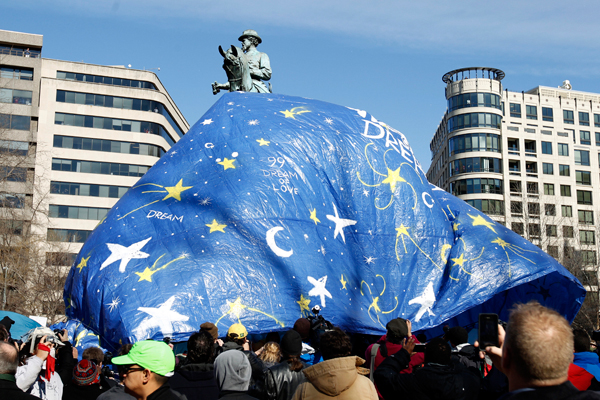
The Tent of Dreams (Credit: Reuters/Kevin Lamarque)

In 122 days OccupyDC had managed to change the nation’s capital. The question on Monday night was, Would they make it to 123?

As if determined to vindicate the occupation movement’s every argument about the power of the 1 percent , Rep. Darrell Issa, the richest man in Congress, had taken the greatest offense at their use of public space in the heart of the city to broadcast their egalitarian message. Last week, the California Republican called a hearing to browbeat the flak-catchers of the federal bureaucracy to enforce a ban on camping in public places. And on Friday he got his way. The Park Police posted a yellow notice that come Monday at noon the demonstrators would all be subject to arrest for sleeping in the park.

In response, an ad hoc committee of about 15 occupiers got together last Friday night to talk about what they wanted to do. ”We wanted a confrontation on our terms,” said Ricky Lehner, a 23-year-old man from Florida who has made the camp his home since October.

“We know the Park Police are very protective of the statue,” said Travis McArthur, a researcher at a well-known liberal nonprofit, referring to the mounted figure of Maj. Gen. James McPherson, a Union hero in the Civil War, that stands in the center of the square. ”Since I came here, I’ve come to think of him as our patron saint, our protector.”

If the authorities were going to take away their tents, they decided, they would have to do so on a grand scale. So when the Park Police deadline arrived at noon on Monday, they struck. As the square was thronged with cameramen and spectators looking for confrontation, a couple of young men mounted the statue and the rest hauled out a huge blue nylon dropcloth, which they hoisted up and over McPherson’s shoulders. They secured the flaps to the little iron fence around the statue so everyone could see the yellow and white stars (and a Star of David). They dubbed it, “The Tent of Dreams.”

“The idea was let us sleep so we can dream of  better world,” said McArthur, and all around the tent sprouted witty indignant signs: “I dream of First Amendment Rights” and  ”I dream of taxation on the 1%” and “No sleep, no justice,” and “We the non-corporate people.”

It was the inhabitants of this tent city who had changed Washington. They were hanging around Monday evening happily waiting for the police.

There was Michael, once an African-American kid who went from Alaska to Iraq as a gung-ho warrior and came back from the war zone a happy-go-lucky leftist with a taste for confronting the right-wing media. There was Katie, graduate of a private school in northwest Washington who regularly facilitated the occupation’s general assemblies and learned to try to trust the judgment of the group. There was Sam who came from Virginia with a political science degree in hand, yarmulke on his head, and unshakable interest in non-hierarchical politics. There was Vic, who had traveled the country for the sake of her political activism and found renewed inspiration from a man named Charles Jones, who desegregated a lunch counter in South Carolina long before any of them were born. And there were a few dozen others just like them — and some not at all like them at all — who had claimed a patch of grass in McPherson Square on Oct. 1 and called themselves OccupyDC. There was hardly a professional reformer among them.

It was their impromptu audacity (not the president’s more scripted version) that changed the tone of Washington politics. When these young people first pitched their tents and started a Twitter feed, the chatter in the tasteful restaurants around the square, the discussions in the glassy palaces of K Street, the conversations in the stately editorial offices of the Washington Post one block up 15thStreet, and the debates on Capitol Hill revolved almost entirely around austerity and budget cutting. Few talked about the unpleasant subject of the nation’s startling inequality of wealth or the relentless domination of the political system by corporations and moneyed interests. Four months later, the capital’s discourse was different. The power of the proverbial 1 percent was not yet the subject of negotiation but it had become at least a fit topic of discussion. Even the timid president discovered he might gain credibility by speaking out more firmly about fairness.

“You changed the debate,” said Carey Campbell, chairman of the Green Party of Virginia at the general assembly on Monday evening . “It was your courage, your creativity.”

The people of OccupyDC hardly deserved all the credit for these developments but surely they deserved some. Their occupation of public space had lasted longer than that of their more sophisticated friends in New York’s Zuccotti Park and their more radical comrades in Oakland, Calif. They accommodated the homeless more successfully than their brethren in Philadelphia and they coexisted more effectively with the local police and politicos than the protesters in Boston.

They did not plan to go quietly. As a crowd of 100 people listened at the general assembly, the sustainability committee smuggled in a small pine tree and planted it in the middle of square — another violation of the rules — for the TV cameras and dedicated it to “to all who would crush this movement.”

A member of the medical committee exhorted the people sleeping in the park to get rest and be ready for the police. “Stay hydrated and don’t give them an excuse to hit you in the head,” he said. “I don’t want to be cleaning up your blood.”

The most common rumor was that the police would turn off the street lights and move in after 11 p.m. so as not to make the evening news. The mood was cheerful and expectant but hardly confrontational. Eleven o’clock came and went with not a sign of the police.

“Where are the cops when you need them?” a man quipped.

“There’s apples and oranges at the food table,” someone said around midnight. “Everybody should eat some.”

“We know what they want to do is pick us off one by one,” Ricky said. “If they’re going to arrest one of us, they’re going to have to arrest all of us.”

They played Scrabble and sang along to a strummed guitar. While many straggled off to home or their tents, a small remnant remained under the tent of dreams smoking hand-rolled cigarettes — the legal kind — talking and arguing among themselves. And in the dawn’s early light on Day 123 of the OccupyDC, the tent of dreams was still there. For whatever reason the Park Police had chosen not to act. The end of OccupyDC in McPherson is probably coming soon but for the occupiers to live to see another day was another small and improbable victory.

Jefferson Morley

Jefferson Morley is a staff writer for Salon in Washington and author of the forthcoming book, Snow-Storm in August: Washington City, Francis Scott Key, and the Forgotten Race Riot of 1835 (Nan Talese/Doubleday).

The battle for McPherson Square

Rough police tactics rout 300 protesters from their tent city in the heart of Washington VIDEO

Chaos at OccupyDC(Credit: Eddie Becker)

“Move back!” shouted the cop wielding a clear Plexiglas shield emblazoned with the words “U.S. Park Police” as he moved into the crowd of demonstrators thronging McPherson Square on Saturday afternoon.  The photographer next to me was shouting, “I’m press!” but that didn’t seem to impress the phalanx of officers advancing on us, applying their shields to our shoulders.

“Move back!” the cop explained, and I went sprawling into what used to be the main information tent of OccupyDC. It was the place where you could always find someone who could tell you about the camp’s activities. It was a place where I had debated fiat money with a Ron Paul supporter, chatted with a delusional homeless man, and talked union politics with a woman from National Nurses United. Now the tent was a flat lumpy mess, and people were scrambling over it to get away from the suddenly aggressive cops. Nearby, mounted officers on horses were slowly wading their steeds into a river of people, and some screamed in panic at the approach of the massive animals.

What had started 12 hours earlier as a politically tinged eviction of an unsanitary but entirely peaceful encampment had suddenly turned into an aggressive display of force by the National Park Police officers (including 24 officers bused in from New York City.)

By late Saturday night, the occupiers of McPherson Square had been evicted. The 300 or so denizens of the encampment — and several hundred supporters who rallied to their cause — were dispersed. Seven people were arrested in the course of the day. At least three people were injured. Your reporter lost his notebook but was otherwise unhurt.

The tent of dreams

The battle of McPherson Square began at dawn on Saturday. Park Police officers had received a call around 2 in the morning saying duty called. They assembled at the intersection of 15thStreet and K Street at 5 in the morning and moved in to the OccupyDC camp within the hour. The first thing they told the protesters was that they would have to take down their “Tent of Dreams,” a massive blue sheet they had draped over the statuesque shoulders of Civil War Gen. James McPherson in the center of the park.

The occupation of the park had begun 129 days before when a small group, inspired by the Occupy Wall Street movement in New York, had started camping on the grass and holding daily general assemblies. Over the next four months, the camp grew to more than 100 tents and became a hub for protests targeting the city’s political elite, ranging from Congress to the Chamber of Commerce to the Democratic National Congressional Committee.

The tent of dreams was a violation of Park Service rules, the cops explained. If the protesters did not take it down, the police would. The protesters decided to take down their pride and joy.  ”It was sad,” said John Zangas, one of the protesters. “We put up the Tent of Dreams for all those Americans who have lost their houses in the last couple of years. We wanted to make a symbol for them and the world to see that someone was standing up for them.” In the early morning light, the 50-foot-square nylon drop cloth, emblazoned with twinkling stars and slogans (“Shalom”), was folded up and removed.

The Park Police were well prepared for their mission. Under the command of two commanding officers named Dillon and Reid, 75 officers methodically and politely took control of the park over the course of the day. Citing National Park Service regulations against overnight camping, they asked protestors to leave, giving them time to take personal possessions. The cops set up black iron barricades, and set about inspecting the uninhabited tent city that had captured the capital’s imagination with its idealism and its squalor. Park Service employees in yellow hazmat suits looked through the tents, stuffing abandoned camping gear into trash bags and hauling away refuse.

The process wasn’t always peaceful. To secure the northeast corner of the square, a file of 40 officers bulled their way down one of the sidewalks of the square while the demonstrators chanted, “This is a public space.” One of the occupiers, young Iraq war veteran Michael Patterson, cursed the police but gave way to the overwhelming display of force by the impassive officers. Another protester, a musician named Jonny, called out “mic check” and read the text of the First Amendment. The crowd read along, declaring “Congress shall make no law …  abridging … the right of the people peaceably to assemble.”

The dismay of the demonstrators was palpable.  “I think the tactic of camping out has lost its usefulness,” an occupier named Travis told me. “But I’m here in solidarity because there are a lot of people who have no place to go. How can they evict homeless people from the only home they have?”

By 3 o’clock, it seemed the protesters and police had reached a degree of mutual understanding. As the police dismantled the tents, the demonstrators stood back and contented themselves with mic checks about why they joined the movement. (“I occupy because my friends can’t afford to go to college,” said Ben, a freshman at American University.) While a few young men taunted the police as “fascists” and “faggots,” equally outspoken women in the crowd rebuked them for their language and urged them to show respect.  The cops, carrying guns and gun tear gas, spoke mostly among themselves.

“I look at these cops, most of them are 26 or 27 years old, and I know who they are answering to,” said Andrew Benthall, a bartender and Occupy sympathizer who also stood on the front lines of the confrontation. “They’re just like me. They answer to their wives and their bosses. They’re not bad people. ”

The raid came five days after the Park Service, under pressure from Darrell Issa, a senior Republican congressman, posted an announcement that a previously ignored ban on overnight camping in the park would be enforced. For many demonstrators, Issa, a conservative Republican and the wealthiest man in Congress, embodies the 1 percent elite, whose privileges, they say, come at the expense of the general public.

“They’re not listening to the people”

The trouble started around 5 o’clock when the cops turned their attention to the last uncleared quadrant of the park, home to the camp’s library, a big blue tent where you could borrow a book by Vaclav Havel or a biography of Che Guevara. As darkness and a light rain began to fall, the officers negotiated with the camp’s library committee. When the occupiers declined to leave, the cops seemed to lose patience and professionalism for the first time all day. Two lines of police officers advanced much more aggressively than they had before catching the protesters in a pincher action.

Chaos ensued with the advancing officers shouting, “You have to leave, this area is closed” while shoving people backward. Dozens of people  were knocked down.  The arrival of the mounted police sent people running for safety. As the demonstrators backed up onto the empty expanse of blocked-off K Street, they took pictures with their smartphones and chanted “shame, shame, shame” at the police. After about 10 minutes, everybody, except for the cops and the cleanup crews, had been forced out of McPherson Square.

As the officers set up barricades on the park’s perimeter, the frustration of the demonstrators exploded. “You are animals,” one woman shouted at the line of blue-helmeted officers. “You almost trampled a little girl. Do you have kids?” Another man said, “Go back to Syria. They need you there.” One man who had been taunting the cops all day with vulgar sexual insults was knocked down, manhandled, and hauled away bound and tied.

Stunned but unhurt, Hillary Lazar, a local artist and member of the library committee, said the library holding of more than 1,000 books had not been damaged during the police action.

Laura Potter, a retired Army nurse on disability, watched in disbelief as her green tent was trampled.

“They’re only here to protect the people in government,” she said of the police, leaning on her metal crutch. “They’re not listening to the people. They’re listening to Darrell Issa. They’re using their sticks on people when they should be using their badges to protect them.”

As the rain continued to fall, 40 officers stood in a long line looking grim. The protesters called an impromptu general assembly in the middle of K Street. On the boulevard that houses the city’s leading law firms and lobbying shops, these young radicals reviewed the events of the day with yet another mic check.

“We have seen unprovoked violence toward the occupation in DC,” began one speaker, and the crowd of perhaps 50 people repeated his words.  As  people recounted the best and the worst things about the day, their spirits seems to rise. “We changed the discourse of this city,” said one man. Another pointed out that President Obama lived less than two blocks away, and the chant “Obama is responsible” went up. A third man criticized the movement for not cultivating local political allies who might have protected the camp.  ”It is time for us to take this occupation out into every neighborhood of this city,” he said. “On the edge of the crowd, Ryan Gomez, a perennially cheerful 24-year-old occupier was shaking his head but smiling. “We’ll be back  tomorrow,” he  assured me. “This movement is not going away.”

As tempers cooled and rain let up, the agitated but proud protesters traded hugs, tears and stories while the stoic but equally proud cops retreated silently into the night, their mission accomplished. The ability of the federal government to clear the streets of peaceful protesters had been established, while those who speak for the 99 percent in the nation’s capital could boast they had exposed the face of 1 percent power. In the battle of McPherson Square both sides could claim a victory in a struggle that is sure to continue.

Continue Reading Close
Jefferson Morley

Jefferson Morley is a staff writer for Salon in Washington and author of the forthcoming book, Snow-Storm in August: Washington City, Francis Scott Key, and the Forgotten Race Riot of 1835 (Nan Talese/Doubleday).

OccupyDC confronts Issa’s crackdown

Infuriated by the movement's message, the multimillionaire congressman forces showdown in the capital

Darrell Issa and the Occupy DC camp at McPherson Square (Credit: AP)

The two OccupyDC camps in downtown Washington are mobilizing today for possible police action resulting from Republican Rep. Darrel Issa’s long-running campaign to shut down the camps, holding a midday rally and sponsoring an online petition that already claims 15,000 signatures.

On Friday, the National Park Police began posting notices on tents in the sites that the police would begin to enforce regulations banning 24-hour camping on Monday. The sites are under the jurisdiction of the National Park Service, which has tolerated the overnight presence at the two sites since last October on the grounds the protesters are engaged in 24-hour vigil, not camping.

The Occupy movement has injected a new voice in the politics of the capital since October with a mixture of protest marchesteach-ins and civil disobedience aimed at bringing their message about inequality and corporate domination to  lobbyists, bankers, members of Congress and the White House. Last Friday demonstrators confronted guests, including President Obama, who gathered at the exclusive Alfalfa Club and glitter-bombed Connecticut Sen. Joseph Lieberman. Earlier this month, the Occupy Congress action brought protesters from across the nation to swarm Capitol Hill visiting their congressmen.

The success of the occupation has infuriated Issa, the wealthiest member of Congress, worth at least $195 million, especially as its message about the plight of the 99 percent has found favorable reception in public opinion polls.  In a hearing last week, Issa grilled Park Service officials about conditions in the camp and ignored the district’s non-voting representative in Congress, Eleanor Holmes Norton, who expressed support for the demonstrators and the Park Service. Three days later, the Park Service succumbed to Issa’s pressure and said for the first time that Park Police would enforce the camping ban.

In response, the OccupyDC movement, based in McPherson Square two blocks north of the White House, posted a statement saying that Issa and the 1 percent had

“launched an attack upon the free speech of those of us who disagree with the direction in which our country is going but cannot afford to give unlimited contributions to Super PACs or have lobbyists write legislation for us. In occupying public spaces we act as an ongoing challenge to the K Street lobbyists and elected officials undermining our democracy through the corrosive influence of money in politics.”

Demonstrators in both camps prepared for the worst while expressing hope that the enforcement of the camping ban would not force eviction of the protesters.

“We’re preparing for police to come and removing valuables, but I think they may allow the tents to stay and let the occupation continue as a 24-hour vigil,” said Kevin Zeese, a founder of the occupation camp in Freedom Plaza, located three blocks east of the White House. “In any case, we’re not going away. They can’t snuff out the Occupy movement. They may be able to move the tents, but that’s about it.”

Zeese said the organizers of the Freedom Plaza camp were focusing on a National Occupation of Washington planned for March 30.

In McPherson Square, Lisa McCracken, a volunteer presiding over the camp’s 1,000-volume tent library, said she thought the collection would not be removed as nobody slept in the library. But McCracken said she and her fellow librarians were prepared to remove the library’s most valuable holdings, including an archive of Occupy pamphlets, fliers and manifestoes, on short notice.

In a statement, Issa said the Park Service action was “appropriate and overdue.” He insisted the action was intended to support the First Amendment.

I’m pleased that concerns of D.C. officials, who have warned against waiting for a health or safety ‘emergency,’ are finally being heeded. The laws on camping were carefully crafted to meet with Supreme Court jurisprudence, and a continued failure to enforce them would have undermined the First Amendment.”

Since his election in 2000 Issa has received more than $5 million in campaign contributions.

Continue Reading Close
Jefferson Morley

Jefferson Morley is a staff writer for Salon in Washington and author of the forthcoming book, Snow-Storm in August: Washington City, Francis Scott Key, and the Forgotten Race Riot of 1835 (Nan Talese/Doubleday).

Occupy DC distances from Democrats. Or does it?

A high-dollar fundraiser, a rowdy crowd of demonstrators, and Rep. Donna Edwards

OccupyDC at the W Hotel(Credit: Paul Quinlan)

The more than 100 DC occupiers who marched from McPherson Square Wednesday night to protest outside two high-dollar fundraisers for 15 House Democrats, including Arizona Rep. Gabrielle Giffords, carried what seemed an especially clear message for a movement so often criticized for lacking focus.

As one sign put it: “Democrats are part of the 1 percent.”

Occupy DC ostensibly sought to declare its independence Wednesday night from the Democratic Party, the liberal activist group MoveOn.org and the Service Employees International Union (SEIU), all of whom, protesters fear, are trying to co-opt the movement to win votes in 2012 and advance an agenda equally as corrupt and beholden to monied special interests as that of Republicans.

But amid the shouts, drums and slogan-chanting, the divisions within Occupy DC surfaced over what to make of a congressional Democrat who makes a quiet, public and strong statement of support for a movement that has come under a violent crackdown from police in Los Angeles, New York and other cities.

The differences became evident two-and-a-half hours into the protest outside the W Hotel in downtown Washington, the site of the second of the two Democratic Congressional Campaign Committee fundraisers targeted by occupiers last night. Tickets to the fundraisers, held blocks away from the White House, ran between $5,000 and $75,000 apiece.

The D.C. Police had formed a human chain across the front entrance of the W, opening up a makeshift hallway against the side of the building, so guests and stone-faced members of Congress, hoping to go unrecognized, could slip inside.

Not Rep. Donna Edwards of Maryland. On her way out, Edwards tried to step through the line of police and put on a look of disappointment when she couldn’t. She walked around and moved front-and-center of the group, waited politely until the last speaker finished.

The surprise appearance was bold. Earlier that day, the occupiers had been stood up by Democratic Rep. Elijah Cummings, also of Maryland, who canceled his plans to address the encampment at McPherson Park at 5 p.m. Some speculated Cummings got cold feet when he found out the group would be marching against Democrats. (A spokesman said his schedule was too full.)

Edwards introduced herself.

“I walked in, and didn’t acknowledge you,” she said. “I couldn’t walk out and not acknowledge you.”

“I stand with the 99 percent,” she announced.

Edwards said people in her district had lost homes and their jobs and seen their incomes fall to less then $50,000-per-year, the lowest median income in decades.

“It’s not fair. It’s not right. And it’s time,” she said, pausing for effect, “for us to occupy America.”

A roar of cheering approval, drum-pounding and whistle-blowing ensued. Edwards quickly walked off.

“Thank you, to Rep. Edwards, from Occupy DC!” said the man who had introduced her. More cheers.

A young man named Charles Davis, 27, took to the floor and called out for the group’s attention. Davis told the occupiers he had ridden in an elevator with Rep. Luis Gutierrez of Illinois.

“And he joked that he is the 1 percent,” Davis hollered. Boos all around. “And he called us anarchists!”

“The Democrats are not your friends!”

The group cheered — but not as loudly as they had for Edwards. Davis’ message, meant to reinforce the theme of the night, seemed to fall flat in the excited aftermath of Edwards’ appearance.

The night had been going so well.

Protesters had set out from McPherson Square around 5:30, stopping traffic as they marched south down the middle of 15th Street. Eddies of pedestrians swirled on the sidewalks — men and women who stopped to point, gawk, snap cellphone pictures and call friends. (“The Occupy Wall Streeters are walking right by me!”)

At the first stop outside an office building just up the sheet from the W Hotel, fidgety DCCC aides stood blocking the doorway, as the occupiers filled the cold night air with drumbeats and shouted slogans:

“Hope and change, that’s a lie! Lis-ten to Occupy!”

“No more pay to play!” hollered one protester. Shouted another: “We hope the meal was worth the price of democracy!”

Cheers erupted when someone appeared on the third floor balcony and hoisted a sign that said, “Housing is a human right!”

Edwards had somehow knocked the group off its message.

“She’s turning this into a campaign stop,” Davis said, after he addressed the group.

Occupy DC’s Action Committee had been at odds lately, he said, deciding two nights earlier to reverse a previous decision to join former Obama green jobs czar Van Jones’ group Rebuild the Dream, MoveOn.org, and SEIU in protests on the Mall. Occupy, the committee concluded, would run separate events.

All three third-party groups had tested Occupy’s patience in recent weeks. Jones had angered occupiers earlier in November with his response when CNN’s Suzanne Malveaux suggested Jones might be a “leader” of the Occupy movement. “There are a lot of us,” Jones had said, before calling the group “leader-filled.”

On its website, the DCCC is running a petition that lists as its goal:

“100,000 STRONG STANDING WITH OCCUPY WALL STREET.”

SEIU had likewise tried to yoke itself and President Obama to the Occupy movement last month, when union president Mary Kay Henry said, “Do we want leaders who side with rich corporations, the 1 percent who are prospering, or leaders who side with us, the 99 percent?”

Davis worries that Occupy DC could become a subsidiary of the Democratic Party, much like the Tea Party was for Republicans.

“It’s been kind of a problem, especially here in D.C.,” he said. “People think the Democrats are their friends, and they’re kind of willingly being co-opted. A lot of the people involved in the Action Committee, for instance, are paid to elect Democrats.”

Such may be the nature of protest in the political city, where most everyone falls into one of two categories. Of course, there aren’t many Republicans living in D.C.’s two Occupy Wall Street encampments.

“I think it’s just the culture,” Davis said. “It’s maybe a little bit more politician-friendly than other Occupies around the country.”

Continue Reading Close

Paul Quinlan is a writer in Washington.

D.C. bucks the eviction trend

The Park Service says it has no intention of ousting two occupation camps near the White House

A demonstrator walks through the Occupy DC McPherson Square camp. (Credit: Reuters/Jose Luis Magaua)

As police action against the Occupy Wall Street movement continues across the country, with arrests in Los Angeles and Philadelphia Wednesday, both occupiers and reporters have suggested Washington’s two camps may face imminent eviction.

DC may be next,” said the Washington Post on Tuesday after the National Park Service handed out a circular saying the Park Police would step up patrolling of Freedom Plaza and McPherson Square in downtown Washington, “due to increasing problems of public urination and defecation, illegal drug and alcohol use, and assaults.”

“We regard this as the first step toward eviction,” said Kevin Zeese, a leader of Freedom Plaza camp (and a Salon contributor).

But Carol Johnson, spokesperson for the National Park Service, categorically denied it in a telephone interview Wednesday, saying, “There was no intention that this is a first notice of eviction.” The circular, she said, was only intended to let the occupiers know, “We’re concerned about certain things and we hope they will help remedy the situation.”

The Freedom Plaza camp, located two blocks west of the White House, has a permit to stay through Dec. 30. The larger McPherson Square camp, two blocks north of the White House, does not have a permit. But Johnson indicated the Park Service has no immediate plans to enforce a ban on overnight camping at either site.

“They are allowed to have a 24-hour vigil and they are allowed to have structures to go along with it,” she said. “Obviously, this is a determination that needs to be looked at from a number of different perspectives.”

The implicit message seems to be that the Park Service is willing to overlook technical violations of the law as long as the camps are clean and the occupiers law-abiding.

“That’s great news,” said Zeese when told Johnson’s comments. “The D.C. occupation is getting more important as the others get shut down. Washington is the center of money and power. It’s where they come together, so we want to make sure we have a strong presence here.

Jeff Light, a lawyer advising the McPherson Square camp, said he never regarded the circular as an eviction warning. “It’s a reminder of what the rules are,” he said. “It’s clear the tents are there in support of people expressing their First Amendment rights, so we were not concerned.”

The Freedom Plaza camp has applied for another permit to stay in place for January and February, Johnson said. If the camp meets the requirements, she said, “we’re required to let them demonstrate.”

“In all likelihood, they will work out the details,” she added.

At a time when police departments from New York to Los Angeles have adopted tactics reminiscent of the so-called Miami model, used to crush an anti-globalization action in 2003, and others have speculated, without much evidence, that the Department of Homeland Security has coordinated the crackdown, the Park Service’s position offers a sensible alternative: maximum respect for First Amendment expression. Call it the Washington model. If it works for Washington, why not for the rest of the country?

Continue Reading Close
Jefferson Morley

Jefferson Morley is a staff writer for Salon in Washington and author of the forthcoming book, Snow-Storm in August: Washington City, Francis Scott Key, and the Forgotten Race Riot of 1835 (Nan Talese/Doubleday).

Van Jones can’t occupy us

Democrats who want to co-opt Occupy Wall Street should start their own movement

Left: Van Jones. Right: Occupy D.C. protesters march in front of the White House Nov. 15, 2011. (Credit: Center for American Progress Action Fund / CC BY 3.0/Reuters/Hyungwon Kang)

The corporate media seems to want to anoint a leader of the Occupy Movement, namely former Obama administration official Van Jones, now leader of the Rebuild the Dream organization.

When CNN’s  Suzanne Malveaux suggested to Jones last week that he might be a “leader” of the Occupy Movement, Jones demurred saying, “There are a lot of us,” and that the movement is “leader filled.”

All right, Van Jones, you might at least be a spokesperson, you know, maybe not a leader, but certainly a good spokesperson for the group,” Malveaux replied, according to a transcript, thus expressing the desire of the corporate media to appoint our leaders. Like Time magazine, CNN wants to make Jones a spokesperson for the movement. (Conservative commentators also find Jones useful as a straw man/leader whom they can attack.)

In fact, Jones, who received a golden parachute at Princeton and the Center for American Progress when he left the administration, is doing what Democrats always do: trying to co-opt the movement. Jones sees the energy of an independent movement and is racing to the front of it, in hopes of leading it down the familiar dead end path of electoral politics and essentially destroying it. While Jones and other Democratic Party front groups pretend to support the Occupiers, their real mission is to use it for their own ends.

As Glenn Greenwald noted in a recent Salon article, “White House-aligned groups such as the Center for American Progress have made explicitly clear that they are going to try to convert OWS into a vote-producing arm for the Obama 2012 campaign.”

Before the Occupy movement emerged, Jones said the first task of  Rebuild the Dream was to elect Democrats. Now he urges the movement to make a “pivot to politics,” claiming there will be 2,000 “99 percent candidates” in 2012. These Democrats will be rebranded as part of the 99 percent movement, just as Republican operatives rebranded corporate Club for Growth spokesmen as Tea Party candidates in 2010. (Exhibit A: Sen. Pat Toomey  before and after.) Even the Rebuild the Dream website has been rebranded as an Occupy movement site.

Jones’ call for the movement to “mature” and move on to party politics would only make us a sterile part of the very problem we oppose. As I learned working on Ralph Nader’s presidential campaign and running for the U.S. Senate in Maryland, the electoral system is a mirage where only corporate-approved candidates are allowed to be considered seriously. At Occupy Washington, D.C., we recognize that putting our time, energy and resources into elections will not produce the change we want. What we need to do right now is build a dynamic movement supported by independent media that stands in stark contrast to both corporate-bought-and-paid-for parties.

Democratic operatives want to steal the energy of the Occupy movement because they do not have any of their own.  These front groups operate within the confines of the two-corrupted-party system and their agenda is limited by what big business interests say is politically realistic. Rebuild the Dream is more of the same that has been seen over and over from groups like MoveOn and Campaign for America’s Future. “Elect Democrats” is their mantra; indeed, it is their only program — and it is bankrupt. If it wasn’t, there would be no need for the occupation movement.

Democrats need to derail and co-opt the Occupy Movement because it calls attention to their failure. The American people need a real jobs bill, not one that is merely a political tactic for an election year. We need a truly progressive tax system — one that taxes wealth more and workers less. The poorest Americans pay taxes on necessities like food and clothing, so why is it that neither party urges a tax on the purchase of stocks, bonds and derivatives — a tax that could raise $800 billion over a decade? And finally, we need an end to the wars and militarism maintained and expanded by both parties, bringing huge profits to the arms industry and immense suffering to millions.

We don’t need media-appointed leaders.

Continue Reading Close

Kevin Zeese is an organizer of Occupy Washington DC in Freedom Plaza and co-director of Its Our Economy and co-chair of Come Home America.

Page 1 of 2 in OccupyDC

www.salon.com/topic/occupydc/