
Reproductive Rights

Why the right hates Planned Parenthood

The pressure on the Susan G. Komen Foundation is just part of a war to separate abortion rights and women's health

  • more
    • All Share Services

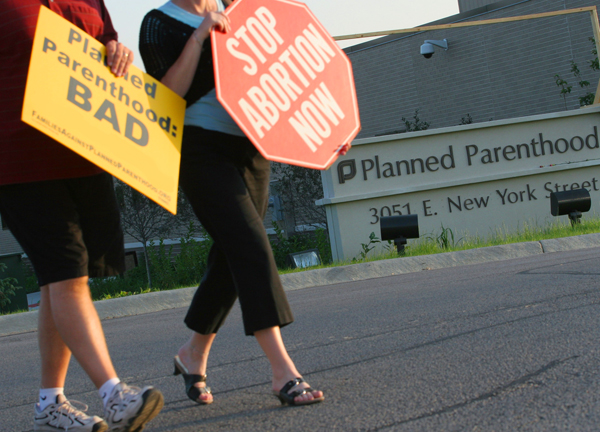
Why the right hates Planned Parenthood (Credit: AP/Stacie Freudenberg)

“I do not support the mission of Planned Parenthood,” Karen Handel, the Susan G. Komen Foundation’s senior vice president for public policy, wrote in 2010, during her failed gubernatorial bid in Georgia. It’s worth asking again what that mission is and why the right hates it so much, now that the foundation has withdrawn its funding for Planned Parenthood to provide breast cancer screenings to low-income women.

The right’s hatred of Planned Parenthood requires some logical inconsistencies, to put it mildly. It means constantly accusing the nonprofit organization of greedy profiteering, even while fantasizing over how stripping Planned Parenthood of federal funding for health services might shut its doors. It means professing to hate abortions but doing everything possible to deny access to contraception — from trying to keep Planned Parenthood from getting Title X funding to opposing comprehensive coverage for contraception under the Affordable Care Act, for which Planned Parenthood was a key lobbyist.

As its important support for the expanded access to contraception underscores, Planned Parenthood’s “mission” is pretty simple: providing comprehensive healthcare to women, which it does more than anyone else in the country. No federal funding, except in extremely limited cases, goes to abortions, and not all Planned Parenthood centers provide abortions, but the fact that the organization refuses to capitulate to abortion foes and pretend that abortion care isn’t a women’s health concern is part of what rankles. It clearly drives the right crazy that an organization with this approach has the scale and resources to not only help actual women make fertility decisions, but also have some leverage with the current administration — enough to prevent the Republican House from shutting down the entire government over Planned Parenthood funding early last year.

Refusing to allow the right’s isolation of Planned Parenthood isn’t just good public policy, although it is that, or even a recognition of women’s fundamental right to self-determination and health, though it is that too. It’s also good politics; despite the right’s best efforts, Planned Parenthood remains popular in public polling. That’s probably because so many people have had positive experiences receiving services there, or know someone who did — and since abortion services are only 3 percent of what Planned Parenthood provides, odds are it was another health service. No wonder Planned Parenthood has been flooded with donations that have already exceeded what it got from Komen.

In many cases, Planned Parenthood is the only access to healthcare that low-income women and men have, and where the right has succeeded in pulling local funding for it, the vacuum in services has been hard to fill. Handel was reiterating her opposition to Planned Parenthood, in a campaign blog post disinterred by Jezebel, because she’d come under fire for presiding over a county that contracted Planned Parenthood to provide “breast and cervical cancer screening, as well as a ‘Healthy Babies Initiative.’” Handel says in her own defense that “Planned Parenthood was the only eligible vendor approved to meet the state criteria,” but adds, “Since grants like these are from the state I’ll eliminate them as your next Governor.” What happens to the babies and the breasts and the cervixes in the absence of an eligible vendor? The right has stopped even pretending to care.

As long as women remember Planned Parenthood as their lifesaver in providing sexual health counseling, emergency contraception or a pap smear, it’s harder to peg abortion providers as back-alley butchers. And it’s easier for them to understand the reality that abortion services are inseparable from any truly comprehensive women’s healthcare, whether one wants to choose them or not.

Irin Carmon

Irin Carmon is a staff writer for Salon. Follow her on Twitter at @irincarmon or email her at icarmon@salon.com.

Abortions made public

States want more data on abortion patients. Zealots want their hands on it. Shame is the new anti-choice strategy

  • more
    • All Share Services

Abortions made public (Credit: Cannaregio via Shutterstock/Salon/Benjamin Wheelock)

It was an “anonymous informant,” Operation Rescue claimed last week, after someone slipped them the April records of 86 women who were treated at Central Family Medical. The clinic’s lawyer was blunter. “It certainly appears to me that a crime was committed,” Cheryl Pilate told the Kansas City Star. Though the clinic (which performs abortions) had already reported a break-in to a locked dumpster, Pilate said it wouldn’t have contained patient records, which are shredded. The “informant” must have gotten the documents – containing names, addresses and details of procedures – another way.

“Our concern is for the privacy of these women and for their health and safety, for which Central Family Planning has shown very little regard,” said Operation Rescue’s Troy Newman – while posting photographs of the documents, partially redacted in black marker, online.

Antiabortion activists want to create the impression that one way or another, a woman’s decision to have an abortion will be discovered and exposed. The Central Family Medical incident is only the latest skirmish in a decades-long effort to undermine the privacy of abortion patients and harass doctors. In the early ’90s, for example, at least one group of clinic protesters printed on their signs the names of women seeking abortions that day, alongside “don’t kill your baby.” Such actions, while failing to make abortion illegal, have nevertheless managed to cloak it in a stigma that belies the fact that one in three women will have an abortion before the age of 45. Now, activists are seeking new ways to shame women who seek abortions, from requiring them to hand over personal information to actually hacking into their medical records.

Kansas has been ground zero for this: Last year, the Kansas Board for Discipline of Attorneys recommended that former Attorney General Phill Kline, a hero to Operation Rescue, have his legal license suspended indefinitely for mishandling the records from murdered abortion provider George Tiller’s clinic. (The Kansas Supreme Court will make the final call.) But the zeal to keep, and sometimes steal, abortion records casts a wide net.

In Texas, the state Department of Health is trying to implement a failed legislative measure that would require abortion clinics to report far more information about their patients to the state. In Florida, voters will weigh in on a ballot measure that would exempt abortion from the privacy clause in the state constitution, with the short-term aim being to strip minors of a right to privacy that would preclude parental consent. The U.K. recently jailed a hacker who stole and intended to publish the records of 10,000 women who visited the country’s largest abortion provider.

“It promotes the idea that abortion – or your privacy, if you have any – is not safe,” says Katie Stack, a graduate student and activist who spoke out about her abortion on an MTV special, “No Easy Decision.” That put her in close contact with the “online ministry” – the name antiabortion activists have given their efforts to reach women considering abortions through the Internet.

This has been the unstated goal of many activists in the antiabortion movement — and, sometimes, the stated one. “This might sound a little strange,” said antiabortion activist Lila Rose at the Value Voters Summit in 2009, but “if I could insist, as long as they are legal in our nation, abortions would be done in the public square, until we were so sick and tired of seeing them that we would do away with the injustice altogether … maybe then we might hear angels singing when we ponder the glory of conception.”

Rose won’t get her wish any time soon, but antiabortion activists are trying to use the Internet to have a similar effect. Rose was recently on a panel at the International Pro-Life Youth Conference about social media and pro-life activism, where topics included targeting women who are seeking information about abortion online, whether through Yahoo Answers or YouTube commenters – including figuring out where they live and recommending a crisis pregnancy center nearby.

“Privacy is very important to women who have abortions,” says Kate Cockrill, program director of the Social and Emotional Aspects of Abortion project, at the University of California, San Francisco. She points out that abortion is traditionally underreported even in confidential surveys, “which is a good indication that women don’t want to be associated with abortion experience in the eyes of someone who’s gathering data, even if it’s anonymous.”

Cockrill recently conducted a survey, as yet unpublished, that seeks to measure the impact of social stigma on women who’ve had abortions. It asked 641 women who had had abortions about 61 items, including questions about the fear people would gossip about you, judge you or hurt you, or the fear that you would lose an important relationship.

So far, she’s found that the women who experienced the most stigma were worried about being judged more than they were about being hurt or harmed, that they feared loss of social status and the ruining of their public identity, that they felt isolated and guilty, and that they feared community condemnation.

But as with other abortion restrictions, which create extra burdens in the supposed service of changing women’s minds, it’s not clear that anyone’s mind is being changed.

“Lots of women who feel a lot of stigma about abortions have abortion anyway,” Cockrill says. “If it’s not doing what antiabortion people want it to do, which is reducing the number of abortions, is it doing something on the other end, [after the fact]?”

Cockrill and her team are going to be using their scale in a study next year to look at the relationship between stigma and poor coping after abortion. Given that antiabortion activists have added to their obsessions the alleged harm abortion causes to women, there’s reason to believe that this is a self-fulfilling prophecy.

Women who have abortions, Cockrill says, “have a huge range of political views.” In fact, in her survey, only 62 percent of the women identified as pro-choice. (Seven percent identified as prolife, and 18 percent described their position as “mixed or neither.”)

“A lot of women don’t experience their abortions as a political act,” Cockrill says, partly an extension of the fact that they don’t see it as constitutive of their identity.

Whether it’s political rhetoric or individual ambivalence, these women are highly sensitive about whom they tell they had abortions. Sixty-four percent of the women in the study said they’d “withheld information about my abortion to someone I’m close to,” and 45 percent said they’d “lied to someone I’m close to about my abortion.”

They may not see it as political, but that silence functions as a vicious circle that antiabortion activists happily seize upon and promote. Cockrill says, “Some people say, ‘We need to have more people come out about their abortions.’ But it’s impossible to get more women to talk about their abortions if they don’t feel supported. And it needs to be on women’s own terms.”

Continue Reading Close
Irin Carmon

Irin Carmon is a staff writer for Salon. Follow her on Twitter at @irincarmon or email her at icarmon@salon.com.

“War on women” isn’t over

Just as pundits said the issue was fading, President Obama took up reproductive rights with new passion

  • more
    • All Share Services

(Credit: Reuters/Yuri Gripas)

On Friday, President Obama did something that, to my recollection and ability to track online, was unprecedented: He condemned a state-level abortion restriction.

“Now we’ve got governors and legislatures across the river in Virginia, up the road in Pennsylvania, all across the country saying that women can’t be trusted to make your own decisions,” he said at Friday’s Women’s Leadership Conference, the second time this month the president has addressed a specifically women-focused event. “They’re pushing and passing bills forcing women to get ultrasounds, even if they don’t want one. If you don’t like it, the governor of Pennsylvania said you can ‘close your eyes.’ It’s a quote. It’s appalling. It’s offensive. It’s out of touch. And when it comes to what’s going on out there, you’re not going to close your eyes. Women across America aren’t closing their eyes. As long as I’m president, I won’t either.” That same quote from Pennsylvania’s Tom Corbett, prominently linking him to Mitt Romney, ended up in an attack video the campaign released the same day that called Romney “extreme on women’s issues.”

That a president who has traditionally stayed on the sidelines of abortion debates would consider them safe waters to jump into shows how far the paradigm has changed.  As I’ve written here before, state laws requiring ultrasounds before abortion used to be the layup of incremental abortion restrictions — they’ve been passing quietly in conservative states for over a decade. There was nothing particularly novel about the one that eventually became law in Virginia in non-specifically-transvaginal form — what was novel was the level of attention and outrage. (In Pennsylvania, popular outrage helped kill the bill that Corbett was supporting.) Yes, this is rallying the base, but given how Republicans were only too happy to jump into the contraceptive mandate debate — no, to wallow in it, slut-talk and all — Obama had plenty of less controversial material to choose from.

Of course, the president didn’t go all out in his support of reproductive freedom — he didn’t mention the word “abortion,” just as he hadn’t in his otherwise full-throated video defense of Planned Parenthood (though, to be fair, he was talking about maintaining federal funding to the organization, none of which goes to abortion). But for a man who less than six months ago was talking about how limiting access to emergency contraception was “common sense,” it was positively a sea change.

On April 12, Slate political reporter David Weigel declared the death of “the war on women” as a Democratic talking point. Republicans thought they drew blood in the Ann Romney/Mommy wars kerfuffle and a Democratic National Committee flack clumsily told Weigel, “I’m not a fan of the term,” and claimed that “we in the DNC have not been running a campaign based on the term ‘war on Women.’ That’s a myth cooked up by Republicans.” But terminology aside, it’s clear from the past few days that the Democrats aren’t done courting (or cementing) the female vote through Republican attacks on reproductive rights, pay equity or benefits disproportionately used by women.

A general-audience video released by the campaign today touts the contraceptive coverage mandate with the lines, “Contraception coverage? Guaranteed.” Meanwhile, the Romney campaign is still trying to turn questions about women voters away from reproductive rights and toward a generalized economy question, with Romney advisor Ed Gillespie proclaiming on “Meet the Press” yesterday,“The U.S. economy is a hostile workplace for women under President Obama … It’s still the economy, and women aren’t stupid.” Obama advisor Robert Gibbs responded, “I don’t think we want to to go back either to eight years ago or, quite frankly, 30 or 40 years ago, whether it’s the economic decisions that women have to make or the healthcare decisions that women have to make. I think there’s a clear contrast.”

There is. And if there’s a second Obama term — quite possibly won on the votes of women — will that contrast outlast the election season opportunism? The answer will partly depend on how much reproductive rights and women’s groups press their current advantage and push the paradigm even further.

Continue Reading Close
Irin Carmon

Irin Carmon is a staff writer for Salon. Follow her on Twitter at @irincarmon or email her at icarmon@salon.com.

The myth of the “morning-after abortion pill”

There's a reason why people mistake emergency contraception and abortion: The right intentionally confuses the two

  • more
    • All Share Services

The myth of the (Credit: Shutterstock/Salon/Benjamin Wheelock)

It started around February, when Republicans were still eager to talk about contraception. The Obama administration, or so Mitt Romney charged in Colorado, was forcing religious institutions to provide “morning-after pills –in other words abortive pills — and the like, at no cost.”

It was, of course, a lie. Romney was conflating two different pills: emergency contraception, known as the morning-after pill, which prevents a pregnancy; and chemical abortion, or mifepristone, which ends a pregnancy of up to seven weeks’ gestation and isn’t covered under the new guidelines. Since both pills were marketed in the U.S. around the same time, even some pro-choicers have gotten confused. But Colorado happens to be the epicenter of people confusing them on purpose. It’s the birthplace of the Personhood movement and home to Focus on the Family, both of which have strategically called emergency contraception “abortion” on the scientifically unproven basis that they could block a fertilized egg from implanting.

There are a host of ironies here. Obama has earned the renewed support of reproductive-rights advocates by requiring health insurers to cover contraception, but the Center for Reproductive Rights is still taking him to court – with oral hearings being held this week before a New York federal court -– for overruling the FDA’s recommendation to lift the prescription requirement on emergency contraception for women under 17. That litigation has been winding its way through the system for over a decade, throughout the Bush-era politicization of the FDA, eventually resulting in a federal judge concluding that “the FDA repeatedly and unreasonably delayed issuing a decision on [the emergency contraception pill] Plan B for suspect reasons.” The FDA was ordered to explain why Plan B shouldn’t be available over the counter for girls 13 and up. When the Obama administration overruled the FDA’s recommendation to make it over the counter, U.S. District Judge Edward Korman suggested the Center for Reproductive Rights reopen its case.

“It seems to me that what we’re going through is a rerun of what happened before,” Korman remarked, referring to politics trumping the recommendations of medical professionals.

The Obama administration’s unspoken but unmistakable fear was of an election-cycle attack line that Michele Bachmann would use anyway: That teenage girls would be able to get Plan B from “the grocery store aisles next to bubble gum and next to M&Ms.” That was, in fact, an echo of the language President Obama himself used to invoke a highly unsupported bogeyman: that “a 10-year-old or 11-year-old going to a drugstore would be able to, alongside bubble gum or batteries, … buy a medication that potentially if not used properly can have an adverse effect.”

But there is another twist, so far mostly overlooked: Emergency contraception won’t be covered by insurance for everyone, since it’s available over-the-counter for those who can show I.D. proving that they’re 17 or older. They’ll still have to fork over around $50 a pop. But as long as girls 16 and younger need a prescription for the morning-after pill and they have insurance, it will be fully covered — effectively free. The same goes for women older than 17 who decide to jump through the hoops of getting a prescription, either for over-the-counter Plan B or the prescription-only generic and Ella versions.

As much as pro-choice advocates want to lift the barriers that make emergency contraception hard to get — because it’s more effective the faster you use it — one of those barriers, the prescription requirement, also mitigates another, the high cost. Said Adam Sonfield, a senior public policy associate at the Guttmacher Institute, of this catch-22, “It presents a tradeoff between cost and access.”

– – — – — – — – — – — – — – — – — – — – — – — – –

Part of the reason people get confused about emergency contraception and abortion is because lots of people are confused about the basic biology of pregnancy: specifically, that it doesn’t necessarily happen instantaneously and that sperm can live in the body for several days, during which time a woman can ovulate and an egg can potentially be fertilized and implant. Regular use of hormonal contraception prevents ovulation and the chance for fertilization; emergency contraception essentially works the same way except that it’s taken after sex, by which point ovulation may have already happened. But according to recent studies, there is no evidence that taking emergency contraception after ovulation and fertilization will stop the egg from implanting.

But the misinformation and misunderstanding have created a contradictory public health picture when it comes to emergency contraception. In some ways, it’s become more accessible. In 2010, the U.S. approved a longer-acting French variant of Plan B, known as Ella, and there are scattered experiments in convenient delivery, from a birth-control vending machine at Shippensburg University in Pennsylvania to a new bike messenger service in London, both of which caused minor news sensations. The annual “Back Up Your Birth Control” campaign has been promoting the line “EC=BC,” emphasizing that emergency contraception is birth control, not abortion — just in case that is a barrier for women who are considering taking it. And the Center for Reproductive Rights’ petition did manage to lower the age restriction from 18 to 17.

But there are more disturbing suggestions that misinformation is triumphing. A recent Boston Medical Center study found that many pharmacists were still often misinformed about the age requirement and were even more likely to wrongly refuse emergency contraception to 17-year-olds in low-income neighborhoods, where the rate of unintended pregnancy is higher. In Honduras, the Supreme Court upheld the criminalization of emergency contraception, which means women who use it could be jailed. Personhood initiatives, which oppose the morning-after pill, have so far failed in Colorado, Mississippi and Oklahoma, but they’ve introduced false doubts by providing even more opportunities for pundits and candidates to say “the morning-after abortion pill.”

It’s a problem that dates back decades: When, throughout the ’90s, the U.S. considered approving a French chemical abortion pill known as RU-486, it was widely called the “morning-after abortion pill,” including, often, in the New York Times. The distinction wasn’t pressed by the pro-choice community itself.  “At the time, the prevailing medical wisdom was that there is a continuum rather than a bright line between EC and mifepristone,” said Gloria Feldt, who was president of Planned Parenthood at the time, with the benefit providing more options for women who did not wish to be pregnant. “It was also assumed that a formulation of mifepristone would eventually be made for use as a true ‘morning-after’ pill.” The widespread belief, she recalled, was that a chemical abortion pill would “solve all the abortion debate problems and guarantee privacy.”

Another problem was that although doctors and non-professionals had been giving women high dosages of regular birth control pills for decades as a form of emergency contraception, the science of exactly how emergency contraception worked remained unclear. The medical definition of pregnancy remains “implantation of a fertilized egg,” but let’s say you believe, as the Catholic Church does, that fertilization itself creates a human life. Anti-choice advocates obsess over what would happen if a woman who took emergency contraception did happen to ovulate anyway and an egg potentially was fertilized, which is enough reason for some of them to call postcoital contraception “abortion.” They have claimed that hormonal contraception makes the lining of the endometrium inhospitable to a fertilized egg, constituting “murder.” Even the official packaging for Plan B, the single-step version of emergency contraception, suggests that “in addition” to blocking ovulation and fertilization, “it may inhibit implantation (by altering the endometrium).”

Except that we now know it doesn’t, even if you walk down the path of remote maybes, which requires you to believe that a zygote, which may not implant for unknowable reasons, has the same rights as a living woman who doesn’t want to be pregnant. As Princeton’s Kelly Cleland pointed out recently, “The science has evolved considerably in the last 13 years. Newer evidence, published since the Plan B label was approved, provides compelling evidence that levonorgestrel EC (LNG EC) works before ovulation, but not after.” The International Consortium for Emergency Contraception and the International Federation of Gynecology & Obstetrics also note that two new studies have shown conclusively that if a woman has ovulated and an egg has been fertilized, it’s too late for emergency contraception to work. They recommended that the language on the product labeling be changed.

Of course, scientific evidence has rarely had much place in this debate. In the meantime, even the most non-ideological news sources keep making the mistake alongside the ideologues. Last week, a furor erupted after the Associated Press reported that “Women seeking to take emergency contraception like the so-called ‘morning after’ pill would have to do so in the presence of a doctor under a bill before the Alabama legislature.” That is, until Erin Gloria Ryan from Jezebel read the actual bill and saw that it was, in fact, a law meant to limit chemical abortion, not emergency contraception. (A spokesperson for the AP said a correction was being prepared). “The confusion over this issue is probably one of the reasons emergency contraception hasn’t had as positive an impact as hoped when it comes to lowering the abortion rate,” wrote Amanda Marcotte at RH Reality Check. “If women think it is some kind of abortion-ish thing, they probably think taking it is a big deal, instead of thinking of it more like taking the pill, since it’s basically the same thing.”

But talk about moved goalposts. If ’90s-era advocates had hoped that the ability to end a pregnancy in the safety of your home with RU-486 — the actual abortion pill, not the morning-after one — would defuse the abortion debate, their more recent counterparts hoped to take it to the next technological level by providing “tele-med” abortions. They would involve doctors seeing a woman over webcam with a nurse practitioner physically present, helping women in remote areas with ever-dwindling options for safe abortions to access them. But four states have already passed requirements meant to undercut these options by forcing a doctor’s presence, and the bill the Associated Press misreported was aiming to add Alabama to the list. All in all, there have been fewer gamechangers, and more cases of one step forward, two steps back.

Continue Reading Close
Irin Carmon

Irin Carmon is a staff writer for Salon. Follow her on Twitter at @irincarmon or email her at icarmon@salon.com.

Rush’s big enabler: The army

A government-funded radio station beams Limbaugh to service members around the globe

  • more
    • All Share Services

Rush's big enabler: The army Rush Limbaugh (Credit: AP Photo/Ron Edmonds)

As Rush Limbaugh faces more heat over his attempts to “slut”-shame Sandra Fluke for testifying before Congress in support of student healthcare-covered birth control, there’s one big supporter of the conservative talk show host that’s largely avoided scrutiny: the U.S. military. On Open Salon, Heather Michon explains:

One of Rush’s biggest enablers has so far escaped attention: the American Forces Network. For years, Limbaugh’s show has been beamed around the globe to service members, military support staff and families. Other attempts have been made to remove him from that network and have failed.

This is the time.

In his more customized attacks on Fluke, it’s easy to overlook the fact that Limbaugh has a two-decade-long track record of classifying women as inferior goods. This is the man who coined the term “Feminazi,” who once stated that “feminism was established to allow unattractive women easier access to the mainstream.” In Rush World, most women are either babes, sluts or whores. They’re cunning and manipulative or whiny and weak. There’s not much middle ground.

Read the whole post on Open Salon.

Continue Reading Close

Hold this between your knees, Rush Limbaugh

Help enrage America's top misogynist. Support women – and join Salon Core

  • more
    • All Share Services

Hold this between your knees, Rush Limbaugh

I thought I’d lost my capacity to be disgusted by Rush Limbaugh. He lives for that; why give him the satisfaction? But he crossed into new territory with his attacks on Sandra Fluke, who used to be a private citizen working toward a Georgetown University law degree, until the Catholic bishops meddled in American politics and in her personal life, and she decided to tell her story.

Fluke tried to testify on behalf of President Obama’s contraception coverage requirements at Rep. Darrell Issa’s Inquisition; excuse me, his hearing on the regulations, which featured an all-male panel to lead off. But she was denied permission, on the grounds that Issa was interested in threats to religious liberty, not women’s lives. That was bad enough. After the GOP congressman shut her down, she told her story to House Democrats as well as journalists. Limbaugh called her a “slut” and a “prostitute,” and promised to buy Fluke and Georgetown women “as much aspirin to put between their knees as they want. We are paying her for having sex. We are getting screwed. So Ms. Fluke and the rest of you feminazis, here’s the deal: If we are going to pay for your contraceptives, and thus pay for you to have sex, we want something for it, and I’ll tell you what it is: We want you to post the videos online, so we can all watch.”

I’m not making this up. I’ve been attacked by Limbaugh before; it’s an honor for liberals. But his remarks about Fluke are unbelievable. Literally. I had to hear it twice to believe it’s what he said. (After I wrote this, President Obama called Fluke to commend her courage and tell her that her parents should be proud of her.)

Limbaugh’s behavior is just the far-right edge on a continuum of conservative misogyny that’s gone beyond trying to outlaw abortion, moved into the once-unimaginable realm of contraception, and mocks women in a way we haven’t heard since my childhood, I think. His “joke” is based on the remark by Rick Santorum’s moneyman Foster Freiss, on the same day as Issa’s “hearing,” recalling the days when gals didn’t need birth control because they put aspirin between their knees. But it’s not just for fun: The entire GOP presidential field has endorsed a “personhood” amendment that could outlaw most non-barrier forms of contraception. On Thursday, Sen. Roy Blunt’s shameful attempt to give employers the right to deny health insurance coverage for any treatment they didn’t approve of – targeting but not limited to contraception – was tabled in the Senate, but not before it got 48 votes, including every Republican except the departing Olympia Snowe, plus three cowardly Democrats, Nebraska’s Ben Nelson, West Virginia’s Joe Manchin and Pennsylvania’s Bob Casey.

I’m happy to say, though, that women – and the men who care about them – are fighting back as never before in my memory. We forced Susan G. Komen to rescind its decision to cut funding to Planned Parenthood. Despite the frothing of conservatives, the Obama administration is still requiring insurers to provide cost-free contraception. The president’s courage on the issue is bringing women back into the Democratic fold, according to recent opinion polls – and has them running away from Mitt Romney and Rick Santorum.

But we have to do more. I’m putting my energy into two causes in the coming months: a grass-roots effort to turn out the women’s vote called #usethe19th – you’ve seen a lot of it on Twitter today – and helping to promote Salon Core. Salon has led the way in covering news about women, by women, since our founding in 1995. We stand out in a world where men’s voices are still dominant – after the discouraging news this week that the nation’s best magazines still overwhelmingly feature men on their table of contents page, ThinkProgress produced a list of 10 women writers they should hire – and two of them, Tracy Clark-Flory and Irin Carmon, work for Salon (and several of the others freelance for us).

Over the years we’ve featured an unmatched array of smart women; Arianna Huffington, Tina Brown, Anne Lamott and Camille Paglia as leading columnists; on the culture side, Laura Miller and my former colleagues Heather Havrilesky and Stephanie Zacharek, some of the smartest writers anywhere; Rebecca Traister is one of the bravest, clearest writers on feminism and American politics that I know. And Mary Elizabeth Williams is one of my favorite writers on everything she writes about. I couldn’t have done the work I do with total freedom and support any place other than Salon.

The only good thing about this assault on women’s rights is that the women writers I know are becoming even more active than ever before. A whole lot of people have jumped into the #usethe19th fray – join us! We need to elect better leaders. We need to tell our stories. And we need to put our money where our mouths are – behind media outlets that tell those stories, as well as politicians who listen.

Over the years Salon has often turned to its readers for support, and this year we’re developing a new membership program to support our work – and support yours, too. I’ll be out on the road during this election season covering the candidates but also meeting Salon Core readers at a new roster of events we’re putting together for our members. When my book comes out in November, we’ll have a special offer for Core. We’ll be hosting members-only chats and other political convenings through November.

Republicans like to say this is the most important election year of their lifetimes. I agree. Make noise. Lobby. Campaign. Run for office. Raise money. Write. Vote. Join Salon Core – support those who support you. And piss off that angry old misogynist, Rush Limbaugh.

Continue Reading Close
Joan Walsh

Joan Walsh is Salon's editor at large.

Page 1 of 2 in Reproductive Rights