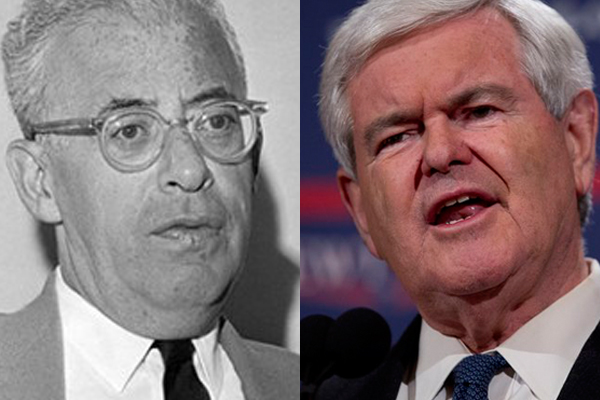

Newt Gingrich

The truth about Newt’s favorite punching bag

Saul Alinsky wasn't a socialist and has no ties to Obama. He was a populist patriot who fought for workers' rights

(Credit: A{)

And now, a word about a good American being demonized, despite being long dead. Saul Alinsky is not around to defend himself, but that hasn’t kept Newt Gingrich from using his name to whip up the froth and frenzy of his followers, whose ignorance of the man is no deterrence to their eagerness, at Gingrich’s behest, to tar and feather him posthumously.

In his speeches, Gingrich pounds away at variations on the theme like the piano player in a cheap Western saloon. He declares, “The centerpiece of this campaign, I believe, is American exceptionalism versus the radicalism of Saul Alinsky,” or, “I believe in the Constitution, I believe in the Federalist Papers. Obama believes in Saul Alinsky and secular European socialist bureaucracy.”

It’s all quite clever and insidious, a classic lesson in how to slander someone who cannot answer from the grave, reminiscent of the tactics Gingrich used in those GOPAC memos back in 1996, when he suggested buzzwords and phrases to demonize opponents: corrupt, decay, pathetic, permissive attitude, self-serving and, of course, radical.

In the case of Saul Alinsky, most of the crowd knows nothing about the target except that they’re supposed to hate him. And why not? There’s the strange foreign name – obviously an alien. One of them. And a socialist at that. What’s a socialist? Don’t know — but Obama’s one, isn’t he? Barack Hussein Obama, Saul Alinsky – bingo! Two peas in a pod, and a sinister, subversive pod at that.

But just who was Alinsky, really? Born in 1909, in the ghetto of Chicago’s South Side, he saw the worst of poverty and felt the ethnic prejudices that fester, then blast into violence when people are crowded into tenements and have too little to eat. He came to believe that working people, poor people, put down and stepped upon, had to organize if they were going to clean up the slums, fight the corruption that exploited them, and get a handhold on the first rung of the ladder up and out.

He became a protégé of labor leader John L. Lewis and took the principles of organizing into the streets, first in his hometown of Chicago, then across the country, showing citizens how to band together and non-violently fight for their rights, then training others to follow in his shoes. Along the way, Alinsky faced down the hatred of establishment politicians, attacks both verbal and physical, and jail time. He was a gutsy guy. Outspoken, confrontational, profane with a caustic wit, one journalist said he looked like an accountant and talked like a stevedore. He had a flair for the dramatic, once sending a neighborhood to dump its trash on the front step of an alderman who was allowing the garbage to pile up. Or immobilizing city hall, a department store or a stockholders meeting with a flood of demonstrators demanding justice.

One thing Newt has right — Saul Alinsky was a proud, self-professed radical. Just look at the titles of two of his books – “Reveille for Radicals” and “Rules for Radicals.” But a communist or socialist he was not. He worked with them on behalf of social justice, just as he worked alongside the Catholic archdiocese in Chicago. When he went to Rochester, N.Y., to help organize the African-American community there after a fatal race riot, he was first invited by the local Council of Churches. It was conscience they all had in common, not ideology.

As far as his connection with Barack Obama, the president was just a kid in Hawaii when Alinsky died, something you would expect a good historian, as Gingrich claims to be, to know. The two men never met, although when Obama arrived on the South Side of Chicago as a community organizer, some of his grass-roots work with the poor was with an Alinsky-affiliated organization.

But that’s how it goes in the fight for basic human rights. Alinsky’s influence crops up all across the spectrum, even in the Tea Party. Get this: According to the Wall Street Journal, the conservative holy of holies, the one-time Republican majority leader in the House of Representatives, Dick Armey, whose Freedomworks organization helps bankroll the Tea Party, gives copies of Alinsky’s “Rules for Radicals” to Tea Party leaders.

Watch out Dick – you could be next on Newt’s list, although, curiously, in his fight against the wealthy Mitt Romney, Gingrich himself has stolen a page from Alinsky’s populist playbook. After Romney beat him in the Florida primary, Newt insisted he would continue the fight for the nomination and shouted, “We’re going to have people power defeat money power,” a sentiment that was Saul Alinsky through and through.

Alinsky died, suddenly, in 1972. At the time, he was planning to mount a campaign to organize white, middle-class Americans into a national movement for progressive change, a movement he vowed to take into the halls of Congress and – his words — “the boardrooms of the megacorporations.”

Maybe that’s why Newt Gingrich has been slandering Alinsky’s name. Maybe he’s afraid, afraid that the very white folks he’s been rousing to frenzy will discover who Saul Alinsky was – a patriot in a long line of patriots, who scorned the malignant narcissism of duplicitous politicians and taught everyday Americans to think for themselves and fight together for a better life. That’s the American way, and any good historian would know it.

Bill Moyers is managing editor of the new weekly public affairs program, "Moyers & Company," airing on public television. Check local airtimes or comment at www.BillMoyers.com.

Michael Winship is senior writing fellow at Demos and a senior writer of the new series, Moyers & Company, airing on public television.

SPIN METER: Rivals airbrush anti-Romney words

After the nastiness of the Republican primary race, former candidates have collective amnesia about Romney disses

FILE - In this Jan. 26, 2012 file photo, Republican presidential candidates, former House Speaker Newt Gingrich and former Massachusetts Gov. Mitt Romney talk during a commercial break at the Republican presidential candidates debate in Jacksonville, Fla. Remember Gingrich calling Romney a liar? Michele Bachmann saying Romney's unelectable? Rick Santorum calling Romney "the worst Republican in the country" to run against Obama? They're hoping you don't. And acting like it never happened _ even though most of their words are just clicks away online. (AP Photo/Matt Rourke, File)(Credit: AP)

WASHINGTON (AP) — Remember Newt Gingrich calling Mitt Romney a liar? Michele Bachmann saying Romney’s unelectable? Rick Santorum calling Romney “the worst Republican in the country” to run against President Barack Obama?

They’re hoping you don’t. And acting like it never happened (even though most of their words are just clicks away online.)

One by one — with the exception of holdout Ron Paul — the GOP also-rans have coughed up endorsements of their onetime rival. And as they do, they’re pulling rhetorical backflips to distance themselves from their former harsh assessments of Romney.

Don’t try this at home, folks. It takes a professional politician to pull it off with a straight face.

A sampling of the also-rans’ anti-Romney rhetoric when they were candidates and their obligatory niceness after endorsing Romney.

___

RICK SANTORUM

The former Pennsylvania senator still doesn’t have trouble curbing his enthusiasm for Romney. He waited a month after dropping out of the race to endorse Romney, then emailed his tepid endorsement in the dead of night. He finally got out the E-word in the 13th paragraph of his 16-paragraph statement.

THEN:

—”He is the worst Republican in the country to put up against Barack Obama.” Santorum later said he was referring to Romney’s standing on health care reform.

—”If Mitt Romney’s an economic heavyweight, we’re in trouble, because he was 47th out of 50 in job creation in the state of Massachusetts when he was governor. He may have had some success at making money for himself and his partners at Bain Capital, and I give him a lot of credit for doing so, but that’s a very different thing than going out and creating an atmosphere for people to create — that create jobs.”

NOW:

—”There are many significant areas in which we agree: the need for lower taxes, smaller government and a reduction in out-of-control spending. We certainly agree that abortion is wrong and marriage should be between one man and one woman. I am also comfortable with Gov. Romney on foreign policy matters, and we share the belief that we can never allow Iran to possess nuclear weapons. And while I had concerns about Gov. Romney making a case as a candidate about fighting against Obamacare, I have no doubt if elected he will work with a Republican Congress to repeal it and replace it.” — Endorsement emailed to Santorum supporters.

___

NEWT GINGRICH

Gingrich didn’t formally endorse Romney when he dropped out of the race but spoke well of him and later said that was close enough. The guy who promised not to run down his GOP opponents at the start of the race had some withering things to say about Romney during the heat of the campaign. Gingrich, a former House speaker, would rather you forget that now, though: His anti-Romney videos on YouTube, once public, are now private. The man who repeatedly branded Romney a “Massachusetts moderate” now calls him a “solid conservative.”

THEN:

—”Someone who will lie to you to get to be president will lie to you when he is president.”

—Are you calling Mitt Romney a liar? “Yes.” Questioned about his previous comment.

—”Can we drop a little bit of the pious baloney?” To Romney during a debate.

—”Why would you want to nominate the guy who lost to the guy who lost to Obama?”

—”We are not going to beat Barack Obama with some guy who has Swiss bank accounts, Cayman Island accounts, owns shares of Goldman Sachs while it forecloses on Florida and is himself a stockholder in Fannie Mae and Freddie Mac while he tries to think the rest of us are too stupid to put the dots together and understand what this is all about.”

—”I think that a bold Reagan conservative with a very strong economic plan is a lot more likely to succeed in that campaign than a relatively timid Massachusetts moderate who even The Wall Street Journal said had an economic plan so timid it resembled Obama.”

NOW:

—”I’m going to campaign for him, I favor him over Obama. I went through, like, seven different issues where I favor him. I’ll do everything I can to help elect Romney. … As far as I’m concerned, I’ve endorsed him.”

—”Compared to Barack Obama, Mitt Romney is a solid conservative. And I think you have to come down to, what’s the choice this November? And the choice is the most radical president in American history and a failed president at the economy and somebody who has a solid record on jobs and who, in fact, on basic principles, is conservative. And I think you can get into arguments about who’s how conservative, but compared to Obama, Mitt Romney is a solid conservative.”

___

MICHELE BACHMANN

Bachmann waited four months after dropping out before she endorsed Romney. The congresswoman from Minnesota campaigned with him in Virginia earlier this month but didn’t bring up health care in their joint appearance.

THEN:

—”He can’t beat Obama because his policy is the basis of Obamacare. The signature issue of Obama is Obamacare. You can’t have a candidate who has given the blueprint for Obamacare. It’s too identical. It’s not going to happen.”

—”He’s been very inconsistent on his positions. He’s been on both sides of the abortion issue, on both sides of the issue with same-sex marriage … he was for the TARP bill, the $700 billion bailout and the global warming initiatives.”

NOW:

—”I am endorsing Gov. Mitt Romney for president of the United States, a man who will preserve the American dream of prosperity and liberty.”

—”This is what victory looks like.” Campaigning with Romney in Portsmouth, Va., on the day she endorsed him.

—”He’s very smart. He has a very optimistic message. Women trust him because they see, this is a man who started a business from scratch, for heaven’s sake.”

—”One thing that Mitt Romney has demonstrated, he will repeal Obamacare. That’s a big compare and contrast between Barack Obama. We will never get rid of socialized medicine, which is Obamacare, under Barack Obama. Mitt Romney has committed himself to repealing Obamacare. … A lot of people know Mitt Romney’s positive agenda.”

___

RICK PERRY

If he couldn’t have the GOP nomination himself, Perry still wasn’t about to back Romney. As he dropped out of the race, the Texas governor endorsed Gingrich. He didn’t come around to endorsing Romney until Gingrich announced last month that he was planning to drop out.

THEN:

—”While you were the governor of Massachusetts in that period of time, you were 47th in the nation in job creation. … You failed as the governor of Massachusetts.”

—”If you are a victim of Bain Capital’s downsizing, it’s the ultimate insult for Mitt Romney to come to South Carolina to tell you he feels your pain. Because he caused it.”

—”I have no doubt that Mitt Romney was worried about pink slips — whether he’d have enough of them to hand out.”

NOW:

—”Mitt Romney has earned the Republican presidential nomination through hard work, a strong organization and a disciplined message of restoring America after nearly four years of failed, job-killing policies from President Obama and his administration.”

___

JON HUNTSMAN

The former Utah governor endorsed Romney at the same time he dropped out of the race in January, but there was no joint appearance.

THEN:

—”You can’t be a perfectly lubricated weather vane on the important issues of the day.”

—”Gov. Romney enjoys firing people. I enjoy creating jobs.”

—”When you combine a record of uncertainty — running first as a senator, as a liberal; governor as a moderate; then as a conservative for the presidency, people wonder where your core is.”

—”He’s been on three sides of every major issue of the day. And because of that it’s going to be very tough in the end to be able to make that trust argument to the American people.”

NOW:

—”It is now time for our party to unite around the candidate best equipped to defeat Barack Obama. Despite our differences and the space between us on some of the issues, I believe that candidate is Gov. Mitt Romney.”

—”I think he’s the best equipped by far to deal with the economic issues and challenges that confront us. … He’s grown a lot, he’s learned a lot. He’s probably better prepared to lead.”

___

RON PAUL

The scrappy Texas congressman was the last man standing among Romney’s GOP opponents, and he’s not ready to make nice yet. Paul announced this week that he won’t campaign anymore, but he’s still collecting delegates at state party conventions and could give Romney grief at the national nominating convention in Tampa, Fla., come August. Paul ran some scorching ads against Romney earlier this year but shied away from going after Romney in person.

THEN:

—Narrator in Ron Paul radio ad: “Mitt Romney can’t fight against Obamacare because he supported the same mandates and government takeovers as governor of Massachusetts. Romney can’t stand up against more bailouts because he supported them. He can’t lead the charge to shrink the government because he has grown it. Romney’s record is liberal and putting him up against Obama is a recipe for defeat.”

NOW:

—”Not soon.” Paul’s answer when he asked Tuesday when he’ll endorse Romney.

___

Associated Press writer Jack Gillum contributed to this report.

Continue Reading Close

Goodnight, sweet Newt

The rise and fall, rise and fall, and rise and fall of the Gingrich 2012 campaign

(Credit: AP/David Duprey)

Today is another fine day for Newt Gingrich, although not his best. After months of neglect, he’ll get the political media to pay attention to him for a final 10 or so minutes. “All of us have an obligation, I think,” he said in Tuesday’s video announcing his announcement of his resignation today, which he first announced last week, “to do everything we can to defeat Barack Obama.” For Gingrich, this typically would mean attacking Mitt Romney. But Newt seems serious about dropping out this time, as shameful as that is for the erstwhile “definer of civilization,” as he called himself in some early-1990s doodles.

Tragic! For now we know that Gingrich won’t even reach that steppingstone, the presidency of the United States, to his predetermined world-historical greatness. And yet he came so close: He was briefly viable at three separate points in this race, before, predictably, tossing it all away — or having Mitt Romney’s super PAC attack snatch it away from him. Let’s recall these three Rises and Falls of Would-Be President Gingrich and share in our despair that the funniest possible presidential nominee, Newt Gingrich in 2012, was not selected in a national primary of his peers.

The Dawn

Rise: For whatever reason (name recognition, actually; that was the reason), many considered Newt a “top-tier candidate” when he first entered the race. “He is in the top tier of prospective candidates but ranks below some of the other contenders,” CNN.com wrote in May 2011, when a CNN.com poll showed him trailing aforementioned “other contenders” Sarah Palin, Mitt Romney, Donald Trump and Mike Huckabee. (For more on how all presidential punditry in 2011 was crap, see this.) That same week, Gingrich decided not to participate in the season’s first debate in South Carolina, joining a “batch” of fellow “top-tier Republican prospects — including Mitt Romney, Sarah Palin… Mitch Daniels and Mike Huckabee,” as Politico wrote, who also fancied themselves too prominent to face such lesser candidates as Rick Santorum. Gingrich, a bold-faced name who’d long toyed with a presidential candidacy, had convinced much of the media, without lifting a finger, that he was a Contender.

Fall: Here’s the sort of reception Gingrich would get from his fellow foot soldiers in the Gingrich Revolution after calling Paul Ryan’s Medicare-busting budget “right-wing social engineering” on “Meet the Press,” shortly after entering the race: “”Why don’t you get out before you make a bigger fool of yourself.”

That didn’t help build support from a Republican Party that had just bet its marbles on the purity and truth of all things Paul Ryan. Shortly thereafter, he and Callista went on a cruise through the Greek Islands — not the greatest sign for doubters who thought he lacked the discipline to carry through a presidential campaign. His six-figure debts to jeweler Tiffany & Co., a stupid, private bit of opposition research that didn’t have any relation to soaring federal deficits, still did not sit well with a party fixated on restoring fiscal responsibility. And then, the June Mutiny, when most of his top aides quit en masse — including spokesman (and later top Gingrich super PAC official) Rick Tyler, who a few weeks earlier had testified to Gingrich’s resilience with this glorious, tongue-in-cheek statement to the press:

The literati sent out their minions to do their bidding. Washington cannot tolerate threats from outsiders who might disrupt their comfortable world. The firefight started when the cowardly sensed weakness. They fired timidly at first, then the sheep not wanting to be dropped from the establishment’s cocktail party invite list unloaded their entire clip, firing without taking aim their distortions and falsehoods. Now they are left exposed by their bylines and handles. But surely they had killed him off. This is the way it always worked. A lesser person could not have survived the first few minutes of the onslaught. But out of the billowing smoke and dust of tweets and trivia emerged Gingrich, once again ready to lead those who won’t be intimated by the political elite and are ready to take on the challenges America faces.

And so Gingrich would reemerge at the top, six months later, for a couple of weeks or so.

The Newtening

Rise: Well, all those Herman Cain supporters who wanted a new unhinged screw-up with tons of baggage only had one place to go once Herman Cain left, right? Bachmann was nothing, Perry was nothing, Santorum (at that point) was nothing, and so the party base turned to its former commander, Newt Gingrich, to once more be the grenade that destroyed another Democratic administration’s chance at effective center-left governance. He’d crush Obama in the debates, after all! By mid-December 2011, Gingrich had hit 40 percent in national polls, opening double-digit leads against Mitt Romney both nationwide and in key early states. “I’m going to be the nominee,” he famously predicted that December. “It’s very hard not to look at the recent polls and think that the odds are very high I’m going to be the nominee.”

Fall: By Dec. 19, Newt Gingrich had fallen to the mid-teens in Iowa polls. He finished fourth in the state’s kickoff caucuses and fifth in the following week’s New Hampshire primary. When he had had the lead, see, he had pledged to run on positivity ads only — a promise candidates make when their campaigns have no money. Mitt Romney’s super PAC, Restore Our Future, did have money, though, and proceeded to remind voters of all the terrible things Newt Gingrich did, both personally and publicly, in the 1990s. It worked, and Gingrich was pissed.

The South Carolina Putsch

Rise: When Gingrich went to South Carolina, his goal was mostly just to pulverize Mitt Romney out of electability, to show the masses, the cretins, what a horrible choice they were making — a “Massachusetts Moderate” instead of a “Bold Reagan Conservative,” as he defined the choice in typically comical fashion. Winning Our Future, the super PAC largely funded by casino billionaire Sheldon Adelson, helped him in this regard, by giving him the attack ad money he needed to keep the campaign alive. Romney, to conservatives’ horror, was trashed as a “vulture capitalist” whose record in private equity at Bain Capital saw him buying and “looting” companies that frequently went out of business, while Romney collected fees regardless of the outcome.

But what really worked for Newt was yelling at a couple of debate moderators. No, really, that was it. He first returned fire at black Fox News correspondent Juan Williams, who had asked him whether he thought it could possibly be offensive to label the first black president a “food stamp president” or to suggest that poor, urban youths would need to become janitors at their schools to learn the value of Hard Work. “Only the elites despise earning money,” Gingrich said, to roaring applause from white males. Then, a few days later, he took on highly targetable, wishy-washy CNN anchor John King, who opened a debate by asking him to address his (second) ex-wife’s tell-all appearance on ABC News that same day. Gingrich was ready with his dismissal of both this question and the mainstream media in general:

Every person in here knows personal pain. Every person in here has had someone close to them go through painful things. To take an ex-wife and make it two days before the primary, a significant question in a presidential campaign, is as close to despicable as anything I can imagine.

My two daughters wrote the head of ABC and made the point that it was wrong, that they should pull it, and I am, frankly, astounded that CNN would take trash like that and use it to open a presidential debate.

He would defeat Mitt Romney in the South Carolina primary by double digits. The party, disrespectfully, forced Gingrich to continue campaigning in the 40+ remaining states’ contests, instead of simply crowning him president then and there.

Fall: Oh, you know this — Romney’s campaign and super PAC spent nearly quadruple the amount of money on ads in Florida that Gingrich and Co. did. Money: It works! As for the debates, which Gingrich had begun touting as the No. 1 reason to select him to face President Obama one-on-one — well, Mitt Romney, in a vintage Mitt Romney move, hired a new debate coach to teach him not to lose miserably to Newt goddamn Gingrich, and it worked. Gingrich couldn’t even flatten CNN moderator Wolf Blitzer, who essentially wears a sign saying “FLATTEN ME” at all times, when he tried. Romney won the state, and from there on out his chief not-really-challenging rival became Rick Santorum. Gingrich was done.

– – — – — – — – — – — – — – — – — – — – — – — – –

A shame, really. Not that Gingrich left much of an impact at all on the election, or could have guided America to better days if he’d become president. He was just funny to watch, is all. And some of his choicest attack lines on rival Mitt Romney will live on through November, thanks to the Obama campaign’s ad team.

Will Newt Gingrich run again? It’s hard to say no definitively, since he is insane. Most likely he’ll do the pre-2012 Newt Gingrich presidency routine, where he pretends that he may run for a little while, just long enough to build up enough PAC donations that can then be converted into a comfortable salary for himself for another few years. We’ll see. If he does run again, though, don’t expect him to do things any differently. He is incapable of change. We salute him.

Continue Reading Close

Jim Newell has covered politics for Wonkette and Gawker and is a contributor to the Guardian.

How much gasoline is a GOP primary voter worth?

Gas prices have barely budged compared to the cost of buying votes in the GOP primaries

Republican presidential candidate former House Speaker Newt Gingrich speaks at his primary night election rally with wife Callista on Tuesday, March 13, 2012, in Birmingham, Ala. (Credit: AP/Butch Dill)

The rising price of gas has become a pressing political concern, with Republicans hammering President Obama for not finding some way to bring prices down. Newt Gingrich has promised to bring the cost of gas down to $2.50, using space technology borrowed from native Martians at our Lunar Trading Post, and he has forced his followers to carry large totems featuring “gas pump” icons.

But as gas prices have soared since the beginning of the year, the cost of a Republican primary vote has plummeted. A few months ago, campaigns were spending a fortune in ad buys and organizations in the small early states. In Iowa, Mitt Romney and the PACs affiliated with his campaign spent around $144 for each vote received. By Florida that number was down to $19. On Super Tuesday, only $2.89 was spent by each campaign for each vote cast nationwide.

Is the price of gas correlated to the price of a primary vote? I decided to chart the price fluctuations in gasoline against the price fluctuations of Republican voters since the Iowa caucuses, because the Internet loves charts and campaign finance. If you think filling up your car is expensive, try running for president! (That is probably something Mitt Romney will say on camera at some point this week.)

Here is the average price of a gallon of regular unleaded versus the average amount spent by all the Republican campaigns per vote cast in each primary and caucus so far: (Click all images to enlarge.)

The same chart, without pricey Iowa distorting the scale:

As you can see, the price of gas has actually barely budged and everyone should calm down.

Now, with millions of dollars spent and votes cast, your typical Republican voter is probably asking himself, “How many gallons of gas am I worth, based on what the campaign spent convincing me to vote for them? We’re here to help, typical Republican voter!

I’ve charted how many gallons of gas each campaign could’ve bought with the money spent per vote received so far. (For example: Ron Paul has spent approximately $31.55 for every vote received. This makes each one of his voters worth a whopping 8.24 gallons!)

In primary battles, as in all aspects of life under capitalism, some people are worth more than others. Delegates, for example. While Mitt Romney has spent about $17 per vote received, he has spent $67,000 for each delegate he’s been awarded. So I added Romney delegates to the preceding chart, in order to properly illustrate just how worthless your vote actually is:

A Mitt Romney delegate is worth 1,700 gallons of gas. That is enough to fill 1,000 Cadillacs!

Data from a variety of sources, including the U.S. Department of Energy, AAA, the Associated Press, the Washington Post, and the New York Times.

Continue Reading Close
Alex Pareene

Alex Pareene writes about politics for Salon and is the author of "The Rude Guide to Mitt." Email him at apareene@salon.com and follow him on Twitter @pareene

Will Newt give up if he starts losing the Old South?

He can't keep this up forever, right?

Republican presidential candidate and former U.S. Speaker of the House Newt "Rocket Man" Gingrich is seen during a campaign event in Manchester, New Hampshire December 21, 2011. (Credit: Jessica Rinaldi / Reuters)

Newt Gingrich’s “path to the nomination” is basically a Billy-from-The Family Circus-style dotted line through his rich fantasy life, but he’s remaining in the race for the time being, because he performs well in the Old South, where likely nominee Mitt Romney does not. There is also a weird casino billionaire who keeps funding his campaign, maybe in part because he thinks it aids Mitt Romney by hurting Rick Santorum.

Well, Newt Gingrich remaining in the race might be hurting Rick Santorum, but by no means would Rick Santorum be winning if Gingrich wasn’t around. Give Santorum all of Gingrich’s delegates, he’s still losing to Mitt Romney. More realistically, as Nate Silver wrote earlier this morning, no Newt would mean more delegates for Rick and Mitt.

Still, Newt’s excuse for remaining in the race (besides as a means of confounding the “elite” who are terrified of his multitude of big ideas) is that the GOP nominee needs to win the South, and only he can win the South. He is basically campaigning right now solely to win Mississippi and Alabama next Tuesday.

But polls now show Mitt Romney beating Gingrich in Alabama. Alabama State University’s Center for Leadership and Public Policy has 22.7 percent for Santorum, 18.7 percent for Romney, and 13.8 percent for Gingrich. The Alabama Education Association has Romney winning at 31 percent with Gingrich 10 points back.

I haven’t seen any recent polls in Mississippi, but Rick Santorum’s super PAC is spending big in both states.

Losing either Alabama or Mississippi — or both — would be bad news for what everyone has taken to calling Newt Gingrich’s “Southern Strategy.” (I am guessing half the people mentioning Newt’s “Southern strategy” on Fox every day have no idea what they’re referring to and the other half know perfectly well and think it’s funny.) It would effectively end his campaign, even if for some weird reason Gingrich decided to just keep going for a while longer, because he has some weird point to make.

Gingrich is either exhausted or still enjoying himself, depending on how you read his dancing with his wife to “Rocket Man” last night. (“The song evokes Gingrich’s support for space exploration and desire to develop a colony on the moon,” according to the Post.) He certainly hates Mitt Romney and believes that The People will eventually see the brilliance of Newt Gingrich if only he’s given a national platform. But I’m not sure Gingrich is insane enough to continue past next week. He has already achieved what was arguably his primary goal in running: significantly increasing his earning power.

Continue Reading Close
Alex Pareene

Alex Pareene writes about politics for Salon and is the author of "The Rude Guide to Mitt." Email him at apareene@salon.com and follow him on Twitter @pareene

No, Newt, don’t quit to make room for Santorum

Never, ever listen to the National Review VIDEO

Newt Gingrich and Rick Santorum (Credit: AP)

The National Review has attracted some attention today for publishing an editorial suggesting that Newt Gingrich abandon his presidential run in order to allow Rick Santorum to fly free and destroy Mitt Romney. (Ramesh Ponnuru contests the notion that the editorial calls on Gingrich to quit the race but “the proper course for him now is to endorse Santorum and exit” seems pretty unambiguous even if it’s prefaced with a reminder that Gingrich told Santorum to do the same thing last month.)

Gingrich should not listen to them. At all. (Not that Gingrich listens to anyone, besides perhaps his wife, but still.) This editorial can be safely ignored for the following reasons:

First of all, everyone should always do the opposite of whatever a National Review editorial says to do. The opposite of what “The Editors” want is invariably the correct choice, morally and politically. If politicians always made “doing the opposite of what The Editors of the National Review want” a top priority, there would be universal peace and prosperity and kick-ass super-trains crisscrossing the nation.

Second, The Editors don’t even have the facts of Santorum’s surge correct: As Dave Weigel points out, Gingrich, contrary to The Editors’ claims, has won more delegates than Santorum thus far. Santorum has three delegates. Three. The press likes to cover caucuses and primaries even when they’re meaningless and non-binding and feature negligible turnout because those are the only actual events to cover in a primary race, but the result is that a couple of random wins are massively over-imbued with supposed import, leading even the politically savvy Editors of the National Review to believe that Rick Santorum has actually won a bunch of delegates because he got some old people into some auditoriums in suburban Minnesota.

Third, there is nothing about the Santorum surge that makes it any more sustainable or solid than all the previous candidate surges, except that it’s happening while primary contests are actually happening instead of last September. In other words, a Santorum collapse could be imminent, and it could come whenever Mitt Romney gets around to seriously devoting his attention to destroying him with money. Santorum has a lot of room to be attacked from the right, especially since he’s got the Rust Belt Republican politician habit of occasionally sounding sympathetic to working-class resentment of rich people. And his political history is filled with assorted crimes against current fanatical GOP dogma. Weigel posted a good one earlier: An old campaign ad in which Santorum actually admits to loving newspapers.

Oh also something about supporting Amtrak, despite trains being part of the UN plot to destroy American sovereignty.

Finally, there is the fact that Rick Santorum is an unambiguously awful candidate. He is not just a “social conservative,” he is a paleolithic anachronism of reactionary thought. The American people, despite the fervid wishes of a couple bishops and Kathryn Jean Lopez, are not actually remotely anti-contraception. Most voters — especially since the ratification of the 19th Amendment — think women should be allowed to have jobs outside the home. The last time the Republicans won a presidential election, they had 48% of the female vote, and I imagine they’d like to tie or beat that number this year, maybe? Rick Santorum is decidedly not the man for that job, unless scientists invent some sort of mind control ray that falls into the hands of Phyllis Schlafly.

So, no, Newt Gingrich, don’t quit just yet, and I’m not just saying that because having Gingrich around makes a political writer’s work marginally more colorful. All Gingrich really needs to remain “competitive” in the media race through Super Tuesday is one more big check from his rich uncle Scrooge McAdelson.

(Not that Gingrich is going to be the nominee! It’s still going to be Romney unless something unprecedentedly hilarious happens at the convention.)

Continue Reading Close
Alex Pareene

Alex Pareene writes about politics for Salon and is the author of "The Rude Guide to Mitt." Email him at apareene@salon.com and follow him on Twitter @pareene

Page 1 of 55 in Newt Gingrich