
It’s official: Barack Obama has decided — not for the first time — that leading by example is just too risky.
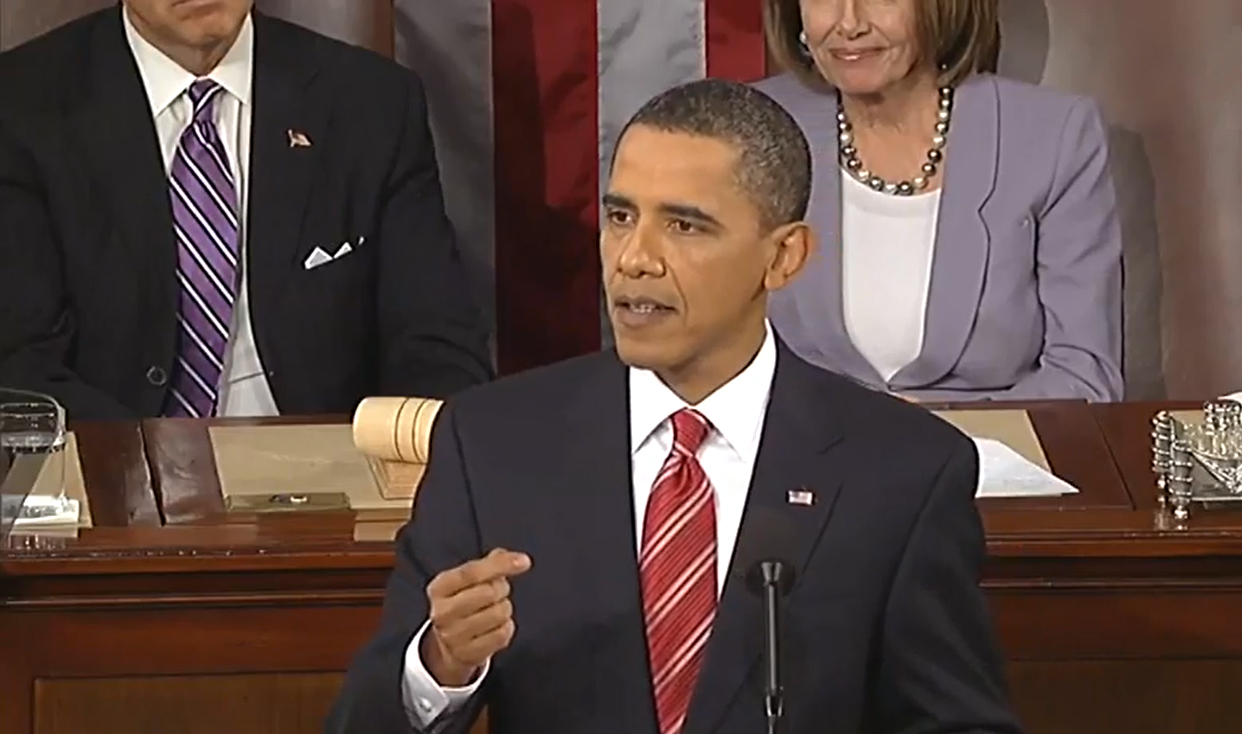
On January 27, 2010, in one of the most celebrated moments of his presidency, Obama stood in the rostrum of the U.S. House and called out to their faces the five members of the Supreme Court who had ruled six days earlier that the federal government has no authority to limit the independent political activity of corporations and unions.
“With all due deference to the separations of powers,” he said, “last week the Supreme Court reversed a century of law to open the floodgates for special interests — including foreign companies — to spend without limit in our elections. Well, I don’t think American elections should be bankrolled by America’s most powerful interests, and worse, by foreign entities, and that’s why I’m urging Democrats and Republicans to pass a bill that helps to right this wrong.”
Since then, Obama has sought to portray himself as the chief conscientious objector to Super PACs, the “independent” advocacy groups that grew out of the court’s Citizens United ruling. While Republicans jumped at the chance to pool huge sums of money from affluent donors, Obama claimed the good government high ground and largely held his own party back from playing the same game. Even though a White House-friendly Super PAC, Priorities USA, was launched a year ago by a former to Obama aide (Bill Burton), the president refused to exploit an FEC ruling that would have allowed him and other members of his campaign team and administration to take part in the group’s fund-raising events.
But all of that abruptly changed last night, with word that Obama has decided to give in and play the Super PAC game just as aggressively as his Republican opponents. As the New York Times reports:
Aides said the president had signed off on a plan to dispatch cabinet officials, senior advisers at the White House and top campaign staff members to make clear to donors that they should support Priorities USA Action, the leading Democratic “super PAC,” whose fund-raising has been dwarfed by Republican groups. The new policy was presented to the campaign’s National Finance Committee in a call Monday evening and was set to be announced Tuesday.
“Dwarfed” is definitely the right word. Fund-raising reports released last week showed that the pro-Mitt Romney Super PAC Restoring Our Future has outraised Priorities USA by more than seven-to-one. And that’s just one component of the Republican Super PAC arsenal. Sheldon Adelson, the casino magnate who has given $10 million to a Newt Gingrich-aligned group, is sending signals that he’ll move his support to Romney if the former Massachusetts governor is Obama’s fall opponent, while a Super PAC launched by Karl Rove has taken in more than $50 million.
In a post that went up on Obama’s official campaign site last night, campaign manager Jim Messina framed the decision as a pragmatic necessity, insisting that Obama still abhors the Citizens Unites ruling while arguing that “our campaign has to face the reality of the law as it currently stands”:
With so much at stake, we can’t allow for two sets of rules in this election whereby the Republican nominee is the beneficiary of unlimited spending and Democrats unilaterally disarm.
Therefore, the campaign has decided to do what we can, consistent with the law, to support Priorities USA in its effort to counter the weight of the GOP Super PAC. We will do so only in the knowledge and with the expectation that all of its donations will be fully disclosed as required by law to the Federal Election Commission.
The move calls to mind Obama’s decision four years ago to rationalize his way out of an early commitment to participate in the public financing system for presidential elections. Then as now Obama had a compelling financial incentive; by thumbing his nose at matching funds, he was able to create a massive gap between his own campaign treasury and that of his Republican opponent. The difference is that this time he’s doing it in the name of leveling the playing field.
In 2008, Obama took plenty of heat from good government-types and even from some supporters, and the same will probably be true this time. In a way, his decision is easy to justify: Given how important money is to modern campaigning and how close the November election is supposed to be, how could Obama not do everything in his his legal power to neutralize any GOP advantage? At the same time, it also reinforces the worst image of Obama — the guy who specializes in high-minded, inspirational rhetoric only to junk it the minute it becomes politically inconvenient.
For that matter, it’s also possible that Obama and his campaign are overreacting to the GOP’s Super PAC strength. After all, his own campaign has been raising huge sums of money. Through December 31, Obama had brought in $30 million more than Romney, Gingrich, Rick Santorum and Ron Paul combined; the main effect of his decision may just be to erase that edge while correcting the Super PAC imbalance. And anyway, a good case can be made that fundraising disparities actually don’t matter that much in presidential general elections provided both candidates enjoy a threshold level of support. But Obama apparently isn’t in the mood to take that chance.
Steve Kornacki writes about politics for Salon. Reach him by email at SKornacki@salon.com and follow him on Twitter @SteveKornacki
More Steve Kornacki.
FILE - In this May 8, 2012, file photo, Republican presidential candidate and former Massachusetts Gov. Mitt Romney speaks in Lansing, Mich. Romney is looking to pad his lead in the race for convention delegates in Republican presidential primaries Tuesday in Arkansas and Kentucky as he inches closer to the nomination he's all but certain to win. (AP Photo/Carlos Osorio, File) (Credit: AP)
When the New York Times reported recently that a pro-Mitt Romney super PAC might launch an ad campaign playing up President Obama’s link to Jeremiah Wright, Romney didn’t wait long to disavow it.
“I repudiate the effort by that PAC to promote an ad strategy of the nature they’ve described,” he said.
Not long after that, Donald Trump used an interview to restate his long, long-ago debunked claim that Obama was born in Kenya.
“That’s what he told the literary agent,” he told the Daily Beast. “That’s the way life works… He didn’t know he was running for president, so he told the truth. The literary agent wrote down what he said… He said he was born in Kenya and raised in Indonesia… Now they’re saying it was a mistake. Just like his Kenyan grandmother said he was born in Kenya, and she pointed down the road to the hospital, and after people started screaming at her she said, ‘Oh, I mean Hawaii.’ Give me a break.”
Trump is a prominent Romney supporter and is scheduled to appear with the candidate in Las Vegas today. But when reporters on Romney’s campaign plane offered Romney the chance last night to distance himself from Trump’s lunacy, he demurred.
“You know,” he said, “I don’t agree with all the people who support me, and my guess is they don’t all agree with everything I believe in. But I need to get 50.1 percent or more, and I’m appreciative to have the help of a lot of good people.”
It’s a weak excuse, obviously, since the same concern didn’t stop him from lashing out at the proposed Wright ad. The question is why Romney is so nervous about raining on Trump’s birther parade.
There are two basic theories here, and they probably overlap somewhat. One has to do with Romney’s relationship with the Republican Party base, where birther sentiment and sympathy for Trump can both be found in high concentration. It may be that Romney has decided that confronting those feelings could further arouse suspicions among conservatives that he’s a secret moderate who will sell them out as president.
The other theory has to do with Trump and his massive media profile. When he sounds off on current events, his reach extends far beyond the world of cable news and political blogs. He’s a genuine national celebrity, one who delights in using his platform to abuse anyone who’s crossed him personally.
Right now, Trump’s ire is focused on Obama, but he’s shown that he’s ready to open fire on Republicans who challenge his birtherism. Just look at his war of words with George Will that’s now playing out. Maybe Romney figures it’s easier to bite his tongue and take some heat from the media than to endure six months of Trump calling him names on every television program in America.
Either way, the Romney camp is looking at this situation too narrowly.
Let’s say that Romney were to come out and make a clear and emphatic break with Trump – calling birtherism invalid, stating that it has no role in the campaign, and reiterating his intent to wage a campaign about the issues (and, of course, Obama’s “failed leadership”). Realistically, what would happen?
Well, it would be a huge story, of course, with Trump probably throwing a hissy-fit. But so what? Republican leaders would stand with Romney, and the voices decrying him (besides Trump’s) would be relegated to the fringes. Maybe some rank-and-file conservatives would turn on Romney because of it, but ultimately it’s Obama-phobia that animates the GOP base. Meanwhile, the media would offer Romney glowing coverage for standing up to Trump, who – by the way – isn’t actually that popular with the masses. For once, Romney would come across as strong and principled. The image boost with swing voters would probably be significant, dwarfing whatever intraparty damage he’d suffer.
It was almost exactly 20 years ago that Bill Clinton staged his “Sister Souljah moment,” using a speech at Jesse Jackson’s Rainbow Coalition to decry a black rapper who had been quoted in the wake of the L.A. riots as saying that blacks had a reason to kill whites. This supposedly was a key part of Clinton’s successful bid to sell himself as a new Democrat, one who was unbeholden to and unafraid of his party’s base.
Trump’s bloviating is an opportunity for Romney to do the same thing – but he and his campaign are apparently blind to it.
Steve Kornacki writes about politics for Salon. Reach him by email at SKornacki@salon.com and follow him on Twitter @SteveKornacki
More Steve Kornacki.
One of the goals of Barack Obama’s campaign is for voters to see Mitt Romney as an out-of-touch rich guy who’s far more attuned to the concerns of corporate executives, bankers and the affluent than middle- and working-class Americans.
The good news for the Obama team is that they’re well on their way to achieving this goal. Further data from an ABC News/Washington Post poll released this morning finds that voters by a 65 to 24 percent margin believe Romney would do more to advance the interests of wealthy Americans. Romney also wins by a big spread on the question of who would do more for financial institutions, 56 to 32 percent. At the same time, Obama enjoys a healthy 9-point advantage, 51 to 42 percent, on who will do more to help the middle class.
The problem for Obama: This isn’t translating into much of an overall lead. In the ABC/WaPo poll, he’s clinging to a 3-point edge, 49 to 46 percent, while the Real Clear Politics average of all polls puts his lead at just under 2 points. There are a lot of voters, in other words, who see Romney pretty much as the Obama campaign wants them to see him but who are still willing to support him anyway.
This speaks to the challenge of running for reelection against a backdrop of pervasive economic anxiety. It gives swing voters a strong incentive to vote the incumbent out, and tends to lower the bar in terms of what they’re willing to accept in a challenger candidate. The ABC/WaPo numbers offer a glimpse of this phenomenon at work.
When it comes to making the race competitive, the key for Romney seems to be a specific type of voter: white, middle-/working-class, and economically struggling. The poll finds that these voters agree with the idea that Romney will better serve the interests of the rich and financial institutions, but that they also see him as better for the middle class. According to the Post’s write-up:
Among white voters trying to stay in the middle class, Romney is considered the better candidate for that group by a 20-point margin; Obama is preferred by better than 3 to 1 among middle-class nonwhite voters, regardless of their sense of security.
This dovetails with earlier polling that showed Obama’s support from non-college-educated white voters – which was never that strong to begin with – plunging to new lows, particularly with men. Several theories have been proposed to explain this, including the idea that it reflects the culture-based attacks and insinuations that have been a staple of the right’s opposition to Obama. There may be something to that, but according to ABC/WaPo nearly three-quarters of whites who say they’re struggling lack college degrees, so they’re sympathy to Romney might simply reflect their own economic anxiety, and their instinct to punish whoever’s running the country for it.
That’s precisely the instinct that Romney’s message is designed to stoke. His economic pitch is in many ways contradictory and incoherent, but that’s intentional. Romney isn’t trying to sell Americans on some detailed, comprehensive plan to rebuild the economy. His goal is to offer broad, pleasant-sounding policy prescriptions while playing up dire statistics and anecdotes about the economy and the deficit. When you really boil it down, as I’ve written before, the Romney message is simply this: If you’re feeling anxious about the economy, don’t ask questions – just vote out the guy in charge. The ABC/WaPo numbers are an indicator of the potential effectiveness of that strategy.
Steve Kornacki writes about politics for Salon. Reach him by email at SKornacki@salon.com and follow him on Twitter @SteveKornacki
More Steve Kornacki.
In this May 2, 2012 file photo, Democrat candidate for the U.S. Senate Elizabeth Warren responds to questions from reporters on her Native American heritage during a news conference at Liberty Bay Credit Union headquarters, in Braintree, Mass.(Credit: AP Photo/Steven Senne, File)
Reports of Elizabeth Warren’s demise have been greatly exaggerated. A new Suffolk University poll puts the consumer advocate in a virtual tie with Massachusetts Sen. Scott Brown, who holds a statistically insignificant 48 to 47 percent lead.
This comes after weeks of intense controversy over whether Warren had advanced her academic career by claiming Native American ancestry based on being 1/32 Cherokee. As the story dragged on, members of her own party groaned at her handling of it, critics charged that she was being evasive, and the press speculated whether Democrats were about to endure a repeat of the Martha Coakley debacle.
The Cherokee story, according to the survey, has definitely dented the public’s consciousness; 72 percent of voters say they’re aware of it. But by a 49 to 28 percent margin, they also say that Warren is telling the truth about it, and by a 45 to 41 percent margin they say she didn’t benefit professionally from listing herself as Native American back in the 1990s.
“I’m not saying there was no damage from the Native American thing, but if you zoom out to see what the net effect was, it was minimal,” David Paleologos, who conducted the poll, told the Boston Globe. “It’s considered a nonstory.”
There are hints of the story taking a toll on Warren’s image. Her unfavorable score is up 5 points from the last Suffolk poll in February, from 28 to 33 percent, while her favorable score sits at 43. Brown, by contrast, has a more robust 56 to 28 percent favorable rating. In that February poll, Brown enjoyed a 9-point lead over Warren, 49 to 40 percent, but that result was dismissed by both sides as an outlier – not that it’s stopping Democrats now from crowing that Warren is surging.
Really, though, the poll just shows that the race is back to being the nail-biter everyone’s long assumed it would be. If the outcome was based strictly on personal popularity, Brown would win easily. But the Republican label is a profound liability in Massachusetts, especially for candidates for federal office. This is why the Suffolk poll also finds Brown failing to break 50 percent against Maria DeFranco, Warren’s little-known Democratic primary opponent. (In a head-to-head race with Warren, DeFranco trails 71 to 6 percent.)
Warren’s challenge isn’t to become better-liked than Brown; it’s to make herself likable and acceptable enough for voters who are fond of and identify with Brown but don’t want to send a Republican vote to the Senate. On this front, there are some encouraging signs for her in the poll. She beats Brown 49 to 36 percent on the question of who will better represent middle-class families and 40-37 percent on who is more honest. And she’s not far behind him (47-42) on who’s more independent – a trait Brown has tried to make his calling card.
Steve Kornacki writes about politics for Salon. Reach him by email at SKornacki@salon.com and follow him on Twitter @SteveKornacki
More Steve Kornacki.
There’s a large swath of rural America, extending from somewhere in Oklahoma up into West Virginia, where Barack Obama never had a chance, and it really showed last night.
A majority of Kentucky’s 120 counties voted against Obama in the state’s Democratic presidential primary, opting instead for “uncommitted.” Big margins in Louisville and Lexington saved the president from the supreme embarrassment of actually losing the state, not that his overall 57.9 to 42.1 percent victory is anything to write home about.
In Arkansas, the other state to hold its primary yesterday, the results were only slightly less humbling to Obama, who defeated an actual human-being candidate — a Tennessee lawyer named John Wolfe — by a 58.4 to 41.6 percent spread, with more than a third of the state’s 75 counties siding with the challenger. Wolfe, if anyone asked him, was running against Obama from the left, on a progressive economic message. But to the average Arkansas voter, his name might just as well have been “not Obama”; he had no money, no campaign organization, and no name recognition, and he received scant media coverage.
Whether this qualifies as Obama’s most humbling primary night of 2012 is open to debate. Just two weeks ago, a federal inmate who somehow maneuvered his way onto the West Virginia ballot racked up nearly 41 percent against the president in that state’s primary and carried 10 counties. Back in March, Obama was held to 57 percent in Oklahoma, losing 15 counties to anti-abortion zealot Randall Terry and another gadfly candidate. Terry actually qualified for delegates in that contest, prompting national Democrats to invoke their “LaRouche rule” and deem him unqualified to actually receive delegates.
There were also problems for the president in pockets of Louisiana, where Wolfe cleared the 15 percent delegate eligibility threshold in several congressional districts. Democrats are refusing to actually allocate any delegates to him, though, on the grounds that he failed to file a comprehensive delegate selection plan – a rationale that is also being invoked in Arkansas. Wolfe is vowing to overturn the rulings in court.
In terms of deciding the Democratic nomination, obviously, none of this really matters. Obama has won most states by the massive margins that incumbent presidents typically rack up against fringe challengers and “uncommitted,” and he long ago surpassed the magic number of delegates needed for re-nomination. In most of America, this year’s Democratic primaries have been just as uneventful and unremarkable as they were in 1996, the last time a Democratic incumbent sought reelection.
But then there’s that sea of resistance in Appalachia and states like Arkansas and Oklahoma. A case can be made that Obama’s energy policies contributed to his West Virginia headache, but otherwise there’s no sense trying to pin this on anything he’s actually done as president because the resistance was just as apparent when he ran four years ago.
Back then, Obama was crushed by Hillary Clinton in West Virginia by 41 points – even though it was clear by primary day that he was on his way to being the nominee. In Kentucky, Clinton’s margin was 35 points. In Arkansas (where she served as first lady for more than a decade), it was 44. And in Oklahoma, it was 25. The same largely poor, rural and white areas that gave Clinton her best numbers in 2008 are now doing the same for John Wolfe, “uncommitted” and Randall Terry. The problem was just as apparent for Obama in the fall of 2008, when he improved on John Kerry’s 2004 performance in just about every corner of the country except the Oklahoma-to-West-Virginia swath.
Chalking this up only to race may be an oversimplification, although there was exit poll data in 2008 that indicated it was an explicit factor for a sizable chunk of voters. Perhaps Obama’s race is one of several markers (along with his name, his background, the never-ending Muslim rumors, and his status as the “liberal” candidate in 2008) that low-income white rural voters use to associate him with a national Democratic Party that they believe has been overrun by affluent liberals, feminists, minorities, secularists and gays – people and groups whose interests are being serviced at the expense of their own.
The good news for Obama is that this probably doesn’t say much about what will happen in November. The damage is limited to states he was already expecting to lose to Mitt Romney. Not that this will stop Republicans from playing up Kentucky and Arkansas as the latest proof of Obama’s shattered popularity. But that’s just spin. He could have a 60 percent approval rating, and he’d still be getting embarrassed in these states.
Steve Kornacki writes about politics for Salon. Reach him by email at SKornacki@salon.com and follow him on Twitter @SteveKornacki
More Steve Kornacki.
Cory Booker did an awful lot of talking last night, but he didn’t really say anything.
After refusing requests all day, the Newark mayor agreed late in the day to a live interview on Rachel Maddow’s MSNBC show. By this point, Republicans had launched an online petition urging their supporters to “stand with Cory” against the Obama campaign’s “attacks on the free market.”
“It wasn’t until the GOP went across that line that I said, ‘Forget it. I’ve heard all I can stand and I can’t stand no more,’” Booker told Maddow when the interview started.
If you only watched Booker’s 12-minute performance last night, you’d probably be tempted to believe his claim of near-total innocence and even victimhood in an episode that overtook the presidential campaign Monday. This only makes sense; Booker can talk with the best of them. But in all of his earnest pleadings and verbose answers, he never actually confronted what landed him in hot water in the first place.
On Sunday’s “Meet the Press,” Booker seemed to call the Obama campaign’s attacks on Mitt Romney’s private equity record “nauseating” and to liken them to efforts by some on the right to make Jeremiah Wright an issue in the race. On Maddow’s show, he played off the “nauseating” line as a reference to super PAC-era negative campaigning in general and copped only to some sloppy phrasing.
“Obviously, I did things in the ‘Meet the Press’ interview, as I told you, that did not land the points that I was trying to make,” Booker said. “And in some ways, frustratingly, I think I conflated the attacks that the Republicans were making with Jeremiah Wright with some of the attacks on the left. And those can’t even be equated.”
And as he did in a hastily produced video on Sunday night, Booker insisted that Romney’s Bain Capital past is fair game, and that he’s happy to “echo” Obama’s efforts to highlight it. Other than that, though, Booker mainly talked around the private equity issue. He invoked marriage equality several times, the war on women, universal healthcare and college tuition affordability, and bragged that “I’ve been standing with Barack Obama since before most people were standing with Barack Obama.” He also excoriated Republicans for not focusing on issues affecting cities like his and moralized at length about the corrosiveness of attack ads.
This was damage control at its slipperiest. The reality is that Booker did more than just clumsily register his objections to the negative tone of politics on “Meet the Press.” He specifically stood up for Romney’s private equity firm and its record:
“I have to just say from a very personal level, I’m not about to sit here and indict private equity. To me, it’s just we’re getting to a ridiculous point in America. Especially that I know I live in a state where pension funds, unions and other people invest in companies like Bain Capital. If you look at the totality of Bain Capital’s record, they’ve done a lot to support businesses, to grow businesses.”
He had no interest in grappling with this in his Maddow interview, though, so he filibustered.
What’s happening here really isn’t that complicated. Booker, like many Democrats (especially in the New York/New Jersey area), spent years cultivating Wall Street and the investor class. He was better at it than most, building an enviable network of elite financial supporters by leveraging personal ties (from his Stanford/Yale/Oxford days) and convincing them that he shared their basic worldview.
In the Clinton-era, this was a standard part of the Democratic playbook, but in post-meltdown America, intimate ties to Wall Street can be poisonous inside the party. Booker, who likes to portray himself as a third way/new politics figure, clearly didn’t appreciate this before Sunday. And now, with Democratic activists turning on him, he’s scrambling to put out the fire – without completely contradicting himself or permanently alienating the Wall Street base that will still be crucial to his statewide political aspirations.
The result was his 12-minute display of charismatic evasion last night.
* * *
After Booker’s interview last night, I was on MSNBC’s “The Last Word” to talk about it:
Steve Kornacki writes about politics for Salon. Reach him by email at SKornacki@salon.com and follow him on Twitter @SteveKornacki
More Steve Kornacki.
Steve Kornacki surveys the burgeoning and bloated world of political news and opinion and explains the day's most essential story in Opening Shot, posted by 8:30 a.m. each weekday. Bookmark this page; follow @SteveKornacki on Twitter.