
Opening Shot

Mitt Romney’s night from hell

A stunning sweep by Rick Santorum pushes the GOP race closer than ever to complete chaos

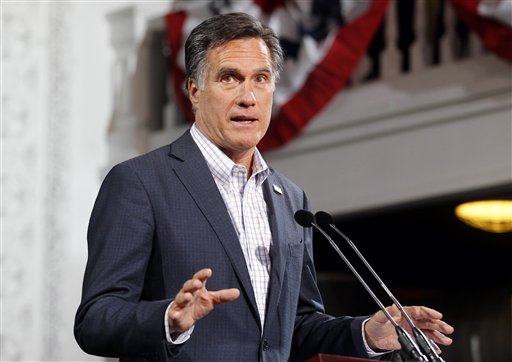
Republican presidential candidate, former Massachusetts Gov. Mitt Romney speaks at his Colorado caucus night rally in Denver, Tuesday, Feb. 7, 2012. (AP Photo/Gerald Herbert) (Credit: AP)

Don’t be fooled by the fact that no delegates were directly awarded – what happened in the Republican presidential race on Tuesday night is very significant.

The headline is that Rick Santorum won monster victories in the Minnesota caucuses and in Missouri’s non-binding primary and that he completed the sweep in Colorado, where his surprise victory over Romney was made official around 1 a.m.

But the bigger story is what amounts to a meltdown for Romney, who would like us all to believe that he’s the candidate of inevitability. But the inevitable candidate isn’t supposed to get crushed by 30 points, as Romney did in Missouri. And he’s not supposed to finish a very distant third, 10 points behind Ron Paul, as he did in Minnesota. And he’s certainly not supposed to let a candidate like Rick Santorum, who before tonight had barely been relevant since the Iowa caucuses, post the clean sweep Santorum just did.

Romney’s campaign knew trouble was coming, which is why they started Tuesday by releasing an expectations-lowering memo that pointed out that John McCain lost 19 individual contests in the 2008 race and emphasized the long game. And they hoped that the fact that no delegates were directly at stake in any contests would lead the media to downplay the results.

But the delegate situation was mostly a red herring. Really, there was no difference between the caucuses in Minnesota and Colorado and those that were held in Iowa on Jan. 3. In all three states, Republicans gathered at precinct caucuses that officially functioned as the first in a multi-step process to choose national convention delegates. At the local caucuses, Republicans were polled on their presidential preference, with the results not tied to delegate allocation. So if the political world is going to treat Iowa as a legitimate nominating contest, there’s no reason not to extend the same treatment to Colorado and Minnesota.

And while Missouri’s primary truly was a beauty contest (no delegates of any type were selected or allocated), 250,000 Republicans voters still turned out for it. That number is considerably lower than the 2008 total, but it still represents a significant statement by that state’s Republican electorate, especially when you consider that Romney only mustered a quarter of the vote without one of his chief foes on the ballot.

The results point to two specific trouble areas for Romney that probably have some overlap. The first is regional. So far this primary season, he seems to be struggling in the Midwest, losing every contest that’s been held in the region. The other is demographic. The contests in which evangelical Christians hold the most sway have so far been the most problematic for Romney. No exit polls were conducted on Tuesday, but all three states have substantial evangelical pockets – and the activist-oriented caucus environments of Minnesota and Colorado probably increased those voters’ importance.

More broadly, the results underscore the widespread reluctance to get behind Romney that continues to exist among the GOP base. Romney’s campaign can write off Missouri because of the unusual circumstances there and argue they didn’t focus much energy or money on Minnesota, but that only points to the degree to which Romney’s nomination strategy depends on attacking his rivals and overwhelming them financially.

February was supposed to be a cruise control month for Romney – a series of effortless, momentum-building victories that would marginalize his opponents and lead to one emphatic, nomination-sealing sweep on Super Tuesday. Instead, he now faces a real challenge just to make it through the rest of the month, which will include contests in Michigan and Arizona, without any more embarrassments. And the prospect of further setbacks in early March, when Ohio and several Southern states that are culturally ill-suited to Romney will vote, now seems likely.

What’s worse for Romney is that Santorum may get such a boost out of his big night that he further marginalizes Gingrich and gets the one-on-one shot at Romney that he’s long coveted. In this sense, the Missouri result may actually be meaningful; Gingrich wasn’t on the ballot, but it seems that his would-have-been supporters flocked to Santorum. If Gingrich fades out now and Santorum claims the lion’s share of his voters, he could do some real damage – maybe even this month. The flip side, of course, is that Santorum will now experience what Gingrich has faced for the past few weeks: a withering and well-funded assault from the Romney campaign.

Still, after Tuesday night, the finish line in the GOP race seems farther away than ever.

Steve Kornacki

Steve Kornacki writes about politics for Salon. Reach him by email at SKornacki@salon.com and follow him on Twitter @SteveKornacki

Booker, in retreat

His attempt to downplay his “nauseating” comment doesn’t pass the sniff test

It didn’t take long for Cory Booker to get the message. Just hours after undermining the Obama campaign’s main line of attack against Mitt Romney, the Newark mayor released a video late Sunday afternoon in an effort to repair some of the damage.

Booker had seemed to pronounce the Obama effort to highlight unflattering aspects of Romney’s private equity background “nauseating,” but in the video, he suggested he was making a broader statement about negative campaigning.

“I used the word ‘nauseating’ on ‘Meet the Press’ because that’s really how I feel when I see people in my city struggling with real issues and still feeling the challenges of this economy, and still looking for hope and opportunity and real specific plans,” Booker said. “I get very upset when I see such a level of dialogue and calls to our lowest common denominator.”

But he insisted that he sees Bain as a legitimate topic for Obama to raise: “Let me be clear. Mitt Romney has made his business record a centerpiece of his campaign. He’s talked about himself as a job creator. And therefore it is reasonable — and in fact I encourage it — for the Obama campaign to examine that record and discuss it. I have no problem with that.”

Booker’s new line is a bit hard to swallow, though, because his “Meet the Press” comments clearly went beyond simply decrying the tone of the campaign. At one point, he offered a pointed defense of Romney’s Bain past, saying:  “I’m not about to sit here and indict private equity. If you look at the totality of Bain Capital’s record, it — they’ve done a lot to support businesses, to grow businesses. And this to me — I’m very uncomfortable.”

An RNC spokesman told Politico that “it’s clear this video was orchestrated by the Obama campaign,” which certainly sounds plausible. Shortly after Booker posted his clarification, an Obama campaign press secretary tweeted out a link to a condensed version of it featuring only Booker’s statement about Bain being fair game.

As I noted yesterday, Booker has throughout his political career cultivated and maintained close ties to Wall Street and affluent, investor class donors – people who, in many cases, believe the administration has declared war on their world and see the Bain attacks as an extension of that effort. Booker’s statewide political aspirations are no secret in New Jersey, and the presumption is that he’s eyeing a Senate run in 2014 (others have mentioned him for governor next year, but that’s less likely for a number of reasons).

Booker’s actions on Sunday are best understood in that context. In sticking up for private equity, he was tending to a financial base that’s been there for him before and that he’ll need in the future. Running ads in the New York and Philadelphia markets is an expensive proposition, so Booker will need a ton of cash for a statewide run. And in rushing to clarify (but not exactly retract) what he said, Booker was trying to contain the damage with a Democratic Party base that likes Obama and has no problem with his attacks on Bain.

In a way, the episode is simply a high-profile illustration of the very real tension that exists, especially in the New York area, between elite Democratic donors and rank-and-file voters. Booker is hardly the only tri-state region Democrat who’s cultivated Wall Street, but in 2012 not many are as open about it as he is.

Continue Reading Close
Steve Kornacki

Steve Kornacki writes about politics for Salon. Reach him by email at SKornacki@salon.com and follow him on Twitter @SteveKornacki

The GOP healthcare farce

The past 24 hours are a case study in why Republicans have virtually nothing to say on how to replace Obamacare

House Speaker John Boehner of Ohio speaks at the Peter G. Peterson Foundation's 2012 Fiscal Summit, Tuesday, May 15, 2012, in Washington. (AP Photo/Manuel Balce Ceneta) (Credit: AP)

House Republican leaders put out the word on Wednesday night that they’ll be prepared to swing into action if the Supreme Court invalidates President Obama’s healthcare law next month.

The political necessity of this was obvious: “Obamacare” itself doesn’t tend to poll that well, but some of its individual components do, and when voters are asked which party they trust more on healthcare, Democrats enjoy a clear advantage. So if the court does away with the law, it will be hard for Republicans to hit the campaign trail this fall without having some sort of plan that they can point to for dealing with the issue.

Of course, calling what GOP leaders leaked a “plan” is really stretching the term. As stories in the New York Times and Politico made clear, the intent seemed more to shield the party from Democratic attacks that it helped kill off provisions of the law that are actually popular:

If the law is partially or fully overturned they’ll draw up bills to keep the popular, consumer-friendly portions in place — like allowing adult children to remain on parents’ health care plans until age 26, and forcing insurance companies to provide coverage for people with pre-existing conditions. Ripping these provisions from law is too politically risky, Republicans say.

The problem, as critics were quick to note, is that the popular components of Obamacare are only made feasible by the unpopular parts. Forcing insurance companies to cover preexisting conditions only makes sense with the individual mandate that Republicans abhor, since it compels young and healthy people who would otherwise forgo coverage to enroll too. Beyond that, the Times reported, the House GOP was prepared to consider a variety of modest measures that might bring down insurance premium rates slightly:

Republicans are dusting off proposals that date back more than a decade: allowing individuals to buy health insurance across state lines, helping small businesses band together to buy insurance, offering generous tax deductions for the purchase of individual policies, expanding tax-favored health savings accounts and reining in medical malpractice suits.

But even this may be too much for the right. By late Thursday morning, just hours after the GOP leadership’s plans were leaked, Rep. Paul Ryan threw cold water on the idea that Republicans would offer any specific legislation before the November election, telling the Washington Examiner: “Now, we’ve got nine weeks of session left. Do we want to cram through our own 2,700 page vision? No, that’s what the country hated. But do we believe in patient-centered health care and market-based medicine? A lot of us have put time and effort into this, yeah.”

And by the end of the day, Politico reported that a revolt had broken out on an influential conservative Google email group that GOP House leaders monitor, where the sentiment seemed to be that publicly supporting any components of Obamacare – even the popular ones – would amount to a sellout of conservative principles.  The uprising, according to Politico, began almost as soon as the stories leaked Wednesday night, leading to this:

Cognizant of the conservative anger, Dave Schnittger, Boehner’s longtime deputy chief of staff, sent a separate email to a small group of fellow leadership aides Wednesday night, saying that, during his weekly media availability, the speaker would “knock … down” the plan that had leaked.

Boehner did not address health care once in his 12-minute news conference. Aides say he was prepared to talk about it — if the issue came up.

One of the first moves Republicans made when they reclaimed the House in 2011 was to pass legislation repealing the healthcare law. It was a symbolic move, since it had no chance of clearing the Senate, but it was also billed as the first step. Soon, Republicans insisted, they’d unveil a new, better plan to replace Obamacare. More than a year later, that plan still hasn’t seen the light of day, and if the events of the last 24 hours are any indication, there’s not going to be one before the election – or maybe ever.

Continue Reading Close
Steve Kornacki

Steve Kornacki writes about politics for Salon. Reach him by email at SKornacki@salon.com and follow him on Twitter @SteveKornacki

They just can’t let Rev. Wright go

An anti-Obama billionaire may bankroll a campaign that would “do exactly what John McCain would not let us do”

In this March 25, 2010 file photo, Rev. Jeremiah Wright speaks at Jackson State University in Jackson, Miss. (AP Photo/Rogelio V. Solis, File) (Credit: AP)

There’s a persistent belief on the right that President Obama snuck into office in 2008 because an awestruck media refused to look into his background and personal associations, preventing voters from learning about all sorts of radical, anti-American connections that would have turned them against the Democratic nominee. In this narrative, John McCain also comes in for criticism because of his refusal to fully exploit Obama’s ties to Rev. Jeremiah Wright during the general election.

This is the mind-set that, according to a New York Times story from Jeff Zeleny and Jim Rutenberg, has a billionaire super PAC overseer mulling a $10 million anti-Obama ad blitz that’s designed to “do exactly what John McCain would not let us do.”

According to the Times, Joe Ricketts, the Ameritrade founder whose super PAC just played a crucial role in the upset victory of a Sarah Palin-backed candidate in Nebraska’s Republican Senate primary, has been presented with a 54-page blueprint drawn up by GOP media consultant Fred Davis, who produced the anti-Obama “Celebrity” ad that the McCain campaign ran four years ago:

“Our plan is to do exactly what John McCain would not let us do: Show the world how Barack Obama’s opinions of America and the world were formed,” the proposal says. “And why the influence of that misguided mentor and our president’s formative years among left-wing intellectuals has brought our country to its knees.”

The story includes all kinds of interesting tidbits about the proposal, including its suggestion that the super PAC hire an “extremely literate conservative African-American” as a flack in order to deflect charges of race-baiting.

The reality, though, is that even if Ricketts signs off on the plan – and the story makes it clear that it’s just one of several options he’s mulling – it won’t have the devastating impact its authors envision. It probably won’t have much, or any, impact at all.

For one thing, the notion that Obama wasn’t fully vetted by the press in 2008 and that voters are in the dark about all sorts of troubling biographic details and character traits just doesn’t compute. The Rev. Wright issue, for instance, was covered exhaustively by the press, enough to compel Obama to deliver a lengthy speech on race that, if anything, probably made him more appealing to the average swing voter. And while McCain may not have authorized ads about Wright, many of his allies on the right (not to mention his own vice presidential nominee) filled the air with warnings about Obama’s secret radicalism. None of this seemed to move voters back then.

And nothing that has happened in the intervening four years has given Americans any reason to believe that there was anything to the radicalism charges of ’08. Obama’s approval rating isn’t that great right now, but it’s because the economy is in rough shape and voters are questioning his policies. It’s not because he’s said or done anything that validates the charge of radicalism; the policies he’s pursued are entirely within the mainstream of the Democratic Party. So the idea that a bunch of ads that dredge up a four-year-old controversy will make voters suddenly conclude that the warnings were right seems entirely off-base.

More to the point, the airwaves will be awash in political ads this summer and fall, with the Obama and Romney campaigns and all sorts of party committees, independent groups and super PACs launching their own multimillion-dollar campaigns. The Wright ads probably wouldn’t stand out nearly as much as the Davis blueprint suggests. And, as Jonathan Bernstein has pointed out, “voters will pay less attention to information they hear through paid advertising when there is plenty of other information available, as is the case with high-profile presidential elections.”

What the news about Ricketts and his super PAC could do, however, is put Mitt Romney in a bit of an awkward spot. The law prohibits him from coordinating with super PACs, but that doesn’t mean the media won’t demand that he make a statement over whether he thinks the Wright stuff is fair game.

It’s clearly not a road that the Romney campaign and most Republican leaders want to go down. They (mostly) recognize that Obama is more personally popular with Americans than their party’s base realizes, and that there’s a real political risk in pushing too far on race/culture-based attacks on him. This is why, for instance, Haley Barbour has been arguing that the GOP’s general election effort should focus on Obama’s record, not on anything personal.

Continue Reading Close
Steve Kornacki

Steve Kornacki writes about politics for Salon. Reach him by email at SKornacki@salon.com and follow him on Twitter @SteveKornacki

Dems’ best friend: The GOP base

The conservative masses revolt again, this time in Nebraska's Senate primary

At the very least, the Republican Party base’s revolt against its own establishment cost the GOP a 50-50 Senate tie in 2010, with primary voters forcing unelectable nominees on the party in three races that it had otherwise been on course to win. A decent case can be made that the uprising actually cost Republicans outright Senate control.

And now the same thing may be happening all over again, with Nebraska joining a growing list of unexpected 2012 Senate battlegrounds – at least for the moment.

The impetus is the surprise victory of Deb Fischer, a little-known state legislator, over two seasoned opponents in Tuesday’s Nebraska Republican Senate primary. Fischer’s candidacy seemed dead in the water until about a week ago, when she was endorsed by Sarah Palin. A last-second ad blitz from a super PAC controlled by the founder of Ameritrade added to her momentum, and Fischer ended up beating out state Attorney General Jon Bruning, who had been the favorite, by 5 points.

The outcome was greeted with immediate joy by Democrats, with the DSCC putting out a statement calling Fischer an “untested” and “accidental” nominee for the seat being vacated by Democrat Ben Nelson. The hope for Democrats is that the 61-year-old Fischer, who has represented a rural western Nebraska district in the state Senate since 2005, will melt under the spotlight of a high-stakes general election contest – much the way Sharron Angle, Christine O’Donnell, Ken Buck and Joe Miller did in 2010.

This may prove to be wishful thinking. Fischer could end up being a perfectly competent candidate, one who isn’t prone to erratic behavior and pointlessly inflammatory rhetoric and who doesn’t have any serious skeletons in her closet. Certainly, she showed strong communication skills in her acceptance speech Tuesday night. And because of Nebraska’s deep red shading and its particular antipathy toward Democrats in the Obama era, Fischer’s margin for error is probably substantial. The same mistakes that derailed Angle in Nevada may only be the difference between, say, a 20- and 10-point win in Nebraska.

That said, Fischer absolutely is an untested candidate. Bruning and the race’s other major candidate, state Treasurer Don Stenberg, spent months firing shots at each other and gobbling up all of the attention. The intensity of their battle probably helped create the opening that Fischer seized, but the late timing of her surge also spared her from facing much in the way of media scrutiny or attacks from her rivals. She raised and spent very little money, and not much is known about her.

For Democrats, that’s reason to cheer. Had Bruning (or even Stenberg, a veteran of eight previous statewide campaigns) won the primary, the general election race would have been a snore. Polls showed both men comfortably ahead of the Democratic candidate, former Sen. Bob Kerrey, who won elections in the state in 1982 (for governor), 1988 and 1994, back when he was something of a local hero. But Kerrey spent the last decade running the New School in New York and hasn’t been on a Nebraska ballot in 18 years. Partisan divisions have hardened since then, and Kerrey now faces cries of carpetbagging.

There are no meaningful Fischer/Kerrey poll numbers out yet. Presumably, the GOP nominee will begin with a solid lead, just because this is Nebraska (and because right now she embodies a neat underdog story). The question is how she’ll hold up, and on that score there’s some real doubt, which means that Nebraska is in play, at least provisionally.

Add in Indiana, where the Tea Party-aligned Richard Mourdock knocked off Dick Lugar last week, and two GOP primaries in one week have resulted in a surprise general election opportunities for Democrats. And primary season isn’t over yet. As Josh Kraushaar notes, the GOP’s grass roots seem poised to rise up against former Gov. Tommy Thompson in Wisconsin; that race is already considered a tossup, but a weak GOP nominee could tip the scales.

Other developments over the last year have also bolstered Democrats’ chances of holding the Senate, including the emergence of Elizabeth Warren in Massachusetts (her recent troubles notwithstanding), Olympia Snowe’s unexpected retirement in Maine, and encouraging news from Arizona and maybe even North Dakota. What looked like an awful Senate map for Democrats at the start of this cycle has come to seem more manageable – even more so after Tuesday night’s shocker in Nebraska.

Continue Reading Close
Steve Kornacki

Steve Kornacki writes about politics for Salon. Reach him by email at SKornacki@salon.com and follow him on Twitter @SteveKornacki

A brand-new Sarah Palin headache

Don’t look now, but her candidate might be on the verge of a huge upset in Nebraska today

Sarah Palin (Credit: AP)

Let’s be clear: No matter what, Republicans in the state of Nebraska will be nominating a very conservative candidate for the U.S. Senate today. But the sudden prospect of a surprise victory by an underfunded state legislator best known for the endorsement she received from Sarah Palin lends potential national significance to tonight’s outcome.

To set the stage, the front-runner in the race is (and has been the entire way) Jon Bruning, Nebraska’s third-term attorney general. The 43-year-old Bruning has made some gestures to his party’s restive base, suing the Obama administration over its healthcare reform law and contraception mandate and likening welfare recipients to raccoons. But his polished demeanor and political resume – elected to the state Senate at age 27, a seamless rise to the AG’s office six years later, and now a Senate bid – make him seem more like an establishment man on the rise.

Which can be a problem in the Tea Party era. Conservative leaders and voters today aren’t as easily satisfied as they once were by candidates who are with them on paper. They want proof of absolute commitment to the cause – reason to believe that a would-be senator won’t ever compromise away a single conservative principle, no matter how much pressure is coming from party leaders, polling and the press. And Bruning, who has had to contend with revelations about his personal investments in state-regulated businesses and his purchase of a summer home with two executives from a company that the AG’s office had previously sought to help, doesn’t really have the image of a true believer.

Until very recently, Bruning’s main challenger for the GOP nomination was supposed to be Don Stenberg, the current state treasurer and a former attorney general. Backed by some serious money from the Club for Growth, Sen. Jim DeMint’s Senate Conservatives Fund and FreedomWorks, Stenberg has been portraying himself as the candidate of purity and pounding away at Bruning. But Stenberg, a veteran of three failed Senate bids and two other statewide offices, is something of a perennial candidate, and he lacks the freshness and outsider credentials that Tea Party conservatives tend to respond to. Thus did Bruning still seem poised to win the primary … until last week.

That’s when Palin came through with a surprise endorsement of the third candidate in the race, Deb Fischer, whose personal story is the most naturally appealing to the Tea Party crowd. The 61-year-old didn’t enter politics until 2004, when she won a seat in the state Senate, and on the campaign trail plays up her work as a rancher. She doesn’t ooze the same ambition as her opponents, and of the three candidates she’s the most likely to be immune to Potomac Fever.

The Palin announcement offered a huge jolt of momentum to Fischer’s effort, and was followed a day later by an endorsement from 1st District Rep. Jeff Fortenberry. Then, over the weekend, came one more surprise: a last-minute $200,000 ad buy from a super PAC that has decided to promote Fischer, and savage Bruning.  (The super PAC is run by Ameritrade founder Pete Rickets, whose son, Pete, defeated Stenberg in the 2006 GOP Senate primary.)

Where, exactly, the race stands in hard to say. Fischer’s campaign has been promoting internal polls that show her leapfrogging Stenberg and threatening Bruning for the lead. There hasn’t been a reputable public poll since earlier in the race, when Bruning was still the runaway favorite.

The national implications are twofold. If Fischer does manage to win, Nebraska could actually emerge as a Senate battleground this fall. With Democrat Ben Nelson declining to seek reelection, the seat has long been assumed to be an automatic Republican pickup, even after Bob Kerrey, a one-time governor and senator, decided to return to the state and launch a comeback bid. Polls have shown Kerrey getting trounced by Bruning – and with Barack Obama on course to lose the state by at least 20 points, it’s not as if Kerrey is going to get any help from the top of the ticket.

Fischer, though, would be a wild card. She’s largely untested, and there’s a lot that isn’t known about her background and her skills as a candidate. If she wins the nomination, she might do fine in the general election, but there’s also the chance she’d prove to be another Sharron Angle. And, of course, it could be that she does turn out to be the next Angle, and that it still doesn’t matter, given Nebraska’s partisan bent. (It’s doubtful that a Stenberg win would do much to help Kerrey, since he’s a more established figure and has been able to win before.)

The bigger consequence of a Fischer win, though, would be to reinforce the message that was sent to Republican senators by last week’s Indiana Senate primary, when Dick Lugar was trounced by his Tea Party-aligned challenger. As I wrote yesterday, the Tea Party movement really isn’t about making the GOP a more conservative party; it’s about making what is already a conservative party more obstinate, unyielding and hostile to Democrats. A surprise victory by Sarah Palin’s candidate today would help that cause.

Continue Reading Close
Steve Kornacki

Steve Kornacki writes about politics for Salon. Reach him by email at SKornacki@salon.com and follow him on Twitter @SteveKornacki

Page 1 of 25 in Opening Shot