
Heirlooms

Bridging the Irish-Italian divide

A Jersey transplant shares the chicken Parmesan recipe his outcast aunt brought to the family

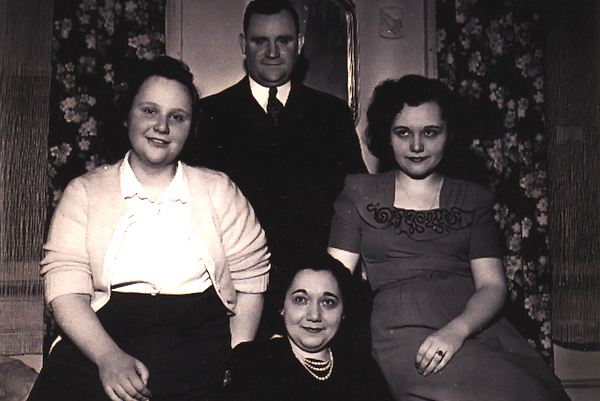
Clockwise from left: Aunt Sissy, Uncle Frank, Aunt Jonie and Aunt Rosie (Credit: Courtesy of Tom Gannon)

You wouldn’t want to tangle with Tom Gannon. When I look at Tom, I end up imagining his ribcage, which must be massive, like the stays in the hull of a galleon. He has a wide chest and meaty arms scrolled with tattoos: on one arm, a full sleeve of roses against a black background; on the other arm, a giant Ganesh winks from a swirl of peacock feathers and smoke. Tom is tall and balding with a neatly shaved head, a red goatee dusted with white, and no-nonsense blue eyes. But in the end, his fortress-like demeanor stems not so much from his appearance as from his attitude.

Maybe it’s the Jersey. Tom’s dad was a New York cop, and his mom worked full-time as a nurse, yet somehow found the time to give four boys a good Catholic upbringing. “It was different in the city,” Tom remembers. “We were surrounded by family and other people who had tons of kids. Childcare was not an issue.” When Tom was 9 the family moved from the city to River Edge, N.J., where they lived in a close-knit neighborhood Tom describes as “very Irish and Italian, with some token Protestants.”

Listening to Tom talk about his family is like watching a nostalgic movie about growing up on the East Coast — one of those films that begins with a rueful voice-over as the camera pans in on the old neighborhood. Tom is not sure when his ancestors emigrated from Ireland to New York: “We don’t know. My father’s generation was the first generation that was literate. No one could read. I don’t think anyone kept track.” He describes his family as close; they ate dinner around the table every night (classic stuff: meatloaf, spaghetti with meatballs, roasted chicken), watched the game together and took care of their own, no questions asked. When I ask Tom if he can pinpoint a family philosophy, he answers immediately: “The philosophy of my family is family,” he says, and laughs a little as he unloads a shopping bag full of onions and canned tomatoes.

Tom’s chicken Parmesan recipe comes from his great aunt Rosie, who caused a huge family scandal when she married Tom’s great uncle Frank in 1914. Frank was 16 and Rosie was only 14, but the scandal had nothing to do with age. Tom’s densely Irish family disapproved of Frank marrying an Italian. “Their generation was, of course, very bigoted,” Tom remarks, rolling an onion onto the cutting board. “By the time my father’s generation rolled around, it was much more common. Some of my dad’s best friends married Italian women and nobody cared. But back in Rosie’s day, it was different, it was a huge deal. Until they got married — then you couldn’t say anything.”

Rosie and Frank moved into an apartment above Frank’s brother’s funeral parlor in Gramercy Park, where they would live for the next 70 years. As soon as Frank married and the family realized they were stuck with Rosie, everyone shut up about the Italian issue. “As a matter of fact,” Tom says, “she became like the most popular person in the entire family. I mean everybody loved Aunt Rosie. She was very gregarious. She was very opinionated. She liked to complain a lot, but in a funny way.” When I ask him what she looked like he says, in his thick Jersey accent, “She looked very stereotypical. She had a wide nose and hair like steel wool. Very sad eyes, kinda baggy, like some kind of basset hound or something like that. She liked to eat,” he adds, slapping his gut. He remembers Rosie pinching the kids’ cheeks, drinking Seven and Seven and “a fair amount of wine,” and cooking constantly, until her classic Italian-American recipes were adopted by every household in a proudly Irish family. In fact, half of Tom’s favorite family recipes are Italian-American.

To make Rosie’s chicken Parmesan, Tom starts with the sauce. He shows me a neat way to peel a large quantity of garlic cloves: Put the unpeeled cloves in a lidded cook pot and shake vigorously.  I’m amazed to see that half the cloves are peeled in the first rough shake; after a second session, all the cloves are skinless. He throws the garlic in with the onion, which is already sautéing in a cast iron pan. “This is about how you want them to look,” Tom remarks, gesturing to the pan full of translucent golden onions. He dumps two cans of whole tomatoes into the pot and mashes at the mixture with a potato masher.

Despite making a huge mess in the kitchen, Tom is not a haphazard cook. He takes his time as he slices each chicken breast into cutlets, and then dips the meat in eggs and bread crumbs. He’s a more precise cook than I am — his every motion betrays the typical New York obsession with exact culinary tradition.  When I suggest we could use a preexisting bag of panko to coat the chicken filets for the Parmesan, he looks horrified. “No,” he says decisively. “We need the cheap stuff.”

While he’s making the Parmesan, he’s instructing me on how to make another family specialty, Uncle Frank’s meatballs. When I start rolling the mixture of pork, beef, eggs, panko and spices, he views my handiwork with a dubious expression — it’s clear that my meatballs are neither small enough nor round enough for Tom’s taste. When I later offer to help fry the chicken fillets for the Parmesan, Tom doesn’t allow me to bread the cutlets myself — he does it for me, and then hovers behind the stove to make sure I’m letting the cutlets get crispy enough before I flip them.

Tom’s concern doesn’t come across as fussy — he’s just the type of guy who likes to do things right. It makes me think about the difference between East Coast and West Coast culinary culture. I come from a culinary tradition that is primarily focused on innovation and substitution. “Sure, that’s good, but how can I make it with nettles?” Tom’s background is more old school — recipes were passed down from generation to generation, and changing things up was more likely to be viewed with horror than with admiration.

But Tom’s family story isn’t all about staying the same. During the course of our conversation, Tom affectionately describes his family as square and later says his parents were “straight as a pin.” The same could hardly be said for Tom: He says he always felt a little different, never liked suburbia or really bought into the whole Jesus thing. When I ask him how he “was led astray,” he laughs and answers: “rock ‘n’ roll”. After a deadhead phase, Tom moved to Seattle, where he fell in with a group of friends that reads like a who’s who of the grunge era. His family back home didn’t know much about his Seattle life. “They never saw my tattoos for years,” he says, taking a sip of beer and meditatively stirring the red sauce. “In those days I only went home for Thanksgiving, and I always wore long-sleeved shirts. I didn’t know how long I could keep it going, but I always figured as long as I could keep it going for that Thanksgiving, I’d be fine,” he laughs. “But then I got real sick with pneumonia — it was around 1998, and my lungs stopped working. I was in a coma. My parents flew out. They thought I was dying. That’s when they first saw my tattoos — I’m lying in a hospital bed, totally inked, and they’re like ‘what the hell?’ But I never got a lick of shit for it, because I lived — suddenly me having tattoos didn’t seem too important to anybody. Never any discussion about it — to the point when my mom eventually even started thinking she wanted a tattoo herself.”

Despite their dramatic tattoos and stereotypically West Coast behaviors (Tom manages the recycling program for the city of Seattle, his wife Becky eats organic) Tom and his wife are pillars within their East Coast family: In the summertime the entire extended family vacations in the Adirondacks, where Tom and Becky’s son Jack runs wild with his Jersey cousins.  I hear shades of Aunt Rosie in Tom’s story, and both tales remind me of something that’s been on my mind lately: When we are forced to accept Italian Aunt Rosie or tattooed Uncle Tom or gay cousin Doug, we become a little less likely to jump to conclusions and, more often than not, our realities are enriched in untold ways. (In a best case scenario, this enrichment appears in the form of cheese-coated chicken cutlets.) On a grander scale, the way we are forced to evolve as families plays out in the way we see the world and the way we change as a nation.

But perhaps I’m getting too high-minded — when I’m sitting in the glow of candlelight spooning Aunt Rosie’s chicken Parmesan onto my plate, I’m just happy. The sauce is tangy and simple, the chicken is crunchy and coated in gooey cheese, and the company is solid. I wouldn’t have it any other way.

Aunt Rosie’s Chicken Parmesan (Serves 6)

Ingredients

  • 1 package spaghetti noodles (cooked, still hot)
  • 6 tablespoons olive oil
  • 1 onion (chopped)
  • 3-4 garlic cloves (chopped)
  • 1 32-oz can whole tomatoes
  • ½ cup red wine
  • 1 bay leaf
  • 1 tablespoon fresh oregano (minced)
  • 1 tablespoon fresh basil (minced)
  • 1 teaspoon sugar
  • Salt to taste
  • 2 lbs chicken breasts (sliced into ½-inch thick fillets)
  • 2-3 eggs (beaten)
  • 1½ cups bread crumbs
  • 1 small zucchini (sliced)
  • 10 ounces baby spinach
  • 1 tablespoon butter
  • Mozzarella cheese (sliced)
  • Grated Parmesan

Directions

  1. In a large pan, heat 3 tablespoons of olive oil and sauté onion over medium low heat for 5-6 minutes. Add garlic. Continue to cook until onion is translucent. If necessary, turn heat down.
  2. Add tomatoes, wine and bay leaf. Break up whole tomatoes as you stir. Simmer sauce for 30 minutes. Add water or stock if necessary.
  3. Add spices, sugar and salt to taste. While sauce continues to simmer, slice chicken breasts into cutlets and preheat oven to 350.
  4. Dip cutlets in eggs and then in bread crumbs. Brown cutlets in olive oil. When one side is thoroughly brown, flip and fry the other side.
  5. While cutlets are frying, add zucchini, spinach and butter to sauce. Cook for a few minutes and remove sauce from flame.
  6. Cover bottom of baking pan with sauce. Add chicken. Cover chicken with mozzarella and additional sauce. Bake in oven for 15 minutes.
  7. Serve over spaghetti with Parmesan cheese.

Felisa Rogers studied history and nonfiction writing at the Evergreen State College and went on to teach writing to kids for five years. She lives in Oregon’s coast range, where she works as a freelance writer and editor.

Lessons of a reluctant hunter

A transplant to Oregon teaches me about growing up in rural Mexico, killing iguanas and grilling chicken

Jazmin Rudin with her mother, Esperanza

Jazmin is 27 years old and beautiful. She has the fierce, dark beauty of a Mexican Indian, but she’s tall, and when you see her move, you think Masai warrior or maybe ninja. And it’s true: She does have ninja skills. When I first met Jazmin, she’d just killed a pheasant. She was sitting on the deck talking with a friend when she spotted the bird at the edge of the yard, 20 feet away. She casually picked up a two-by-four and hurled it. The missile hit the pheasant in the head, a neat kill. Jazmin walked over and picked it up. “Dinner,” she said.

She says she doesn’t particularly like killing animals, but she does kill from time to time, if she has good reason. A deer invaded her garden and she killed it with a machete, and she sometimes nets fish in the surf near her home on the coast of Guerrero, Mexico. It’s a skill born from practice and necessity: She grew up rural and poor. Her father abandoned her family when she was 8, and her mother, Esperanza, had to find a way to support seven children. “We ate a lot of natural things,” she says. “Things from the forest.  My brother used to kill iguanas. I’ve got a good iguana recipe if you want it. It’s the best meat as far as I’m concerned. There are two types of iguana: green and black. The black is good to eat. The green is too beautiful to kill. Last winter I found a big black one in my house! Can you believe it? The way you kill them is you step lightly on their heads and then pull on the tail.”

Humans worship athleticism, talent and perfection. We have a fascination with the tiny fraction of people who stand on the other side of the line that separates life from art: the grand master, the prima ballerina. We are drawn to people who embody something of the divine; the ones who, through their grace and inspiration, remind us that to be alive is majestic. Often these heroes in our spotlight are athletes. Sometimes they are leaders — warriors, politicians or rebels. Sometimes they are great chefs or composers or guitarists. But outside the spotlight and the enchantment of our collective worship, there are other artists, who turn mundane actions into magic, who approach humble tasks with perfect artistry. The masters of skills born of necessity and perfected to fulfill a pride that is autonomous from credit or accolades, a pride based on the perfection of the action itself, the economy of movement, the swiftness of results.

Jazmin Rudin is one such person. She possesses the grace and determination to execute any task at hand with astonishing efficiency. For example, she hunts shrimp in the river with a homemade metal spear. ”You take a long sharp piece of metal, filed at the end. It has to be really sharp. You attach that to a piece of surgical tubing so it snaps back to you when you throw it,” she says. She mimes aiming a spear, and remarks that on a good day she can spear two kilos of shrimp this way. I express disbelief. She shrugs.

“It’s a cultural thing. If you learn when you’re really little it’s easy enough. You have to learn because the shrimp are not going to come to your house and knock on your door.” She explains her technique: “The shrimp are under the rocks. You go underwater, and lift each rock. Don’t lift it all the way. You need to lift gently so they don’t see you.” She’s a demonstrative teacher. She talks slowly, and pauses to make eye contact. She’s checking to make sure I understand her. To help me get it, she uses hand motions. “They also like to hide in the roots of the trees that grow into the river; they hang out in there, caved up. Before you go for it, you have to check out all the potential exits they might have.” She mimes looking around and adds, “Sometimes you have to grab them with your hand, which can be prickly. But I say no! You’re for me. I don’t care if you bite me, you’re not escaping me!” She laughs. “But really, it’s all about taking aim. Just like hunting with a gun. When everything is correct you’ve got your shrimp.”

But hunting isn’t Jazmin’s only talent. The lectures on killing iguanas and spearing shrimp are just digressions: I’m here in her Oregon kitchen for a lesson in grilling chicken, estilo Mexicana. She learned this recipe for pollo asado from her mother, who raises chickens. Her mother learned it from her grandmother. Both women have lived their entire lives in the same small Guerrero village. Jazmin describes her grandmother as “muy antiquada,” or very antiquated. “She has Indian ways, folk ways,” Jazmin says. “There’s something a little witchy about her.”

Jazmin starts by butterflying a chicken thigh with a deft stroke of her knife. When I admire her technique she says, “My mother always says: ‘I know how to cook chicken, but you are the chicken maestro.’” There’s too much delight and humor in Jazmin’s countenance for this revelation to sound boastful. Besides, as I watch her demonstration, I realize she’s just stating a truth. “Take the leg,” she says. “Find the thickest part and slice it open, like so. Don’t cut it all the way through. Leave a layer of flesh so that you can fold the meat back. When you fold it open, the bones and meat are on one side, and there’s pure meat on the other side. You want to cut it so both sides are of equal thickness.” She slams the chicken leg flat on her cutting board. “Chickens prepared this way absorb more sauce,” she says and gives me a challenging look. I’m not about to argue with someone who can kill living shrimp with a handmade spear.

After salting the butterflied chicken legs and breasts, she sets the meat aside in a bowl and works on the sauce. “You’ll want to put seven dried chiles guajillos to soak in a bowl of water,” she says, helpfully adding, “It’s important to soak the chiles first, because it helps the chile to retain the red color.” She assembles her spices: powdered oregano, cumin seed, ground cloves and whole peppercorns, which she’ll grind in a stone mortar and pestle, or molcajete. The basalt bowl stands on its own three legs; the grinding stone is the size and texture of an avocado. “In Mexico everyone has the rock,” she says, laughing. “But if you don’t have a molcajete, use the blender. It’s not quite the same, but it works.” To make the sauce, she places two cloves of garlic and strips of wet chile in the molcajete, and then deftly adds spices and water a little at a time. The finished result is a uniform liquid, which she ladles over the chicken.

While the chicken marinates and the grill heats, we talk. Jazmin’s pueblo on the coast of Guerrero sounds a lot like the village in coastal Jalisco where I spent part of my childhood. It’s a rural culture, rooted in farming and fishing and family. Jazmin has always felt different from the other girls in town; she’s never cared for makeup or clothes. “I’m old-fashioned like my grandmother,” she admits. But although her values may be old-fashioned, she’s not exactly a textbook campesina: Her great joy in life is surfing, she raves about Hank Williams III, and she’s taught her dog, Rambo, to ride on the front of her four-wheeler. She married Mark, an older guy from Oregon, when she was 19, so that could help explain her cultural idiosyncrasies. But as I watch Jazmin laugh uproariously at a silly joke, it strikes me that even without the foreign influence, she would have been an oddball. She’s one of those rare individuals who always cleaves true to some inner compass.

“The secret to barbecuing chicken is to make sure the flame isn’t too hot,” she says, holding her hand over the gas grill, which she views with some contempt. We’re standing on a back porch in Bend, Ore., and Jazmin has been waxing poetic about the superiority of Mexican chickens. “In Mexico, we get a chicken that’s been killed that day. And it’s double good when you grill it over real coals; these gas grills have nothing on real charcoal.” She slaps a chicken thigh on the grill. “Keep turning the chicken over and over again,” she instructs. “It’s a totally different style. Not as juicy maybe, but more flavorful.” She’s right; when we pull the chicken off the grill a scant 20 minutes later, the meat has a satisfying, chewy texture and the flavor sings, savory and complex. Jazmin gives me a look, as though to say, “I told you so.”

“What do you call this recipe?” I ask.

“It’s called pollo asado,” she says, grinning. Grilled chicken. The answer is pure Jazmin: no nonsense and uttered with the easy confidence of a maestro. Like any great artist, she knows to let her work speak for itself.

Ingredients

  • 1 chicken, cut into pieces
  • Salt
  • Soy sauce (optional)
  • 7 dried red chiles guajillos
  • 1 teaspoon of ground cloves
  • 1-2 cloves of garlic
  • 1 teaspoon of cumin seed
  • 1 teaspoon of whole peppercorns
  • 1 teaspoon of powdered oregano

Directions

  1. Butterfly chicken.
  2. Splash chicken with soy sauce and sprinkle with salt.
  3. Rinse chiles and put them in a bowl. Fill the bowl with water until the chiles are covered. Let soak for 10 minutes. Reserve water.
  4. When the chiles are the consistency of wet satin, grind or blend them with the garlic and spices.
  5. Add the water left over from soaking the chiles to the spice/chile mixture.
  6. Pour liquid over raw chicken and leave to marinate for an hour.
  7. Heat your grill.
  8. When chicken is marinated and grill is hot, throw your chicken on the grill.
  9. Turn the chicken every minute or two until it’s done.
Continue Reading Close

Felisa Rogers studied history and nonfiction writing at the Evergreen State College and went on to teach writing to kids for five years. She lives in Oregon’s coast range, where she works as a freelance writer and editor.

When home-grown was apolitical

An 80-year-old Wisconsinite's recipe for parsnips recalls a time when healthy, home-cooked food wasn't a statement

Carol with her sister Joanne (Credit: Courtesy of Carol)

In an argyle sweater, girlish gray corduroys and a pink hat embroidered with the phrase “Obey me!”, Carol looks as light as a husk. Despite her 80 years, her brown hair is just frosted with gray and her eyes are sparrow bright. She lives in Phoenix, Ariz., where she is faithful to her church (Catholic) and her party (Republican). Although she was once infamous for her sharp tongue and the rigidity of her beliefs, the past 10 years have mellowed her; her husband’s sudden death and her own health problems have changed her perception of what really matters. She doesn’t blink an eye at choices that once would have alarmed her: a grandson’s shaggy hair, another grandson’s Japanese wife, a gay nephew’s marriage. One thing that hasn’t changed in all these years is her attitude toward food, which remains staunchly old school.

Although she’s recovering from a serious fall, she still bakes. I sample a slice of moist, honey-tinged rye, and she plies me with sugar-crusted oatmeal cookies. As we talk, she peels parsnips at the kitchen sink. She says she doesn’t understand the modern obsession with doing everything fast. She thinks something is lost in the translation.

“When I was growing up,” she says, “there wasn’t much prepackaged stuff in the grocery store. Quick stuff — I don’t see any advantage to it. It’s a whole lot cheaper doing it from scratch. Four potatoes don’t cost you as much as those dehydrated ones. And I think it’s almost the same amount of time to make things from the box.” She finishes slicing the parsnips into oblong pieces, and cracks an egg into a bowl. “Fried parsnips — this was my mother’s recipe,” she says.

When Carol was growing up, farm to table was the norm. As a small child, she lived on a small farm outside Centuria, Wis. “Even during hard times we did all right. We grew our own vegetables, raised our own beef. My uncles cured bacon and ham. We made maple syrup. If someone in the family wasn’t doing so well, the rest of the family made sure they didn’t go hungry. I mean, it wasn’t free, but we worked things out.” As an adult, Carol kept a big garden. “I loved it. I grew onions, beets, radishes, carrots, tomatoes, green beans. I’d grow parsnips over the winter, and we’d dig them up in the early spring.” The aforementioned shaggy-haired grandson wanders into the kitchen and remembers summer visits to Carol’s house in Wisconsin: “There were always garden-fresh vegetables. My grandpa loved green onions and fresh sliced tomatoes with salt on them. So there would always be a plate of that. Grandpa would stop by a local farm for sweet corn. And she made the best roast — to this day, that’s my favorite food.”

Like everyone I’ve interviewed for this series, Carol’s life can be read two ways. Her father was the town postmaster, and she had three sisters. In 1953, she married a childhood friend, Merald, the son of the town banker. They raised four children. Merald worked his way from clerk to president of the Polk County Bank, an old-fashioned rural institution. Carol was a homemaker who baked cookies every Wednesday and kept her house as neat as a pin. The story is as neat and squared away as Carol’s housekeeping. On the other hand, unconventional memories bob into Carol’s narrative: “Joanne and I decided we needed a car, so we bought a car together.” Carol rolls the parsnip sticks in egg and dunks them in a bowl of cracker crumbs. She pours oil into a cast-iron pan. “But you know, girls just didn’t own cars in those days,” she says, lighting the stove. “So again, everyone probably thought ‘Well, those brazen hussies. Those two Hoyt girls.” She laughs.

Joanne and Carol would drive to the local dance hall or, for a lark, go bird hunting. When Carol was 20, the sisters and a friend drove the ’36 Ford all the way to Mexico. Border towns weren’t enough of an adventure for three girls from rural Wisconsin; they hit the gas and traveled around the country, making it as far south as Mexico City. “Joanne and I were the devils,” Carol says, laughing. “We were the two sisters who were always making trouble.”

While Carol fries the crumbed parsnips golden brown, I slide a pan of pork chops from the oven and put the finishing touches on a salad. We sit down at the kitchen table, and Carol says grace.  The parsnips are delicious — the root’s complex sweetness is grounded by the savory fried crust. “When you were eating fried parsnips with your family, what else would have been on the table?” I ask. “Pork chops, rolls, potatoes,” she says, pointing at each item on our table. She laughs a little — I had put together the rest of the dinner without consulting her, but hit upon her childhood combination anyway. “And a salad,” she finishes. “My mother always had a salad.”

Today’s effete foodie would salivate at the food that graced Carol’s childhood table: pork chops from local pigs, garden-fresh parsnips and salad greens, homemade bread and fresh butter. Her life story reminds me of an important fact: We haven’t been this way for long. Living people, indeed relatively spry living people, remember a time when the industrial food chain was not a matter of course. A time when you knew where your food came from, a time when the command to “eat local” would have seemed laughable, a time when farm to table was not a political statement but common sense.

I doubt Carol has heard of Michael Pollan, and she would be unlikely to agree with his points in the manner that he presents them. But her life reflects an attitude about food that is not so out of pace with his supposedly liberal values: She takes delight in vegetables; she sees the value of gardening; she’s not above enjoying a glass of wine with dinner; she eschews boxed food in favor of baking and cooking from scratch. When I ask her if her family ate meals together every evening, she says, “Oh yes. Of course we did.”

As a young woman in the late ’40s and early ’50s, Carol was out of step with the cultural norm in the sense that she was something of a daredevil, too independent. Today she’s out of step with mainstream America in that she believes that time spent in the garden and kitchen is not time wasted, that the essence of quality is attained through toil, not technology. When it comes to food, her habits give me hope. She reminds me that our current culture of convenience is such a new thing. Could it be that we can still correct our misstep? My question is not: How did we get to the point where a home-cooked, home-grown meal is a political statement? But rather: How do we get back to a point when it isn’t?

Note: Carol points out that the parsnips can be parboiled over the weekend to save time when cooking weeknight suppers.

Fried parsnips

Ingredients

  • 3-4 parsnips (look for the smallest ones you can find)
  • 1 egg
  • 1 1/2 teaspoons of water
  • 1 cup crushed saltines or salted bread crumbs
  • 3-4 tablespoons of grape seed or vegetable oil

Directions

  1. Peel parsnips and slice lengthwise into pieces the dimension of carrot sticks. Parboil until they are tender.
  2. Beat egg and water in bowl. Dunk parsnip sticks in egg and then roll in crumbs.
  3. Heat oil in pan to medium high. Fry parsnip sticks. When sticks are completely brown on one side, turn and repeat until sticks are golden brown all over.
Continue Reading Close

Felisa Rogers studied history and nonfiction writing at the Evergreen State College and went on to teach writing to kids for five years. She lives in Oregon’s coast range, where she works as a freelance writer and editor.

The recipe for security

A friend tells me about a doughnut tradition that's held her family together through tough times for generations

Jan's grandparents, Opal and Paul, with her father, Jerry (Credit: Courtesy of Jan Kinney)

The house is big and heavy-timbered, with log supports and ceiling beams hewn from trees that once grew nearby. Inside, there is chatter and light and the hiss of boiling grease; outside skeins of cloud settle over a dark winter forest.

Jan stands at the wooden kitchen island. She cuts neat circles from a rectangle of flattened dough. She is thin, with short graying hair and blue eyes that are at once friendly and shrewd. Her three granddaughters run screaming loops through the kitchen, and guests cluster around the bar inspecting the cocktail selection, but Jan seems unflustered by the crowd. She passes a platter of uncooked doughnuts to her son-in-law Lou, who mans a stock pot of bubbling oil.

As a general rule, I do not like doughnuts, but I make an exception once a winter. I’ve been attending the annual Kinney doughnut party since I was a kid. But it’s not just nostalgia that compels me to eat Kinney doughnuts — the powdered confections are piping hot, with a texture that is at once pillowy and chewy. I wash down a chocolate-filled doughnut hole with a French75, and the winter months ahead seem to promise cozy cheer instead of dreary gloom. As Jan’s granddaughter Opal chases past me, I think of parties in this house when I was little, of eating doughnuts till I was sick, and of the year it actually snowed and a fantastic wooden toboggan materialized. I remember, as I often do, Jan’s son Japhy, who was two months older than me and a hero of my childhood.

A few days after the party, Jan and I meet so that she can tell me more about the doughnut recipe’s background, about her grandparents, who migrated west in a Model T Ford loaded with all their earthly possessions. The plan is to walk while we talk. We drive to Jan’s favorite hiking spot in my car, a decrepit ’92 Honda Civic with no exhaust system to speak of. I’m a little embarrassed because Jan is a neat and orderly and extremely functional person, and the car is anything but. I’ve cleaned it up a little in her honor, but it’s beyond hope — the floor is covered in a thick layer of pine needles and dust. Jan is not surprised, of course. She’s known me all my life and views my foibles with a wry and expectant eye.

We park at the foot of a logging road. As expected, Jan exclaims about my inappropriate shoes and my hatlessness. Her concern is not unfounded — rain smatters the steep gravel road. As we ascend into a windy forest of giant firs, Jan recalls her grandparents’ relocation from Kansas to Oregon. 1931 was a hard year for the family: Jan’s grandfather Paul was out of work and his wife, Opal, had just lost a child. “An 18-month old girl,” Jan remembers with a precision that hurts. Opal didn’t want to leave their tight-knit German community, but Paul decided to go west. He’d heard there was work in Oregon. Opal acquiesced.

“There were two kids and two adults and she was massively pregnant with a third kid,” Jan says. “They packed the family and all their stuff into a Model T Ford, and they did not have a trailer. When they came to the mountains they just couldn’t make it up the roads. They had to offload stuff. But even then, the carburetor didn’t work going at a slant and there were areas when they had to put the car in reverse and go up the mountain in backwards. It was just epic. They were like the Joads — you know, from ‘The Grapes of Wrath.’”

Jan remembers her grandmother as neither severe nor especially sweet. “I always look at Grandma as someone who had so much to give to the world. And how could she do that within the constraints of the society at that time is really interesting to me,” Jan says. When I ask her about the basic tenets of Opal’s character, she answers right off the bat: “Opal? Safety, security, order. She was a classic German housefrau in that her house was always clean and orderly and it was important to her that it be that way … But at the same time she was very creative, which I think is why she was a good cook,” Jan muses. Opal made a point of bringing the kids together for an annual winter doughnut party, an old family tradition. “Always my grandmother’s kitchen,” Jan muses. “For me it was always about safety and security and warmth and acceptance. She liked cooking. She loved the presentation — the doughnuts were always about presentation, and that came through in how they were cooked. It wasn’t a chaotic scene when we were making doughnuts at her house.”

Jan’s own parents were young and eccentric, sometimes chaotic. Jan was an orderly little girl with a heavy sense of responsibility for her younger siblings. She saw her grandmother Opal as a haven. Although she is thankful that her artistic mother gifted her with an abiding curiosity and a love for reading, Jan looked to Opal for security. She remembers her grandmother bringing the family together through food: making sauerkraut, baking bread, fixing summer dinners bright with garden vegetables, frying perfect doughnuts.

The wind picks up and roils the branches of the great firs. Somewhere in the woods, a branch cracks. A blur crosses our path with the sound of wings beating air. Jan pauses in her story. “For the record,” Jan says, “that was a grouse.” A native of western Oregon, Jan has lived in the Oregon Coast Range for most of her life. She married at age 17 and she and her husband, Ray, moved out to the woods to start a family.

“You know, we moved to Deadwood with the intent of creating and being part of a larger community,” Jan says. She sees parallels between her rural community in Oregon and the community Opal left behind in Kansas. This surprises me because Deadwood, Ore., is an infamous enclave of hippies and rednecks, and Opal came from solid German Lutheran stock. As the forest opens up for a view of the adjacent mountains, Jan illuminates the similarities: Although her grandparents were Lutheran, Jan thinks that to them church was really about community, a gathering spot much like Deadwood’s community center and fire hall. “Their kids grew up with a neighborhood,” Jan says. “The parents remained lifelong friends. Cooking and eating was always at the center of social events. You knew people’s foibles and strengths. You accepted them for whatever, loved them even. There were no secrets, which keeps us accountable …” Jan now sees Deadwood as an extension of her own family, which is why she includes the community in the doughnut tradition that was once intended for the immediate family.

After Opal moved to Oregon from Kansas, she managed to get a job at the cannery in Eugene. After that she worked as a housekeeper until she was well into her 60s. Even though she was always busy, she took the time to cook and bake from scratch.  From Opal, Jan learned to see cooking as a manifestation of love. She thinks Opal’s fixation with maintaining culinary traditions stems in equal measures from the security of her Kansas community and the uncertainty of her childhood home life.

“She had an insecurity,” Jan says. “When she was 4 or 5, her mother was five months pregnant with her second child, and she developed encephalitis and she died. So grandma lost her mother. Her father couldn’t cope with his wife’s death or with his little daughter, and he farmed her out to his parents. He remarried and eventually took Opal back, but as the much older sibling, she became a caregiver to her father and stepmother’s nine children.” Jan remembers Opal saying that her family never emphasized that she was the half-sister and not her stepmother’s biological daughter.

“So she wasn’t made to feel different?” I ask.

“I think she was, because she said she wasn’t,” Jan says definitely. “Why did she even talk about it if it wasn’t an issue?”

Opal’s story makes me think how our positive aspects are so often shaped in reaction to loss and hardship. In order to survive the vagaries of life, we mimic the people and activities that represent islands of solace. “I think one of the reasons that our family really centered on her traditions was that she was always determined to be the secure, safe person — and nobody was going to feel left out or abandoned,” Jan says. Opal created the sense of family and security she missed as a child, and Jan continued the tradition.

Jan’s family has now weathered the death of her son Japhy, her own battle with cancer, her husband Ray’s back problems and the rewarding but tumultuous experience of generational cohabitation: Jan and Ray now share their home with their grown daughter Mizu, her husband, Lou, their three little girls, and Jan’s mother, Margie. Food is still an important part of family life. Margie is a master gardener, so they are able to maintain Opal’s tradition of garden vegetables. Jan believes in making things from scratch, and every weekend, she bakes enough bread for the entire family. Like Opal, she struggles to find time for everything:  After starting out as a young general assistant at a local clinic, she has worked her way up from the bottom to become Director of Quality at a hospital, a job that requires a two-hour commute daily. “Director of Quality” is a pretty apt title for Jan.

When I ask Jan her secret for surviving the long hours and the tumult of a large family, she says that her tongue is calloused from biting it, but then admits that her son-in-law probably feels the same way. This year they argued over the doughnut party. Lou wanted to serve cocktails and other types of fried food such as deep-fried cheese curds and calamari. Jan was resistant to modifying her family tradition. Now she concedes that Lou’s idea wasn’t so bad. “Isn’t that how traditions always are? Don’t they always change? For me the nucleus of the doughnuts is the family. And what that family looks like and when it happens … that’s where all the change happens.”

Opal’s Doughnuts (makes 18)

Equipment

  • 2 bowls
  • Stock Pot
  • Doughnut cutter
  • Cooking thermometer
  • Paper towels

Ingredients

  • 1 tablespoon yeast
  • ¾ cup of warm milk
  • 1/3 cup of sugar
  • ¼ cup of shortening
  • 1 teaspoon of salt
  • 2 eggs
  • 3-3 ½ cups of flour
  • Vegetable oil for frying.
  • Sugar to dust on doughnuts

Directions

  1. In a large bowl, dissolve yeast in warm milk.
  2. Add sugar to mixture.
  3. In a smaller bowl, beat eggs and shortening together.
  4. Add salt and 2 ½ cups of flour to the milk mixture.
  5. Add the egg and butter mixture to the large bowl.
  6. Beat well.
  7. Gradually add more flour to make a moderately soft dough.
  8. Beat or knead until smooth.
  9. Shape dough into a ball and put ball in a greased bowl.
  10. Put dough in a warm place to rise until it doubles (45-60 minutes).
  11. Punch down.
  12. On a lightly floured board, divide the dough in half.
  13. Roll each piece out until it is ½-inch thick.
  14. Cut doughnuts from dough using doughnut cutter. Put doughnuts on plates. Cover and let them rise for another 30 minutes.
  15. Heat vegetable oil in a large pot or fryer.
  16. When oil is 375 degrees, begin frying doughnuts.
  17. Cook each doughnut for about one minute on each side.
  18. Drain doughnuts on paper towels.
  19. Roll doughnuts in sugar.
Continue Reading Close

Felisa Rogers studied history and nonfiction writing at the Evergreen State College and went on to teach writing to kids for five years. She lives in Oregon’s coast range, where she works as a freelance writer and editor.

The Republican in-laws I’ve come to love

Our politics couldn't be more different, but holiday cooking reminds me of the important things we do share

The author's husband's grandmother Betsy with her children (Credit: Courtesy of Felisa Rogers)

Apart from passing acquaintances at school and work, I didn’t actually know any real Republicans until I married into a conservative Catholic family. Holiday conversations shifted from the familiar (meditation, magic and global warming), to the unfamiliar (guns, the evil legacy of Jimmy Carter, and the importance of building a better fence along the U.S.-Mexico border).

My parents raised me to see the right wing as an unpredictable and malignant species, entirely separate from my own people. In my family, we talked about Republicans in the same tone of voice your average American reserves for the Taliban. “Christian” was a damning epitaph, to be delivered in a dark and significant whisper. Getting to know my conservative in-laws was something of an education.

Right off the bat, I was shaken by several astonishing discoveries. For instance, some people actually revere Ronald Reagan! But perhaps even more surprising: I actually liked these people. I liked people who watched Fox News and blamed America’s problems on welfare and environmentalists. Not only did I like these people, but somehow I felt at home with them.

Ever since I realized that I feel comfortable in the midst of this conservative Midwestern military family, I’ve been digging around trying to solve the mystery. Holiday cooking with my mother-in-law, Kris, seems as good a time as any. “I can remember my mom making these cookies when I was a child,” Kris says, setting butter and a bag of pecans on the pink Formica countertop. We are baking one of Kris’ specialties: nut butter balls. The recipe has been in the family for at least three generations. Kris learned it from her mother, Betsy, who in turn learned it from her mother-in-law, Alice.

Kris has sandy gray hair and eyes so dark and steady that they seem to absorb light. The effect is not sinister, but rather mildly soothing, like staring into a winter pond. Her heritage is French Canadian and American mutt, including some American Indian. The Native ancestry is far back enough that she doesn’t know the tribe, but you can still read the bloodlines in the breadth of her face and in the shape of her eyes.

The grandmother with the famous nut butter ball recipe is from the French Canadian side of the family. I ask Kris to describe her, and she remembers a heavyset, very prim woman who always looked tidy in a belted shirtwaist dress and sweater. “She never really talked that much. She was very much like my mother in that way. When all the family gathered, the women, you know, the wives, kinda sat back and didn’t say a whole lot. She always wore her hair the same way,” Kris adds. “She had very long white hair. She used to braid it and wrap it around her head. There was never anything sticking out, it was always just perfect. When she stayed at our house, she’d take her braid out in the evening, and us girls would love to sit and watch her brush her hair. And she always did it 50 times like, you know, they tell you you’re supposed to do.”

Kris was born in 1955, and she grew up in Wisconsin in a large backwoods family dominated by rowdy brothers. She remembers her mom cooking all the food from scratch, not out of virtue, but out of necessity; it was the cheapest way to feed seven kids. Modern food writers spill ink over bounty that Betsy relied on for thrift: venison, duck, wild asparagus. The family ate around the table every night. “I remember leaving the table a little hungry sometimes, because I wasn’t quick enough,” Kris recalls, setting a cookie tin next to her electric mixer. “I was a little shorter and sometimes the platters would pass over me. If you didn’t grab right away it would be gone.”

Kris talks about her family frankly: She remembers walking to church barefoot in the snow because she didn’t have shoes that fit; she remembers an aunt who hung herself in the barn; she remembers her father praying in a voice like James Earl Jones; she remembers Sunday nights when the family would crowd around a small black-and-white television to eat cocoa cake and drink hot chocolate and watch “The Wonderful World of Disney.”

Kris has a salt-of-the-earth quality that reminds me of my cousin Kida. They are both completely without pretense. I think about what the three of us have in common: poor, rural upbringings, various tales of tragedy and hardship. Is the rural element our common ground? Or is it economics? Or are the mysteries of personality deeper than that, running below the trappings of location, economics, politics, religion and taste?

To make nut butter balls (essentially Russian tea cakes), Kris creams butter and powdered sugar, and then adds flour, vanilla, salt and pecans. “The only trick is to let the dough chill before baking,“ she says as she opens a little recipe box and hands me a yellowed note card. I am reminded of my own family recipe collection, a metal box that I inherited when my dad died. Like Kris’ cookie recipe, some note cards in my box bear the mark of a typewriter; others are penciled in my dad’s familiar scrawl: pineapple upside down cake for birthdays, chicken cacciatore for company, creamed onions for Christmas Eve.

When Kris was growing up, nut butter balls were a holiday treat; her mother baked the first batch of the year after Thanksgiving and the last batch at Christmas. “She’d make batch after batch — they were one of my dad’s favorite cookies. And I can remember her allowing us kids to do the powdered sugar on them, which was a treat because we weren’t usually allowed to help bake; there were too many of us.” On that note, Kris leaves the room to get ready for her shift housekeeping at the hospital. I am left in her kitchen to stare at her decorative plates and large collection of cow memorabilia.

Kris returns and I ask her about her mom. She hesitates. “With seven kids it was hard for her to give each one of us individual attention,” she says slowly. She remembers how hard her mom worked, day in and day out: When Kris’ dad’s heart began failing, Betsy became the breadwinner in the family; she’d come home on her lunch break to cook for her disabled husband. Kris speculates that her mother never wanted such a large family, but she hastens to add, “She was a good mother.” She speaks of Betsy with fondness and reverence, but her voice is tinged with sadness.

As we’re talking, Steve wanders in. Steve is a thin man with glasses and a mustache and graying hair that’s verging on long. He looks like an old hippie or a libertarian gun nut, and he has a mind like a steel trap. When I ask him how he and Kris ended up hanging out, they both laugh.

“I hit her with my truck,” Steve says.

“I’ve got the scars to prove it,” Kris says, bunching up the sleeve of her beige scrubs to reveal two mean-looking marks on her forearm. Evidently, the scenario involved beer, skipping catechism, and general teenage high-jinks, and ended with Kris in the hospital nursing a snapped bone. When I mention this story to my husband, Rich, he puts it this way: “My parents were small-town Midwestern hellions.”

A year or two after Kris and Steve started dating, Steve’s ultraconservative mom got sick of his wild ways and, as family legend has it, marched him down to the military recruiting office. He enlisted in the Navy, married Kris and had a son, all before his 21st birthday. His military career would take the family from Wisconsin to Colorado to Philadelphia to Oakland to San Clemente. After 19 years of service he’d retire into the civilian workforce, and his job as a technician for medical equipment would eventually settle the family in Twin Falls, Idaho, an appropriately red state.

Kris leaves for work before the cookie dough is set, and Steve returns to his home improvement project. While the oven heats, I slap balls of cookie dough onto an ungreased pan. As the kitchen fills with the smell of warming vanilla, I think about family, and America, and Betsy, and the sadness of unsung lives.

When the holiday is over and I return to my blue state home, I find a message from Kris: “You asked me the other day about what I would say about my mother and I found myself struggling with an answer. Her life was always hard, growing up the oldest in a large family and then marrying and having a large family of her own. She worked from the time I was 13, as my Dad was disabled. It wasn’t till I was in my late thirties that I realized she was a very strong woman with a heart of gold. She just didn’t know how to show it physically, but instead showed it in her cooking and baking.”

This last line, of course, is common ground. Although my own parents never had difficulty expressing love in other ways, food was always at the heart of our family dynamic, and cooking is still my way of creating a sense of home. I am always on the lookout for a recipe of divine proportions — basic techniques applied to simple ingredients to magically yield happiness. My mother-in-law’s Russian tea cakes are one such find; they melt in the mouth, leaving an aftertaste that’s sweet and nutty and profoundly comforting. It occurs to me that the teacakes are now more than just Kris’ family recipe — they’re mine too.

Ingredients

  • 1 cup soft butter
  • 1/2 cup powdered sugar
  • 1/2 teaspoon salt
  • 2 teaspoons vanilla
  • 2 cups flour
  • 1-2 cups nuts
  • 1-2 tablespoons of powdered sugar for dusting

Directions

  1. Preheat oven to 350 degrees.
  2. Cream butter, sugar and salt.
  3. Add flour and vanilla.
  4. Add nuts.
  5. Refrigerate dough for at least an hour.
  6. Form dough into balls. Place balls on ungreased cookie sheet.
  7. Bake 10-12 minutes.
  8. Remove cookies from oven.
  9. Wait 2-3 minutes and then roll cookies in powdered sugar.
Continue Reading Close

Felisa Rogers studied history and nonfiction writing at the Evergreen State College and went on to teach writing to kids for five years. She lives in Oregon’s coast range, where she works as a freelance writer and editor.

www.salon.com/topic/heirlooms/