
Violence Against Women
The Senate and Grammys condone domestic abuse
Republicans won't back a key anti-violence act, Chris Brown is celebrated -- and the Internet just cheers along
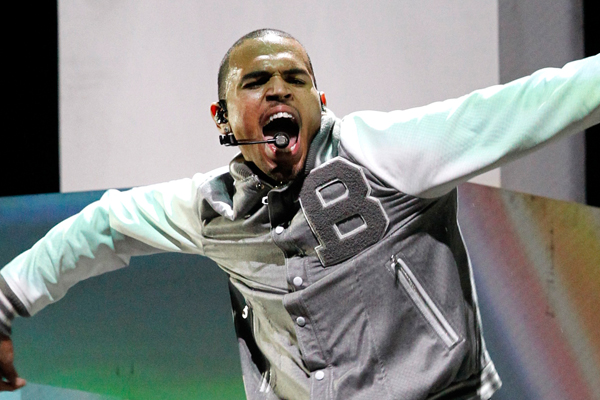
Chris Brown performs at the 54th annual Grammy Awards on Sunday. (Credit: AP/Mario Anzuoni) It’s a great time to be a domestic abuser. Just last week, not a single Republican on the Senate Judiciary Committee voted to reauthorize the Violence Against Women Act – a law that in 2000 and 2005 swept easily through the renewal process. While saying he “supports this law, always has,” Sen. Charles Grassley, R-Iowa, did helpfully offer some changes – including, according the New York Times, “a huge reduction in authorized financing, and elimination of the Justice Department office devoted to administering the law and coordinating the nation’s response to domestic violence and sexual assaults.” Surely those contentious new provisions that would offer protection to gay, lesbian and transgender victims as well as undocumented aliens wouldn’t have anything to do with the holdup. Writing for GOPUSA last Tuesday, the perennially terrible Phyllis Schlafly crowed that the move was “a refreshing indication that Republicans are no longer intimidated by feminist demands” over a law that was “promoting divorce, breakup of marriage and hatred of men.” Well, thank God we dodged that bullet. Now just fend for yourself dodging the real bullets, ladies.
We’ve also seen the surprisingly low-key response to the arrest Sunday of Hugh Hefner’s son Marston on a domestic abuse charge. The younger Hefner is accused of assaulting his girlfriend Claire Sinclair, the 2011 Playmate of the Year. The Los Angeles Times reports that police, responding to a domestic assault call, “determined Sinclair had suffered minor injuries consistent with an assault,” and a photo of a bruised Sinclair on TMZ seems to corroborate.
Sinclair says she doesn’t want to press charges “if [Hefner] keeps his word to give a public apology for physically abusing me on several occasions, and seeks psychiatric help for his anger issues.” (She has, however, sought a temporary restraining order.) And ever since the news broke, the always-classy TMZ commenters have been busy calling Sinclair “a whore [who] deserves everything she got,” “gold-digging trash,” and “a ho ass liar.” Because girls who pose naked in magazines and date the boss’ son shouldn’t be surprised when they wind up bruised, right?
Hef himself, meanwhile, has been expectedly tight-lipped about the altercation. He did tell People this week that “If they care about each other, they’ll patch it up.” Sure, sometimes couples get in fights and they turn physical on both sides. But that’s a hell of a hopeful response to having your son accused of beating his girlfriend – a woman you know and work with, by the way. A word or two about how it’s not OK to hit the ladies, that the Playboy empire does not condone violence, might have been nice to add, as well.
But the biggest winner this Abuse-uary has been Chris Brown. Brown, who pleaded guilty to felony assault in 2009 for the beating of his then-girlfriend Rihanna — and has been known to go berserkers after TV appearances and fire off a homophobic tweet or two for good measure — was off to a rocky start Thursday when a Los Angeles judge denied his request to end his supervised probation early for good behavior. But by Sunday, he was all over the Grammys – performing in not one but two frantic numbers and snagging the prize for best R&B album.
The most demoralizing thing about Brown’s triumph – sadder, even, than his bat-winged backup dancers — was the way in which it set off a grotesque array of supportive, “go ahead and hit me” responses on the Internet. Perhaps inspired by Brown’s track record, Buzzfeed quickly slapped something up: a collection of tweets and Facebook updates from viewers who declared they’d be happy to let Chris Brown beat them to a pulp. A banner night for Brown – a Grammy and a deluge of offers to “punch me in the face.”
You can’t judge a civilization on the dumb comments people leave on Twitter and TMZ. But you can wonder what would happen if we valued each other enough to start from a place where no one “deserves” or invites abuse. As Roxane Gay eloquently explained in the Rumpus, “We fail you every single time a (famous) man treats a woman badly, without legal, professional or personal consequence.” And the failure isn’t just in the relative ease with which the Violence Against Women Act can be brushed aside or a girlfriend beater can win music’s highest honors. The failure is renewed every time we shame and blame women based on how they dress or what they do for a living, or romanticize assault as something to be patched up or playfully pleaded for. The failure is whenever we decide that violence is a legislative inconvenience or a joke. The failure isn’t just at the end of a man’s fist. It’s in the culture that condones him.
Mary Elizabeth Williams is a staff writer for Salon and the author of "Gimme Shelter: My Three Years Searching for the American Dream." Follow her on Twitter: @embeedub. More Mary Elizabeth Williams.
The coming fight over violence against women
Republicans are determined to demagogue the Violence Against Women Act. They're wrong on the politics and the facts
Sens. Chuck Grassley and Dianne Feinstein (Credit: AP/Susan Walsh/Luis M. Alvarez) Reauthorizing the once-bipartisan Violence Against Women Act used to be a matter of Senate routine, but it has now gone the way of debt-ceiling negotiations — into the trenches of partisan warfare. Reading recent reports of the coming Capitol Hill showdown on the VAWA, you would either conclude that Republicans are broadening their assault on women, or Democrats have politicized the bill with various poison pills involving LGBT rights, immigration and Native American communities. What gets lost in both explanations is the merits of the actual changes.
Continue Reading Close
Irin Carmon is a staff writer for Salon. Follow her on Twitter at @irincarmon or email her at icarmon@salon.com. More Irin Carmon.
How to prevent rape without blaming victims
News of assaults often inspires tips on prevention -- but sometimes well-meaning advice becomes dangerous
When the news broke, I took straight to Facebook: “Not to be alarmist,” I wrote in my status update, “but San Francisco friends, FYI.” There followed a link to the police department’s notice about a suspect in two rapes that took place within days of each other in my neighborhood. A local blog gruesomely reported that the latest victim was assaulted while walking to work at 6:30 a.m. — and that afterward, the fire department had to rinse blood off the street. An email from a friend warned, “It’s particularly brutal (breaking necks) and he’s doing it in public.
Continue Reading Close
Tracy Clark-Flory is a staff writer at Salon. Follow @tracyclarkflory on Twitter. More Tracy Clark-Flory.
After I left my abusive boyfriend
I transformed myself when we split, but it wasn't just about reclaiming my self-worth. It was about becoming normal
The author (Credit: Photo courtesy of the author) This isn’t a story about an abusive relationship. This is a story about what happened next.
I decided to leave my boyfriend not because he had hurt me, but because I was turning 30. He had hurt me, but by the time I left him, it had been four years since he’d harmed me. Our first year together was violent; eventually he was arrested for domestic assault, and he became one of the small percentage of men to go through a batterer intervention program and never attack their partner again. For the years that followed his arrest, I stayed with him because I needed to prove to myself that there was a reason I’d stayed in the first place. The relationship was never a good one, but by the end, it was tolerable. I didn’t want to spend the rest of my life in a passable relationship. That is why I left.
Continue Reading CloseAutumn Whitefield-Madrano examines beauty at The Beheld. Her essays have appeared in Glamour, Marie Claire, and Jezebel, and she is a contributing editor at The New Inquiry. More Autumn Whitefield-Madrano.
The sex crimes that shocked Brooklyn
The NYPD, the media and the community seized on the idea of a single perp. The truth is much more complex
(Credit: NYPD) The first thing she said was no. Then she began to scream. It went on for nearly a minute, loud and shrill, echoing down the quiet block of 16th Street in Brooklyn, N.Y., at 11:30 one night last March.
Across the street, Donald Harrington peered out his window. Down the block, Gretchen Barton called 911. A neighbor named Ray lumbered down his steps and rumbled, “Hey, what’s going on?”
The man loosened his grip on the woman. She sprinted up the block screaming. He ran too. Patrol cars arrived. They sped around the block to look for the woman and the assailant, but found neither.
Continue Reading CloseLisa Riordan Seville is a freelance contributor to The Crime Report based in Brooklyn, New York. More Lisa Riordan Seville.
What constitutes rape?
An FBI definition excludes a wide range of sexual assaults, including ones against men. That might finally change
(Credit: Alexander Gitlits via Shutterstock) For nearly a decade, Carol Tracy, the executive director of the Women’s Law Project, has been agitating for a change in what she describes as the FBI’s ”archaic” definition of rape.
This month, the agency made a major step forward to doing just that.
At a meeting in Washington last Friday, members of the Police Executive Research Forum (PERF), including representatives from police agencies in Chicago, Baltimore and Philadelphia, came together with FBI officials and victims’ advocates to discuss the importance of broadening the definition of a crime that most experts believe is significantly underestimated by the FBI’s Uniform Crime Report (UCR).
Continue Reading ClosePage 1 of 49 in Violence Against Women