
2012 Elections

The 196 people who will choose our next president

Billionaires like Adelson and Freiss are behind the vast majority of super PAC dollars. The rest of us don't count

  • more
    • All Share Services

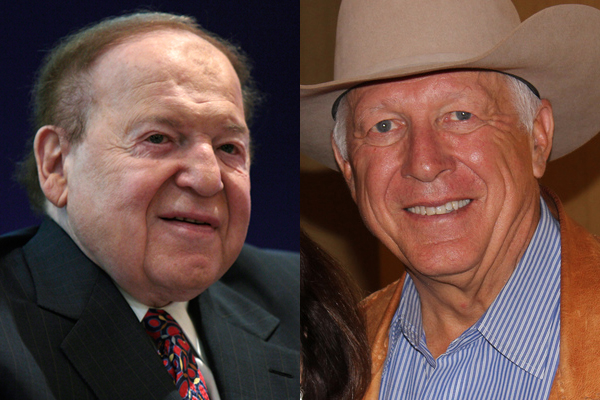
The 196 people who will choose our next presidentSheldon Adelson and Foster Friess (Credit: Reuters/Voices To Action with Alice Linahan / CC BY 3.0)
This piece originally appeared on TomDispatch.

At a time when it’s become a cliché to say that Occupy Wall Street has changed the nation’s political conversation — drawing long overdue attention to the struggles of the 99 percent — electoral politics and the 2012 presidential election have become almost exclusively defined by the 1 percent. Or, to be more precise, the .0000063 percent. Those are the 196 individual donors who have provided nearly 80 percent of the money raised by super PACs in 2011 by giving $100,000 or more each.

These political action committees, spawned by the Supreme Court’s 5-4 Citizens United decision in January 2010, can raise unlimited amounts of money from individuals, corporations or unions for the purpose of supporting or opposing a political candidate. In theory, super PACs are legally prohibited from coordinating directly with a candidate, though in practice they’re just a murkier extension of political campaigns, performing all the functions of a traditional campaign without any of the corresponding accountability.

If 2008 was the year of the small donor, when many political pundits (myself included) predicted that the fusion of grass-roots organizing and cyber-activism would transform how campaigns were run, then 2012 is “the year of the big donor,” when a candidate is only as good as the amount of money in his super PAC. “In this campaign, every candidate needs his own billionaires,” wrote Jane Mayer of the New Yorker.

“This really is the selling of America,” claims former presidential candidate and Democratic Party Chairman Howard Dean. “We’ve been sold out by five justices thanks to the Citizens United decision.” In truth, our democracy was sold to the highest bidder long ago, but in the 2012 election the explosion of super PACs has shifted the public’s focus to the staggering inequality in our political system, just as the Occupy movement shined a light on the gross inequity of the economy. The two, of course, go hand in hand.

“We’re going to beat money power with people power,” Newt Gingrich said after losing to Mitt Romney in Florida as January ended.  The walking embodiment of the lobbying-industrial complex, Gingrich made that statement even though his candidacy is being propped up by a super PAC funded by two $5 million donations from Las Vegas casino magnate Sheldon Adelson. It might have been more amusing if the GOP presidential primary weren’t a case study of a contest long on money and short on participation.

The Wesleyan Media Project recently reported a 1,600 percent increase in interest-group-sponsored TV ads in this cycle as compared to the 2008 primaries. Florida has proven the battle royal of the super PACs thus far. There, the pro-Romney super PAC, Restore Our Future, outspent the pro-Gingrich super PAC, Winning Our Future, 5-to-1. In the last week of the campaign alone, Romney and his allies ran 13,000 TV ads in Florida, compared to only 200 for Gingrich. Ninety-two percent of the ads were negative in nature, with two-thirds attacking Gingrich, who, ironically enough, had been a fervent advocate of the Citizens United decision.

With the exception of Ron Paul’s underdog candidacy and Rick Santorum’s upset victory in Iowa — where he spent almost no money but visited all of the state’s 99 counties — the Republican candidates and their allied super PACs have all but abandoned retail campaigning and grass-roots politicking.  They have chosen instead to spend their war chests on TV.

The results can already be seen in the first primaries and caucuses: an onslaught of money and a demobilized electorate. It’s undoubtedly no coincidence that, when compared with 2008, turnout was down 25 percent in Florida, and that, this time around, fewer Republicans have shown up in every state that’s voted so far, except for South Carolina. According to political scientists Stephen Ansolabehere and Shanto Iyengar, negative TV ads contribute to “a political implosion of apathy and withdrawal.” New York Times columnist Tim Egan has labeled the post-Citizens United era “your democracy on meth.”

The .01 Percent Primary

More than 300 super PACs are now registered with the Federal Election Commission. The one financed by the greatest number of small donors belongs to Stephen Colbert, who’s turned his TV show into a brilliant commentary on the deformed super PAC landscape. Colbert’s satirical super PAC, Americans for a Better Tomorrow, Tomorrow, has raised $1 million from 31,595 people, including 1,600 people who gave $1 each. Consider this a rare show of people power in 2012.

Otherwise the super PACs on both sides of the aisle are financed by the 1 percent of the 1 percent. Romney’s Restore Our Future super PAC, founded by the general counsel of his 2008 campaign, has led the herd, raising $30 million, 98 percent from donors who gave $25,000 or more. $10 million came from just 10 donors who gave $1 million each. These included three hedge-fund managers and Houston Republican Bob Perry, the main funder behind the Swift Boat Veterans for Truth in 2004, whose scurrilous ads did such an effective job of destroying John Kerry’s electoral prospects. Sixty-five percent of the funds that poured into Romney’s super PAC in the second half of 2011 came from the finance, insurance and real estate sector, otherwise known as the people who brought you the economic meltdown of 2007-2008.

Romney’s campaign has raised twice as much as his super PAC, which is more than you can say for Rick Santorum, whose super PAC — Red, White & Blue — has raised and spent more than the candidate himself. Forty percent of the $2 million that has so far gone into Red, White & Blue came from just one man, Foster Friess, a conservative hedge-fund billionaire and Christian evangelical from Wyoming.

In the wake of Santorum’s upset victories in Colorado, Minnesota and Missouri on Feb. 7, Friess told the New York Times that he’d recruited $1 million for Santorum’s super PAC from another (unnamed) donor and upped his own giving, though he wouldn’t say by how much. We won’t find out until the next campaign disclosure filing in three months, by which time the GOP primary will almost certainly be decided.

For now, Gingrich’s sugar daddy Adelson has pledged to stay with his flagging campaign, but he’s also signaled that if the former speaker of the House goes down, he’ll be ready to donate even more super PAC money to a Romney presidential bid. And keep in mind that there’s nothing in the post-Citizens United law to stop a donor like Adelson, hell-bent on preventing the Obama administration from standing in the way of an Israeli attack on Iran’s nuclear facilities, from giving $100 million, or for that matter, however much he likes.

Before Citizens United, the maximum amount one person could give to a candidate was $2,500; for a political action committee, $5,000; for a political party committee, $30,800. Now, the sky’s the limit for a super PAC, and even more disturbingly, any donor can give an unlimited contribution to a 501(c)(4) — outfits defined by the IRS as “civic leagues or organizations not organized for profit but operated exclusively for the promotion of social welfare,” and to make matters worse, that contribution will remain eternally secret.  In this way, American politics is descending further into the darkness, with 501(c)(4)s quickly gaining influence as “shadow super PACs.”

A recent analysis by the Washington Post found that, at a cost of $24 million, 40 percent of the TV ads in the presidential race so far came from these tax-exempt “social welfare” groups. The Karl Rove-founded American Crossroads, a leading conservative super PAC attacking Democratic candidates and the Obama administration, also runs a 501(c)(4) called Crossroads GPS. It’s raised twice as much money as its sister group, all from donations whose sources will remain hidden from American voters. Serving as a secret slush fund for billionaires evidently now qualifies as social welfare.

The Income Defense Industry

In his book “Oligarchy,” political scientist Jeffrey Winters refers to the disproportionately wealthy and influential actors in the political system as the “Income Defense Industry.” If you want to know how the moneyed class, who prospered during the Bush and Clinton years, found a way to kill or water down nearly everything it objected to in the Obama years, look no further than the grip of the 1 percent of the 1 percent on our political system.

This simple fact explains why hedge-fund managers pay a lower tax rate than their secretaries, or why the U.S. is the only industrialized nation without a single-payer universal healthcare system, or why the planet continues to warm at an unprecedented pace while we do nothing to combat global warming. Money usually buys elections and, whoever is elected, it almost always buys influence.

In the 2010 election, the 1 percent of the 1 percent accounted for 25 percent of all campaign-related donations, totaling $774 million, and 80 percent of all donations to the Democratic and Republican parties, the highest percentage since 1990. In congressional races in 2010, according to the Center for Responsive Politics, the candidate who spent the most money won 85 percent of House races and 83 percent of Senate races.

The media loves an underdog story, but nowadays the underdog is ever less likely to win. Given the cost of running campaigns and the overwhelming premium on outspending your opponent, it’s no surprise that nearly half the members of Congress are millionaires, and the median net worth of a U.S. senator is $2.56 million.

The influence of super PACs was already evident by November 2010, just nine months after the Supreme Court’s ruling. John Nichols and Robert McChesney of the Nation note that, of the 53 competitive House districts where Rove’s Crossroads organization outspent Democratic candidates in 2010, Republicans won 51. As it turned out, however, the last election was a mere test run for the monetary extravaganza that is 2012.

Republicans are banking on that super PAC advantage again this year, when the costs of the presidential contest and all other races for federal posts will soar from $5 billion in 2008 to as high as $7 billion by November. (The 2000 election cost a “mere” $3 billion.)  In other words, the amount spent this election season will be roughly the equivalent of the gross domestic product of Haiti.

The Myth of Small Donors

In June 2003, presidential candidate Howard Dean shocked the political establishment by raising $828,000 in one day over the Internet, with an average donation of $112. Dean, in fact, got 38 percent of his campaign’s total funds from donations of $200 or less, planting the seeds for what many forecast would be a small-donor revolution in American politics.

Four years later, Barack Obama raised a third of his record-breaking $745 million campaign haul from small donors, while Ron Paul raised 39 percent from small dollars on the Republican side.  Much of Paul’s campaign was financed by online “money bombs,” when enthusiastic supporters generated millions of dollars in brief, coordinated bursts. The amount of money raised in small donations by Obama, in particular, raised hopes that his campaign had found a way to break the death grip of big donors on American politics.

In retrospect, the small-donor utopianism surrounding Obama seems naive. Despite all the adulatory media attention about his small donors, the candidate still raised the bulk of his money from big givers. (Typically, these days, incumbent members of Congress raise less than 10 percent of their campaign funds from small donors, with those numbers actually dropping when you reach the gubernatorial and state legislative levels.) Obama’s top contributors included employees of Goldman Sachs, JP Morgan Chase and Citigroup, hardly standard bearers for the little guy. For obvious reasons, the campaign chose to emphasize the small donors over the big ones in its narrative, as it continues to do in 2012.

Interestingly enough, both Obama and Paul actually raised more money from small donors in 2011 than they did in 2008, 48 percent and 52 percent of their totals, respectively. But in the super PAC era that money no longer has the same impact. Even Dean doubts that his anti-establishment, Internet-fueled campaign from 2004 would be as successful today. “Super PACs have made a grass-roots campaign less effective,” he says. “You can still run a grass-roots campaign but the problem is you can be overwhelmed now on television and by dirty mailers being sent out … It’s a very big change from 2008.”

Obama is a candidate with a split personality, which makes his campaign equally schizophrenic. The Obama campaign claims it’s raising 98 percent of its money from small donors and is “building the biggest grass-roots campaign in American history,” according to campaign manager Jim Messina. But the starry-eyed statistics and the rhetoric that accompanies it are deeply misleading. Of the $89 million raised in 2011 by the Obama Joint Victory Fund, a collaboration of the Democratic National Committee (DNC) and the Obama campaign, 74 percent came from donations of $20,000 or more and 99 percent from donations of $1,000 or more.

The campaign has 445 “bundlers” (dubbed “volunteer fundraisers” by the campaign), who gather money from their wealthy friends and package it for Obama.  They have raised at least $74.4 million for Obama and the DNC in 2011. Sixty-one of those bundlers raised $500,000 or more. Obama held 73 fundraisers in 2011 and 13 last month alone, where the price of admission was almost always $35,800 a head.

An increase in small donor contributions and a surge of big money fundraisers still wasn’t enough, however, to give Obama an advantage over Republicans in the money chase. That’s why the Obama campaign, until recently adamantly against super PACs, suddenly relented and signaled its support for a pro-Obama super PAC called Priorities USA.

A day after the announcement that the campaign, like its Republican rivals, would super PAC it up, Messina spoke at the members-only Core Club in Manhattan and “assured a group of Democratic donors from the financial services industry that Obama won’t demonize Wall Street as he stresses populist appeals in his re-election campaign,” reported Bloomberg Businessweek. “Messina told the group of Wall Street donors that the president plans to run against Romney, not the industry that made the former governor of Massachusetts millions.”

In other words, don’t expect a convincing return to the theme of the people versus the powerful in campaign 2012, even though Romney, if the nominee, would be particularly vulnerable to that line of attack. After all, so far his campaign has raised only 9 percent of its campaign contributions from small donors, well behind both Sen. John McCain, 21 percent in 2008, and George W. Bush, 26 percent in 2004.

In the fourth quarter of 2011, Romney outraised Obama among the top firms on Wall Street by a margin of 11 to 1. His top three campaign contributions are from employees of Goldman Sachs ($496,430), JPMorgan ($317,400) and Morgan Stanley ($277,850). The banks have fallen out of favor with the public, but their campaign cash is indispensable among the political class and so they remain as powerful as ever in American politics.

In a recent segment of his show, Stephen Colbert noted that half of the money ($67 million) raised by super PACs in 2011 had come from just 22 people. “That’s 7 one-millionths of 1 percent,” or roughly .00000071 percent, Colbert said while spraying a fire extinguisher on his fuming calculator. “So Occupy Wall Street, you’re going to want to change those signs.”

To stay on top of important articles like these, sign up to receive the latest updates from TomDispatch.com here.

Ari Berman is a contributing writer for the Nation magazine and an Investigative Journalism Fellow at The Nation Institute. His book, "Herding Donkeys: The Fight to Rebuild the Democratic Party and Reshape American Politics" is now out in paperback with a new afterword.

Florida purging voter rolls

Governor Rick Scott moves forward with a plan to disqualify thousands of mostly Hispanic and Democratic voters

  • more
    • All Share Services

Florida purging voter rollsRick Scott (Credit: Reuters/Brendan McDermid)

Hated Florida Governor Rick Scott has a great idea: A big, massive purge of the state’s voter roll right before a sure-to-be-close presidential election. The governor ordered his secretary of state to compile a list of registered voters who might not be citizens, based on an unreliable and out-of-date state motor vehicle administration database. The secretary of state made a list and then realized the list was not actually very useful or accurate. Then he resigned, and now Scott is just purging away.

Some people (communists) have noted that the timing of this big voter roll purge is a bit suspect and that it’s also weird that the vast majority of people on the list are Hispanics who are registered Democrats or independents. But as hero-senator Marco Rubio said recently of voter ID laws, “What’s the big deal?” Hundreds of the 1,638 people flagged as ineligible in Miami-Dade County have already offered proof of citizenship, so the system works. Let’s assume the 1,200 people who haven’t responded to the letter are all definitely not qualified.

(If I were an illegal immigrant, do you know what I would definitely not ever try to do? Vote! When you’re evading detection by the government, registering to vote and then casting a ballot — and in the process committing a felony — seems like asking for trouble.)

As must always be pointed out when writing about these sorts of things, there is no voter fraud epidemic. At all. Where there is genuinely illegal voting, it tends to be accidental or so small-scale as to present no challenge to the legitimacy of an election. The liberal position on election security is something like, “Better to let a couple of isolated instances of fraudulent or improper voting happen than to preemptively disenfranchise hundreds or even thousands of perfectly legal voters.” The conservative position tends to be, “We mustn’t let the Mexicans steal the election for the nanny state socialists ACORN ACORN BILL AYERS ACORN.”

Here’s the Tampa Bay Times with more on Florida’s war on (certain people) voting:

This is part of a pattern. Republicans actively gin up voter fraud claims to justify turning voting into an obstacle course to dissuade Democratic-leaning constituencies. It’s what happened in Florida last year when the Legislature used voter fraud as an excuse to cut early voting days and make it harder for renters and college students to vote a regular ballot. The most disgraceful part of the law imposes steep penalties and fines on groups conducting voter registration drives that fail to meet burdensome bureaucratic rules and turn forms in within 48 hours, causing the League of Women Voters to cancel its drive.

But if we let renters vote, why would anyone buy a house? Then how would we save the economy?

Don’t worry, though, it will still be very easy for… certain other kinds of people to cast votes:

Meanwhile, there was no attempt by the Florida Legislature to tighten rules for absentee voting, which is probably the easiest way to produce a fraudulent ballot since there is no way of knowing who fills it out. Maybe this lack of interest stemmed from the fact that absentee voters tend to lean Republican, while early voters typically lean Democrat.

Well. Now that I know how easy it is to absentee vote in Florida, I am off to commit some voter fraud with my illegal immigrant friends. Next stop, Sharia!

Continue Reading Close
Alex Pareene

Alex Pareene writes about politics for Salon and is the author of "The Rude Guide to Mitt." Email him at apareene@salon.com and follow him on Twitter @pareene

Mitt Romney: Politics “like a sport”

What makes Mitt tick? The nominee says he likes politics because "I can't compete in competitive sports very well"

  • more
    • All Share Services

Mitt Romney: Politics Republican presidential candidate and former Massachusetts Governor Mitt Romney gestures as he leaves a campaign event in Hillsborough, New Hampshire May 18, 2012. (Credit: Reuters/Jessica Rinaldi)

Mitt Romney may have unintentionally opened a window onto his somewhat obscured motivations for running for president in an interview with the Wall Street Journal’s Peggy Noonan today, explaining that he likes sports, but isn’t very good at them, so he does politics instead.

Asked about whether he likes “the game” of politics, the presumed GOP nominee replied, “I like competition, and I think the game [of politics] is like a sport for old guys. I mean, you know, I can’t compete in competitive sports very well, but I can compete in politics, and there’s the — what was the old ABC ‘Wide World of Sports’ slogan? ‘The thrill of victory and the agony of defeat.’ The only difference is victory is still a thrill, but I don’t feel agony in loss.”

He continued, “The only time I’m unhappy is if I’ve done something that hurt the prospects for the success of our effort.”

Democrats appear eager to jump on the comment. “For President Obama, the desire to serve the American people certainly outweighs the thrill of sport,” DNC spokesperson Melanie Roussel told Salon in an email. “It’s the same competitive spirit that drives Romney economics — doing whatever it takes for him and his investors to profit, regardless of the cost to workers, companies and communities. In Romney’s game, there are two sets of rules – one for himself and others at the top, and another for everyone else.”

Former Romney opponent Ted Kennedy’s own presidential ambitions hit an early stumbling block that he never fully recovered from in 1979 when he badly fumbled the seemingly simple question, “Why do you want to be president?” His rambling answer was so damaging and iconic that it later became the basis of a “West Wing” episode. Romney may have to work on his own answer a bit.

His comment seems telling, coming from someone who has struggled to articulate a real desire to be president. As Alex Pareene writes in his new e-book: “This is the essential problem with Mitt Romney, politician: Where others seek office to gain power or improve people’s lives, Romney has no perceptible interest in either goal.”

Pundits have long puzzled over what’s behind Romney’s political ambitions, often concluding that his serial runs for Senate, governor and then president are a product of living in the shadow of his governor and presidential candidate father. One of the key data points in the Oedipal theory of Romney’s ambition is his supposed fear of gaffes stemming from the fact that George Romney’s comment that military leaders “brainwashed” him on the Vietnam War effectively killed his presidential candidacy. “Mitt Romney’s tendency to make verbal slips is a subconscious repetition of his father’s mistakes, or so the theory goes,” Mike Allen and Evan Thomas write in Politico’s second e-book on the campaign. But when Noonan asked Romney about the “brainwashed” comment, the younger Romney replied, “I don’t think my father’s comment figures into my thinking at all.”

The compulsion to look at politics as a game or sport is one of the most loathed aspects of today’s political media, but journalists have the excuse of needing to remain independent, and the sports paradigm is an easy way to avoid getting into messy policy issues that could be construed as “bias.”

But it’s another matter entirely coming from a presidential candidate himself. And it may not help a candidate already struggling with a perception of being out of touch that he’s only sad when he does something that hurts his chances of winning the election, because he likes winning the “sport for old guys” so much.

Continue Reading Close

Alex Seitz-Wald is Salon's political reporter. Email him at aseitz-wald@salon.com, and follow him on Twitter @aseitzwald.

Trump insinuates self into Romney campaign

How a toxic attention-seeker (not Newt) will likely end up speaking at the RNC

  • more
    • All Share Services

Trump insinuates self into Romney campaignBusinessman and real estate developer Donald Trump (L) greets Mitt Romney after endorsing his candidacy for president at the Trump Hotel in Las Vegas, Nevada February 2, 2012. (Credit: Reuters/Steve Marcus)

So. Donald Trump again? Are we really doing this again? I guess we are!

There were stories, recently, in the usual places, about how Trump was being seriously considered for a major speech at the Republican Convention. I did not dwell on the story much, because I assumed that these rumors were a product of Donald Trump’s prodigious vanity and powerful imagination. Ha ha ha, sure, the Republicans will definitely want the stupid make-believe TV mogul who pretends to fire people for a living, at their big party.

Now that “Celebrity Apprentice” is done, Trump is back to pretending to be a major political player. He just announced his intention to start his own super PAC, because he is a weird attention-hungry idiot with a bit of money to burn (though not as much money to burn as he would like you to think he has to burn).

He is just, essentially, begging the party to let him be on TV at their convention. But Maggie Haberman wrote today that while Trump is just definitely not going to be anyone’s running mate, the Republicans might actually have him speak at their convention. Because Romney is actually getting a lot of use out of Trump:

He’s been a surrogate for Romney, recorded robocalls for him and pushed him on the Fox News airwaves and over Twitter. He’s also raised money for him, and both Ann and Mitt Romney have thanked him in public for his help. There is no question that he has an appeal to some voters and that Romney has been better off having Trump with him than against him.

“Some voters.” Awful voters. The worst voters. But yes, it is basically true: Romney embraces Trump because there’s very little downside. He gets support from horrible people, and he is not really taken to task by non-horrible people (or, for the most part, journalists) for associating with him. This is how Trump will end up at the convention, despite being the most prominent birther in the nation.

In fact, the Romney campaign is auctioning off dinner with Donald Trump, in case you have a couple thousand dollars and some sort of horrible grudge against someone. That does not suggest that anyone at the Romney campaign is particularly wary of the guy.

Here’s another line from Trump’s Newsmax interview, just so we understand that this Donald Trump is not any less invested in conspiratorial race-tinged dog-whistle Jerome Corsi nonsense than he was last year:

He adds: “If you’re going to look at that, on something that I don’t believe ever happened, you have to look into Barack Obama saying that he was heavy into drugs, heavy into alcohol, was a total disaster, was a horrible student. Then you have to say if he was a horrible student, how did he get into Columbia? How did he get into Harvard?

Suspicious! How did Obama get into Harvard? (Maybe his father was secretly … Charles Kushner!)

Continue Reading Close
Alex Pareene

Alex Pareene writes about politics for Salon and is the author of "The Rude Guide to Mitt." Email him at apareene@salon.com and follow him on Twitter @pareene

“Battlefield Earth”: Romney vs. the Psychlos

The GOP's standard bearer calls L. Ron Hubbard's bizarro sci-fi epic his favorite novel. Is that cause for concern?

  • more
    • All Share Services

Republican presidential candidate and former Massachusetts Governor Mitt Romney reads a book to children in Manchester(Credit: Brian Snyder / Reuters)

There’s a scene near the end of “Battlefield Earth,” Scientology founder L. Ron Hubbard’s 1982 science fiction epic, that may explain a bit of why Mitt Romney has said (most recently this week) that it’s his favorite novel.

Our hero, Jonnie Goodboy Tyler, has just finished taking down the Psychlo empire, which has ruled Earth for the past millennium and has dominated most of the known 16 universes for going on 300,000 years. Now Jonnie has to negotiate with the alien powers who are jockeying to fill the power vacuum left behind, and things aren’t looking so good for the human race.

Homo sapiens seem destined to suffer one of the more common fates of common folk after the end of totalitarian rule — war, chaos and brutal, if less total, exploitation at the hands of tyrants, oligarchs, warlords and military juntas.

Into this dire situation steps Jonnie, who proves that his genius isn’t just for armed insurrection but for diplomacy and great power politics as well. He outwits his enemies at the conference table, finds a way to settle the 60 trillion galactic credit debt that Earth discovers it owes to the Galactic Bank and threatens the assembled dignitaries and thugs into signing a treaty forbidding war forever. Then to top it all off, he draws on his recently acquired knowledge of ancient Earth economic theory to persuade them that their interests would be best served not by reaping wealth through war, as they’ve been accustomed to doing, but by introducing free market capitalism, and commercial banking, to the universes.

“There are other ways of handling economies,” Jonnie explains. “You could phase every war industry you have over to what is called ‘consumer production.’ You make things for the people. The people are employed. They make things for one another. Your people are your best market for your industries. … Your people, now starving and rioting, can become gainfully employed in peace industries. They can have things for themselves. Such things as better houses and furniture, better clothes, better food.”

It does not require an esoteric reading of Hubbard’s text, in other words, to identify conservative notions of the kind Romney seems to hold. It’s full of explicit commentary about the stupidity of taxes and the dangers of an overly intrusive state. The Earth government that Jonnie helps set up after the dust settles is a kind of paternalistic libertarian utopia, in which no one pays any taxes except what they volunteer as donations; the rest of the expenses are quietly covered from Jonnie’s personal account. There’s even an offhand insult of “some nut named Keynes,” whose bad theories Jonnie encounters while cramming for his meeting with the Galactic Bank.

Earth’s foreign policy, once the Psychlos are gone, is like a neoconservative fantasy of what the Forces of Freedom and Light could do if we had a Death Star and were willing to use it. Jonnie coerces the signatures on his pan-universal peace treaty by showing his rivals a holographic recording of the nuking and subsequent implosion of the Psychlo planet. He then calmly explains to them that he’ll do the same to their planets if they don’t comply. They sign, and freedom rolls forth.

Even for 1982, when the novel was published, it reads a bit retrograde in its earnest celebration of white guys kicking ass. There are almost no women, and the few who show up are virginally pure. There’s a sentimental ethnotyping of the various surviving human populations (Chinese people are good at cooking and understanding the rules of courtly etiquette; Scottish men all sound like Montgomery Scott and dress like highlanders). And the white guys are total Übermenschen. Jonnie himself was “a muscular six feet shining with the bronzed health of his 20 years,” with “corn yellow hair and beard,” and “ice-blue eyes.” It was as if Hubbard hadn’t gotten the memo that it wasn’t the 1940s anymore, when he and his buddy Robert Heinlein had helped work out the formula for this kind of high adolescent science fictional adventure tale.

But for all that, my guess — and I can only guess at this — is that it misses the point to assume that Romney likes the book for these reasons. I suspect he’s drawn to it more for the reasons I was.

I first read the novel when I was 12 or 13. I didn’t quote the above passages from memory, but you’ll have to trust me when I say that I knew exactly where to find them in the text when I booted it up on my iPad. “Battlefield Earth” is a ridiculous book, every bit the gargantuan exercise in nerd-boy wish fulfillment you’d expect from someone like Hubbard, who was such a nerd-boy bent on wish fulfillment that he invented a religion to fulfill his dreams of mastery and immortality.

But “Battlefield Earth” is also an incredibly exciting book, pulp of the pulpiest order. It’s the kind of adventure story that exerts a particularly strong pull, I’d wager, on boys of a certain age with a certain need to escape into, or project themselves into, heroic tales of conquest, mastery and moral clarity.

For me it was, I half-realized as a teenager and fully realize now, consolation. It was comfort food, compensation for my feelings of insecurity, inadequacy, anxiety.

I don’t think I read the whole, 1,000-plus-page thing through more than twice, but I read my favorite set pieces dozens of times. I read it late at night, when I should have been getting sleep for school. I read it, at times almost hungrily, when I was home on vacation from college. I read it to feel better, to feel nothing, to escape.

That’s not to say that there was nothing political about my attraction to the book, and to the hundreds of other such books I read. But the politics of it went deeper, into the muck of those psychological processes by which we process, deny or sublimate the data of the world, our fears, our fantasies. I wanted to save the world. I wanted to be strong. I wanted to vanquish enemies. I wanted good and evil to be clear. I wanted to run away. I wanted to escape the anxieties of my family, of school, of sexual desires that I had no real means of satisfying. A lot of the time I just wanted to disappear into the time-displacing comfort of a well-plotted adventure.

At a minimum Mitt Romney was 36 or 37 when he first read the book. I’m now 36, and though I haven’t read “Battlefield Earth” in a while, I’m not clean. I still read science fiction and fantasy, and though I’m wiser and more sophisticated than I was as an adolescent, when they exerted their strongest pull, that hasn’t meant discarding those parts of me that were formed by the books.

It hasn’t meant rejecting the books. It’s meant reckoning with the influence they’ve had on me, and with those parts of me that sought them out. It’s not wrong to want to save the world, be a hero, fight for the cause of justice, live a purposeful life. But it’s unserious to believe that these things are easy, that they can be achieved without sacrifice or compromise, that being heroic in one’s own life is going to look anything like what it looks like for Jonnie Goodboy Tyler. And it can be horribly toxic to continue as an adult to view the world through an unreconstructed Hubbardian lens. Women, I’ve learned, actually do exist. Death Star foreign policy is problematic in a number of ways. It’s not bogus left-wing literary theory to notice that aliens, in books like “Battlefield Earth,” are often proxies for the kinds of dark-skinned humans that we palefaces have historically had a hard time seeing as human. Problems like war, poverty, oppression and exploitation don’t just melt away when you set loose patriotic, super-resourceful, can-do capitalist-engineer-ninjas to do their thing.

The key question about Romney and “Battlefield Earth” — or Anne McCaffrey’s “Dragon Flight,” or Orson Scott Card’s “Ender’s Game,” two other old favorites of mine that Romney’s mentioned liking — isn’t: What does it mean that he likes the book so much? I like the book. I wouldn’t be shocked to find out that Barack Obama likes the book, or Karl Rove, or David Petraeus (all of whom have at least a glint of the nerd-boy about them). The question is what has Romney done with it? How has he reckoned with it?

What was going through his mind, back in the 1980s, when he came home at night after a long day of leveraged buyouts, when the kids were all in bed and he and his wife, Ann, lay side by side in their bed, she with her “Anna Karenina” and he with his “Battlefield Earth”? Did he see himself as heroic like Jonnie Goodboy Tyler? Was he saving companies from the Forces of Bad Management and Government Intrusion? Was he reading, instead, as an escape from the moral compromises of the work he was doing at Bain Consulting, which, however you slice it macroeconomically, didn’t meet the standards of moral purity that would have satisfied Jonnie Goodboy Tyler?

What does he think about the politics (explicit and implicit) of “Battlefield Earth” now that he’s running for president, and may soon end up in a position where he has to decide how to handle the Psychlos at home and abroad?

It seems unlikely that Romney’s going to engage these questions, and in the absence of such answers it’s inappropriate to go too far in analyzing him by way of the book. But it’s worth saying this: “Battlefield Earth” is in most respects a silly story, but for a lot of us it’s just such silly stories that have made us who we are. If Romney is elected president, he will wield enormous power over the people of Earth, and I have a feeling that somewhere in that psyche of his there’s the voice of Jonnie Goodboy Tyler, and L. Ron Hubbard, saying something about how to be righteous in the world. I hope for our sake, and for the sake of galactic peace and prosperity, that Romney has enough wisdom to take from those voices what’s good in them, and to keep the rest in proper perspective.

Continue Reading Close

Daniel Oppenheimer's book "Turncoats: The Journey from Left to Right and How It’s Transformed America," a political and intellectual history of six prominent American intellectuals who journeyed from the left to the right of the political spectrum, will be published by Simon and Schuster

Will Latinos elect Obama?

Hispanic voters may not be as decisive a voting bloc as everyone assumes. Just look at the swing states

  • more
    • All Share Services

Will Latinos elect Obama?(Credit: AP/Jae C. Hong)

The conventional wisdom is that the growing Latino vote is key to President Obama’s reelection prospects. By all accounts, Latinos favor the president over Mitt Romney by wider margins than they favored him over John McCain in 2008, when he won two-thirds of the Hispanic vote and captured crucial swing states with large Hispanic populations, including Colorado, Nevada and Florida. Bloomberg reported this week that lower-than-average unemployment in the key battleground states “coupled with the growth of adult minority populations in those states create a higher bar” for Romney in his quest to oust the incumbent.

But a closer look at the numbers is not so reassuring for the president. Much of the growth in the Latino population has occurred in California, Texas, Illinois and New York, which are not likely to be competitive come Election Day. While the Latino population is growing fast, the Latino electorate is not. Compared to other ethnic/racial groups, Latinos are more likely than whites to be under 18 years of age or to be non-citizens. “For every 100 Hispanic residents in the United States, only 44 are eligible voters aged 18 and over and U.S. citizens,” notes William Frey, demographer at the Brookings Institution. “In contrast, 78 of every 100 white residents are able to vote.”

Frey has argued that “minorities will decide” the 2012 election, but he acknowledged in a telephone interview that Latinos, as a group, do not loom large in most of the dozen battleground states. According to his analysis of 2008 and 2012 census data, Latinos comprise less than 2 percent of the voting population in Ohio and Virginia. In North Carolina, New Hampshire and Iowa, they comprise 3 percent or less of the electorate. In Wisconsin, they comprise 3.1 percent of voters, down from 3.7 percent in 2008.  Even if Obama won an additional 10 percent of the Latino electorate in these states over what he did against McCain, the increase would be smaller than his margin of victory in 2008 in every case.

That leaves Florida, Nevada, New Mexico and Colorado, where the Latino vote appears to be large enough to be decisive in a close race. The good news for Obama is that many of those states could make the difference between winning and losing the White House. The bad news is that the outlook is distinctly less favorable to a more decisive Latino role than 2008.

As Frey has noted:

Minorities mattered in 2008 for three reasons: first, their relative sizes compared with whites increased in each state; second, their enthusiasm for the Democratic candidate was greater than in 2004; and third, white support for the Republican candidate (John McCain) waned in comparison to the previous election.

None of those factors appear to hold true in Florida. Latinos comprise about 15 percent of the state’s voters, unchanged from 2008. While a Gallup swing state poll earlier this month found Democrats are more enthusiastic about the president than Republicans are about Romney, they are also less enthusiastic about Obama’s candidacy now than they were in 2008, especially minority voters. As Real Clear Politics  has noted:

Enthusiasm among non-white voters is down from 74 percent at this point in 2008 (vs. 58 percent for whites) to 48 percent today (the same goes for whites). And, indeed, in 2010, African-American turnout reverted to the mean. If this occurs in 2012, Democrats will need a massive surge in the minority population elsewhere to make up for this regression.

The most likely place for this to occur is within the Latino community. That population grew smartly over the 2000s. But — much less remarked upon — the Latino electorate did not. Indeed, since 2004, it has been almost perfectly flat, and it contributed only marginally to the decline of the white vote from 2004 to 2008.

Only in the three swing states of the Southwest — New Mexico, Nevada and Colorado — does the Latino vote seem big enough to be decisive. In New Mexico, Latinos are 38 percent of the electorate, down slightly from 2008. In Nevada, Latinos are now 17.3 percent of all voters, up from 13.3 percent from four years ago. And in Colorado, Latinos are now 12.1 percent of all voters, up from 11.3 percent in 2008.  Only in these states does the combination of the size and growth of the Latino electorate and Obama’s edge on Romney appear capable of giving him a margin of victory he might otherwise lack. In the rest of the swing states, he’s going to need something else.

Continue Reading Close
Jefferson Morley

Jefferson Morley is a staff writer for Salon in Washington and author of the forthcoming book, Snow-Storm in August: Washington City, Francis Scott Key, and the Forgotten Race Riot of 1835 (Nan Talese/Doubleday).

Page 1 of 202 in 2012 Elections