
Writers and Writing
Anthony Shadid yearned for home
In a soon-to-be published memoir the fallen war reporter told the story of rebuilding his grandmother's house.
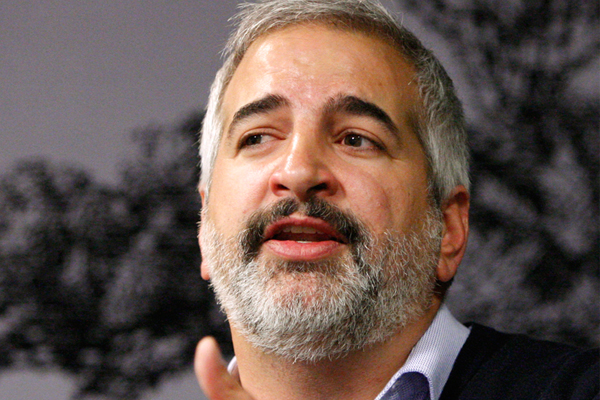
Anthony Shadid (Credit: AP) Anthony’s Shadid’s now unbearably poignant book, “House of Stone,” opens with a scene of carnage that will be familiar to anyone who read his coverage of the wars of the Middle East. As a reporter for the Washington Post in the summer of 2006, he arrived in the devastated Lebanese town of Qana to find that “Israeli bombs caught their victims in the midst of a morning’s work … the dead standing, sitting looking around, the village, its voices and stories, plate and bowls, letters and words, its history, obliterated in a few extended moments” of indiscriminate violence perpetrated by America’s favorite ally. As he wandered amid the devastation, he found a man mourning the death of his wife and five children. “‘I wish God would have left me with just one child,’ said the bereft former father.”
In its sympathetic detail, rhythmic language and political realism, the passage is pure Shadid. But the book quickly pivots from war into a ruminative “memoir of home, family and a lost Middle East.” From Qana, Shadid went on to visit Marjayoun, a village in southern Lebanon where his grandmother had lived as a girl before emigrating to the United States. When he saw that a half-exploded Israeli rocket had wrecked the abandoned house where she grew up, he promised to himself that he would rebuild it, to create what Arabic speakers call a bayt, not just a house, not just a home, but the enduring edifice of a family.
He needed one. Shadid’s success in becoming a Pulitzer Prize-winning war correspondent for the Post and New York Times had cost him his marriage and most contact with his 6-year old daughter. He took a leave from his job and launched on the project of rebuilding the house of Isber Shadid, his great-grandfather. It was a therapeutic venture in genealogy and home improvement intended to repair himself.
“House of Stone” is the very opposite of the war stories he told so well. As Shadid hires the workers and supervises construction, he excavates the history of his family and why they left the region once known as the Levant. The result is a braided tale of becoming and going. The story alternates between tales of his slow-motion construction project, with its tragic-comic cast of male artisans and suppliers, and finely etched flashbacks of the Shadid clan making its way in America in the 1920s, with the focus on his grandmother Raeefa who went on to become the wealthy matriarch of a family of strivers in Oklahoma.
Shadid starts his project by hiring Abu Jean, a master tradesman (maalim) whose prickly pride and constant promises to get the job done “tomorrow” leave Shadid smoldering with rage. But when Shadid realizes that Abu Jean actually cares more about him than the job, he finally understands the man. “He showed up every day to make me happy,” he writes in wonder. “Abu Jean cared about me.”
He discovers the rewards of small town life. He savors the local expressions (“Coffee without cardamon is like a bride without her gown,” a cousin tells him) and slows down to tend his small garden (hoquora). As the grounds around the house take shape, he marvels:
The olive trees were full of buds and the three pomegranates that Cecil had given me had managed to survive, sprouting a few leaves. I learned to respect the garden, where rituals and right action prevailed. Patience was requisite. There was redemption in silence. Seasons were restorative. A garden, I realized, heals.
But he admits he never quite feels at home. The people of Marjayoun take great pride in what their disapora had done, with different families accumulating fortunes in the Persian Gulf and the United States. “Yet there was a hint of resentment over their abandonment of their homes,” he writes. “No one came back to Marjayoun.” And still he tries. He thinks of Raeefa, crossing the ocean without her family. “Like my grandmother, I understood questions of identity, how being torn in two often leaves something less than one.”
When the house is done, he goes back to reporting. He goes to Libya where he is stopped by soldiers, thrown face down in the dirt. He hears one of them say, “Shoot them.” Expecting to die, he feels “emptiness, aridity, hopelessness, the antithesis of creation and imagination.”
He lives and has no thought but to return to Marjayoun and his finished home. Back among the olive trees, he exults in anticipation of his daughter’s imminent arrival, picturing her “suddenly grown, beside these trees and saying the words that I would one day teach her, words that would take her back to Isber’s world.”
That day will never come. On Feb. 16, just a few weeks before the publication of “House of Stone,” Shadid died while on assignment in Syria. This is the last testament of a superb reporter and citizen of the world who had the wisdom to find his bayt.
Jefferson Morley is a staff writer for Salon in Washington and author of the forthcoming book, Snow-Storm in August: Washington City, Francis Scott Key, and the Forgotten Race Riot of 1835 (Nan Talese/Doubleday). More Jefferson Morley.
Jonathan Lethem’s “perfect” album
The "Motherless Brooklyn" and "Fortress of Solitude" author's new book explains his fixation with the Talking Heads
Jonathan Lethem In essay collections like “The Disappointment Artist” and last year’s acclaimed “The Ecstasy of Influence,” best-selling novelist Jonathan Lethem brought his sharp critical lens and personal passion to bear on Marvel Comics, Roberto Bolaño, Bob Dylan and the John Carpenter movie “They Live.” Add to that diverse list of cultural artifacts the Talking Heads album “Fear of Music,” the subject of Lethem’s latest book, and published as part of Continuum’s 33 1/3 series of music writing.
Continue Reading CloseBrian Gresko has contributed to The Huffington Post, The Atlantic, The Daily Beast, The Paris Review Daily and The Millions. He lives in Brooklyn. More Brian Gresko.
In Iraq and on “The Wire,” it’s all acting for Benjamin Busch
In a lyrical memoir, a novelist's son discusses his strange path into war -- and David Simon's TV masterpiece
Benjamin Busch Benjamin Busch’s “Dust to Dust” is a remarkable book — part military memoir, part childhood reminiscence, and also an effort to explain his relationship with his father, the celebrated novelist Frederick Busch.
And yet it is also more than all of those things. Busch is filled with complicated and fascinating contradictions. Yes, he’s the son of a famously introspective and domestic writer, who grew up in rural New York obsessed with toy guns and building massive military forts. But he studied visual arts at Vassar, where he confused everyone by joining the Marine reserves — especially his commanders, when he accidentally announced himself in a roll call as part of the “Vassar infantry.”
Continue Reading CloseDavid Daley is the senior culture editor of Salon. More David Daley.
When I sold out to advertising
Like any proper writer and academic, I always shunned the profession. Then I realized I was the delusional one
Peggy Olson of "Mad Men" (Credit: AMC) The best cautionary story I ever heard came from a distinguished man in a snug, hillside coffee shop on a thundery Seattle afternoon.
I was new to the area, trailing a high-tech spouse who worked 14-hour days. The gloom had settled in. It was good weather for writing but after several hours, scenes from “The Shining” would be running through my head. I was slogging away at a second novel (my first was a tiny seller, now remaindered). I’d been a visiting professor in Providence and Minneapolis, but for the first time I couldn’t even find an adjunct job.
Continue Reading CloseAnn Bauer's novel, "The Forever Marriage," will be published by Overlook Press in June. This article came from her blog, which you can read at www.theforevermarriage.com. More Ann Bauer.
Wait, maybe my spy thriller is true …
Fact and fiction mysteriously converge for the author of the best-selling new novel "The Expats"
It has recently come to my attention that some people suspect that my wife is, in addition to being a senior executive at the largest book publisher in the world, also a spy. This misapprehension is almost entirely my fault. To set the record straight:
In my new novel, “The Expats,” a married couple with young sons move to Luxembourg — just as my wife and I did a few years ago (for a job of hers at an American-based technology company) — and it turns out that the wife had been a spy for the entirety of her adult life, and never told her husband.
Continue Reading CloseThe private lives of great writers
Like it or not, Edith Wharton's looks and Saul Bellow's sexual problems do shed light on their work
Edith Wharton and Saul Bellow Just how relevant is an author’s private life to our appreciation or understanding of his or her work? Many would argue that we should disregard it entirely. Others (myself included) might point out that while you can thoroughly enjoy a novel or poem without knowing who wrote it, any deeper grasp requires at least some basic information. It matters that Edna O’Brien is Irish, certainly, and it’s almost impossible to imagine how the writings of Jack Kerouac or Charles Bukowski could be separated from their life stories.
Continue Reading Close
Laura Miller is a senior writer for Salon. She is the author of "The Magician's Book: A Skeptic's Adventures in Narnia" and has a Web site, magiciansbook.com. More Laura Miller.
Page 1 of 57 in Writers and Writing