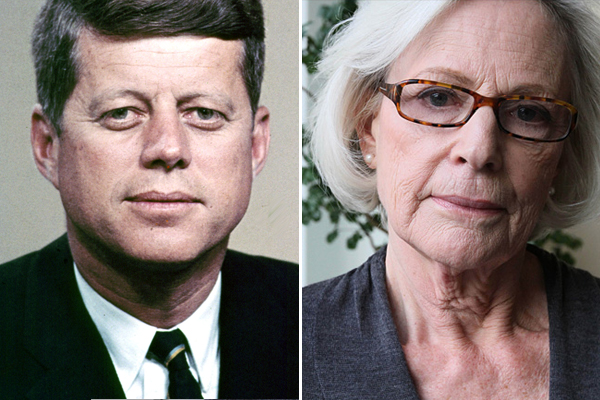

JFK

JFK: “Better red than dead”

At the height of the Cuban Missile Crisis, the president embraced anti-nuclear war rhetoric, a new book claims

John F. Kennedy and his one-time girlfriend Mimi Alford (Credit: AP/AP/Tina Fineberg)

In his charmed life, he seduced young women in the White House with ruthless ease. In his violent death, he plunged the American government into a crisis of confidence whose effects are still visible 50 years later.

How President John F. Kennedy lived and died still has the power to set tabloid hearts aflutter, while providing a rich lode of material for those interested in the inner workings of the American national security state.

But first, the sex. In June 1962, Mimi Alford was a 19-year old freshman from Wheaton College who had an internship at the White House. Within four days of meeting her, JFK took her on a tour of the White House, maneuvered her into a bedroom, undressed her, and made love to her “as if it was the most natural thing in the world.”

Now, a half century later, Alford has written a book called “Once Upon a Secret,” which the New York Post touted as a book by “JFK’s teen mistress.” That’s a great headline for 1963, but more than a little misleading in 2012. Now 69 years old, Alford is a mother and grandmother living in New York who wants to unburden herself of a secret of which she was both proud and ashamed. She writes not to titillate but to understand her life, and her candid account is all the more credible for it.

Alford’s story of her 18-month affair with JFK is corroborated on many key points. Barbara Gamerekian, a former White House aide, gave an oral history in which she talked about Kennedy’s many lovers, including one named Mimi. When a New York Daily News reporter contacted her in 2003, she reluctantly admitted the affair. Her account dovetails with other histories of the Kennedy administration; JFK biographer Robert Dallek told MSNBC he thought Alford’s story is “quite credible.”

Along with Nina Burleigh’s excellent 1998 book “A Very Private Woman,” about Mary Meyer, a Washington artist who was perhaps JFK’s most significant Other Woman, “Once Upon a Secret” sheds more light on an aspect of JFK’s presidency that is both sensationalized and trivialized. While traditional historians dismiss these relationships as merely sexual, exploitative, risky or compulsive, they were obviously central to JFK’s self-image as a man. They revealed aspects of his consciousness and desires that he could not share with family, friends or the public. In Alford’s story, we glimpse a truth denied by admirers and critics: JFK was libertine in his morality and liberal in his impulses.

Alford’s story matters because she spent time with JFK on perhaps the single most important day in his presidency. It came in late October 1962 during the Cuban Missile Crisis. The U.S. had discovered that the Soviet Union secretly installed nuclear missiles in Cuba to defend the revolutionary government of Fidel Castro. Most of JFK’s national security advisors — and all of the Joint Chiefs of Staff  — recommended JFK order the invasion of the island to destroy the missiles and overthrow the impudent Castro. JFK, a war hero, resisted. He accepted the lesser measure of a Naval blockade of the island while searching for a diplomatic solution.

Alford, back at school in Massachusetts, evokes the dread of those days when the world stood on the brink of nuclear war,  an “atmosphere of deep concern in some quarters and outright hysteria in others. We were warned about a national shortage of bomb shelters. We were besieged with apocalyptic estimates of how many people would die in a nuclear exchange.” No doubt seeking diversion from the burdens of office, JFK invited her to Washington. (He’d sent Jackie Kennedy and his children out of town.)

When Alford arrived at the White House on Oct. 28, 1962, Dave Powers, JFK’s personal aide, told her that the president had just sent a message to Moscow asking, for the last time, that the missiles be removed. Many thought war would start within 48 hours.

“Normally, he would have put his presidential duties behind him, had a drink and done his best to lighten up the room,” Alford recalls. Instead, JFK paced, contemplating whether he would soon have to make a decision to send thousands, if not millions, of people to a violent death.

Then she writes:

At one point, after leaving the room to take another urgent phone call, he came back shaking his head and said to me, “I’d rather my children be red than dead.” It wasn’t a political statement or an attempt at levity. These were the words of a father who adored his children and couldn’t bear them being hurt.

If true, it’s a telling comment. JFK was echoing a popular slogan of the peace movement of the 1960s: “Better red than dead.” The idea was anathema to the American right but common on the left in Europe: It would be better to live under communism than to die in a nuclear war. At the climactic moment of the Cuban missile crisis, Alford says JFK voiced this sentiment.

Some will say Alford’s story cannot be true because JFK was not a leftist but an anti-communist — but there’s nothing unusual about a politician having different views publicly and privately. Others may say Alford made up the story to sell books — as if an anecdote about JFK’s liberalism would entice readers interested in his libido. In the context of the crisis at hand, it is more plausible to think that the president was expressing an abhorrence of the nuclear terror that defined the Cold War and voicing a desire to escape its clutches as his advisors pressed for war.

The next morning Mimi returned to school, after waving goodbye to JFK while he was on the phone. Within an hour, the White House received a message from the Soviet leadership. The missiles would be removed. Without JFK’s restraint, most historians now agree, the U.S. would have found itself engaged in a land war in Cuba and quite possibly a nuclear war. The public welcomed the peaceful solution, but many in the Pentagon and the CIA thought JFK had squandered an opportunity to get rid of Castro. Air Force Chief of Staff Gen. Curtis LeMay, a belligerent right-winger who hated Kennedy, called the resolution of the missile crisis “the greatest defeat in our history.”

In the crisis’ aftermath, JFK moved left in his foreign policy. He publicly downplayed the Cuban issue, leading to feelings of betrayal in the upper ranks of the CIA. It is true that JFK privately authorized his brother Bobby to organize an alternative anti-Castro leadership independent of the Agency, but that only inspired contempt in Langley. In June 1963, JFK gave a speech at American University calling for the end of the Cold War, which inspired even more loathing on the right.

Alford’s book makes clear that JFK’s hunger for women was well-known to many in the White House. Burleigh’s book makes clear that his promiscuity was also well-known to his enemies, not the least of whom was James Angleton, the chief of the Agency’s counterintelligence staff. Angleton was a brilliant and paranoid man who loathed JFK’s Cuba policy and knew of his affair with Mary Meyer. She was the ex-wife of Cord Meyer, another senior Agency official with whom he worked closely. (Angleton “knew Cord pretty well,” said retired CIA officer Howard Hunt, who knew both men.)

It may be coincidence, but in the course of 1963, Angleton’s office was regularly informed about the travels, activities and political activities of an itinerant ex-Marine named Lee Harvey Oswald. As I documented in my 2008 book “Our Man in Mexico,” this information was not (per the CIA myth) considered “routine”  but was channeled to Angleton’s trusted aide, Jane Roman. When the CIA’s Mexico City station reported in October 1963 that Oswald had visited the Soviet Embassy there, Roman and others in Angleton’s office sent a deceptive cable to other U.S. agencies saying the CIA had learned nothing about Oswald’s activities since May 1962. (Roman acknowledged her role in writing this inaccurate memo in this 1994 interview, which I first reported in the Washington Post.)

Mimi Alford saw JFK for the last time on Nov. 15, 1963. On a visit to the White House, she told him she was engaged to her college boyfriend.

“He took me in his arms for a long embrace and said, ‘I wish you were coming with me to Texas.’ And then he added, ‘I’ll call you when I get back.’ I was overcome with sudden sadness. ‘Remember, Mr. President, I’m getting married.’

“’I know that,’ he said, and shrugged. ‘But I’ll call you anyway.’”

A week later, JFK was riding with Jackie in a motorcade in downtown Dallas when gunshots rang out. Kennedy was struck in the back and the head and died within an hour. Oswald was arrested for the crime, then murdered while in police custody. Suspicions of a conspiracy flared immediately and have never gone away, despite the claims of major news organizations and some historians. For many scholars and most Americans, the preponderance of evidence indicates that others were involved in the Dallas ambush, though no conspirators have ever been identified beyond a reasonable doubt.

In her grief over the murder of her lover, Alford confessed the affair to her fiancé. He felt hurt and humiliated and she felt a shame she could not voice; they eventually divorced. She says she wrote the book so her daughters would know the full story of her life.

“It’s sort of like closing a chapter on that 18 months,” she said, “and closing a chapter on keeping secrets.”

Mary Meyer was not so fortunate. In April 1964, she was shot and killed by homeless man as she walked along the C&O canal in Georgetown, the victim of what seems to have been a random street crime. Jim Angleton immediately went to Meyer’s house and seized (then later destroyed) her diary, which detailed her romance with the late president. The canny spymaster knew full well that the details of JFK’s relationships with other women were politically sensitive and historically important. Mimi Alford’s brave book confirms the point.

Jefferson Morley

Jefferson Morley is a staff writer for Salon in Washington and author of the forthcoming book, Snow-Storm in August: Washington City, Francis Scott Key, and the Forgotten Race Riot of 1835 (Nan Talese/Doubleday).

The return of “Castro did it” theory

A new book by a former CIA man implicates the Cuban leader in JFK's assassination

John F. Kennedy and Fidel Castro (Credit: Wikipedia)

The Cuban intelligence service, under the leadership of Fidel Castro, connived in the assassination of President John F. Kennedy, according to a new book by a retired CIA analyst. Coming from Brian Latell, the Agency’s former national intelligence officer for Latin America, the charge is both sensational and uncorroborated, yet still important.

Latell says flatly that Castro played a role in Kennedy’s murder in Dallas on Nov. 22, 1963.

“Castro and a small number of Cuban intelligence officers were complicit in Kennedy’s death but … their involvement fell short of an organized assassination plot,” he writes in “Castro’s Secrets: The CIA and Cuba’s Intelligence Machine,” a well-footnoted polemic about Cuba’s General Directorate of Intelligence to be published next month. Latell says accused assassin Lee Harvey Oswald told Cuban diplomats in Mexico City in September 1963 that he might kill JFK. Latell also speculates, without any direct evidence, that Oswald kept the Cubans apprised of his plans as he made his way to Dallas.

The  charge is sensational because Latell is the highest-ranking former CIA official to ever accuse the Cuban leader of personal responsibility for JFK’s death. It is uncorroborated because much of the evidence Latell cites in the book is not in the public record or available to JFK scholars. Even the CIA is keeping its distance. When I asked the Agency to comment on Latell’s thesis on Wednesday, a spokesperson replied, “You can report the CIA declined comment.”

Still, Latell is a former CIA official in good standing, and his allegations signal the CIA may be changing its institutional position on the causes of JFK’s death. As the 50thanniversary of JFK’s death approaches in 2013, Latell’s book indicates the Agency defenders are moving toward “a modified limited hangout” — Washington lingo for a public relations maneuver to release previously hidden information in the service of preventing exposure of more damning detail.

For most of the past five decades the institutional posture of the CIA has said that there is no evidence of  conspiracy in Kennedy’s death and no evidence that Lee Harvey Oswald, a known leftist, acted at Castro’s behest. In 1967, CIA director Richard Helms sent an order to every CIA station in the world ordering them to take steps to combat speculation about Oswald’s motives and associations. The Agency’s line echoed the Warren Commission: that Oswald had killed JFK for reasons known only to himself and anybody who thought differently was irrational or anti-American or both. If Latell, a career CIA employee, had written his book in the 1960s or 1970s, he would have been fired.

Indeed, Latell’s book implies a  harsh assessment of the FBI and the CIA’s performance in 1963. If what he says is true, both agencies were closely watching a known leftist encouraged by a hostile intelligence service and failed to prevent him from killing the president of the United States in broad daylight—and then failed to discern Cuba’s involvement for close to a half-century. Latell, reached by telephone, declined to discuss specifics of the book in advance of its publication in April,  but he did say of the FBI and CIA, “They should have done a better job.” When asked if the CIA or Congress should investigate his findings, Latell said, “I don’t know that they should do anything.”

Latell’s most intriguing contribution is the testimony of Florentino Aspillaga, a career General Directorate of Intelligence officer who defected to the United States in 1987. Latell interviewed him extensively in 2007 and 2008, and found him unusually credible on the workings of the Cuban security forces. Aspillaga told Latell that on Nov. 22, 1963, he was manning a Cuban radio monitoring station that usually focused on Miami or Langley. His bosses, he said, made an unusual request that day: monitor the airwaves in Texas. Soon came the shocking news that JFK had been killed in Dallas. “Castro knew,” Aspillaga is quoted as saying. “They knew Kennedy would be killed.”

This story is worth checking. A number of other credible witnesses (not mentioned by Latell) came forward over the years to say they knew Kennedy’s life was in danger in Dallas. The Cuban intelligence service had many informants among anti-Castro, anti-JFK militants with whom Oswald associated in 1963. It’s quite possible that Cuba has not disclosed all that it knew about the accused assassin.

To buttress his case, Latell cites three other stories, all of them familiar to JFK scholars.

He quotes the reports of Jack Childs, a leader of the American Communist Party who also worked as an FBI informant. Childs met with Castro in May 1964 and reported that the Cuban leader had said that Oswald had told Cuban diplomats that he would kill the president and that Cuba had denied him a visa because of his provocative behavior. When the FBI received Childs’ report, director J. Edgar Hoover downplayed its significance to the Warren Commission.

Latell cites the account of Vladimir Rodriguez Lahera, the member of Cuban intelligence services who defected in early 1964. According to the results of a  lie detector test, Rodriguez Lahera’s answers indicated that Oswald was known to Cuban intelligence services before Kennedy was killed. Rodriguez Lahera was considered credible and worked for the CIA for a couple of years. But as Latell notes, the CIA did not share this information with the Warren Commission.

Latell also cites the intercepted conversation of a woman who worked in the Cuban Embassy in Mexico City named Luisa Calderon. A CIA wiretap picked up her remarks after the assassination in which she said, “I knew about it almost before he [Kennedy] did.” Latell thinks the remark is indicative of foreknowledge of a plot to kill Kennedy. But the CIA’s Mexico City station chief Win Scott didn’t think her comment was significant and he didn’t share it with the Warren Commission.

Which raises an obvious question: If this evidence is so compelling in 2012 why didn’t the CIA and FBI forward it to the Warren Commission for investigation back in 1964? The answer is found in the hundreds of thousands of new JFK documents forced into the public record in the 1990s. The CIA and FBI didn’t investigate what the DGI knew about Oswald in 1964 because any such inquiry would have revealed the curious role that the CIA itself played in the genesis of the “Castro did it” theory.

As I reported for Salon in 2003, within hours of JFK’s murder, an Agency student group in Miami was giving reporters evidence of Oswald’s pro-Castro ways. Declassified CIA records show that the group, Cuban Student Directorate, received $51,00 a month from an undercover CIA officer running  “psychological warfare” operations. The group’s revelations about Oswald’s public support for Castro in New Orleans generated scores of headlines across the country that linked Kennedy’s murder to a “Castroite.” When the Cuban students proclaimed in print the next day that Oswald and Castro were the “presumed assassins,” it was the first JFK conspiracy theory to reach public print. Whether Latell knows it or not, his book is a direct descendant of this CIA-funded operation.

Yet in the days and weeks that followed the CIA blocked investigation of Oswald’s Cuban contacts. When U.S. Ambassador to Mexico Tom Mann pushed for such an investigation in Mexico City in the days after the assassination, Mexico City station chief Win Scott rebuffed him with the support of the FBI. In Langley, the senior CIA official in charge of reviewing Oswald files, John Whitten, wanted to investigate Oswald’s Cuban connections in Miami and New Orleans. He was promptly removed from his position by deputy CIA director Richard Helms.

The problem was that the Agency’s pre-assassination interest in Oswald, far from being “routine” as the CIA told JFK investigators in 1978, was intense. The newly declassified records showed that between 1959 and 1963 more than 40 different reports were placed in Oswald’s file, including State Department cables, intercepted personal letters and FBI reports. When Kennedy was alive, the file was controlled by the Agency’s secretive counterintelligence staff, which is responsible for detecting threats to the Agency’s operations.

Latell is aware of this record. He served as chief of the Agency’s Center for the Study of Intelligence, which oversaw the declassification of the long-secret CIA material between 1994 and 1998. But the book does not address what the  Agency knew about Oswald before the assassination.

And this is what the modified limited hangout of the “Castro did it” theory achieves. It concedes errors and calls attention to new information about JFK’s death while turning public discussion away from the troubling totality of the historical record and the thousands of JFK assassination records that remain secret. We are sure to hear more of the “Castro did it” theory between now and the 50th anniversary of JFK’s death. It deserves the closest scrutiny.

Continue Reading Close
Jefferson Morley

Jefferson Morley is a staff writer for Salon in Washington and author of the forthcoming book, Snow-Storm in August: Washington City, Francis Scott Key, and the Forgotten Race Riot of 1835 (Nan Talese/Doubleday).

How will today’s O’Reilly explain JFK’s murder?

Before he made it big, Bill uncovered possible ties between Oswald and the CIA. His book likely won't be so daring VIDEO

(Credit: AP/Wikipedia)
This article originally appeared on WhoWhatWhy.

WhoWhatWhyYou may have heard that the Fox News celebrity host Bill O’Reilly has a forthcoming book on JFK, timed for release this fall. How could you have not heard? Scheduled in anticipation of the 50th anniversary of Kennedy’s death in 2013, the book has been heavily covered by the media—examples here, here and here–despite a near total lack of information as to the content. Here’s an excerpt from USA Today which is typical:

“As with most baby boomers, the murder of JFK was a signature moment in my life,” O’Reilly, the top-rated Fox News talk show host and a former high school history teacher, said in a statement. “’Killing Kennedy’ will answer many questions about the president and why his life was cut short.”

What sort of answer will O’Reilly provide to the fundamental and extremely controversial question about why Kennedy died? Will he perpetuate the mainstream media’s near-constant advocacy of the lone-nut scenario? O’Reilly did not even hint at how he would handle it or whether he has any new information.

Yet another book by O’Reilly, his recent “Killing Lincoln,” was, as some reviewers noted, more like a John Grisham rendition of the tragedy than the work of an investigative journalist or scholar intent on major breakthroughs—or even deeper understanding.

OBLIVION

Let’s compare the nature of O’Reilly’s current bestseller fare, and the media’s receptivity to it, with journalism done some years back, again on the JFK assassination—by the very same Bill O’Reilly. The earlier work had some major, groundbreaking revelations—and legitimate, very hot content, based on reporting conducted in the early 1990s. It will come as a surprise, because most of us never heard about the show’s revelations—not at the time, and not since. There’s a reason: the highly disturbing, even threatening evidence of a mostly unexplored link between Oswald and U.S. government agents.

Watch Bill O’Reilly below, back when he hosted the syndicated television show Inside Edition:

Key excerpts:

“O’REILLY: Living in Dallas, Oswald was befriended by Russian-born George de Mohrenschildt. Investigators determined he was a contract agent for the CIA in Central America and the Caribbean. In 1977, moments before he was to be interviewed by House investigators, de Mohrenschildt blew his brains out with a 20-gauge shotgun. House investigators believe he was a crucial link between the CIA and Lee Harvey Oswald.

There is no question that the sealed JFK Files are extremely embarrassing for the CIA. House investigators have told Inside Edition that the Agency did not fully cooperate in their investigation and that the CIA had final say in the final report that the House Assassinations Committee made public. Thus the public report makes no mention of the CIA’s links with Lee Harvey Oswald. But the secret documents are another story.

…House investigators uncovered evidence that the CIA planted nine agents inside the Garrison investigation to feed him false information and to report back to Langley what Garrison was finding out.

That was explosive content, and O’Reilly was prepared for major press interest in this scoop. That’s not, however, the way things played out. Jerry Policoff, who interviewed O’Reilly back in those days for an article in the alternative newsweekly The Village Voice remembers:

“He thought the piece was so important that he held a press conference to promote it. Of course no mainstream media showed up. He expressed his astonishment to USA Today, and I interviewed him as a follow-up. He repeated to me that he could not understand how the media could not even show up at a press conference on such an important issue.

Ok – so that was Bill O’Reilly back then, in the 1990s, before he became a breakout star. Will O’Reilly’s new Kennedy book really tell us why he died?

Not likely, if we consider what it took for O’Reilly to make it big-time.

One pundit, who used to appear on Fox a lot in O’Reilly’s first years there. recalls a producer mentioning that O’Reilly wanted to continue doing JFK assassination reports, but that network chief Roger Ailes and other top management “kept stepping on the story.”

Years later, O’Reilly is on a roll that is likely to continue—provided he plays his cards right.

The lesson is this: Listen to the higher-ups, don’t step on the wrong toes, and you, too, can make it to the top.

We look forward to seeing if today’s O’Reilly takes inspiration from his younger, feistier self in probing beneath the official story of the Kennedy assassination. But we’re not holding our breath.

Continue Reading Close

Russ Baker, an award-winning investigative journalist, is founder and editor-in-chief of WhoWhatWhy.com.

www.salon.com/topic/jfk/