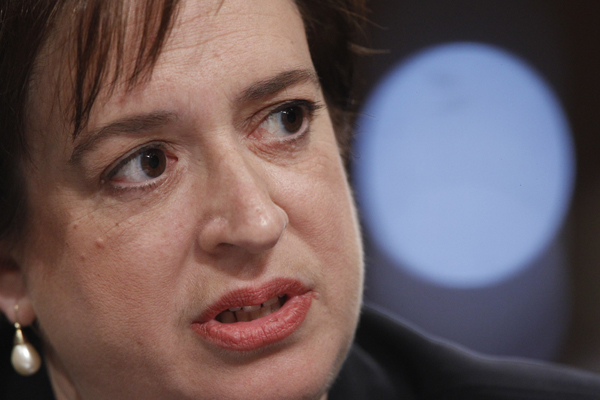

Glenn Greenwald

Justice Kagan sides with the Right on Miranda

The 6-3 Court vote on a key issue that has long divided right and left may bode poorly for the Kagan appointment

Although I praised and vigorously defended President Obama’s choice of Sonia Sotomayor to replace Justice David Souter on the Supreme Court, I argued vehemently against his appointment of Elena Kagan to replace Justice John Paul Stevens. My argument against Kagan was three-fold: (1) even if (as was likely) she more often than not votes with the relative liberals on the Court, the fact that she was replacing the most liberal justice meant that the net effect of her appointment would likely be that she would move the Court to the Right (as I wrote at the time: “by ’the Right,’ I mean: closer to the Bush/Cheney vision of Government and the Thomas/Scalia approach to executive power and law“); (2) far too little was known about her judicial philosophy to risk her appointment, particularly when there were so many outstanding judges available who had a long and clear record of outstanding jurisprudence; and most importantly, (3) to the extent anything could be discerned about her judicial and legal views, she evinced a strong belief in broad executive authority and government/police power, among the most important areas the Supreme Court would adjudicate over the next decade or so (at the time, I summarized my argument against the Kagan nomination on Democracy Now, where a transcript can be read here, as well as on Rachel Maddow’s show and ABC‘s Sunday This Week program).

Thus far, it’s been far too early to know what type of Justice she will be — in part because she recused herself from so many important cases (because she had worked on them as Obama’s Solicitor General) and because the wheels of justice grind especially slowly on the Supreme Court level. To the extent there has been any evidence, it has been mixed: she refused to join with Justices Ginsburg and Sotomayor in voting to review both (1) a death sentence imposed on a woman whose lawyers argued “is borderline mentally retarded, with the intellectual ability of about a 13-year-old,” and (2) dismissal of a case brought by two Colorado residents alleging that their First Amendment free speech rights were violated when they were forcibly removed from a Bush campaign event due to anti-war t-shirts they were wearing. Those were somewhat disturbing decisions (though of limited value in knowing her judicial approach); on the other hand, she authored an important and powerful dissent enforcing the First Amendment bar against state establishment of a  religion.

Today, although the overall picture is still incomplete, we have probably the clearest — and definitely the most troubling — sign yet. In Howes, Warden v. Field, released today, the U.S. Supreme Court reversed a decision of the Sixth Circuit Court of Appeals, which (along with the federal district court hearing the case) had held that a prisoner’s Constitutional rights had been violated when prison officials interrogated him for five to seven hours without advising him of his Miranda rights. The prisoner confessed during his lengthy interrogation; the State then used the confession at trial; and he was ultimately convicted and sentenced to 10 to 15 years in prison. He then filed for a writ of habeas corpus in federal court, arguing that he was in “custody” during the protracted interrogation and the failure to advise him of his Miranda rights meant the State was barred from using the confession to convict him (Miranda warnings are required for any “custodial” questioning: when the person being interrogated is “held” for interrogation). Both the district court and Sixth Circuit agreed that he was in “custody” during the interrogation, and thus granted habeas corpus due to the failure of prison officials to advise him of his right to remain silent, his right to an attorney, etc.

The Supreme Court today reversed the Sixth Circuit’s grant of habeas corpus. All nine of the justices agreed that the legal conclusion of the Sixth Circuit — that “isolation from the general prison population, combined with questioning about conduct occurring outside the prison, makes any such interrogation custodial per se” – was not “clearly established Federal law” (a prerequisite to granting habeas corpus relief for a state prisoner). But on the question of whether the prisoner was entitled to be read his Miranda rights under the circumstances here — i.e., he did not consent to being removed from his cell for interrogation and was “questioned by two armed deputies long into the night and early morning,” often with the door closed — the Supreme Court split by a 6-3 vote. Six justices (the 5 right-wing justices plus Kagan) signed onto Justice Alito’s opinion ruling that the prisoner was not in “custody for purposes of Miranda,” while the 3 relative liberals on the Court (Ginsburg, Sotomayor and Breyer) all joined Justice Ginsburg’s dissenting opinion, which concluded (citations omitted):

As the Court acknowledges, Fields did not invite or consent to the interview. He was removed from his cell in the evening, taken to a conference room in the sheriff ’s quarters, and questioned by two armed deputies long into the night and early morning. He was not told at the outset that he had the right to decline to speak with the deputies. Shut in with the armed officers, Fields felt “trapped.” Although told he could return to his cell if he did not want to cooperate, Fields believed the deputies “would not have allowed [him] to leave the room.” And with good reason. More than once, “he told the officers . . . he did not want to speak with them anymore” . . . .

Was Fields “held for interrogation”? See Miranda, 384 U. S., at 471. Brought to, and left alone with, the gun-bearing deputies, he surely was in my judgment. . . . For the reasons stated, I would hold that the “incommunicado interrogation [of Fields] in a police-dominated atmosphere,” without informing him of his rights, dishonored the Fifth Amendment privilege Miranda was designed to safeguard.

I don’t want to overstate the importance of this ruling: it’s not the most significant Supreme Court decision ever and it’s not dispositive on the question of whether Kagan will turn out to be a good replacement for Stevens; that still remains to be seen. But it’s also far from unimportant. As the lawyer Bmaz at Marcy Wheeler’s blog observes today, “the decision is a significant further erosion of the critical Constitutional protections embodied in Miranda.” That’s because it “specifically holds that police are not automatically required to tell prisoners of their legal right to remain silent and have an attorney present when being questioned in prison about another crime.”

But beyond the specifics of this case, one’s views on Miranda have long been a key determinant of where one falls on the jurisprudential spectrum. Miranda rights have long been a prime bugaboo of the authoritarian Right’s complaints about supposedly excessive protections for criminal defendants (Justices Scalia and Thomas, in a 2000 case, actually argued that Miranda should be overruled). Conversely, the recognition of that right was one of the crown jewels of the Warren Court, and its stalwart protection in robust form has been a litmus test for whether one is devoted to Constitutional safeguards to ensure a fair criminal justice system (President Obama has invoked Terrorism to justify the erosion of Miranda). To watch Elena Kagan side with Justices Scalia, Thomas, Alito, Roberts and Kennedy and against Ginsburg, Sotomayor and Breyer on such a central and long-standing dispute — the scope of Miranda – does not bode well.

Notably, the last significant Supreme Court case on Miranda came in the 2010 case of Berghuis, Warden v. Thompkins. There, the conservative faction also prevailed in significantly limiting the scope of Miranda protections. Except there, the vote was 5-4, not 6-3. That’s because Justice Stevens joined with Ginsburg, Breyer and Sotomayor in defense of robust Miranda protections; this time, the vote was 6-3 because Stevens’ replacement — Justice Kagan — joined with the conservative majority. That’s what many of us who were concerned about Kagan’s nomination meant when we argued that, even if she often votes with the liberal wing, there is a high risk that, as the replacement for Justice Stevens, she will move an already right-wing court further to the Right, particularly in areas of executive authority and state police power.

Obama’s new free speech threat

An Executive order seeks to punish U.S. citizens even for "indirectly" obstructing dictatorial rule in Yemen

President Barack Obama speaks at the White House in Washington, Tuesday, May 15, 2012. (AP Photo/Carolyn Kaster) (Credit: AP)

(updated below)

There is substantial opposition in both Yemen and the West to the new U.S.-backed Yemeni President, Abed Rabbo Mansour Hadi. Hadi was the long-time Vice President of the Yemeni dictator Ali Abdullah Saleh, and after Saleh finally stepped down last year, Hadi became President as part of an “election” in which he was the only candidate (that little fact did not prevent Hillary Clinton from congratulating Yemen “on today’s successful presidential election” (successful because the U.S. liked the undemocratic outcome)). As it does with most U.S.-compliant dictators in the region, the Obama administration has since been propping up Hadi with large amounts of money and military assistance, but it is now taking a much more extreme step to ensure he remains entrenched in power — a step that threatens not only basic liberties in Yemen but in the U.S. as well:

President Obama plans to issue an executive order Wednesday giving the Treasury Department authority to freeze the U.S.-based assets of anyone who “obstructs” implementation of the administration-backed political transition in Yemen.

The unusual order, which administration officials said also targets U.S. citizens who engage in activity deemed to threaten Yemen’s security or political stability, is the first issued for Yemen that does not directly relate to counterterrorism.

Unlike similar measures authorizing terrorist designations and sanctions, the new order does not include a list of names or organizations already determined to be in violation. Instead, one official said, it is designed as a “deterrent” to “make clear to those who are even thinking of spoiling the transition” to think again. . . .

The order provides criteria to take action against people who the Treasury secretary, in consultation with the secretary of state, determines have “engaged in acts that directly or indirectly threaten the peace, security or stability of Yemen, such as acts that obstruct the implementation of the Nov. 23, 2011, agreement between the Government of Yemen and those in opposition to it, which provides for a peaceful transition of power . . . or that obstruct the political process in Yemen.”

In other words, the U.S. Government will now punish anyone who is determined — in the sole discretion of the U.S. Government — even to “indirectly” obstruct the full transition of power to President Hadi. But what if someone — a Yemeni or an American — opposes Hadi’s rule and wants to agitate for a real election in which more than one candidate runs? Is that pure political advocacy, as it appears, now prohibited by the U.S. Government, punishable by serious sanctions, on the ground that it “obstructs” the transition of power to Hadi? Can journalists who report on corruption or violence by the Hadi regime and who write Op-Eds demanding a new election be accused, as it seems, of “threatening Yemen’s political stability”?

Jeremy Scahill, who has reported extensively from Yemen over the last year, reacted to the news of this Executive Order this morning by writing: ”This Executive Order appears to be an attack on Americans’ 1st Amendment Rights and Yemenis’ rights to self-determination“; he added: ”apparently the 1st Amendment had an exception about Yemen in it that I missed.” He then asked a series of questions, including: “What if a Yemeni citizen doesn’t believe in a one candidate ‘election’ and is fighting to change their government? US sanctions?” and ”How would Obama define an American citizen as ‘indirectly’ threatening the stability of Yemen’s government?” and “what if an American citizen doesn’t support Yemen’s government and agitates for its downfall? Sanctions from US Treasury? Wow.” Marcy Wheeler has some typically astute points to make about this as well.

The Post article notes that, as unusual as this Executive Order is, Obama issued a similar one for Somalia in 2009, and it has one other precedent: “In 2006, President George W. Bush issued a similar order regarding Ivory Coast in West Africa.” Newspapers should just create a template that says that for every article: this radical and controversial power that Obama has just seized for himself has its genesis in the executive power and war theories of Bush/Cheney. Except for the power to secretly target U.S. citizens for due-process-free assassination-by-CIA and the manic war on whistleblowers — those are Obama originals — that’s a reliable claim to make, which is the point.

When I first began writing about Bush’s War on Terror abuses, I would sometimes be asked whether America still protects certain liberties more than most other countries, and my answer would always be the same: First Amendment rights in the U.S. of free speech and a free press are still more robust than most other countries in the world. It was one realm which the Bush War on Terror had by and large — not entirely, but by and large — left alone. That is just no longer true. Under Obama, we have seen a series of aggressive erosions of even this right in the name of Terrorism.

The Obama DOJ persuaded the U.S. Supreme Court in Holder v. Humanitarian Law to adopt an extraordinarily broad interpretation of “material support” statutes, such that, as Georgetown Law Professor David Cole put it, the Court “–for the first time in its history—[held] that speech advocating only lawful, nonviolent activity can be subject to criminal penalty, even where the speakers’ intent is to discourage resort to violence.” We now routinely see from the Obama DOJ Terror prosecution of Muslim Americans grounded in the expression of their pure political views. Long before any alleged evidence emerged that U.S. citizen Anwar Awlaki had any involvement in any Al Qaeda plots, the Obama administration placed him on a “hit list” because of its fear of the efficacy of his anti-American sermons. American Muslims are routinely targeted by sophisticated FBI entrapment campaigns if their criticisms of U.S. foreign policy (constant bombing of Muslim countries) is sufficiently strident.

There seems to be little question that the Obama administration is devoted to imposing dictatorial order on Yemen through the use of force and liberty abridgment. As Scahill previously reported, Obama has played a direct personal role in the ongoing imprisonment of a Yemeni journalist who committed the crime of documenting the large number of civilian deaths from a U.S. cluster bomb attack on his country as well as exposing the joint lies of the Yemeni and U.S. Government. The latest U.S. drone strike in Yemen yesterday, even according to Yemeni officials, killed more civilians than alleged “militants.”  The bombing campaign in Yemen now increasingly resembles the one conducted in Pakistan, though Yemen saw more drone strikes this month than any previous month in Pakistan. AP reported yesterday that there are now U.S. troops on the ground aiding Yemeni soldiers in their fights against alleged AQAP members.

What’s most amazing about all of this is how covert it is. What percentage of Americans even know that the Obama administration is continuously bombing and killing civilians in Yemen, or that American soldiers are now on the ground there in an advisory capacity? How many network news shows air any questions about any of this, and how many MSNBC shows (other than this one) have ever stopped talking long enough about all the supreme GOP Evil to even mention to their progressive audience that any of this is happening or aired questions and challenges about it? I’d be willing to bet that the vast, vast majority of Yemen mentions — almost all — entail little more than grave warnings about the scary threats emanating from there against the U.S., combined with gleeful celebrations of all the glorious Terrorist Kills our strong, resolute, brave Commander-in-Chief has commanded. In the meantime, not only endless militarism and war march on unabated, but so, too, does the erosion of core liberties which it entails.

* * * * *

Speaking of ongoing erosions of core liberties: a bipartisan group of House members is attempting to enact a law specifying that the indefinite detention powers vested in the President by last December’s passage of the NDAA does not apply to those arrested on U.S. soil; in other words, they are trying to ban military detention on American soil without charges. Even though President Obama, after he signed the bill into law, said he does not intend to use these powers for that purpose, the sponsors of this bill are concerned that — because the law does vest this power — Obama could change his mind at any time or a subsequent President could use those powers. Unfortunately, they are being opposed by key Democratic Senators such as Carl Levin in close cooperation with standard neocon members of Congress. As one tweeter wrote to me yesterday about this: “The fact that government has to be told NOT to do that is insane.” Indeed, and it’s easy to forget how frequently true that is. But the War on Terror has so normalized even the most warped powers — warrantless eavesdropping, torture, indefinite detention, renditions, due-process-free-assassinations, Executive Orders like the one today — that it’s sometimes easy to forget that this is the only real reaction that should be needed.


UPDATE: Those wishing to defend actions such as the issuance of this Executive Order typically argue that although it has the potential to sweep up legitimate and innocent political activity, the U.S. Government intends to use it only to constrain the Bad People: those who seek to use violence or other illegitimate means to achieve their end. Click here for a very partial history of that assurance and then decide if you feel comfortable trusting it.

Continue Reading Close

Likely victory for MeK shills

Former U.S. officials, paid to advocate for a designated Terror group, are now on the verge of succeeding

MEK fighters in Iraq. (Credit: AP/Brennan Linsley)

(updated below)

A bipartisan band of former Washington officials and politicians has spent the last two years aggressively advocating on behalf of the Mujahedin-e Khalq (MeK), an Iranian dissident group that has been formally designated for the last 15 years by the U.S. State Department as a “foreign Terrorist organization.” Most of those former officials have been paid large sums of money to speak at MeK events and meet with its leaders, thus developing far more extensive relations with this Terror group than many marginalized Muslims who have been prosecuted and punished with lengthy prison terms for “materially supporting a Terrorist organization.” These bipartisan MeK advocates have been demanding the group’s removal from the Terror list, advocacy that has continued unabated despite (or, more accurately, because of ) reports that MeK is trained and funded by the Israelis and has been perpetrating acts of violence on Iranian soil aimed at that country’s civilian nuclear scientists and facilities (also known as: Terrorism).

Now, needless to say, the State Department appears likely to accede to the demands of these paid bipartisan shills:

The Obama administration is moving to remove an Iranian opposition group from the State Department’s terrorism list, say officials briefed on the talks, in an action that could further poison Washington’s relations with Tehran at a time of renewed diplomatic efforts to curtail Iran’s nuclear program.

The exile organization, the Mujahedin-e Khalq, or MeK, was originally named as a terrorist entity 15 years ago for its alleged role in assassinating U.S. citizens in the years before the 1979 Islamic revolution in Iran and for allying with Iraqi strongman Saddam Hussein against Tehran.

The MeK has engaged in an aggressive legal and lobbying campaign in Washington over the past two years to win its removal from the State Department’s list. . . . Senior U.S. officials said on Monday that Secretary of State Hillary Clinton has yet to make any final decision on the MeK’s status. But they said the State Department was looking favorably at delisting MeK if it continued cooperating by vacating a former paramilitary base inside Iraq, called Camp Ashraf, which the group had used to stage cross-border strikes into Iran.

This highlights almost every salient fact about how Washington functions with regard to such matters. First, if you pay a sufficiently large and bipartisan group of officials to lobby on your behalf, you will get your way, even when it comes to vaunted National Security and Terrorism decisions; if you pay the likes of Howard Dean, Fran Townsend, Wesley Clark, Ed Rendell, Rudy Giuliani, Tom Ridge and others like them to peddle their political influence for you, you will be able to bend Washington policy and law to your will. As Andrew Exum put it this morning: “I guess Hizballah and LeT just need to buy off more former administration officials.”

Second, the application of the term “Terrorist” by the U.S. Government has nothing to do with how that term is commonly understood, but is instead exploited solely as a means to punish those who defy U.S. dictates and reward those who advance American interests and those of its allies (especially Israel). Thus, this Terror group is complying with U.S. demands, has been previously trained by the U.S. itself, and is perpetrating its violence on behalf of a key American client state and against a key American enemy, and — presto — it is no longer a “foreign Terrorist organization.”

Third, this yet again underscores who the actual aggressors are in the tensions with Iran. Imagine if multiple, high-level former Iranian officials received large sums of money from a group of Americans dedicated to violently overthrowing the U.S. government and committing acts of violence on American soil, and the Iranian Government then removed it from its list of Terror groups, thus allowing funding and other means of support to flow freely to that group.

Fourth, the rule of law is not even a purported constraint on the conduct of Washington political elites. Here, the behavior of these paid MeK shills is so blatantly illegal that even the Obama administration felt compelled to commence investigations to determine who was paying them and for what. As a strictly legal matter, removing MeK from the Terror list should have no effect on the criminality of their acts: it’s a felony to provide material support to a designated Terror group — which the Obama DOJ, backed by the U.S. Supreme Court, has argued, in a full frontal assault on free speech rights, even includes coordinating advocacy with such a group (ironically, some of this Terror group’s paid advocates, such as former Bush Homeland Security adviser Fran Townsend, cheered that Supreme Court ruling when they thought it would only restrict the political advocacy of Muslims, not themselves).

The fact that the Terror group is subsequently removed from the list does not render that material support non-criminal. But as a practical matter, it is virtually impossible to envision the Obama DOJ prosecuting any of these elite officials for supporting a group which the Obama administration itself concedes does not belong on the list. The removal of this group — if, as appears highly likely, it happens — will basically have the same effect, by design, as corrupt acts such as retroactive telecom immunity and the shielding of Bush war crimes and Wall Street fraud from any form of investigation: it will once again bolster the prime Washington dictate that D.C. political elites reside above the rule of law even when committing violations of the criminal law for which ordinary citizens are harshly punished.

* * * * *

Speaking of the assault on the free speech rights of Muslim critics of the U.S. under the guise of “material support” prosecutions (an assault which also erodes free speech rights for everyone), Michael May has a great long article in The American Prospect on the horrendous, free-speech-threatening prosecution of Tarek Mehanna, whose extraordinary sentencing statement I published here.


UPDATE: In 2003, when the Bush adminstration was advocating an attack on Iraq, one of the prime reasons it cited was “Saddam Hussein’s Support for International Terrorism.” It circulated a document purporting to prove that claim (h/t Hernlem), and one of the first specific accusations listed was this:

Iraq shelters terrorist groups including the Mujahedin-e-Khalq Organization (MKO), which has used terrorist violence against Iran and in the 1970s was responsible for killing several U.S. military personnel and U.S. civilians.

So the group that was pointed to less than a decade ago as proof of Saddam’s Terrorist Evil is now glorified by both political parties in Washington and — now that it’s fighting for the U.S. and Israel rather than for Saddam — is no longer a Terror group.

Continue Reading Close

Andrew Sullivan’s father figure

The tearful Newsweek writer speaks on why paternalistic acceptance from the president is so meaningful

Andrew Sullivan at a White House state dinner in March. (Credit: AP/Charles Dharapak)

(updated below – Update II – Update III [Tues.] – Update IV [Tues.])

Andrew Sullivan — who has become the most reliable media hagiographer of an American President since . . . . the 2002 version of Andrew Sullivan under President Bush — spent the past three years continuously insisting that President Obama’s opposition to same-sex marriages was largely irrelevant (“We will win not by begging presidents to back us (they have no role in a matter involving state legislatures, governors and courts”)). Based on that view, he constantly berated gay groups and gay activists for complaining about Obama’s opposition to marriage equality: “this desperate desire among some gays for some kind of affirmation from one man is a little sad,” he wrote just last week. But that was when President Obama opposed same-sex marriage, so defending the President required one to voice that position.

Last week, everything changed. President Obama “evolved” into a supporter of same-sex marriage. So now let’s hear what Andrew Sullivan has to say on this topic. The day Obama announced his reversal evolution, Sullivan wrote that he was “uncharacteristically at a loss for words”; that “ it reaffirms for me the integrity of this man we are immensely lucky to have in the White House”; “that’s why we elected him. That’s the change we believed in”; and that “there are tears in my eyes.” He then spent the next week on his blog hailing Obama’s courage, integrity and greatness as reflected by this decision of historic significance (the same decision that he spent three years insisting was irrelevant before Obama made it). He then penned this week’s Newsweek cover story in which he wrote that “when I watched the interview, the tears came flooding down” and “to have the president of the United States affirm my humanity—and the humanity of all gay Americans—was, unexpectedly, a watershed.” Yesterday, he went on The Chris Matthews Show, and this actually happened:

That’s from the same person who, to defend anti-gay-marriage Obama, has been writing things like: “this desperate desire among some gays for some kind of affirmation from one man is a little sad.“ I’ve long defended Sullivan as much as anyone; I consider him a friend; and I understand that as one of the first marriage equality advocates, he might be more emotional than most about this admittedly emotional issue. Still, this has to be one of the creepiest episodes in American punditry in some time, and that’s true for two independent reasons:

First, it shows the dedication some media figures and Obama followers have to glorifying and justifying whatever the President does, even when the acts being defended are the exact opposite of one another. Sullivan spent three years aggressively scorning everyone who criticized Obama’s marriage position on the ground that it’s irrelevant and inconsequential what the President thinks about marriage equality, even arguing that it’s “sad” to watch gays seek presidential approval; then, the minute Obama announces that he supports same-sex marriage, Sullivan takes the lead role in depicting this act as the Peak of Human Courage and Integrity, one of monumental significance, while he all but crusades for Obama’s instantaneous Sainthood. Given how effusive Sullivan now is about the incalculable importance of Obama’s support for same-sex marriage — for gay youth, for equality generally, for all that is Good and Noble in Our Politics — doesn’t he at least owe an apology to all those gay activists who endured Sullivan’s condescending scorn when they were trying to pressure Obama to “evolve”?

But the more important point is that it’s dangerous, literally, to be willing to twist one’s own views this way to glorify whatever the leader does at any given moment. Sullivan has been willing to criticize Obama more than most of the President’s most devoted followers, but this complete turnaround in the flash of a presidential gesture is hard to watch.

Second, and much more important, it is wrong on every last level to relate to the President as a “father figure.” There was a time when I thought Sullivan’s serial blinding reverence for political leaders — Reagan and Thatcher, then Bush 43, now Obama — was the by-product of some sort of transferred British need to be subjects of a monarch. But I don’t think that theory explains much, since all kinds of native-born Americans do the same (remember all this and this?). I was supportive of Obama’s marriage announcement because of the political benefits it would engender, not because it gave me some kind of personal validation that my father has finally accepted who I am. The President is not Our Father; he’s a politician who, like all people wielding political power, is in great need of constant critical scrutiny and adversarial checks — from all citizens, but especially media figures. Relating to him as some kind of guiding paternalistic authority is, I’m sorry to say, really quite warped. But it’s far from uncommon, and that explains a lot.


UPDATE: Bob Somerby appears in comments and writes: “This is the homeland; the president is the father. Why is this hard to follow?” Language, of course, reveals much about how and what we think, which is part of why I find this so disturbing.


UPDATE II: I don’t have the slightest problem with Andrew Sullivan or anyone else being emotional about Obama’s expression of support for same-sex marriage, and this post has absolutely nothing to do with that issue, so if you’re one of those people who think that I’m objecting in any way to his display of emotion and intend to reply to that, please re-read what’s written here, with an emphasis on the first three paragraphs, to see that what’s being discussed here has no remote relationship to that issue.


UPDATE III [Tues.]: Sullivan referenced and implicitly criticized this critique (while uncharacteristically refusing to link to it); my reply to him, sent by email, is here.


UPDATE IV [Tues.]: Sullivan now has a more detailed and direct response, though my email reply applies equally to it.

Continue Reading Close

Chomsky on Obama

Bush disappeared and tortured those the US disliked, while the Obama administration simply "murders them"

Noam Chomsky (Credit: Reuters/Jorge Dan)

Appearing on Democracy Now this morning, Noam Chomsky said the following:

If the Bush administration didn’t like somebody, they’d kidnap them and send them to torture chambers.

If the Obama administration decides they don’t like somebody, they murder them.

Though a bit oversimpified — the Bush administration killed plenty of people, while the Obama administration makes use of kidnapping and torture chambers albeit by proxy; also, as this tweeter noted: it’s “unfair to say the Obama administration kills those it doesn’t like, since they claim power to kill people without even knowing who they are”  – this concise comparison just about about sums it up. But it’s important to note that President Obama has progressivism in his heart and that makes all the difference in the world.

Regarding the Obama administration’s constant killing of Muslims in numerous countries, Chomsky said that “it’s almost as if they’re consciously trying to increase the threat” (last week, a former CIA counter-terrorism chief warned that Obama’s drone strikes in Yemen risk converting Yemeni domestic militants into “dedicated enemies of the west“). What’s most remarkable, Chomsky said, is how little debate is stirred by these constant acts of lawless violence compared to the controversy created by the less lethal Bush policies (though see the prior paragraph for why that is: “President Obama has progressivism in his heart and that makes all the difference in the world”).

In related news, the administration of President Obama — whom Andrew Sullivan has repeatedly credited with “presiding over” the Arab Spring — announced on Friday that the U.S. would resume arms sales to the regime in Bahrain, a move that “has incensed opposition activists in the tiny Gulf kingdom who see the deal as a signal that the US supports Bahrain’s repression of opposition protests.” Moreover, “the resumption comes despite Bahrain doing little to sufficiently address” systematic human rights abuses against democratic protesters. But as Sullivan put it in his latest in a long line of Newsweek love letters to the Commander-in-Chief, Obama succeeded last week “the way he always does: leading from behind and playing the long game.” Given that, I’m sure there is some good explanation for how these arms sales to the regime in Bahrain proves he’s more supportive than ever of the Arab Spring and democracy, just as his failed effort to keep troops in Iraq meant He Ended The Iraq War, his unprecedented war on whistleblowers demonstrates his commitment to open government, increased anti-American sentiment in the Muslim world shows he nobly restored America’s standing in the world, and his relentless civilian-killing drone assaults prove the merit of his Nobel Peace Prize. It’s all about the long game.

Continue Reading Close

Various matters

Causes of Yemeni terrorism, Obama and marriage equality, lawlessness in Libya, and the 2012 election

(1) On Wednesday, I was on Cenk Uygur’s Current TV show with Michael Hastings discussing the Yemen bomb plot, and the video of that seven-minute segment is below. The discussion focused on the way in which U.S. “counter-Terrorism” policy in Yemen causes the very Terrorism it ostensibly seeks to battle. Yesterday, The Washington Post reported on several U.S. attacks in Yemen from this week alone and noted: “The latest strikes, aimed at al-Qaeda operatives in southern Yemen, bring the total this year to at least 15, about as many as in the previous 10 years combined“; just this morning, 17 more people were killed by U.S. airstrikes in Southern Yemen. The Obama administration recently leaked that it was escalating its attacks in Yemen to target those who names it does not know — not only with drones but also from the sea — and The Nation‘s Jeremy Scahill wrote this week that still more escalation is likely: “It seems there’s going to be a pretty serious, widespread bombing campaign with ground support in southern Yemen very soon.”

As I did this segment, I actually thought about how complete is the media suppression of the question of what causes Yemenis to want to attack the U.S. Extensive establishment media coverage has been devoted over the last few weeks to Yemen, and almost nobody in those discussions ever raises the question of why some people in Yemen might support such attacks. If you think about it, it’s really quite an impressive propaganda feat. It’s just natural for people who are targeted with violence to wonder what is motivating the attackers — recall the “Why-Do-They-Hate-Us?” bafflement in the wake of 9/11 — and yet that question has been almost entirely disappeared from establishment media discourse:


(2) For those of you who weren’t sufficiently angry at me for my praise of Obama’s support for same-sex marriage, I now have an Op-Ed in The Guardian elaborating on one discrete point: why this is an event of historical significance. I was actually motivated to write it by this excellent comment in response to my post on Wednesday; the commenter explained that what mattered here isn’t how this does or does not reflect on Obama but rather the impact of the act itself:

I’m generally no fan of Obama, and many of the reasons why are reported regularly in Glenn’s blog. . . .

On this issue, Obama’s statement today will be remembered 20 years from now, while his motives, and the North Carolina vote yesterday, and Biden’s carefully calibrated statement last week, and Obama’s previous dithering on this issue, will be long forgotten. A sitting President of the United States is willing, for the first time, to personally back basic civil rights for people who love others of the same sex. That is an action. It’s mostly symbolic, sure, but it will mean a whole lot to a whole lot of people.

I’m old enough to remember eight years of Ronald Reagan not once mentioning the AIDS pandemic while it raged. Any queer or queer ally who lived through that era will instantly recognize today’s significance. That was less than 25 years ago. To get from there to this is remarkable.

No, today’s statement doesn’t get any legislation passed (at least, not directly), and the states’ rights hedge is a copout. But the important takeaway is that marriage equality opponents, and homophobes in general, can no longer dismiss gay civil rights as a fringe concern, and the notion that we can be separated from the fabric of American life and be shunned, buried, and forgotten is officially dead.

Eventually, marriage equality and all those other civil and social rights straight people take for granted will become the law of the land and the norm for everyone. Today helps get us there. That’s worth celebrating no matter how many odious other things Obama’s done.

As he suggests, people who have lived through and were personally affected by that history probably have an instinctive understanding of the significance of this week’s events, so I wanted to place this issue in an historical context and used the Guardian Op-Ed to do that.


(3) In The New York Times Sunday Magazine, Robert Worth has a long and superbly reported article on the rampant torture, lawlessness, arbitrary detentions, vengeance “justice”, and militia rule plaguing Libya — more than six months after the killing of Moammar Ghadaffi (he also notes some isolated flashes of human decency in the midst of the horrors). A couple of days ago, the NYT reported on an attack on the prime minister’s headquarters and said this:

Truckloads of armed men attacked the Tripoli headquarters of Libya’s interim prime minister on Tuesday, in a new demonstration of the lawlessness pervading the capital just weeks before a scheduled national election. . . . Security in the capital is negligible, and gunfights between armed groups from rival neighborhoods or towns are a frequent occurrence in its streets. . . .

“You know that security here is a big joke,” Fathi Baja, a council member, said at the time. With an antiaircraft gun mounted on a pickup truck, he said, “you can do whatever you want — nobody can stop you.”

Obviously, one of the lessons from the attack on Iraq was that if foreign nations use military force to remove a long-standing despot and then fail to stabilize the country, it will be followed by extreme levels of violence, lawlessness, chaos, brutality and militia rule. That is precisely what is happening in Libya, and has been happening there for almost a year now.

As I wrote from the start of the proposed intervention, one cannot say that things have improved for Libyans by the mere killing of Gadaffi without knowing what replaces his rule (those who declared victory based solely on Gadaffi’s death were guilty of succumbing to the adolescent, Hollywood-manufactured tendency to view the supreme foreign goal as killing the “bad guys”; Chris Hayes wrote about that mentality a year ago). It’s still possible, of course, that the situation in Libya can improve, but it’s been fairly infuriating to watch the loudest advocates of the intervention, who flamboyantly claimed vindication upon Gadaffi’s death, simply ignore the aftermath. For obvious reasons, that conspicuous indifference seriously calls into question the role that “humanitarianism” actually played here.


(4) Matt Taibbi has an excellent post on the 2012 presidential election, focusing on how boring and apathy-producing it is, particularly compared to the 2008 election, and how this threatens to undermine one of the prime purposes of American elections — distracting citizens’ attention from what is actually being done:

Meanwhile, Obama has turned out to represent continuity with the Bush administration on a range of key issues, from torture to rendition to economic deregulation. Obama is doing things with extralegal drone strikes that would have liberals marching in the streets if they’d been done by Bush. . . .

In other words, Obama versus McCain actually felt like a clash of ideological opposites. But Obama and Romney feels like a contest between two calculating centrists, fighting for the right to serve as figurehead atop a bloated state apparatus that will operate according to the same demented imperial logic irrespective of who wins the White House.

Then there’s one more thing – Obama versus Romney is the worst reality show on TV since the Tila Tequila days. The characters are terrible, there’s no suspense, and the biggest thing is, it lacks both spontaneity and a gross-out factor. In Reality TV, if you don’t have really sexy half-naked young people scheming against each other over campfires in the Cook Islands, you need to have grown men eating millipedes or chicks in bikinis drinking donkey semen. And if you don’t have that, you really need Sarah Palin.

This race has none of that. . . . The presidential race is always a great illusion, designed to distract people from the more hardcore politics in this country, the minutiae of trade and tax and monetary policy that’s too boring to cover. When the presidential race is a bad show, people might not have any choice but to pay attention to those other things. And this year’s version is the worst show in memory. It’ll be interesting to see how it plays out.

Digby dissents from that last point on the ground that political strategists and media mavens are adept at keeping interest levels high by manufacturing the appearance of meaningful conflicts: “It’s like one of those Housewife reality shows where everyone is obscenely wealthy and they create phony feuds and stage screaming fights and then magically become bffs the next season. It’s kind of a trainwreck that you can’t keep your eyes off of at first, but then you just end up falling asleep in front of the TV.”

I think I side more with Digby on this specific question. No matter how trivial are most of the differences between the two candidates and no matter how much each of them is a banal, status-quo-perpetuating imperial manager, the power of political manipulation is potent indeed. Recall that the Obama campaign was named Advertising Age‘s Marketer of the Year for 2008 for its excellence in brand management (the brand being Obama), and the campaign also “claimed two top awards at the Cannes Lions International Advertising Awards.”

To see how vulnerable people are to this advertising manipulation, one need look only a few posts down from the one by Digby which I just quoted, to one on her blog written by Democratic Party door-to-door canvasser David Atkins. He posted a super-trite one-minute video from the Obama campaign that begins by blaming Bush for America’s woes while sad villain music plays in the background. Then, when 2009 arrives, the ad suddenly shifts to happy, majestic, uplifting muzak — the kind played on an ABC after-school special when a boy and his lost dog are finally re-united – as we see images of the Democratic Commander-in-Chief boldly exiting his presidential helicopter as he stiffly salutes Marines, followed by a grainy-green video feed of U.S. military helicopters dispatched on a dangerous mission under his strong command. We are told that, under Obama, “our greatest enemy [cue bin Laden's face] was brought to justice by our greatest heroes [U.S. soldiers using night-cam helmets and automatic rifles]” and that “He believed in us, fought for us,” and that the American middle class is returning to its greatness, and that “you don’t quit, and neither does he.”

After viewing this mundane, vapid jingoistic tripe, Atkins gushed:

It’s beautiful. Brilliant. . . . It’s hopeful. Inspiring. . . . As a political observer, watching the ad gives me a rush of endorphins, not least because I know that the team that puts out ads like this is probably going to defeat Mitt Romney’s more hapless crew.

Watching that ad literally causes a chemical change to his brain: it triggers “a rush of endorphins.” It makes him feel pleasure, and powerful, and purposeful. And remember, this is someone who writes on (and thus presumably reads) the blog of a very astute political commentator, one who on a virtually daily basis documents the cynicism, deceit and deficiencies at the heart of the Obama presidency (and was also one of the earliest and most vocal skeptics of the notion that Obama the Candidate was some sort of grand, transformational figure), so just imagine how ads like this affect someone less exposed to those facts than he. Indeed, Atkins himself expressly acknowledges that the imagery injected into his brain bears little resemblance to reality, but that rational awareness is no match for the emotional and psychological manipulation. He stands helpless before it, and is grateful for that (just as those who feel thrills “running up their legs” or “starbursts” in their groins when watching their favorite political leader are grateful for those chemical sensations).

That’s what effective political oratory accomplishes: it overrides rational thought and imposes a false reality from the outside. Recall what Ezra Klein wrote in 2008 after listening to Obama, in an article appropriately entitled “Obama’s Gift”:

Obama’s finest speeches do not excite. They do not inform. They don’t even really inspire. They elevate. They enmesh you in a grander moment, as if history has stopped flowing passively by, and, just for an instant, contracted around you, made you aware of its presence, and your role in it. He is not the Word made flesh, but the triumph of word over flesh, over color, over despair. His speeches are so big as to expose the smallness of the pretty prejudices and mundane considerations that might interrupt the march of his words, so big that they inspire his listeners to rise to meet their challenge. The other great leaders I’ve heard guide us towards a better politics, but Obama is, at his best, able to call us back to our best selves, to the place where America exists as a ideal, and where we, its honored inhabitants, seem capable of achieving it, and thus of sharing in its meaning and transcendence.

That’s virtually biblical in its praise. And while Klein himself, after watching Obama up close for several years, has become more measured and grounded, Obama is still a highly effective politician capable of this level of exploitation: exploiting people’s hopes and desires. When you combine that with the desire to believe — to feel once again that he will uplift people’s lives and that the hope one placed in him was justified and not misguided: nobody wants to feel like they were successfully defrauded — it’s an easy trick to repeat. There will probably be lowered levels of enthusiasm this time around. There will be some 2008 supporters who refuse to vote for him at all. But political operatives on each side will spend the next six months using every available form of brand management and advertising manipulation to continuously impart the message that Everything is At Stake — that it’s a grand Manichean battle between Our Great Leader and Their Evil Villain — and there will be plenty of endorphins pumping through people’s brains. There will be enough to drown a large country.

Continue Reading Close

Page 1 of 331 in Glenn Greenwald

www.salon.com/writer/glenn_greenwald/