
Immigration

The man behind Romney’s “self-deportation” plan

Adviser Kris Kobach hopes to force 5.5 million undocumented residents out of the U.S. by 2016

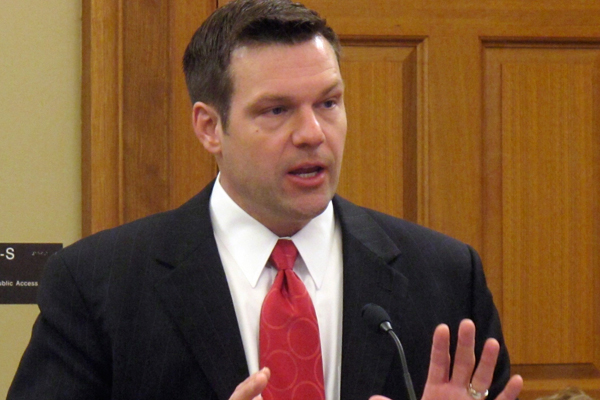
Kris Kobach(Credit: AP/John Hanna)

 If Kansas Secretary of State Kris Kobach has his way, Mitt Romney’s first term as president will see the largest forced exodus of people from the United States since the mid-1950s. Kobach, an adviser to the Romney campaign on immigration policy, is also the chief legal architect of a long-standing conservative campaign to stop the influx of undocumented immigrants, primarily from Mexico and Central America, who come to America to work .

“If we had a true nationwide policy of self-deportation, I believe we would see our illegal alien population cut in half at a minimum very quickly,” Kobach told Salon in a recent intervew. With an estimated 11 million undocumented residents in the country, Kobach is hoping to force 5.5 million people to leave the country by 2016

Kobach, elected to statewide office in Kansas in 2010, advocates “self-deportation” but says  he does not want “to do it at gunpoint.” Undocumented residents, he said, “should go home on their own volition, under their own will, pick their own day, get their things in order and leave. That’s a more humane way.”

A 45-years old Harvard graduate and father of three, Kobach is the man behind the Republican front-runner’s most clearly articulated immigration goal: “Self-deportation.” While the term does not appear on Romney’s campaign website, Kobach uses it all the time. With the Republican candidates gathering in Mesa Arizona tonight for a nationally televised debate, the discussion of immigration issues may well touch on Kobach’s rhetoric, as well as his legal accomplishments.

As general counsel for the legal arm of the Federation of Americans for Immigration Reform (FAIR) from 2004 to 2010, Kobach authored a number of state and local laws intended to discourage illegal immigration. He wrote S.B.1070, the Arizona’s controversial law designed to identify and deport illegal aliens, a measure which has been partially blocked by a lawsuit brought by the Justice Department.The law is strongly supported by Arizona Governor, Jan Brewer, the finger-wagging foe of President Obama.

In an email Kobach said the enforced provisions of the Arizona law “are having the intended effect of making it more difficult for sanctuary cities to emerge in the state, and in facilitating greater cooperation between state and local government agencies and federal immigration enforcement efforts.”

Echoes of Operation Wetback

On immigration Romney has gained politically by talking tough. When Rick Perry said opponents of Texas’s version of the federal DREAM Act, giving the children of illegal immigrants in-state college tuition, as heartless, the former Massachusetts governor, replied, “I think if you’re opposed to illegal immigration, it doesn’t mean that you don’t have a heart. It means that you have a heart and a brain.” When Newt Gingrich proposed a path to citizenship for long-time tax-paying undocumented families with no criminal records, Romney called it “a new doorway to amnesty.”

Romney has matched his tough language with action. While the Republican front-runner  “tread lightly” on immigration issues during Florida primary, his campaign maintained regular contact with Kobach and announced the endorsement of former California Governor Pete Wilson, best known as a strong supporter of Proposition 187, a 1994 ballot initiative in California that was a precursor to SB 1070 that sought to cut off many public services to undocumented immigrants.

Political analysts say Romney’s stance will alienate Latino voters. As columnist Albor Ruiz of the New York Daily News notes,  Pete Wilson’s “support for Proposition 187 didn’t work out too well for the GOP, provoking a massive flight of Latino voters to the Democratic party.”

“Because he attracted such lightning rod figures (Wilson and Kobach) Latinos are going to take a hard look before voting for Romney,” Patrick Young, a writer for the New York Immigration Action Fund website told Ruiz. “He has moved so far to the right compared to McCain and George W. Bush, that next to him, even Gingrich sounds moderate.”

Kobach argues a policy of “attrition through enforcement” is a common sense measure that will boost economic recovery for people of all races and ethnicities. Full enforcement of SB 1070 in Arizona, he told me, will make it “more difficult for illegal aliens to violate the law; and that will in turn open up jobs for unemployed US citizens and unemployed lawfully present aliens.”

Pro-immigration conservatives don’t buy it. Morton Kondracke, executive editor of Roll Call, fears the “Arizonification of America,” recalling how tough immigation enforcement hit home in Mesa in October 2008. Joe Arapaio, the famously hard-line Maricopa county sheriff, sent a 60-member SWAT team on a 2 a.m. raid of the city hall and public library, hunting for undocumented immigrants who worked there as janitors.

Kobach’s goal of harassing 5.5 million people into “self-deportation” by 2016 has no precedent in American history. The closest parallel may be Operation Wetback, an insultingly named deportation program launched in 1954-55 by the Eisenhower administration. Aimed at Mexicans living illegally in Texas and California, the program resulted in claims that 1.3 million people had departed or been deported, according to the Texas State Historical Association; many people thought the real figure was far lower. (FactCheck.org has a useful survey here.)

Kobach thinks a Romney administration could oust four times as many illegal immigrants as Operation Wetback over the course of its first four years. He cites Alabama’s new anti-illegal immigration law, which he also helped write, as a model. The law, which requires public school student to prove their citizenship, undoubtedly prompted many illegal residents to leave. Within a week of passage of the law 2,285 Latino students were absent from school, according to the Immigration Policy Center, 7% of all Latino students statewide. Farmers complained they faced labor shortages. The Democracy Now radio program portrayed the bill’s effects as a “humanitarian crisis.”

Kobach defends the law saying it was “the catalyst” for the drop in the state’s unemployment rate from 9.8 percent in September to 8.1 percent in December. But critics dispute the long-term economic benefits of self-deportation. A University of Alabama study, reported by Bloomberg, concluded that 40,000 to 80,000 immigrants will leave their jobs, shrinking the state’s economy “by at least $2.3 billion and costing the state not less than 70,000 jobs.”

Most of the damage will come from reduced demand for goods and services provided by Alabama businesses patronized by immigrants, says the study’s author, Dr. Samuel Addy, an economist and director of the university’s Center for Business & Economic Research. Addy estimates the law  will annually cost the state betweeen $56.7 million to $264.5 million in tax revenue.

Alabama is paying for Kobach’s “failed experiment,” said the editors of the Mobile Press Register earlier this month “What have we gotten for playing the guinea pig?” they asked earlier this month. “Crops rotting in the field, a net loss to the economy, higher racial tensions and a PR black eye, to boot.”

Kobach says Romney, as president, should drop the Justice Department lawsuits against Arizona and Alabama laws and order the Justice Department to file suit against states that allow qualified long-term unauthorized immigrant students to receive in-state tuition. Kobach argues such laws are illegal, a position that has not found much support in the courts.

“A rational Justice Department would not be going after states that are trying to help enforce the law,” Kobach told me. “A rational Justice Department would go after the states that are breaking federal law” by giving illegal aliens in-state tuition rate. (According to the National Conference of State Legislatures, those states with such laws are California, Connecticut, Illinois, Kansas, Maryland, Nebraska, New Mexico, New York, Texas, Utah, Washington and Wisconsin.)

Ever since running unsuccessfully for Congress in 2004, Kobach has faced accusations that he is associated with John Tanton, a veteran anti-illegal immigration activist and founder of FAIR.  The liberal Southern Poverty Law Center describes FAIR as a “nativist hate group” because of  its sometimes racially tinged arguments against illegal immigration.

Earlier this month Politico reported two Democratic party operatives in Kansas say that Kobach received “significant funding from a notoriously racist group” in his congressional bid:

The donor organization in question is the U.S. Immigration Reform PAC (USIRPAC), which gave Kobach $10,000 in 2003 and 2004, according to the Federal Election Commission. USIRPAC President Mary Lou Tanton is the wife of John Tanton.

In an email Kobach said he is “not familiar with [Tanton's] writings or his views,” adding, “The efforts by some critics to tie me through six degrees of separation to people I have no connection with is absurd.  I have not done any legal work for any organization that expresses or supports racial discrimination, nor will I ever do so in the future. ”

One question facing Mitt Romney on immigration issues is whether he shares Kobach’s goal of prodding 5.5 million undocumented residents to leave the country by the end of  his first term. Another question is whether his administration would sue states whose universities offer in-state tuition to qualified children of illegal immigrants.

Kobach says he will not attend tonight’s debate in Arizona but adds ” I am in regular contact with Governor Romney’s campaign.”


Jefferson Morley

Jefferson Morley is a staff writer for Salon in Washington and author of the forthcoming book, Snow-Storm in August: Washington City, Francis Scott Key, and the Forgotten Race Riot of 1835 (Nan Talese/Doubleday).

Obama’s broken immigration promise

ICE said it would target dangerous immigrants, but it's actually deporting a higher percentage of non-criminals

A man in Ciudad Juarez, Mexico, stands next to the border fence as two U.S. law enforcement officers look on from the U.S. side of the fence. (Credit: AP/Raymundo Ruiz)

The Obama administration claims that it is deporting record numbers of illegal immigrants while focusing on those with criminal records. But new data from Immigration and Customs Enforcement shows that the number of deportation orders has declined dramatically since last summer and non-criminals comprise a growing percentage of those expelled from the country.

That wasn’t supposed to happen under a policy of “prosecutorial discretion” announced by ICE director John Morton last June. The goal of the policy, announced with much fanfare in the Spanish language media, was to spare “longtime lawful residents” from deportation and to focus on criminals.

Since then, the adminstration has deported many fewer non-criminal aliens. But non-criminals remain the vast majority of those deported. And those with no criminal record now actually comprise a slightly larger percentage of those forced to leave the country than they did before Morton’s announcement.

In the three months before the policy was announced last summer ICE filed for deportation proceedings against 61,192 people of whom 15 percent had criminal records. In the first three months of 2012, ICE sought 37,659 deportations orders, 14 percent of which involved people with criminal records.

“The agency continues to be headed in the opposite direction of its stated goals,” said Susan Long, co-director of the Transactional Records Access Clearinghouse at Syracuse University, which collected the data from ICE via a Freedom of Information Act request.

The goal of prosecutorial discretion, Long said in a conference call with reporters, “was to target and bring before the court those with more serious criminal history. As yet we’re not seeing any change. They have not turned the ship around.”

The administration implemented prosecutorial discretion in response to complaints that young people with no criminal records continue to face deportation. But the new data will come as no surprise to student groups such as United We Dream, National Immigrant Youth Alliance and DreamActivist, which continue to highlight the cases of law-abiding young people facing deportation.

Rep. Luis Gutierrez, D-Ill., has championed the case of a South Carolina man, Gabino Sánchez, a married father of two, who was arrested for driving without a license last year and now faces deportation.

“Gabino Sánchez has lived and worked and raised a family here for more than a decade and it is not in anyone’s interest to have him deported,” Rep. Gutierrez told Fox News Latino on Tuesday after a deportation hearing in North Carolina.  ”I do not understand why ICE has not followed President Obama’s guidelines and decided to move on from this case to go after someone else, someone who is a threat to his community or a serious criminal.”

In response to the TRAC findings, Gutierrez  said, “The president should make sure the Department of Homeland Security is actually following its own rules and he should proclaim proudly and loudly that he will not deport another DREAMer or anyone else who fits the prosecutorial discretion criteria.”

Continue Reading Close
Jefferson Morley

Jefferson Morley is a staff writer for Salon in Washington and author of the forthcoming book, Snow-Storm in August: Washington City, Francis Scott Key, and the Forgotten Race Riot of 1835 (Nan Talese/Doubleday).

Dreamers spurn Obama

Young immigrants feel tricked by the White House line on Marco Rubio's revival of the DREAM Act

Supporters of the DREAM Act take part in a demonstration in front of the White House. (Credit: AP/Pablo Martinez Monsivais)

Mohammad Abdollahi has not followed every twist and turn of the national immigration debate.  He has been too busy trying to save a friend from deportation.

Last month, 20-year-old Izlia Luna of Medford, Ore., was stopped by police for a traffic altercation. The judge threw out the charges. But under the mandate of the Obama administration’s Secure Communities program, Luna’s fingerprints had been taken. She was found to be undocumented. Luna was brought to the United States from Mexico when she was 2 years old. Instead of being released she was sent to an ICE detention facility in  Tacoma, Wash., 340 miles from her home.

“This is what immigration reform under Obama has gotten us,” says Abdollahi, who traveled to Tacoma to rally public attention to Luna’s case. “The right to spend up to $5,000 to get a loved one out of jail. When Obama says he isn’t deporting dreamers, he’s lying.”

“Marco Rubio is being a lot more authentic with us,” Abdollahi added.

The positive response of young immigrants  to Rubio’s still-vague alternative to the Democrats’ DREAM Act is central to the changing politics of immigration in the 2012 presidential campaign. In a series of meetings in Washington, Rubio is shopping for support, hoping to put forward a legislative proposal in the next few weeks. The Washington Post endorsed the idea on Monday.

By flirting with Rubio, the DREAM activists — representing an estimated 1 million young Americans, or “dreamers,” who are now barred from a path to U.S. citizenship — have wrong-footed the Obama White House and given pause to reelection campaign officials who had been counting on Latinos to fall in line with the president’s reelection. They have also caught the interest of Republican strategists worried about Romney’s narrowing path for victory in November.

Rubio is expected to propose the creation of a non-immigrant visa that would ensure undocumented young people who don’t have criminal records would not be deported and could eventually become citizens. The original DREAM Act failed to pass  the Senate in 2010.

“We are going to support whoever will come out and talk about the issue,” said Gabby Pacheco, a 26-year-old special education teacher from Miami and DREAM Act activist. “Rubio realizes this is key for us. Even if he is only doing it for political reasons, we’re willing to listen.”

The dreamers are backed by Latino Democrats on Capitol Hill, who feel betrayed by the Obama administration’s boasts of deporting a record annual average of 400,000 people over the last four years. After a friendly if inconclusive meeting with Rubio, Rep. Luis Gutierrez of Illinois told Politico his liberal allies  accused him of being the Florida senator’s new “best friend.”

The Obama White House hates the idea. Last week, presidential advisors Celia Munoz and Valerie Jarrett tried to discourage the dreamers from embracing Rubio’s proposal, saying it put at risk the original DREAM Act, which laid out a specific path to citizenship. According to the Washington Post, they had a meeting with DREAM Act-eligible students in Washington, arguing that “Rubio had not demonstrated he could win support from fellow Republicans and that the president would use his clout to push an immigration plan next year. ”

Pacheco, who attended the meeting, was not impressed with the White House appeal.

“You can’t wait until next year if you’re getting deported this year,” she said.  She described the White House officials as “very strategic” in their opposition to Rubio. She said the dreamers asked Munoz and Jarrett if the president could stop the deportations by taking administrative action that would not need to be approved by Congress, as Florida immigration activist Cheryl Little recently wrote in the Miami Herald.

“The thing that surprised us was they said no,” Pacheco told me. “They said, practically, ‘We don’t have the power to do this.’We’re trying to find out if that is true.”

It isn’t true, says Laura Lichter, an attorney in Denver and president-elect of the American Immigration Lawyer’s Association.

“The Obama administration  could certainly be doing more and better to improve the situation for DREAM Act students and to make immigration law and policy predictable and fair for everybody,” Lichter said in a telephone interview. “Whether they’re willing to do that in any way that might look like reasonable treatment for the undocumented remains to be seen.”

Presumptive Republican nominee Mitt Romney, who has advocated “self-deportation” for the likes of Abdollahi and Luna and the estimated 1 million DREAM Act-eligible students, is noncommittal about Rubio’s idea. Romney’s hard-line immigration advisor, Kansas Secretary of State Kris Kobach, initially rejected the suggestion as “amnesty,” but has more recently said he can “work with” the Florida senator, a nod to the growing realization that running on a platform of “self-deportation” is Romney’s ticket to self-destruction among Latino voters in November.

Whether Rubio’s gambit can sway Republican votes on Capitol Hill is doubtful. House Speaker John Boehner described passage of such a bill this year as “difficult at best.” Helping the undocumented is not a priority for most non-Latino voters, according to Republican pollster Scott Rasmussen.

While elite Republicans like Haley Barbour have said positive things about Rubio’s idea, the conservative blogosphere is notably unenthusiastic. The Weekly Standard touted Rubio’s recent foreign policy speech while ignoring his much-publicized idea of helping young undocumented Americans closer to home. The National Review hyped Rubio as a Romney running mate without taking a stand  on his proposal “to give the children of illegal immigrants a visa to continue their studies.” Talk radio stalwarts like Rush Limbaugh and Hugh Hewitt have yet to mention Rubio’s plan, while Mickey Kaus, the Daily Caller’s anti-immigrant blogger, notes conservative intellectuals can only agree to disagree on the issue.

If the Republicans’ intellectual base seems stumped by Rubio’s gambit, the Democratic incumbent comes off as arrogant. In a recent interview with Telemundo, President Obama said:

This notion that somehow Republicans want to have it both ways — they want to vote against these laws [like Arizona and Alabama] and appeal to anti-immigrant sentiment … and then they come and say, ‘But we really care about these kids and we want to do something about it’ — that looks like hypocrisy to me.

To the dreamers, Obama is just as hypocritical. “A lot of folks want us to be against  it,” Abdollahi said. “At the same time we hear from Obama administration that they’re not deporting dreamers. They’re tricking us. That’s what makes us supportive of Rubio.”

Continue Reading Close
Jefferson Morley

Jefferson Morley is a staff writer for Salon in Washington and author of the forthcoming book, Snow-Storm in August: Washington City, Francis Scott Key, and the Forgotten Race Riot of 1835 (Nan Talese/Doubleday).

Will Arizona case help Obama?

The Supreme Court's consideration of the state's tough immigration law puts Mitt Romney in a tough place

As the Supreme Court hears oral arguments today on the constitutionality of Arizona’s hard-line immigration law, lawyers will revel in arcane discussions of “preemption” and “severability” and “harmonious regulation.” Others will ponder the ever-elusive question of whether the eight sitting justices (Justice Elena Kagan is recused) will prove to be “strict constructionists” or “judicial activists.”

The rest of us may prefer to cut to the political chase. The justices will, in all likelihood, either generally uphold the constitutionality of Arizona’s law — which expands the powers of state police officers to ask about the immigration status of anyone they stop and to hold those suspected of being in the country illegally — or they will throw out its key provisions as a usurpation of the federal government’s powers. What happens then?

The court’s decision, expected in June, is sure to roil an accelerating presidential campaign where immigration has already proven to be a potent issue — and possibly in unexpected ways. ”In terms of electoral politics, it’s a win-win for Obama,” says Antonio Gonzalez, president of William C. Velasquez Institute, a Latino public policy research organization. If the court throws out the law, Obama can claim vindication that immigration restrictionists have gone too far, Gonzalez says. If the court upholds the Arizona law, he can “condemn the decision and vow to fight other state laws,” a stance that is likely to be popular with Latinos who now make up 25 percent of the electorate and whose support is crucial to the president’s reelection prospects.

While upholding  the law would “give a shot in the arm to the politics of immigrant exclusion,” Gonzalez argues it would also limit Romney’s ability to expand his appeal to Latino voters, something that the candidate seems inclined to do.

During the primary season, Romney effectively blunted challenges from Texas Gov. Rick Perry and former House Speaker Newt Gingrich by portraying them as soft on illegal immigrants, the vast majority of whom are from Mexico and Central America. At the same time, polls showed Obama opening an enormous lead among Latino voters, prompting Romney to confide to supporters that his campaign was “doomed” unless he could win Latino votes. This week the Romney campaign distanced itself slightly from Kansas Secretary of State Kris Kobach, author of the Arizona law and a Romney adviser. At the same time the candidate stumped with Sen. Marco Rubio of Florida who has said the Arizona law is “not a model” for the country.

“He’s trying to get out of the shackles” of his hard-line position, Gonzalez argues. “If law is upheld, it makes it much harder for him to do that.”

If the law is thrown out, “Romney has more of an opening to back up from his primary positions and talk about alternative plans,” says Chuck Rocha, executive director of the Latino Project, a Democratic political action committee. “If its not thrown out, he has to own it.”

Rocha says his PAC will use a decision favorable to Arizona “to appeal to Mexican-American voters who see this law as Republican overreach” in a dozen contested congressional elections from Florida to California.

Meanwhile, immigration restrictionists talk bravely that Romney will benefit among the general electorate, if not with Latinos, if the law is upheld.

“If Romney holds firm, we know there’s a broad activist base across the country that is highly motivated and that doesn’t want to see taxpayers pay for services for people who have no right to be here,” says Dan Stein of Federation for American Immigration Reform (FAIR), which supports the Arizona law.

Stein is right that restrictionist laws are increasingly popular. Five states (Alabama, Georgia, South Carolina, Utah and Indiana) have adopted similar laws, but have been enjoined from enforcing them. FAIR says six other states are actively considering them. But they have also mobilized resistance from business interests. When Rubio served as Speaker of the Florida House, Arizona-style immigration legislation never got out of committee. Even in solidly Republican Texas and Mississippi, restrictionists could not get an Arizona-style blll approved this year.

Chris Newman, general counsel for National Day Laborer Network in Los Angeles, isn’t so sure, however, that the case will help Obama. He think a decision favorable to Arizona would “put Obama in a tough spot.” While the Obama administration has fought the states seeking to establish their own immigration policies, it has also carried out record numbers of deportations, including children.

“He’ll have to make normative arguments why Arizona law is immoral and unjust and he’ll have a hard time doing that because many parts of the law track his own policy. His signature policy has sought to sue local police as a ‘force multiplier’ for immigration enforcement. Arizona policies are a symptom of that force multiplication.”

“The administration,” he says, “has sought to benefit from the misery imposed on immigrants on Arizona.”

The political impact of the court’s decision may be most decisive in two swing states where the immigration issue is most hotly contested: Missouri, where the legislature is considering an Arizona-style bill, and Arizona itself, where the devastating effects of the law on families with undocumented members is driving so many Latinos away from the Republican Party that the Obama campaign now dreams of winning the state in November.

“The issue is not going to go away,” says Stein. “If anything its hotter and more robust than ever.”

Continue Reading Close
Jefferson Morley

Jefferson Morley is a staff writer for Salon in Washington and author of the forthcoming book, Snow-Storm in August: Washington City, Francis Scott Key, and the Forgotten Race Riot of 1835 (Nan Talese/Doubleday).

Romney’s lame Latino pivot

With Kris Kobach controlling his immigration message, Mitt can't move to the center

How do you say “pivot” in Spanish? Cambiar su postura. No sooner had Mitt Romney sewn up the Republican presidential nomination, than he did just that, offering messages tailored to appeal, not to just Republican primary voters, but to general election voters of Mexican, Central American and Caribbean descent. The Obama campaign shadowed Romney’s moves by launching “Latinos for Obama” yesterday and floating the cocky but not impossible idea that the president might carry Arizona in November with Latino help. After months of being ignored in favor of white conservatives, the Latino voter is now center stage in campaign 2012.

Romney’s desire to maneuver is transparent. When he hired Ed Gillespie, former Bush White House pollster and immigration moderate, the Hill newspaper saw ” a sign the campaign will heavily court Hispanic voters — perhaps at the expense of immigration hard-liners in the party.” Then Romney allowed himself to be overheard telling supporters that “we have to get Hispanic voters to vote for our party” and warning that overwhelming Hispanic support for Obama “spells doom for us.” He also mouthed approving sounds about Marco Rubio’s pitch for a Republican version of the DREAM Act. Republican immigration advocate Tamar Jacoby pronounced herself “thrilled.”

But the perils of the pivot emerged when Romney’s campaign tried to Etch A Sketch away the candidate’s working relationship with Kris Kobach, the Kansas secretary of state and immigration hard-liner. It was Kobach who persuaded Romney to advocate “self-deportation” as the solution to the presence of 11 million undocumented immigrants in the country. When a campaign spokesperson told Politico on Monday that Kobach is not a campaign “advisor” but a “supporter,” Kobach responded by telling Think Progress that his relationship with the campaign has not changed. Then he upped the ante by telling WaPo’s Greg Sargent that Rubio’s idea is an unacceptable variation on amnesty and he expects Romney to reject it.

How long can Kris Kobach maintain de facto control of Romney’s immigration message? With Romney’s Latino poll numbers sinking toward single digits and Gillespie taking a larger role in the campaign, it may not be long. Restrictionist blogger Mickey Kaus thinks Romney is most likely to make a “targeted concession” such as backing a variation on the DREAM Act. Rubio, by most accounts, is planning to introduce a bill to legalize the status of high-achieving undocumented students in coming weeks with an eye toward forcing a Senate floor vote in the fall.

Both pro-and anti-immigration advocates deride Rubio’s idea as a stunt, and, depending on its language, it may be.  But the Romney campaign has no better card to play. “The dreamers,” as the students call themselves, are held in high esteem by the Latinos, nine out ten of whom  support for the DREAM Act. And fortunately for Romney, two leading student groups that have fought for the DREAM Act say they are open to Rubio’s idea.

“We definitely support the concept,” Mohammad Abdollah of DreamActivist.org told Salon. “From everything we’ve heard, it sounds like something we could support. We need relief. If it comes from a Democratic or a Republican proposal, for us it doesn’t matter.”

Gaby Pacheo of United We Dream, which is supported by the Service Employees International Union, which has endorsed Obama, was more cautious.

“We’re willing to entertain the idea,” she said. “We’re glad to see a Republican coming forward on this issue. We want to see what the bill says and who are the Republicans who will also support it. Rubio is going to need support not just in the Senate but in the House as well. Where are Mitch McConnell and John Boehner?” The message seems clear. Without Republican support in the House, Rubio’s measure cannot become law and if it can’t become law it will get no help from its putative beneficiaries.

And therein lie the limits of Romney’s ability to pivot on the immigration issue: his allies. To send Latino voters a new message in the fall, he needs the cooperation of Kris Kobach and the Republican congressional leadership, neither of whom is inclined to give it.

The anti-immigration forces say pandering to Latinos who won’t vote Republican anyway will be less effective for Romney than running hard against Obama’s economic record. This strategy has its limits too. The post-2008 downturn, it turns out, has been less severe for Latinos than for whites. A Pew Hispanic Center study found Latinos lost less than whites in the 2007-09 recession and gained more in the 2009-2011 recovery. Latinos are now gaining jobs at twice the rate of whites. So the economic issue is not as sharp as it might be. Besides, wrote Ali Noorani of National Immigration Forum in a column for Fox News, “no one is going to listen to your economic message if you want to deport their mother.”

Obama’s pitch to Latinos is an ethnically flavored variation on his general election message: I saved you from disaster and delivered benefits.

President Obama has spent the first three years of his term working to restore economic security to the middle class and Latino community. He’s kept nearly 2 million Latinos out of poverty, doubled the amount spent on Pell Grants so 150,000 more Latino students can afford their educations. And by 2014, Obamacare will provide health coverage to 9 million Latinos who are currently uninsured.

Romney’s pitch to Latinos? It’s a work in progress.

Continue Reading Close
Jefferson Morley

Jefferson Morley is a staff writer for Salon in Washington and author of the forthcoming book, Snow-Storm in August: Washington City, Francis Scott Key, and the Forgotten Race Riot of 1835 (Nan Talese/Doubleday).

Another National Review contributor pals around with nativists

National Review editor-at-large John O'Sullivan was on the board of anti-immigrant site VDARE

It’s hard to expunge white nationalist racism from respectable conservatism when some of the most respectable of conservatives dabble in white nationalist racism. John Derbyshire, accomplished as he was, was just a contributor to the National Review. John O’Sullivan is a former editor of the National Review, a current “editor-at-large,” a fellow at the Hudson Institute, a former speechwriter for Margaret Thatcher, and Commander of the British Empire. He’s also on the board of directors at the foundation that publishes VDARE, the nativist site listed as a hate group by the Southern Poverty Law Center.

Gus from Little Green Footballs found documents showing O’Sullivan was on the board of the “Lexington Research Institute Limited,” aka the VDARE Foundation, from 2006-2010. During that time, VDARE helped found nativist site “Alternative Right” with a $35,000 grant. Alternative Right is edited by Richard B. Spencer, yet another racist/racialist white nationalist.

O’Sullivan was demoted from editorship by National Review ouster-in-chief William F. Buckley during a 1997 purge of Peter Brimelow, a virulent anti-immigration writer (and English immigrant) O’Sullivan championed who went on to found VDARE. VDARE has published a wide variety of extremist white nationalists, like Jared Taylor and Sam Francis.

O’Sullivan is still on the masthead at the National Review, and he was published defending Derbyshire at length at NRO a few days ago.

O’Sullivan says Derbyshire’s “satire” of “anti-white racism” sadly went a bit too far:

It therefore strengthens the anti-white racism it is meant to satirize which, as it happens, is a growing problem in the U.S. — not in the suburbs or backwoods but in the corporate executive suites, the media elites, the courts, the bureaucracy, and of course the entire industry of sensitivity training which used to go under the more honest title of “Political Reeducation” in the gulag.

Yes, “anti-white racism” is obviously a huge and growing threat in our corporate executive suites, as any glance at the Fortune 500 will demonstrate.

Having allowed that Derbyshire’s piece was sloppy and a bit racist, O’Sullivan goes on to defend each point anyway. Sure, Derbyshire believes that black people are innately criminal and stupid, but is that really a fireable offense? He might be right!

After half-purging O’Sullivan more than a decade ago, what possible reason is there to keep him around to embarrassingly defend his more explicitly awful colleagues? Especially while he’s working with the wackos at VDARE.

Continue Reading Close
Alex Pareene

Alex Pareene writes about politics for Salon and is the author of "The Rude Guide to Mitt." Email him at apareene@salon.com and follow him on Twitter @pareene

Page 1 of 68 in Immigration