
Inside that new anti-Occupy bill

HR 347 is drawing fire -- but many of its shameful restrictions already exist

Topics: Occupy Chicago, Occupy Wall Street, Washington, D.C.,

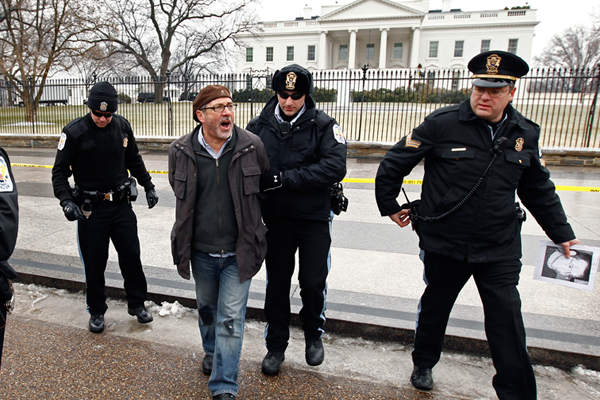
Inside that new anti-Occupy billA protester is arrested at the White House in January, 2011.(Credit: AP/Kevin Lamarque)

In recent days, there has been a considerable amount of online speculation over a bill that made its way through the House and the Senate last week with little opposition — HR 347, or the Federal Restricted Buildings and Grounds Improvement Act of 2011. Some have decried it as specifically anti-Occupy legislation with the aim to further curtail First Amendment rights. HR 347 makes it a prosecutable offense to knowingly, and without lawful authority, enter “(1) the White House or its grounds or the Vice President’s official residence or its grounds, (2) a building or grounds where the President or other person protected by the Secret Service is or will be temporarily visiting, or (3) a building or grounds so restricted due to a special event of national significance.”

This would, of course, include the areas restricted in Chicago for the NATO summit and Camp David for the G-8. However, concerns focusing solely on the passing of HR 347 seem to be a red herring of sorts, as most of its content has long been enshrined into law.

The new bill specifically addresses certain trespassing violations in D.C., which currently do not fall under the remit of federal law (i.e., HR 347 now makes it a federal issue if you trespass onto White House grounds). The only other significant change in the bill is a shift in language, which will make it easier to prosecute those who are found to unlawfully have entered these restricted areas. The law used to say that the person must have entered the area “knowingly” and “willfully.” HR 347, however, scrapped the “willfully,” which essentially now renders it a crime to remain in a restricted area, even if you do not know that it’s illegal for you to be there.

“By striking out ‘willfully’ they make it easier to prosecute under ‘knowingly,’” explained Mara Verheyden-Hilliard, executive director of the Partnership for Civil Justice Fund. She noted with some exasperation that the campaigns focusing energies against HR 347 miss the bigger, ongoing fight for basic free speech and threats to it, as this specific law is only an amendment to laws that were primarily established in 2006. For Verheyden-Hilliard, HR 347 is best understood as the government “looking at the tools in their arsenal and polishing them up” in time for major, protest-drawing summits and political conventions this year.

This is not to say that free speech issues raised by HR 347′s passage should be ignored, but rather contextualized against a backdrop where protest and dissent are already consistently treated as illegal.

Continue Reading Close

Natasha Lennard is an assistant news editor at Salon, covering non-electoral politics, general news and rabble-rousing. Follow her on Twitter @natashalennard, email nlennard@salon.com.

Next Article

Featured Slide Shows

What To Read Awards: Top 10 Books of 2012 slide show

close X
  • Share on Twitter
  • Share on Facebook
  • Thumbnails
  • Fullscreen
  • 1 of 10
  • 10. "The Guardians" by Sarah Manguso: "Though Sarah Manguso’s 'The Guardians' is specifically about losing a dear friend to suicide, she pries open her intelligent heart to describe our strange, sad modern lives. I think about the small resonating moments of Manguso’s narrative every day." -- M. Rebekah Otto, The Rumpus

  • 9. "Beautiful Ruins" by Jess Walter: "'Beautiful Ruins' leads my list because it's set on the coast of Italy in 1962 and Richard Burton makes an entirely convincing cameo appearance. What more could you want?" -- Maureen Corrigan, NPR's "Fresh Air"

  • 8. "Arcadia" by Lauren Groff: "'Arcadia' captures our painful nostalgia for an idyllic past we never really had." -- Ron Charles, Washington Post

  • 7. "Gone Girl" by Gillian Flynn: "When a young wife disappears on the morning of her fifth wedding anniversary, her husband becomes the automatic suspect in this compulsively readable thriller, which is as rich with sardonic humor and social satire as it is unexpected plot twists." -- Marjorie Kehe, Christian Science Monitor

  • 6. "How Should a Person Be" by Sheila Heti: "There was a reason this book was so talked about, and it’s because Heti has tapped into something great." -- Jason Diamond, Vol. 1 Brooklyn

  • 4. TIE "NW" by Zadie Smith and "Far From the Tree" by Andrew Solomon: "Zadie Smith’s 'NW' is going to enter the canon for the sheer audacity of the book’s project." -- Roxane Gay, New York Times "'Far From the Tree' by Andrew Solomon is, to my mind, a life-changing book, one that's capable of overturning long-standing ideas of identity, family and love." -- Laura Miller, Salon

  • 3. "Billy Lynn's Long Halftime Walk" by Ben Fountain: "'Billy Lynn's Long Halftime Walk' says a lot about where we are today," says Marjorie Kehe of the Christian Science Monitor. "Pretty much the whole point of that novel," adds Time's Lev Grossman.

  • 2. "Bring Up the Bodies" by Hilary Mantel: "Even more accomplished than the preceding novel in this sequence, 'Wolf Hall,' Mantel's new installment in the fictionalized life of Thomas Cromwell -- master secretary and chief fixer to Henry VIII -- is a high-wire act, a feat of novelistic derring-do." -- Laura Miller, Salon

  • 1. "Behind the Beautiful Forevers" by Katherine Boo: "Like the most remarkable literary nonfiction, it reads with the bite of a novel and opens up a corner of the world that most of us know absolutely nothing about. It stuck with me all year." -- Eric Banks, president of the National Book Critics Circle

  • Recent Slide Shows

  • Share on Twitter
  • Share on Facebook
  • Thumbnails
  • Fullscreen
  • 1 of 10

More Related Stories

Comments

18 Comments

Comment Preview

Your name will appear as username ( profile | log out )

You may use these HTML tags and attributes: <a href=""> <b> <em> <strong> <i> <blockquote>