
Media grows bored of Occupy
And that means, according to a new report, that Americans can expect to hear a lot less about income inequality
By Natasha LennardTopics: Occupy Wall Street, Occupy, Income inequality, Media Criticism, Politics News
As evidenced by the lack of stories about the May Day general strike last week, the mainstream media’s interest in Occupy Wall Street has waned. It’s a shame because, as a new report indicates, Occupy has been central to driving media stories about income inequality in America. Late last week, Radio Dispatch’s John Knefel compiled a report for media watchdog Fairness and Accuracy in Reporting (FAIR), which illustrates Occupy’s success: Media focus on the movement in the past half year, according to the report, has been almost directly proportional to the attention paid to income inequality and corporate greed by mainstream outlets. During peak media coverage of the movement last October, mentions of the term “income inequality” increased “fourfold.” Meanwhile:
As mentions of “Occupy Wall Street” or “Occupy movement” waned in early 2012, so too have mentions of “income inequality” and, to an even greater extent, “corporate greed.” The trend is true for four leading papers (New York Times, Washington Post, USA Today, Los Angeles Times), news programs on the major networks (ABC, CBS, NBC), cable (MSNBC, CNN, Fox News) and NPR, according to searches of the Nexis news media database. Google Trends data also indicates that from January to March, the phrases “income inequality” and “corporate greed” declined in volume of both news stories and searches.
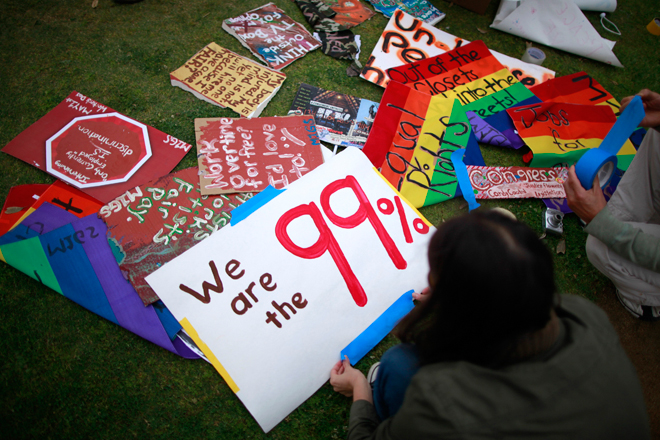
Knefel notes that tokens of Occupy rhetoric — most notably the idea of a “99 percent” against a “1 percent” — has seeped into everyday cultural parlance. Since Occupy’s inception last fall, references to “the 1 percent” don’t elicit the response, “of what?”; these numbers are now understood far and wide to connote class disparity – even though many Occupy participants have at times felt the slogan too reductive to signify complicated socio-politico-economic issues. Knefel points out too “the danger, of course, is that ‘the 1 Percent’ simply becomes a buzzword and ceases to have any connection to the way American capitalism produces and reproduces economic and social inequality.”
FAIR’s findings prompt a number of critiques, both of the media’s attention span and of Occupy’s lasting power. It is a troubling state of affairs that in order to push conversations about rampant inequality in the press, it seems there needs to be continuous, headline-grabbing protests, occupations and public manifestations of anger (with newsworthy slogans, of course). But this should perhaps come as no surprise — after all, it was in recognition of our very troubling state of national and international affairs that Occupy participants took to the streets, parks and encampments in the first place.
Occupy supporters may well be saddened by FAIR’s news: that their important messages about corporate greed and class disparity have not permanently shifted the mainstream media’s coverage of these issues. Knefel’s report is at once a reminder of the long slog it takes to really shift a discourse. It’s a reminder too that mainstream media outlets are fickle creatures, ready to move on to the next shiny object with little focus on the issues underpinning stories.
It’s reasonable (although perhaps less so after the mass mobilizations in streets across the country on May 1) to debate Occupy’s current relevance. For me, the problem highlighted here might not be a radical movement’s failure to stay in the headlines, however; the fault is rather with a mainstream political and media machine that ignores economic and social inequality; hence the importance of radical movements. The question then becomes whether assemblages like Occupy should continue to work to hold the attention of such a machine, or work toward challenging its ability to determine political discourse.
Natasha Lennard is an assistant news editor at Salon, covering non-electoral politics, general news and rabble-rousing. Follow her on Twitter @natashalennard, email nlennard@salon.com. More Natasha Lennard.
You Might Also Like
More Related Stories
-
White House delays key component of healthcare overhaul
-
Is the NSA monitoring Reddit?
-
Red-state women will transform America
-
Irish lawmakers back measure to allow for abortion in limited cases
-
Meet the "Journalists Against Journalism" club!
-
Mitch McConnell Auto-Tunes Alison Lundergan Grimes
-
Egyptian unrest squeezes Gaza
-
Travyon Martin conspiracy theorists get desperate
-
BART strike snarls traffic for second straight day
-
GOP rules SCOTUS
-
Chris Christie isn't "post-partisan" on LGBT rights
-
Wendy Davis trails Rick Perry in potential Texas match-up
-
Bizarre gay pride photobomb makes it to front page of local paper
-
ENDA will reportedly get Senate committee vote
-
"Whistle-blower" now means "homegrown terrorist"
-
LeVar Burton explains how not to be killed by police
-
Meet the Wendy Davis truthers
-
Why is "sensible" Jeb Bush fundraising for nutty Paul LePage?
-
Watch Bill O'Reilly freak out over the gay marriage rulings
-
13 facts about tax-dodging corporations that will blow your mind
-
How epic GOP bumbling could inadvertently save food stamps
Featured Slide Shows
7 motorist-friendly camping sites
close X- Share on Twitter
- Share on Facebook
- Thumbnails
- Fullscreen
- 1 of 9
- Previous
- Next
Sponsored Post
-
White River National Forest via Lower Crystal Lake, Colorado For those OK with the mainstream, White River Forest welcomes more than 10 million visitors a year, making it the most-visited recreation forest in the nation. But don’t hate it for being beautiful; it’s got substance, too. The forest boasts 8 wilderness areas, 2,500 miles of trail, 1,900 miles of winding service system roads, and 12 ski resorts (should your snow shredders fit the trunk space). If ice isn’t your thing: take the tire-friendly Flat Tops Trail Scenic Byway — 82 miles connecting the towns of Meeker and Yampa, half of which is unpaved for you road rebels. fs.usda.gov/whiteriveryou
Image credit: Getty
-
Chattahoochee-Oconee National Forest via Noontootla Creek, GeorgiaBoasting 10 wildernesses, 430 miles of trail and 1,367 miles of trout-filled stream, this Georgia forest is hailed as a camper’s paradise. Try driving the Ridge and Valley Scenic Byway, which saw Civil War battles fought. If the tall peaks make your engine tremble, opt for the relatively flat Oconee National Forest, which offers smaller hills and an easy trail to the ghost town of Scull Shoals. Scaredy-cats can opt for John’s Mountain Overlook, which leads to twin waterfalls for the sensitive sightseer in you. fs.usda.gov/conf
Image credit: flickr/chattoconeenf
-
Nordhouse Dunes Wilderness Area via Green Road, Michigan The only national forest in Lower Michigan, the Huron-Mainstee spans nearly 1 million acres of public land. Outside the requisite lush habitat for fish and wildlife on display, the Nordhouse Dunes Wilderness Area is among the biggest hooks for visitors: offering beach camping with shores pounded by big, cerulean surf. Splash in some rum and you just might think you were in the Caribbean. fs.usda.gov/hmnf
Image credit: umich.edu
-
Canaan Mountain via Backcountry Canaan Loop Road, West Virginia A favorite hailed by outdoorsman and author Johnny Molloy as some of the best high-country car camping sites anywhere in the country, you don’t have to go far to get away. Travel 20 miles west of Dolly Sods (among the busiest in the East) to find the Canaan Backcountry (for more quiet and peace). Those willing to leave the car for a bit and foot it would be remiss to neglect day-hiking the White Rim Rocks, Table Rock Overlook, or the rim at Blackwater River Gorge. fs.usda.gov/mnf
Image credit: Getty
-
Mt. Rogers NRA via Hurricane Creek Road, North CarolinaMost know it as the highest country they’ll see from North Carolina to New Hampshire. What they may not know? Car campers can get the same grand experience for less hassle. Drop the 50-pound backpacks and take the highway to the high country by stopping anywhere on the twisting (hence the name) Hurricane Road for access to a 15-mile loop that boasts the best of the grassy balds. It’s the road less travelled, and the high one, at that. fs.usda.gov/gwj
Image credit: wikipedia.org
-
Long Key State Park via the Overseas Highway, Florida Hiking can get old; sometimes you’d rather paddle. For a weekend getaway of the coastal variety and quieter version of the Florida Keys that’s no less luxe, stick your head in the sand (and ocean, if snorkeling’s your thing) at any of Long Key’s 60 sites. Canoes and kayaks are aplenty, as are the hot showers and electric power source amenities. Think of it as the getaway from the typical getaway. floridastateparks.org/longkey/default.cfm
Image credit: floridastateparks.org
-
Grand Canyon National Park via Crazy Jug Point, Arizona You didn’t think we’d neglect one of the world’s most famous national parks, did you? Nor would we dare lead you astray with one of the busiest parts of the park. With the Colorado River still within view of this cliff-edge site, Crazy Jug is a carside camper’s refuge from the troops of tourists. Find easy access to the Bill Hall Trail less than a mile from camp, and descend to get a peek at the volcanic Mt. Trumbull. (Fear not: It’s about as active as your typical lazy Sunday in front of the tube, if not more peaceful.) fs.usda.gov/kaibab
Image credit: flickr/Irish Typepad
-
As the go-to (weekend) getaway car for fiscally conscious field trips with friends, the 2013 MINI Convertible is your campground racer of choice, allowing you and up to three of your co-pilots to take in all the beauty of nature high and low. And with a fuel efficiency that won’t leave you in the latter, you won’t have to worry about being left stranded (or awkwardly asking to go halfsies on gas expenses).
Image credit: miniusa.com
-
Recent Slide Shows
-
7 motorist-friendly camping sites
-
Gripping photos: The people of the Turkey protests (slideshow)
-
The week in 10 pics
-
Photos: Turmoil and tear gas in Instanbul's Gezi Park - Slideshow
-
- Share on Twitter
- Share on Facebook
- Thumbnails
- Fullscreen
- 1 of 9
- Previous
- Next
-
The week in 10 pics
-
10 summer food festivals worth the pit stop
-
The week in 10 pics
-
The week in 10 pics
-
9 amazing drive-in movie theaters still standing
-
The week in 10 pics
-
The week in 10 pics
-
The week in 10 pics
-
The week in 10 pics
-
The week in 10 pics
-
The week in 10 pics
-
Netflix's April Fools' Day categories
-
The week in 10 pics
-
The week in 10 pics
-
The week in 10 pics
Related Videos
Most Read
-
We must hate our children Joan Walsh
-
NSA reportedly has secret data collection agreement with several European countries Prachi Gupta
-
The best of Tumblr porn Tracy Clark-Flory
-
James Clapper is still lying to America David Sirota
-
Thanks for nothing, college! Tim Donovan
-
Before Edward Snowden: "Sexual deviates" and the NSA Rick Anderson
-
You are how you sneeze Ryan O'Hanlon, Pacific Standard
-
SCOTUS: No right to remain silent unless you speak up Christopher Zara, International Business Times
-
The smearing of Rachel Jeantel Mary Elizabeth Williams
-
Texas Senate meets, promptly votes to recess until July 9 Katie Mcdonough
Popular on Reddit
links from salon.com

421 points422 points423 points | 19 comments

293 points294 points295 points | 29 comments

73 points74 points75 points | 9 comments
From Around the Web
Presented by Scribol
-

Biggest Banks Have 'Little To Cheer' As U.S. Tightens Rules
-

State Senate Votes On Restrictive Abortion Measure Tacked On To Anti-Sharia Bill
-

(Water) Gun Enthusiasts March On Washington
-

Connie Pillich: Is Your Uterus a Budget Issue?
-

Charlotte Robinson: Exclusive: AFER Prop 8 Players Talk About U.S. Supreme Court Ruling (AUDIO)


Comments
85 Comments