
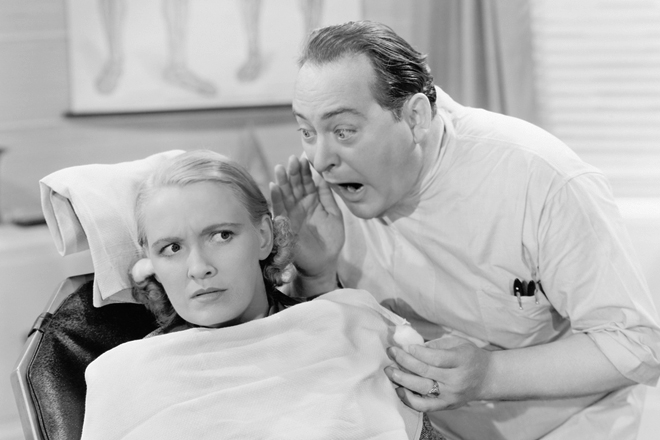
My doctor always walks into the exam room smiling. It’s not necessarily the countenance you’d expect from a man who spends much of his time working with people with Stage 3 and Stage 4 cancers — the kind that haven’t responded to other forms of treatment. Yet even when we speak on the phone, I sometimes swear I can hear him smiling. Granted, I’ve given my doctor something to smile about – I’ve been doing spectacularly well in my Phase I trial, delivering CT scan results that he appreciatively refers to as “neat.” Yet the extraordinary thing about my doctor is that he was smiling the day I met him, when I was facing a diagnosis that put my long-term odds of survival in the “probably not going to happen” range. And from that first grin, he deflated my terror and made me believe I was in the hands of someone not just invested in my wellness, but downright optimistic about it.
A natively cheerful demeanor isn’t a requirement for being a competent healer. But what is far too often lost in our grueling, impersonal and cost-driven healthcare system is the basic fact that a human being in the chaotic and scary world of injury or illness deserves sensitivity and compassion. That a shivering person in a paper dress deserves dignity. So if you’re a doctor, nurse or technician, here’s your reminder. And if you’ve ever been a patient, we’d love to read your own additions to the list.
Take your hand off the goddamn doorknob already.
We know you are incredibly busy and important and that your office has wildly overbooked your schedule today. You know what, though? It’s not our job to streamline your day. Conveying information while you’re walking out the door may work if you’re a character on “Revenge,” but it’s a crummy way to have a conversation with a person about his or her health. We just sat out in the waiting room for 45 minutes reading last week’s hype-trolling issue of Time magazine; we’ve sat here in a robe for a half-hour looking at the pain assessment chart. Now you can at least pretend to give us your full attention for the five minutes you’re prodding our vulnerable, unclad bodies. You’ll immediately rise in our esteem.
Dr. Carma Bylund, director of the CommSkil program at Memorial Sloan-Kettering, notes that studies have shown that “when a doctor comes into the room and sits down with the patient, the patient perceives the visit as longer. The doctors are at eye level; they’re attentive — and they can’t put a hand on the doorknob.”
Remember that this random collection of faulty parts is a person.
At a Times talk last winter, Will Reiser, the writer of “50/50,” admitted he’d loosely based the poker-faced oncologist of the film on his own doctor, referring to him as “a mechanic” who saw him as the car he had to fix. It was a generous assessment of clinical sangfroid, one that acknowledged that nobody wants a doctor who’s lacking in the professional boundaries department. But that doesn’t mean you should let yourself turn into a robot.
Early in my treatment, I had a doctor on my clinical trial bring in a team of research fellows to look at “the tumor.” That the tumor had a sentient human host seemed utterly irrelevant to him. And when my friend Ariel had a miscarriage, the sonogram technician confirmed it by briskly announcing, “Yup, no heartbeat,” and walking out of the room. This is what is known, in medical terms, as a nightmare.
You may deal in tumors and miscarriages in a revolving door of horrible things all day long, but your patients live in a very different world. Their tumors and miscarriages and dying parents are pretty important to them. The moment they become trivial to you, seriously rethink why you ever wanted to do this for a living.
Consider that the patient is telling you something the charts don’t.
“I had one endocrinologist clearly point out during my exam all of the physical characteristics that lead him to believe I was hypothyroid and had adrenal function issues,” says my friend Alice. “He pointed out stretch marks (without childbirth). He pointed out dry skin. He pointed out my premature gray hair (specifically a prevalent streak near my forehead). My weight gain and inability to lose weight. Quite a few other characteristics. But the lab tests came back ‘normal’ and that is literally what he offered me. ‘Your tests say normal so there is nothing wrong.'” Can you understand why Alice was exasperated?
Most of us truly get it that doctors don’t know everything. We don’t expect all-seeing miracle workers. And we understand that some patients are either incapable of giving accurate information or are just plain wrong about what they believe they have. But a person who is suffering, who is symptomatic, is entitled to a fair and thorough investigation – and if you can’t provide it, please, suggest somebody who can. Don’t shrug off pain with a blasé suggestion of Tylenol or cutting out dairy and not even look at the person. Instead, be like the doctor who once told me, “There’s always something more we can do for a patient.” Do something more.
Accept that we didn’t go to medical school
You know how you’re rattling off protocols and surgery plans and fancy words for body parts we didn’t even know we had? Whoa whoa whoa – slow down there, partner. You’re talking to someone who may not know a colostomy from a semicolon. Your rapid-fire delivery is intimidating and scary. It makes us feel stupid and bothersome, like we should know all this stuff and not ask questions.
“Doctors forget that the minute a patient hears bad news or that there’s a problem, patients stop listening,” says my doctor friend Joe. “Or if they hear anything, they’re hearing incomplete info. The onus then is on us to find ways to help patients understand what just happened, whether it’s writing down instructions, calling a patient later in the day after the dust settles, or simply asking a patient to repeat something back.”
“Healthcare providers often have a kind of script,” adds Dr. Bylund. “They may have certain things they may always say to everybody. We teach doctors to check patients’ understanding and use that to tailor consultation to the person’s needs. Say things like, ‘Tell me what you know about your disease,’ or ‘Tell me what your last doctor said.’ And we show them how people’s past experiences may impact their choices now.” Maybe we don’t know anything about Parkinson’s. Maybe we know a harrowing amount because of what Mom went through, and we’re frightened to death of it. Start with what we know before you dump everything you know on us.
Leah Berkenwald, a health communication student and writer, says, “What good is the diagnosis or treatment if a patient cannot understand it or follow instructions? What is often deemed noncompliance is often a result of a failure to communicate.” And, she says, “It doesn’t matter how good a physician is at diagnosis or treatment if the patient doesn’t understand what they’re supposed to do, how to do it, or why it matters. Medical knowledge and clinical skill become moot when a physician makes assumptions about their patients’ cultural values, beliefs and practices.”
Talk frankly about how we’ll pay for this – and don’t assume anything
As Salon reader Lila says, “The calculation about what choices are available to me seems to be made before I hear the medical advice … Don’t get me wrong, it can be tricky for individuals to figure out how to afford healthcare, and I’m glad for healthcare professionals’ sensitivity to that. But when my husband was being sent home from the hospital — too early, we felt — a problem came to light: The doctor finally said she too felt it was too early but said the insurance wouldn’t pay another day. In fact she was wrong (and the insurance ultimately did pay another day), but more problematic is that she made a decision to discharge based upon something other than medical reasons — and we didn’t know that was happening.”
Nobody – on either the medical or patient end – wants to get walloped with a contentious bill. So talk to us so we can work together to get the most care for the buck. Don’t treat us like dirtbags if we’re out of network or uninsured, either; work with us to find other options. And you can pass that tidbit on to your office staff. Imagine what it feels like to be both sick and poor — now imagine what it’s like to add “demeaned” to your list of problems.
All of us, even the strongest among us, find ourselves on the business end of the stethoscope sometimes. And though it seems pretty basic, I’ll let a real doctor say it so you take it seriously: “Ultimately, health and wellness have a lot to do with the comfort a patient has with a doctor. You’ll give better information when you have a doctor who makes you feel secure,” says Dr. Bylund. When you’re compassionate to us, we’ll show up for our checkups. We’ll be honest about conditions and circumstances, because we aren’t afraid of being shamed or judged. We’ll still put our faith in science, and accept that pain and sickness are sometimes unavoidable. But we’ll be less scared when we walk through those very scary doors. And though we’ll do our best to ward off disease, we’ll gladly submit to something infectious – the power of being decent, and your faith in us.

