
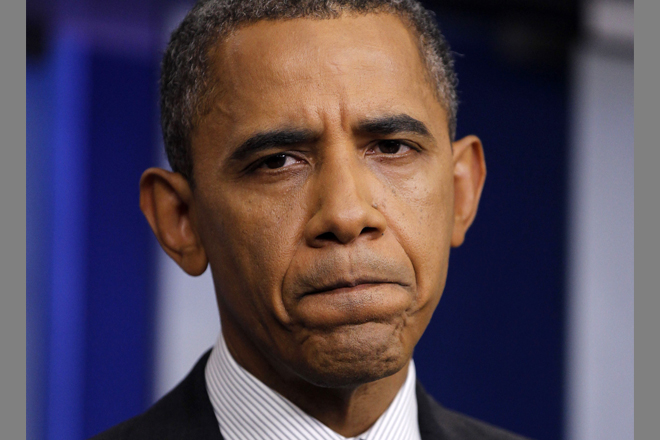

This is the point in a presidential election when people begin talking about the lesser of two evils, when the weaknesses in one’s own candidate pale in comparison to the reality of the other side taking over. But in a remarkable essay in the new issue of Harper’s magazine, the political thinker Thomas Frank levels President Obama’s first term as a dramatic failure compared to the rhetoric that landed him in office, and the potential he had to truly transform the country.
Frank, whose books include “What’s the Matter With Kansas” and “Pity the Billionaire,” makes the case that Obama’s conciliatory nature has been a tragic flaw, one exploited by conservatives in Congress again and again. But he also argues that Obama has “enthusiastically adopted” the ideas of the right when it comes to deficit spending, Wall Street regulation, torture policies, healthcare and more. And his reward for reaching for compromise and grand bargains, “for bowing to their household gods,” has been to be depicted as a socialist and a radical leftist.
The end result? Frank writes that “What Barack Obama has saved is a bankrupt elite that by all means should have met its end back in 2009. He came to the White House amid circumstances similar to 1933, but proceeded to rule like Herbert Hoover.”
We talked to Frank over the phone Wednesday about his essay, Obama’s first term, and what a second might look like.
You make the case in this essay that President Obama has failed to bring the kind of change he promised, that in many ways he has continued the policies of George W. Bush — and that we shouldn’t be surprised by any of this, given his history as a conciliator. Let me start with the simplest question: Are you suggesting there’s not much of a difference between the Obama administration and Bush?
Well, certainly there are differences, of course. I don’t think Bush would have pulled out of Iraq so quickly. How soon we forget. That would still be dragging on in some way, I think. The stimulus would have been handled differently. Bush did several rounds of stimulus as president, and they always involved tax cuts. And I don’t mean to brush off the way the Obama team runs the apparatus of the state; go back and look at something like the Labor Department under George Bush, which was a joke. They were cracking down on labor unions. That’s what they thought their mission was. Of course, that’s no longer going on. The EPA — the Republicans put it in the hands of a series of people who were hostile to the mission, and that’s not going on any longer.
Obama definitely governs differently now and then, but look, the things that matter, as everyone is saying now, are economic issues. And what’s telling about the stimulus is what he didn’t do. The part that he apparently did want, that he said he wanted — the direct hiring by the federal government in the Roosevelt manner — he didn’t do any of that. They didn’t do any of the sort of WPA thing that they should have done. There was a real failure of imagination throughout his presidency. The bailouts, the differences between Obama and Bush on the bailouts are insignificant. Obama deliberately went way out of his way to signal continuity on that front, which was probably the most important issue of them all. The bailouts have been (this is the sort of original sin that is dragging him down) the thing that has been most unpopular.
So how have the Republicans been so effective, from the minority, in dragging the center toward their positions? Is this where they have simply exploited Obama’s love of bipartisanship and his stated goals of working together to find compromise?
Right, it’s not just that he’s a conciliator, but that he announced it. This is what his whole life has been about. He’s not just a conciliator, he’s an intellectually committed conciliator. He’s a philosophical believer in bipartisanship.
And when that’s announced in advance, it is hard to negotiate.
Well, it compromises your position right off the bat. It almost by definition makes you a bad negotiator, yes. But if you do this as a sort of mental exercise, if you have one side that has already announced that it believes in bipartisanship as a philosophical goal, this is their greatest commitment, how is the other side going to play that? Well, if the other side decides, we’re not going to give an inch on anything and make them come to us all the time, they’re obviously going to win. The thing is, centrism of this kind, the reason that it is celebrated by pundits and columnists alike, the reason they celebrate it so is because it’s so sophisticated, and it’s supposed to be the way to play the game. What I wanted to do in this column is point out how that’s absolutely contrary to reality.
Obama thinks he is reaching across the aisle, the Republicans move farther to the right, and as he stretches and stretches for compromise, he’s being dragged to an entirely new part of the political spectrum.
Yes, which they have done. And that’s the thing that nobody understands, which is when you declare — which Obama did and Clinton partially did before him — that the two parties are the only thing that matter, and bridging the differences between them and the distance between them is what matters, it makes the issues themselves kind of secondary. It’s the centrism that comes first, and the bipartisanship that comes first. Everything comes down to this sort of geometrical relationship between the two parties. If that’s the case, then everything is freed from its moorings and the Republicans are allowed to move whichever way they want. Obviously that’s going to be to the right in order to drag the debate with them.
It’s not just game theory, of course. The Republicans were presented with the same challenge as Obama, which is how do you deal with the financial crisis and this incredible economic setback. And they actually came up with a compelling answer to this question. Obama came up with an answer to the question of what should we do about partisanship, because like many people here in Washington, he thinks partisanship is the real challenge. He thought the real problem with America is that we have these parties and they fight with each other over every little thing. And he’s right to some degree. It is a problem, and it’s annoying if you turn on the TV and here’s Fox News, and you turn on another channel and here’s MSNBC. They’re both insulting and stupid in their own way. Yes, it’s a problem, but it’s not the main problem. It’s not even in the top 10 problems, as far as I’m concerned, but for Obama it’s the No. 1 problem.
Now the other side looks out at what is actually the real problem, which is economic catastrophe. What the public really wants is not someone who is going to reach out across the aisle and shake hands with the other side and say that “we aren’t red states and we aren’t the blue states, we’re the United States.” No. They wanted an answer to the problem at hand, and here’s the crazy thing: the Republicans came up with one. It’s a fanciful answer, the answer that we deregulate more, that we have to reach out and achieve that perfect capitalism that’s eluding us.
Their solutions are the same policies that got us into the mess. More deregulation, more tax cuts. And somehow it’s taken as a serious position.
Right, they’re doing it with the very policies that got us into trouble in the first place. The idea of deregulating Wall Street is absolutely insane, but that’s their answer to the question. At least it’s an answer. Reaching across the aisle and making friends with the other side is in some ways precisely the wrong thing for the moment. The public is in the throws of this revolt against elites, and against insiders. Against Wall Street insiders, Washington insiders, whatever you want to call it. And this is both left and right; this is Occupy Wall Street and the Tea Party movement. And here’s Obama saying, you know, if we just put experts in charge they’ll fix everything, and we all need to get together here in Washington and fix everything. It’s exactly the wrong message for the moment.
Obama cleaned the Republicans’ clock in 2008. And then, as you write, handed “a vanquished but utterly intransigent foe a veto” over his agenda. How does that happen?
That part of it, it’s the insult added to the injury. The worst part of it is that he didn’t seal the deal after he won in 2008. He did not want to talk about the economy and what went wrong; he did not want to talk about what went wrong with the Bush administration, and you think of all of the sort of regulatory disasters … You want to talk about what went wrong, about the people regulating Wall Street, and you couldn’t have an easier way of making that case about regulatory capture. You look at these agencies, who was in them, who was in charge of them, who they answer to, and they’re filled with lobbyists from the financial industry. It was open and shut. He doesn’t want to go back and talk about it.
Then you have the oil spill disaster, where the regulators were, again, asleep — completely missed it. Another perfect example, perfect object lesson for him to go back and talk about what’s wrong with the regulatory state. He never does. And this is something where protesters on both the left and right are talking about regulatory capture now, and about the insiders ruling the country. Everybody is talking about this—except for him. He let that victory just slip through his fingers because he doesn’t want to go and speak about the dark side of people’s suspicions. He wants to remain cheery and upbeat.
And as a result, you suggest that Obama saved a bankrupt elite that we had the chance to shove off the stage in 2009.
Every financial commentator of the last 20 years was proven to be an ass; Alan Greenspan and all of them, looked like fools. All the people who were put in charge, all the people who were on the Op-Ed pages, like the New York Times, all the popular financial books, everything. I thought that we really had arrived at a kind of day of reckoning, and here was Barack Obama to make it happen. You think back to the 1930s, and there was this huge intellectual shift. It wasn’t just political, it was intellectual, in the academy and in magazines, everywhere you looked, in the way people felt about the economy. And that didn’t happen this time. All those people who were so badly discredited, they hung on. They’re still there; they got to keep those jobs. They just went from the old administration to the new one. He just brought in a couple of Clinton retreads and even a couple of Bush retreads, and they just kept going. There was no fallout for these people. There were no consequences for these people.
The most disheartening thing when you look at it is that we didn’t make the turn. History came to a corner and we didn’t turn.
So what is the lesson to take from that? That things are so impossibly broken, that there is this ruling class that cannot be defeated?
Well, I don’t know. They haven’t been defeated by my team, you know, by Team Liberal. Let Paul Ryan get in there and do his tricks … No, that’s a really cynical, awful thing to say. I’m very disheartened these days, let me put it that way. I don’t mean to be cynical, but I don’t see any other way to talk about this. I myself will probably vote for Barack Obama, almost for sure, because you know, getting Paul Ryan and company in power would be a disaster for this country, there’s no question about it. We need look no further than Todd Akin to remember why.
But yes, I am coming to a very cynical place … I mean, that’s what happens when that kind of idealism sours. That is the result, it congeals into a kind of cynicism. Now I was never as optimistic about Barack Obama as a lot of people were, but at the same time I did certainly expect that there would be a kind of intellectual transition in this country, that change would come. And instead it’s been the exact opposite, you know? It changed the other way.
And yet, the right’s caricature of Obama is the exact opposite — that he has led us to European-style socialism.
Yeah, it’s a hoot isn’t it? I think the reason why they say that is just because they can. It’s like going for his strong point, which was his centrism. To deny that in such a counterintuitive way, to look at a guy like Barack Obama and instead of seeing this born conciliator, which is what “The Audacity of Hope” is all about, to depict him as exactly the opposite. But it’s also about, that’s what Republicans do. That’s historically how they’ve approached their opponents.
It’s almost impossible to imagine Democrats being this effective in opposition, ever.
It’s because they don’t believe in fighting. They’re campaigning much more effectively this time around than they have in the past. I mean, John Kerry just took it, you know? They’re not doing that this time, they’re fighting back hard, and I like to see that. And Obama, he’s doing the populist thing, which is the right thing to do when you’re faced with a guy like Mitt Romney, one of the richest men in America. That is certainly the right way to play it, and I’m enjoying it a lot. I mean, I’m loving watching this campaign unfold. It’s a lot of fun. But that’s a spectator sport, and it shouldn’t blind us to what he has actually done in the White House in the last four years. He hasn’t been he kind of president that his political rhetoric would imply. It would be nice if in his second term maybe he’ll come around. Maybe he has changed his ways; it wouldn’t surprise me if the rough handling he’s gotten from Boehner and co. taught him a lesson.
Do you think he has learned lessons in a first term that he’d apply in a second in a more aggressive, progressive politics?
Oh I think he has, and I think he changed — the turning point for him I think was the debt ceiling showdown with the Republicans. It became so screamingly obvious that it would be impossible for him not to realize it. He was still talking about a grand bargain at that point. He put Social Security on the table and that still wasn’t enough. That was incredible, when he did that, that a Democratic president would do that.
Then to get back to your question earlier — why are they so bad, why are they so weak — this is the chronic question that goes back to the ’70s, and it’s unfortunately because they don’t believe in the sort of traditional hand that they’ve been dealt. They’re Democrats, but they don’t like being Democrats. What they want to be is a kind of Tom Friedman Democrat. I’m serious, they believe in free trade and the world is flat and all that kind of bullshit. It’s not the vision of the Democratic Party of FDR or Harry Truman or even Lyndon Johnson.
