
Rick Santorum’s dirty hands

In a dishonest, anti-welfare race-baiting speech, he quietly told white people they're "dependents" too

Topics: Rick Santorum, Republican National Convention, Welfare,

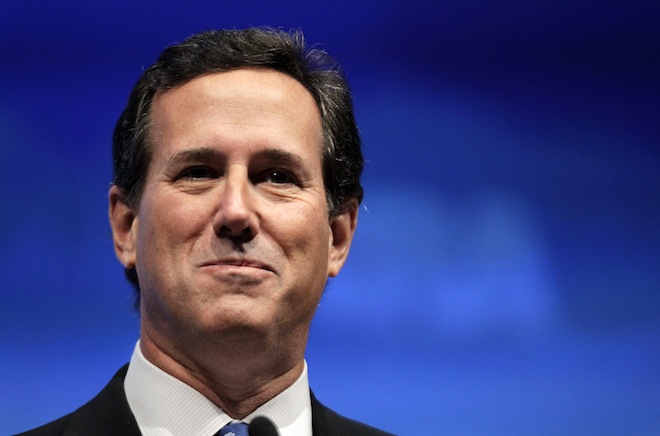
Rick Santorum's dirty hands(Credit: AP/Michael Conroy)

Chris Christie got tapped to make the keynote attack on President Obama, but Rick Santorum was assigned to throw out some of the reddest meat at the GOP convention: about the way Obama supposedly gutted the work requirement for welfare (he didn’t).

And in case anyone was in danger of missing the racial subtext, Santorum linked Obama’s waiving the work requirement (he didn’t) to “his refusal to enforce the immigration law.” Welfare recipients and illegal immigrants, oh my! Santorum made sure to scare the white working class with the depredation of those non-white slackers and moochers. It’s 1972 all over again.

But Santorum moved beyond “blah” people to claim that all of America is caught up in “a nightmare of dependency, with almost half of Americans receiving government assistance.” To get to half, Santorum had to be including Social Security, Medicare, Medicaid and food stamps, programs that are overwhelmingly going to white people.

Implicitly, Santorum praised Charles Murray’s thesis (which he praised explicitly during the primary campaign) that “marriage is disappearing in places where government dependency is the highest.” Of course, where in the 1980s Murray made that claim about black people, now he’s making it about the white working class. But Santorum and the GOP are counting on the fact that the white working class — the core of their base — aren’t paying attention to that analysis, they’re only hearing the dog whistles about the non-white. The entire 2012 race hinges on that.

Apart from its race-baiting and lying, the GOP’s attacks on welfare are most remarkable because the program has been slashed dramatically. Before Bill Clinton signed the welfare reform law, 68 percent of 100 families in poverty got welfare; now it’s 27 percent. The caseload declined 58 percent; it now represents .07 percent of the federal budget. Welfare is no longer an issue – unless you’re reaching back into Pat Buchanan’s playbook because you’re desperate.

That’s what Santorum did Tuesday night, in a speech notable not only for race-baiting but for some overall creepiness. He reprised what was a moving description of his coal-mining grandfather’s hands back in January, and this time made it sound weird. Then he went on at length with a riff on all sorts of hands that started, “I shook the hand of the American dream and it has a strong grip”; the whole soliloquy was creepy.

Santorum made it plain why he wasn’t the nominee.

But he didn’t say anything to explain why Mitt Romney should be president.

Continue Reading Close

Next Article

Featured Slide Shows

What To Read Awards: Top 10 Books of 2012 slide show

close X
  • Share on Twitter
  • Share on Facebook
  • Thumbnails
  • Fullscreen
  • 1 of 10
  • 10. "The Guardians" by Sarah Manguso: "Though Sarah Manguso’s 'The Guardians' is specifically about losing a dear friend to suicide, she pries open her intelligent heart to describe our strange, sad modern lives. I think about the small resonating moments of Manguso’s narrative every day." -- M. Rebekah Otto, The Rumpus

  • 9. "Beautiful Ruins" by Jess Walter: "'Beautiful Ruins' leads my list because it's set on the coast of Italy in 1962 and Richard Burton makes an entirely convincing cameo appearance. What more could you want?" -- Maureen Corrigan, NPR's "Fresh Air"

  • 8. "Arcadia" by Lauren Groff: "'Arcadia' captures our painful nostalgia for an idyllic past we never really had." -- Ron Charles, Washington Post

  • 7. "Gone Girl" by Gillian Flynn: "When a young wife disappears on the morning of her fifth wedding anniversary, her husband becomes the automatic suspect in this compulsively readable thriller, which is as rich with sardonic humor and social satire as it is unexpected plot twists." -- Marjorie Kehe, Christian Science Monitor

  • 6. "How Should a Person Be" by Sheila Heti: "There was a reason this book was so talked about, and it’s because Heti has tapped into something great." -- Jason Diamond, Vol. 1 Brooklyn

  • 4. TIE "NW" by Zadie Smith and "Far From the Tree" by Andrew Solomon: "Zadie Smith’s 'NW' is going to enter the canon for the sheer audacity of the book’s project." -- Roxane Gay, New York Times "'Far From the Tree' by Andrew Solomon is, to my mind, a life-changing book, one that's capable of overturning long-standing ideas of identity, family and love." -- Laura Miller, Salon

  • 3. "Billy Lynn's Long Halftime Walk" by Ben Fountain: "'Billy Lynn's Long Halftime Walk' says a lot about where we are today," says Marjorie Kehe of the Christian Science Monitor. "Pretty much the whole point of that novel," adds Time's Lev Grossman.

  • 2. "Bring Up the Bodies" by Hilary Mantel: "Even more accomplished than the preceding novel in this sequence, 'Wolf Hall,' Mantel's new installment in the fictionalized life of Thomas Cromwell -- master secretary and chief fixer to Henry VIII -- is a high-wire act, a feat of novelistic derring-do." -- Laura Miller, Salon

  • 1. "Behind the Beautiful Forevers" by Katherine Boo: "Like the most remarkable literary nonfiction, it reads with the bite of a novel and opens up a corner of the world that most of us know absolutely nothing about. It stuck with me all year." -- Eric Banks, president of the National Book Critics Circle

  • Recent Slide Shows

  • Share on Twitter
  • Share on Facebook
  • Thumbnails
  • Fullscreen
  • 1 of 10

More Related Stories

Comments

154 Comments

Comment Preview

Your name will appear as username ( profile | log out )

You may use these HTML tags and attributes: <a href=""> <b> <em> <strong> <i> <blockquote>