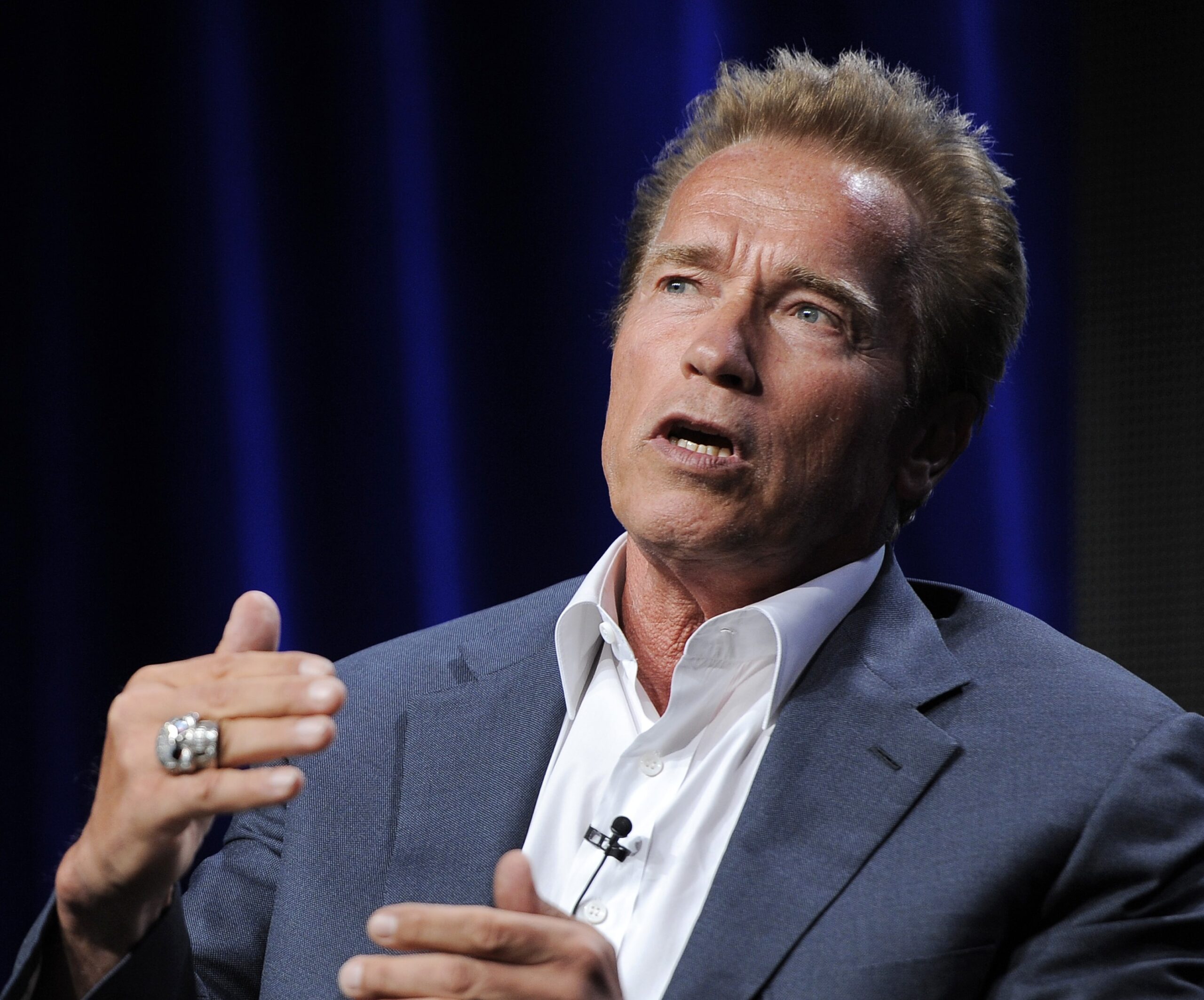

Professor Schwarzenegger
Can the former governor's new think tank get state and local governments to do what the federal government can't?
By Joe MatthewsTopics: Pacific Standard, Arnold Schwarzenegger, California, Governors, Think Tank, Life News
The administration of Gov. Arnold Schwarzenegger often resembled an ambitious global think tank that was affiliated with a gym. In the long days between his early morning and evening workouts, the governor tackled every thorny public policy issue by convening with experts from across the political spectrum, and the world. Then he and his diverse team of advisers — from progressive environmentalists to conservative business lobbyists — would synthesize centrist solutions that were unveiled at press conferences heavy on body-building metaphors.
This approach encapsulates what was so promising, and frustrating, about Schwarzenegger’s seven years as California governor. He had a knack for finding the pragmatic middle ground on difficult subjects. But at times, the breadth of his work and ambition made it hard for the administration to focus. That tendency, in combination with political polarization and the difficulties of governing California’s broken system, sometimes made it hard for him to turn his thinking into action.
So the governor’s establishment of a new think tank at the University of Southern California, the USC Schwarzenegger Institute (along with a professorship), is both fitting and intriguing. Yes, comedians have had a field day with the idea of an Arnold think tank (“Maria Shriver said Arnold came up with the idea of the think tank while thinking things over as he slept on the couch,” quipped Argus Hamilton), and yes, there is considerable cynicism about whether USC is trading on Schwarzenegger’s fame and fundraising ability (he’s promised to raise $20 million for the think tank) and whether Schwarzenegger is seeking some academic gloss to rehabilitate his image. But a close look suggests his plan is serious and super-ambitious.
Maybe too ambitious, in a familiar way. The institute is devoted to developing “postpartisan solutions” — a big task in an increasingly polarized world — across five policy areas, each big enough for multiple think tanks: education, energy and environment, fiscal and economic policy, health and human wellness, and political reform.
“We’re not going to do all those things at once,” says Bonnie Reiss, one of the institute’s two directors (the other is law and public policy professor Nancy Staudt). “We want to have the flexibility, should a new policy challenge arise, to take action in a new direction.”
Reiss says the institute will achieve such breadth through a host of collaborations — with students who become institute fellows, with policy practitioners from school superintendents to governors, with other think tanks and nonprofits. Already, Schwarzenegger is devising collaborations with other parts of the USC public policy school (where the institute will be based) and the film school. It’s not hard to imagine, given the former governor’s ambitions, the institute reaching even further afield — even into the hard sciences. The first of the think tank’s stated principles is: “Science and evidence must play an important an important role when finding solutions to policy and social issues.”
Reiss’ presence is one sign of the institute’s seriousness. She’s a former California education secretary and current member of the University of California Board of Regents who has worked with Schwarzenegger for two decades. Among many other successes, she helped turn his LA Inner City Games program into a national after-school program with operations in a dozen cities.
Another good sign is how the USC institute aims to build on other Schwarzenegger policy projects. The USC institute is collaborating with R20, the nonprofit coalition Schwarzenegger founded early last year with the encouragement of United Nations Secretary General Ban Ki-Moon, who wanted to rebuild momentum for climate change work after the failure of the Copenhagen conference in late 2009. The coalition, made up of large states and provinces from British Columbia to India’s Gujarat state, develops, finances, implements, evaluates and replicates low-carbon and climate-resilient projects with economic benefits. R20 is a natural extension of Schwarzenegger’s gubernatorial work on the issue. Unable to convince the federal government to take more action on climate change, he reached agreements on climate measures with other U.S. states and subnational governments around the globe.
A key player with both the USC center and R20 is Kandeh K. Yumkella, director-general of the United Nations Industrial Development Organization. Yumkella serves on the USC Schwarzenegger Institute’s star-studded advisory board, along with former U.S. Housing Secretary Henry Cisneros, former Secretary of State George Shultz, former Mexican President Vicente Fox, and Austria’s current Chancellor Werner Faymann.
Terry Tamminen, a former California environmental secretary who works with Schwarzenegger on R20, calls the former governor’s aim to harness local and subnational governments to tackle global problems when national governments are paralyzed, “the emerging Schwarzenegger Doctrine.” Duly, Schwarzenegger has been named a professor in state and global policy.
Schwarzenegger expects to collaborate with other political leaders interested in the marriage of subnational governance and global issues. Former Chicago Mayor Richard M. Daley is chairing the Global Cities Initiative, a joint project of Brookings and JP Morgan Chase to encourage collaboration between municipal leaders worldwide on economic issues. And Schwarzenegger’s R20 has close ties to C40, an organization of large cities chaired by New York Mayor Michael Bloomberg, a Schwarzenegger friend, that focuses on climate change.
Schwarzenegger formally launches the USC think tank with a symposium on campus in late September; he’ll keynote USC’s global conference in Seoul next May.
His biggest challenges: Can he sustain a “postpartisan” think tank when policy-oriented donors are mostly partisan? At age 65, can he quickly build something that lives after him? Schwarzenegger is determined to create a think tank that not only comes up with ideas but also works to implement them. Since implementation was the most difficult challenge for his administration, the big question may be not what new lessons the former governor can teach the world, but what lessons Professor Schwarzenegger learned from his time in office.
You Might Also Like
More Related Stories
-
New site hopes to be Kickstarter for porn
-
College debt is destroying my life
-
Hummus: The yummy Middle Eastern invasion
-
Irish lawmakers back measure to allow for abortion in limited cases
-
The downside to saying sorry
-
Huge document dump shows how Church protected abusers
-
Female astronauts wear bras, says an astronaut
-
Bizarre gay pride photobomb makes it to front page of local paper
-
LeVar Burton explains how not to be killed by police
-
Meet the Wendy Davis truthers
-
Who deserves a new lung?
-
Christian leaders have always been misogynists
-
Five states see new antiabortion laws go into effect
-
My year of modesty
-
Six amazing signs from the "Stand with Texas Women" rally
-
Edward Snowden releases statement from Moscow
-
Hey, GOP: Mexican immigrants aren't necessarily Democrats
-
Best of the worst: Right-wing tweets on the Texas abortion battle
-
Texas Senate meets, promptly votes to recess until July 9
-
Erick Erickson, Internet comedian, jokes about reproductive rights
-
Greeting cards for the terminally ill are a great idea
Featured Slide Shows
7 motorist-friendly camping sites
close X- Share on Twitter
- Share on Facebook
- Thumbnails
- Fullscreen
- 1 of 9
- Previous
- Next
Sponsored Post
-
White River National Forest via Lower Crystal Lake, Colorado For those OK with the mainstream, White River Forest welcomes more than 10 million visitors a year, making it the most-visited recreation forest in the nation. But don’t hate it for being beautiful; it’s got substance, too. The forest boasts 8 wilderness areas, 2,500 miles of trail, 1,900 miles of winding service system roads, and 12 ski resorts (should your snow shredders fit the trunk space). If ice isn’t your thing: take the tire-friendly Flat Tops Trail Scenic Byway — 82 miles connecting the towns of Meeker and Yampa, half of which is unpaved for you road rebels. fs.usda.gov/whiteriveryou
Image credit: Getty
-
Chattahoochee-Oconee National Forest via Noontootla Creek, GeorgiaBoasting 10 wildernesses, 430 miles of trail and 1,367 miles of trout-filled stream, this Georgia forest is hailed as a camper’s paradise. Try driving the Ridge and Valley Scenic Byway, which saw Civil War battles fought. If the tall peaks make your engine tremble, opt for the relatively flat Oconee National Forest, which offers smaller hills and an easy trail to the ghost town of Scull Shoals. Scaredy-cats can opt for John’s Mountain Overlook, which leads to twin waterfalls for the sensitive sightseer in you. fs.usda.gov/conf
Image credit: flickr/chattoconeenf
-
Nordhouse Dunes Wilderness Area via Green Road, Michigan The only national forest in Lower Michigan, the Huron-Mainstee spans nearly 1 million acres of public land. Outside the requisite lush habitat for fish and wildlife on display, the Nordhouse Dunes Wilderness Area is among the biggest hooks for visitors: offering beach camping with shores pounded by big, cerulean surf. Splash in some rum and you just might think you were in the Caribbean. fs.usda.gov/hmnf
Image credit: umich.edu
-
Canaan Mountain via Backcountry Canaan Loop Road, West Virginia A favorite hailed by outdoorsman and author Johnny Molloy as some of the best high-country car camping sites anywhere in the country, you don’t have to go far to get away. Travel 20 miles west of Dolly Sods (among the busiest in the East) to find the Canaan Backcountry (for more quiet and peace). Those willing to leave the car for a bit and foot it would be remiss to neglect day-hiking the White Rim Rocks, Table Rock Overlook, or the rim at Blackwater River Gorge. fs.usda.gov/mnf
Image credit: Getty
-
Mt. Rogers NRA via Hurricane Creek Road, North CarolinaMost know it as the highest country they’ll see from North Carolina to New Hampshire. What they may not know? Car campers can get the same grand experience for less hassle. Drop the 50-pound backpacks and take the highway to the high country by stopping anywhere on the twisting (hence the name) Hurricane Road for access to a 15-mile loop that boasts the best of the grassy balds. It’s the road less travelled, and the high one, at that. fs.usda.gov/gwj
Image credit: wikipedia.org
-
Long Key State Park via the Overseas Highway, Florida Hiking can get old; sometimes you’d rather paddle. For a weekend getaway of the coastal variety and quieter version of the Florida Keys that’s no less luxe, stick your head in the sand (and ocean, if snorkeling’s your thing) at any of Long Key’s 60 sites. Canoes and kayaks are aplenty, as are the hot showers and electric power source amenities. Think of it as the getaway from the typical getaway. floridastateparks.org/longkey/default.cfm
Image credit: floridastateparks.org
-
Grand Canyon National Park via Crazy Jug Point, Arizona You didn’t think we’d neglect one of the world’s most famous national parks, did you? Nor would we dare lead you astray with one of the busiest parts of the park. With the Colorado River still within view of this cliff-edge site, Crazy Jug is a carside camper’s refuge from the troops of tourists. Find easy access to the Bill Hall Trail less than a mile from camp, and descend to get a peek at the volcanic Mt. Trumbull. (Fear not: It’s about as active as your typical lazy Sunday in front of the tube, if not more peaceful.) fs.usda.gov/kaibab
Image credit: flickr/Irish Typepad
-
As the go-to (weekend) getaway car for fiscally conscious field trips with friends, the 2013 MINI Convertible is your campground racer of choice, allowing you and up to three of your co-pilots to take in all the beauty of nature high and low. And with a fuel efficiency that won’t leave you in the latter, you won’t have to worry about being left stranded (or awkwardly asking to go halfsies on gas expenses).
Image credit: miniusa.com
-
Recent Slide Shows
-
7 motorist-friendly camping sites
-
Gripping photos: The people of the Turkey protests (slideshow)
-
The week in 10 pics
-
Photos: Turmoil and tear gas in Instanbul's Gezi Park - Slideshow
-
- Share on Twitter
- Share on Facebook
- Thumbnails
- Fullscreen
- 1 of 9
- Previous
- Next
-
The week in 10 pics
-
10 summer food festivals worth the pit stop
-
The week in 10 pics
-
The week in 10 pics
-
9 amazing drive-in movie theaters still standing
-
The week in 10 pics
-
The week in 10 pics
-
The week in 10 pics
-
The week in 10 pics
-
The week in 10 pics
-
The week in 10 pics
-
Netflix's April Fools' Day categories
-
The week in 10 pics
-
The week in 10 pics
-
The week in 10 pics
Related Videos
Pacific Standard is a bimonthly print and daily online magazine that highlights the best thinking in the social sciences, technology, health, and policy, and grounds those ideas in real stories—entertaining, accessible, urgent. We are of the West, but not strictly about the West.
Most Read
-
We must hate our children Joan Walsh
-
James Clapper is still lying to America David Sirota
-
The best of Tumblr porn Tracy Clark-Flory
-
Before Edward Snowden: "Sexual deviates" and the NSA Rick Anderson
-
Thanks for nothing, college! Tim Donovan
-
Texas Senate meets, promptly votes to recess until July 9 Katie Mcdonough
-
Be employable, study philosophy Shannon Rupp, The Tyee
-
I should have slept with Philip Roth Periel Aschenbrand
-
My year of modesty Lauren Shields
-
Dark-skinned and plus-sized: The real Rachel Jeantel story Brittney Cooper
Popular on Reddit
links from salon.com

492 points493 points494 points | 24 comments

382 points383 points384 points | 30 comments

83 points84 points85 points | 9 comments
From Around the Web
Presented by Scribol
-

Connie Pillich: Is Your Uterus a Budget Issue?
-
Chris Kelly: Anti-Choice Politics Aren't a Cause; They're a Form of Fundraising Yield Management
-

Lizzie Aldrich: Lizzie Aldrich: One Career Path to Happiness
-

What Barbie Would Look Like If She Was A 'Normal' Woman
-

Ungrateful Bride Sends Heinous Message To Wedding Guest
-

Diane Gilman: Baby Boomers: A New Life-Construct -- From "Invisible to Invincible!"
-

Susan Gregory Thomas: Why Divorced Boomer Moms Don't Deserve The Bad Rap
-

British Nanny Offered An Annual Salary Of $200,000
-

Arianna Huffington: What I Did (and Didn't Do) On My Summer Vacation
-

Vivian Diller, Ph.D.: Maybe Happiness Begins At 50


Comments
10 Comments