
From “slut” to speaker

Sandra Fluke's unlikely journey culminates with a speech at the DNC. Why she matters

Topics: Democratic National Convention, Sandra Fluke, War on women, 2012 Elections,

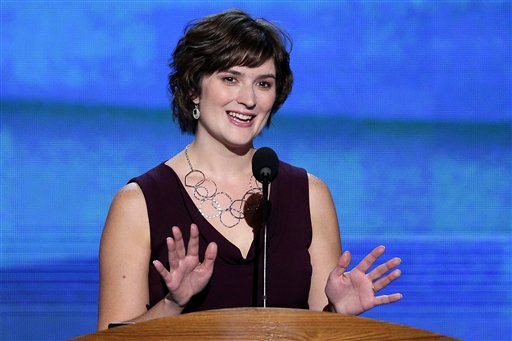
From Sandra Fluke, attorney and women's rights activist addresses the Democratic National Convention (AP/J. Scott Applewhite) (Credit: Associated Press)

CHARLOTTE, N.C. — Here is why Sandra Fluke was onstage at the Democratic National Convention tonight — and it’s not just because so much of the week was devoted to a robust defense of reproductive rights in a bid for female voters. It’s because of “Not the words I would have used,” which is what Mitt Romney said when Fluke was attacked by Rush Limbaugh and other conservative commentators.

“Your new president could be a man who stands by when a public figure tries to silence a private citizen with hateful slurs,” Fluke said tonight. “Who won’t stand up to the slurs, or to any of the extreme, bigoted voices in his own party.” In other words, Romney is Limbaugh (is Akin, is Ryan). And Barack Obama is the guy who called her up and told her she was doing a good job by defending his healthcare reform bill’s women health provisions for private insurers.

You could argue, as some critics have (even ones sympathetic to her position), that Fluke is only famous because she was attacked by misogynists. She happens to be an articulate and committed activist, but even if it was just about Limbaugh, so what? True, the right to speak up in public does not mean the right not to be criticized. But the pathetic, gleeful, spiteful ganging up on her was a teaching moment for anyone who half-believed that this was about religious liberty, not sex and sluttery.

A most amusing and telling right-wing conspiracy theory about Sandra Fluke is that the Obama administration planted her to try and fail to testify at that hearing about contraception destroying religious liberty. As the videoblogger and writer Jay Smooth pointed out at the time, it was a tacit admission from conservatives that all it would take for them to make themselves look bad was putting a young woman in front of them. Why did Democrats force them to show their cards?

In fact, 30-year-old Sandra Fluke is, more than anything else, a product of viral Internet culture. It was because the photo of the all-male panel without her was huge on Facebook; because “Stand With Sandra” raised money online; because relatively unengaged women related to Fluke, saw her as just someone speaking up for her friend who lost an ovary, her classmate who was raped. Who did everything by the books and was called a slut who needed to have sex on camera for Rush Limbaugh’s benefit anyway.

It wasn’t so much about Sandra Fluke as it was about what conservatives really thought about women.

Continue Reading Close
Irin Carmon

Irin Carmon is a staff writer for Salon. Follow her on Twitter at @irincarmon or email her at icarmon@salon.com.

Next Article

Featured Slide Shows

What To Read Awards: Top 10 Books of 2012 slide show

close X
  • Share on Twitter
  • Share on Facebook
  • Thumbnails
  • Fullscreen
  • 1 of 10
  • 10. "The Guardians" by Sarah Manguso: "Though Sarah Manguso’s 'The Guardians' is specifically about losing a dear friend to suicide, she pries open her intelligent heart to describe our strange, sad modern lives. I think about the small resonating moments of Manguso’s narrative every day." -- M. Rebekah Otto, The Rumpus

  • 9. "Beautiful Ruins" by Jess Walter: "'Beautiful Ruins' leads my list because it's set on the coast of Italy in 1962 and Richard Burton makes an entirely convincing cameo appearance. What more could you want?" -- Maureen Corrigan, NPR's "Fresh Air"

  • 8. "Arcadia" by Lauren Groff: "'Arcadia' captures our painful nostalgia for an idyllic past we never really had." -- Ron Charles, Washington Post

  • 7. "Gone Girl" by Gillian Flynn: "When a young wife disappears on the morning of her fifth wedding anniversary, her husband becomes the automatic suspect in this compulsively readable thriller, which is as rich with sardonic humor and social satire as it is unexpected plot twists." -- Marjorie Kehe, Christian Science Monitor

  • 6. "How Should a Person Be" by Sheila Heti: "There was a reason this book was so talked about, and it’s because Heti has tapped into something great." -- Jason Diamond, Vol. 1 Brooklyn

  • 4. TIE "NW" by Zadie Smith and "Far From the Tree" by Andrew Solomon: "Zadie Smith’s 'NW' is going to enter the canon for the sheer audacity of the book’s project." -- Roxane Gay, New York Times "'Far From the Tree' by Andrew Solomon is, to my mind, a life-changing book, one that's capable of overturning long-standing ideas of identity, family and love." -- Laura Miller, Salon

  • 3. "Billy Lynn's Long Halftime Walk" by Ben Fountain: "'Billy Lynn's Long Halftime Walk' says a lot about where we are today," says Marjorie Kehe of the Christian Science Monitor. "Pretty much the whole point of that novel," adds Time's Lev Grossman.

  • 2. "Bring Up the Bodies" by Hilary Mantel: "Even more accomplished than the preceding novel in this sequence, 'Wolf Hall,' Mantel's new installment in the fictionalized life of Thomas Cromwell -- master secretary and chief fixer to Henry VIII -- is a high-wire act, a feat of novelistic derring-do." -- Laura Miller, Salon

  • 1. "Behind the Beautiful Forevers" by Katherine Boo: "Like the most remarkable literary nonfiction, it reads with the bite of a novel and opens up a corner of the world that most of us know absolutely nothing about. It stuck with me all year." -- Eric Banks, president of the National Book Critics Circle

  • Recent Slide Shows

  • Share on Twitter
  • Share on Facebook
  • Thumbnails
  • Fullscreen
  • 1 of 10

More Related Stories

Comments

49 Comments

Comment Preview

Your name will appear as username ( profile | log out )

You may use these HTML tags and attributes: <a href=""> <b> <em> <strong> <i> <blockquote>