
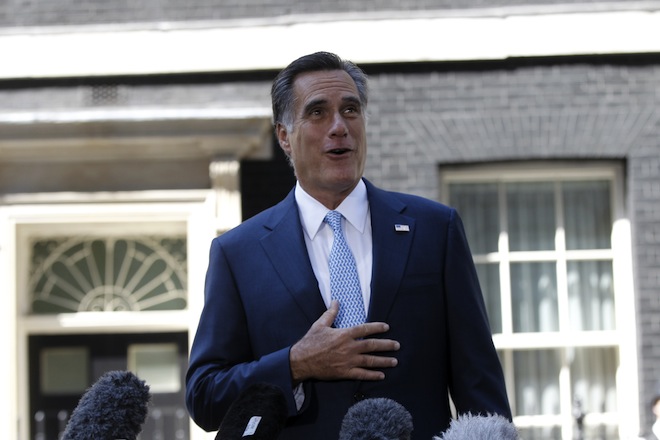

Mitt Romney’s “off-the-cuff” remarks that nearly half of Americans are “dependent” on government and believe they are “victims” who are “entitled to health care, to food, to housing, to-you-name-it,” were widely publicized. This is in fact old saw for a certain kind of anti-government conservative. I have given talks deep in conservative territory where courteous members of the audience would come up to me afterwards and say they agree we should pay taxes for infrastructure but not for giveaways “to those people.”
 But coming from a presidential candidate of one of the major parties, such remarks are stunning. Moreover, Romney later claimed he stood by them. He insulted half the American people; at least the people who spoke to me were talking about perhaps only one quarter of them! Romney also used the once-ubiquitous claim by conservatives that only half of Americans pay income tax.
There was widespread criticism of Romney’s rhetoric, but the stronger case against his condescending and elitist remarks is to present the facts, of which he seems happily unaware. Fortunately, the Tax Policy Center and the Center on Budget and Policy Priorities have pointed out that the large majority of Americans pay federal taxes when payroll taxes for Social Security and Medicare are included. The only Americans who don’t pay taxes are some of the elderly, the poor, and the young.
But it is the dependency issue that requires real information. Income for the lower half of American earners has been growing very slowly since the late 1970s — more or less when Ronald Reagan took office. Compared to economies overseas, the wage performance has been just plain bad.
Why? The declines of unions, the refusal to raise the minimum wage with inflation, and the increased pressure by Wall Street to minimize expenses in the short run — typically labor expenses — have all contributed. So have rapidly lost manufacturing jobs and globalization in general. Finally, on average economic growth was slow in the 1980s until the mid-1990s. Only in the late 1990s did growth push the unemployment rate down adequately to boost incomes for the lower half. In the 2000s, we had adequate growth but little job or wage growth. Without social programs like the Earned Income Tax Credit, the lower half would have hardly seen incomes grow at all.
Was dependency a cause of low incomes? This is easily refuted nonsense. Had social programs hurt rather than helped Americans, poverty rates would have been low in the 1950s. As Michael Harrington alerted America, the poverty rate was probably 30 percent in the 1950s. Finally, the U.S. government computed a poverty line — a low one, mind you. It found the poverty rate at about 22 percent.
Why? Couldn’t have been dependency. The War on Poverty had not yet begun. By the 1970s, however, the poverty rate was down to 11 percent. As Social Security expanded, elderly poverty rates fell from 50 percent to about 10 percent. And so on. These are the purposes of government, Mitt.
On our Rediscovering Government website you can find a set of charts and an important summary paper by Lane Kenworthy on this issue.
