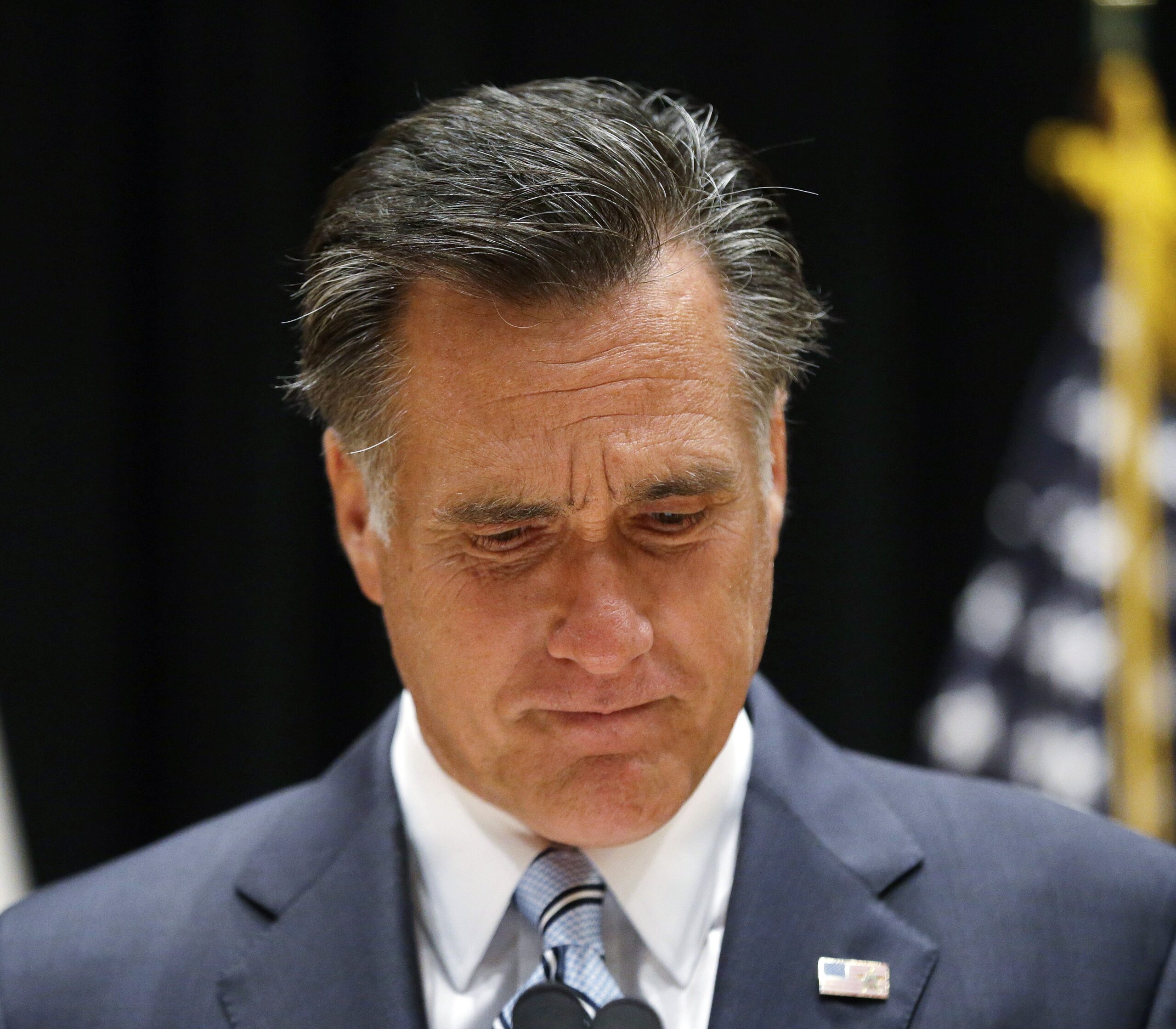
What does a vote for Mitt mean?

In short, supporting the unprecedented concentration of wealth and power at the very top

Topics: The 47 Percent, Medicare, RobertReich.org, 2012 Elections, Social Security, Republican Party, Mitt Romney,

What does a vote for Mitt mean? (Credit: AP/Charles Dharapak)
This originally appeared on Robert Reich's blog.

It’s not just his giant income or the low tax rates he pays on it. And it’s not just the videotape of him berating almost half of America, or his endless gaffes, or his regressive budget policies.

It’s something that unites all of this, and connects it to the biggest underlying problem America faces — the unprecedented concentration of wealth and power at the very top that’s undermining our economy and destroying our democracy.

Romney just released his 2011 tax returns, showing he paid $1.9 million in taxes on more than $13 million of income last year — for an effective tax rate of 14.1 percent. (He released his 2010 return in January, showing he paid an effective tax rate of 13.9 percent.)

American has had hugely wealthy presidents before — think of Teddy Roosevelt and his distant cousin, Franklin D. Roosevelt; or John F. Kennedy, beneficiary of father Joe’s fortune.

But here’s the difference. These men were champions of the working class and the poor, and were considered traitors to their own class. Teddy Roosevelt railed against the “malefactors of great wealth,” and he busted up the oil and railroad trusts.

FDR thundered against the “economic royalists,” raised taxes on the wealthy, and gave average working people the right to form unions — along with Social Security, unemployment insurance, a minimum wage, and a 40-hour workweek.

But Mitt Romney is not a traitor to his class. He is a sponsor of his class. He wants to cut their taxes by $3.7 trillion over the next decade, and hasn’t even specified what “loopholes” he’d close to make up for this gigantic giveaway.

And he wants to cut benefits that almost everyone else relies on — Medicare, Medicaid, Social Security, food stamps, unemployment insurance, and housing assistance.

He’s even a warrior for his class, telling his wealthy followers his job isn’t to worry about the “47 percent” of Americans who won’t vote for him, whom he calls “victims” and he berates for not paying federal incomes taxes and taking federal handouts.

(He mangles these facts, of course. Almost all working Americans pay federal taxes — and the federal taxes that have been rising fastest for most people are Social Security payroll taxes, which aren’t collected on a penny of income over $110,100. Moreover, most of the “47 percent” whom he accuses of taking handouts are on Medicare or Social Security — the biggest “entitlement” programs — which, not incidentally, they paid into during their working lives.)

Money means power. Concentrated wealth at the top means extraordinary power at the top. The reason Romney pays a rate of only 14 percent on $13 million of income in 2011 — a lower rate than many in the middle class — is because he exploits a loophole that allows private equity managers to treat their income as capital gains, taxed at only 15 percent.

And that loophole exists solely because private equity and hedge fund managers have so much political clout — as a result of their huge fortunes and the money they’ve donated to political candidates — that neither party will remove it.

In other words, everything America is learning about Mitt Romney — his tax returns, his years at Bain Capital, the video of his speech to high-end donors in which he belittles half of America, his gaffes, the budget policies he promotes — repeat and reenforce the same underlying reality.

So much wealth and power have accumulated at the top of America that our economy and our democracy are seriously threatened. Romney not only represents this problem. He is the living embodiment of it.

Robert Reich, one of the nation’s leading experts on work and the economy, is Chancellor’s Professor of Public Policy at the Goldman School of Public Policy at the University of California at Berkeley. He has served in three national administrations, most recently as secretary of labor under President Bill Clinton. Time Magazine has named him one of the ten most effective cabinet secretaries of the last century. He has written 13 books, including his latest best-seller, “Aftershock: The Next Economy and America’s Future;” “The Work of Nations,” which has been translated into 22 languages; and his newest, an e-book, “Beyond Outrage.” His syndicated columns, television appearances, and public radio commentaries reach millions of people each week. He is also a founding editor of the American Prospect magazine, and Chairman of the citizen’s group Common Cause. His widely-read blog can be found at www.robertreich.org.

Next Article

Related Stories

Featured Slide Shows

The week in 10 pics

close X
  • Share on Twitter
  • Share on Facebook
  • Thumbnails
  • Fullscreen
  • 1 of 11
  • A missing poster hangs on a tree outside the Cleveland home of Amanda Berry Wednesday. Berry and two other women, Michelle Knight and Gina DeJesus, made a daring escape this week after being held captive for more than a decade.
    Credit: AP/Tony Dejak

  • Elvis Rafael Rodriguez and Emir Yasser Yeje offer their best impression of  Eric B. & Rakim. On Thursday, New York prosecutors identified the pair as members of an international gang that robbed $45 million in a matter of hours by hacking into a database of prepaid debit cards and draining ATM machines around the world.
    Credit: AP

  • New Jersey Gov. Chris Christie walks to a podium during the groundbreaking ceremony for the Technology Enhanced Accelerated Learning Center at Essex County Newark Tech in Newark, N.J., Tuesday. Christie made less flattering headlines this week after undergoing a secret stomach surgery to curb his weight.
    Credit: AP/Julio Cortez

  • Workers stand outside the Tung Hai Sweater Ltd. factory in Dhaka, Bangladesh, Thursday after a fire broke out in its 11-story building. Eight people were killed in the blaze.
    Credit: AP/Ismail Ferdous

  • Workers rescue a woman trapped for 17 days in the rubble of a garment factory building in Saver, Bangladesh, Friday. The building's collapse was the worst industrial disaster in the country's history, killing more than 1,000 people.
    Credit: AP

  • Former South Carolina Gov. Mark Sanford gives his victory speech Tuesday in Mt. Pleasant, S.C., after winning back his old congressional seat in the state's first district.
    Credit: AP/Rainier Ehrhardt

  • Jodi Arias reacts in Maricopa Country Superior Court Wednesday after being found guilty of first-degree murder in the gruesome killing of her one-time boyfriend, Travis Alexander. Arias has subsequently said she wants the death penalty, claiming she'd "prefer to die sooner than later."
    Credit: AP/The Arizona Republic/Rob Schumacher

  • Ariel Castro stands for his mug shot Thursday at the Cuyahoga County Corrections Center, where he is being held on $8 million bail. The former bus driver is accused of imprisoning three young women and beating them repeatedly over a period of 10 years.
    Credit: AP/Cuyahoga County

  • Charles Ramsey addresses the media Monday after helping rescue three women held captive in Cleveland for more than a decade. Ramsey's hero portraiture has been complicated by revelations of his own domestic violence record.
    Credit: AP/The Plain Dealer/Scott Shaw

  • Michael B. Donley, Secretary of the Air Force, testifies during a Senate Appropriations Defense Subcommittee hearing on Capitol Hill Wednesday. The military branch was rocked this week after its chief sexual assault prevention officer was charged with sexual battery.
    Credit: AP/Carolyn Kaster

  • Recent Slide Shows

  • Share on Twitter
  • Share on Facebook
  • Thumbnails
  • Fullscreen
  • 1 of 11

Comments

11 Comments

Comment Preview

Your name will appear as username

You may use these HTML tags and attributes: <a href=""> <b> <em> <strong> <i> <blockquote>