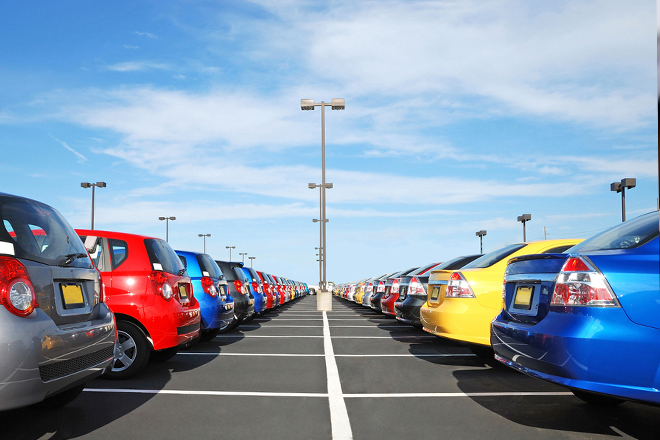

Buy a new car, vote for Obama

Proof that Americans are not despairing at the state of the economy: Sales figures at the local dealership

Topics: Presidential Debates, 2012 Elections, Auto Industry, Great Recession, Business, U.S. Economy, Auto Bailout, ,

Buy a new car, vote for Obama (Credit: carroteater via Shutterstock)

With just hours to go before the first presidential debate, conservative pundits are clamoring for Mitt Romney to attack President Obama on the economy. Fox News’ Wednesday morning offering from John Lott is typical:

Are you better off today than four years ago? Tonight’s presidential debate, with its focus on domestic policy, is Mitt Romney’s chance to put President Obama on the defensive, to make him answer for his abysmal economy policies.

The problem for Republicans, however, is the increasing amount of evidence indicating that Americans do not think the economy is abysmal. Tuesday delivered the most unimpeachable proof so far of blithe confidence: In September Americans bought new cars at a rate not witnessed since February 2008. Chrysler recorded its best September sales since 2007. Honda and Toyota completed their comeback from the earthquake-related disruptions of 2011. Americans are voting with their wallets.

The contrast with 2008 could not be more stark. Four years ago, automobile sales in the U.S. fell off the cliff. Frozen credit markets, the Lehman Brothers bankruptcy, and a series of gut-wrenching stock market drops all contributed to an abrupt evisceration of consumer confidence. High gas prices had been hurting car sales all year along, but the financial crash sent industry sales back to a level not seen since 1991. Without Obama’s bailout, Chrysler and GM would not have survived the wounds inflicted in October 2008.

The phenomenon was easy enough to understand. Buying a car is a big deal — the act implies confidence in the future, in your ability to hang on to your job and your home. But when a global economic recession stares you in the face, it doesn’t make sense to splurge for that new Prius.

Today, Americans feel differently. They’re not as worried about losing their homes (there’s a strong correlation between the health of the housing sector and auto sales) and credit is cheaply available. They’ve been deferring the purchase of new wheels for ages — the average age of the U.S. vehicle fleet hit a record high in 2011 —  and now they’re eager to invest in high fuel-economy small cars that will further insulate themselves from bad economic headwinds.

Mitt Romney will do his best to paint a dark picture of the U.S. economy in the first debate tonight, and he’ll be able to summon plenty of statistics to bolster his case: high unemployment, slow GDP growth, the number of Americans receiving food stamps … But there’s not much he can do about the fact that millions of Americans have already started voting — at the car dealership.

Continue Reading Close
Andrew Leonard

Andrew Leonard is a staff writer at Salon. On Twitter, @koxinga21.

Next Article

Featured Slide Shows

What To Read Awards: Top 10 Books of 2012 slide show

close X
  • Share on Twitter
  • Share on Facebook
  • Thumbnails
  • Fullscreen
  • 1 of 10
  • 10. "The Guardians" by Sarah Manguso: "Though Sarah Manguso’s 'The Guardians' is specifically about losing a dear friend to suicide, she pries open her intelligent heart to describe our strange, sad modern lives. I think about the small resonating moments of Manguso’s narrative every day." -- M. Rebekah Otto, The Rumpus

  • 9. "Beautiful Ruins" by Jess Walter: "'Beautiful Ruins' leads my list because it's set on the coast of Italy in 1962 and Richard Burton makes an entirely convincing cameo appearance. What more could you want?" -- Maureen Corrigan, NPR's "Fresh Air"

  • 8. "Arcadia" by Lauren Groff: "'Arcadia' captures our painful nostalgia for an idyllic past we never really had." -- Ron Charles, Washington Post

  • 7. "Gone Girl" by Gillian Flynn: "When a young wife disappears on the morning of her fifth wedding anniversary, her husband becomes the automatic suspect in this compulsively readable thriller, which is as rich with sardonic humor and social satire as it is unexpected plot twists." -- Marjorie Kehe, Christian Science Monitor

  • 6. "How Should a Person Be" by Sheila Heti: "There was a reason this book was so talked about, and it’s because Heti has tapped into something great." -- Jason Diamond, Vol. 1 Brooklyn

  • 4. TIE "NW" by Zadie Smith and "Far From the Tree" by Andrew Solomon: "Zadie Smith’s 'NW' is going to enter the canon for the sheer audacity of the book’s project." -- Roxane Gay, New York Times "'Far From the Tree' by Andrew Solomon is, to my mind, a life-changing book, one that's capable of overturning long-standing ideas of identity, family and love." -- Laura Miller, Salon

  • 3. "Billy Lynn's Long Halftime Walk" by Ben Fountain: "'Billy Lynn's Long Halftime Walk' says a lot about where we are today," says Marjorie Kehe of the Christian Science Monitor. "Pretty much the whole point of that novel," adds Time's Lev Grossman.

  • 2. "Bring Up the Bodies" by Hilary Mantel: "Even more accomplished than the preceding novel in this sequence, 'Wolf Hall,' Mantel's new installment in the fictionalized life of Thomas Cromwell -- master secretary and chief fixer to Henry VIII -- is a high-wire act, a feat of novelistic derring-do." -- Laura Miller, Salon

  • 1. "Behind the Beautiful Forevers" by Katherine Boo: "Like the most remarkable literary nonfiction, it reads with the bite of a novel and opens up a corner of the world that most of us know absolutely nothing about. It stuck with me all year." -- Eric Banks, president of the National Book Critics Circle

  • Recent Slide Shows

  • Share on Twitter
  • Share on Facebook
  • Thumbnails
  • Fullscreen
  • 1 of 10

More Related Stories

Comments

0 Comments

Comment Preview

Your name will appear as username ( profile | log out )

You may use these HTML tags and attributes: <a href=""> <b> <em> <strong> <i> <blockquote>