

Republicans are having a bad day. But it’s going to get a lot worse when they look beyond the White House and U.S. Senate and fully absorb what just happened in California. The future of American politics — a majority-minority coalition handing complete political power over all branches of government to Democrats — is written here for anyone to see, in big, bold, rainbow-colored letters.
California, reports the San Francisco Chronicle, may have delivered the most unexpected news in a night full of surprises:
California Democrats appear to have picked up a supermajority in both houses of the state Legislature Tuesday night, a surprise outcome that gives the party the ability to unilaterally raise taxes and leaves Republicans essentially irrelevant in Sacramento.
If preliminary results hold, 2012 will mark the first time in 80 years that either political party in California has enjoyed supermajority control. Republicans everywhere should be paying close attention. Because the demographic trends that led to Obama’s reelection — the increasing diversity of the electorate, the relative liberalism of the youth vote, the declining influence of old white males — made their national debut in California in the late ’80s and early ’90s. The rest of the nation is just catching up.
Before 1992, California had not given its electoral votes to a Democrat running for president since Lyndon Johnson’s 1964 electoral landslide. But in the early 1990s California became a majority-minority state, and since then the state has inexorably turned bluer and bluer (aided by ham-handed Republican legislation on immigration that profoundly alienated Hispanics). Only 30 percent of Californians are now registered Republicans, the lowest mark since record-keeping began. In 2012, every single statewide office belonged to Democrats, and Sen. Dianne Feinstein ran essentially unopposed. Arch-conservative Republican Dan Lungren was the state’s attorney general from 1991-1999. He lost his U.S. House of Representatives seat last night. (UPDATE: Lungren has yet to concede his seat, trailing by only 186 votes with ballots yet to be counted.)
As goes California, so goes the nation? House Republicans might want to think twice about continuing their efforts to gut the Endangered Species Act. It might not be long before they are cowering under its protection.
When you combine California’s election results with the fact that Barack Obama is the first president since Ronald Reagan to win 50 percent or more of the popular vote twice, the symbolism becomes even more important. Because the true significance of the new Democratic Californian supermajority is that, at least for a couple of years, it finally releases Californians from the shackles of Proposition 13, the state initiative passed in 1978 that so severely limits the legislature’s ability to raise taxes and govern effectively.
Proposition 13 was a watershed moment in American history, the first crumbling of the post New Deal consensus that supported an activist government intent on educating its citizens and providing them with an adequate safety net. California’s own native son, Ronald Reagan, rode the ideological wave of Proposition 13 right into the White House, and launched an era in which Republicans successfully devoted themselves to crippling government at all levels for decades. Proposition 13 broke California’s government.
The election of Democratic supermajorities suggests that Californians have had enough with broken government. Guess what? If you break something, the other side may get the chance to fix it.
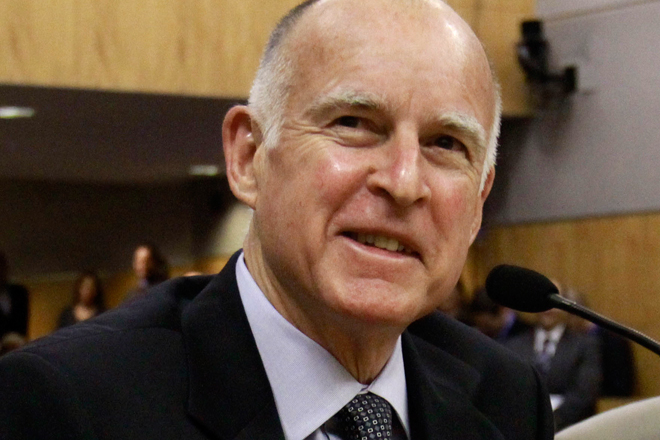
There’s no guarantee, of course, that Democratic control will fix California’s dysfunctions. I think even California liberals might be a little nervous at the spectacle of Gov. Jerry Brown, unchained and at full liberty! Gov. Brown — who, ironically, was also governor of California when 13 passed — now has an extraordinary opportunity to reset the contours of state government, to steer the most populous state in the country back toward prosperity and fiscal sanity. But if he blows it, he could just as easily kick off an entirely new era of disillusionment with Big Government.
We’ll be watching with great interest to see how the next two years play out in the Golden State. As should everyone in Washington. Because demographics don’t lie. All the Republicans currently licking their wounds at the national level should take a deep breath and consider the likelihood that what happened on Election Day 2012 is just the beginning. That’s the message from California.
